Diagnose AC Not Cooling: Why It Fails to Reach Set Temperature
.webp)
Why Your AC Never Reaches Set Temperature During a Heat Wave — and What It Means
If your AC never reaches set temperature during a heat wave, you are not alone — and the cause is usually one of a handful of well-understood problems.
Here is a quick breakdown of the most common reasons:
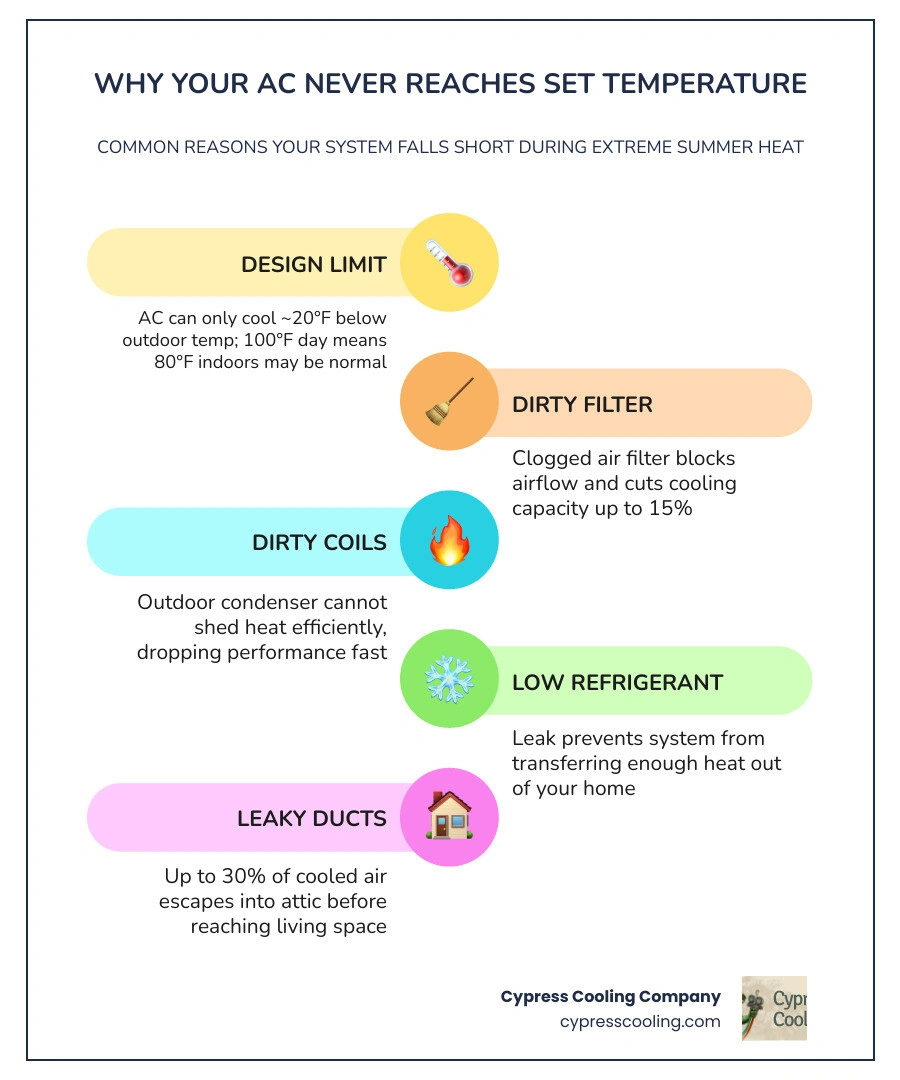
• Design limits reached — AC systems are built to cool about 20°F below the outdoor temperature. On a 100°F day, reaching 80°F indoors may be normal operation, not a failure.
• Dirty air filter — A clogged filter blocks airflow, reducing cooling capacity by up to 15% and straining the system.
• Dirty condenser coils — When the outdoor unit can't shed heat efficiently, cooling capacity drops fast.
• Low refrigerant — A refrigerant leak means the system physically cannot transfer enough heat out of your home.
• Leaky ductwork — Up to 20–30% of cooled air can escape into your attic before it ever reaches your living space.
• Poor insulation or high solar heat gain — Heat pours in faster than your AC can remove it.
• Undersized or aging system — A unit too small for your home, or one past its prime, will struggle even under normal summer conditions.
In South Louisiana, where summer heat and humidity push systems hard for months at a time, even a well-maintained AC can fall a few degrees short on the hottest afternoons. The key question is whether your system is hitting a normal design ceiling or showing signs of a real mechanical problem that needs attention.
The sections below walk through each cause in plain language, so you can figure out exactly what is going on before you pick up the phone.
Key ac never reaches set temperature during a heat wave what is wrong vocabulary:
• ac running constantly in gulf coast heat and humidity
• how high humidity in the new orleans area makes your ac work harder
• why does my ac run all day without stopping in a louisiana summer
Understanding the 20-Degree Rule and Design Limits
Before assuming your air conditioner is broken, it is essential to understand how central cooling systems are engineered. Many homeowners expect their air conditioner to act like a refrigerator, cooling the house to a crisp 68°F regardless of how hot it is outside. However, residential cooling systems operate under physical design limits.
The industry-standard guideline is known as the 20-degree rule. In simple terms, a properly sized and fully functional air conditioner is designed to lower the indoor air temperature by a maximum of 15°F to 20°F compared to the outdoor air. If the outdoor temperature in Metairie or Kenner climbs to 100°F during a brutal summer heat wave, your system is performing exactly as designed if it keeps your indoor air at 80°F.
This limitation is tied to how the system balances sensible cooling (lowering the actual temperature on the thermometer) and latent cooling (removing moisture from the air). In our humid South Louisiana climate, your AC has to work twice as hard because it must wring gallons of water out of the air before you can even begin to feel cooler. When humidity levels are high, the system expends a massive amount of energy on latent cooling, which can make the 20-degree limit feel even more restrictive.
Additionally, HVAC systems are sized according to "design temperatures" established by industry standards. For example, while some regions are designed for mild summers, our local design parameters assume typical summer peaks. When an extraordinary heat wave pushes past those design thresholds, even a perfectly healthy system will run continuously and still fall short of the thermostat setting.
If you are wondering whether your system is performing within its normal limits or suffering from a mechanical issue, you can read more about troubleshooting these initial signs in our guide on AC Not Cooling But Running: What to Check First or explore a deeper dive into these limits at Why Is My AC Not Cooling to Set Temp? Causes, Checks, and When to Call a Pro - Mitmunk .
Why an AC Never Reaches Set Temperature During a Heat Wave: What Is Wrong?
When your ac never reaches set temperature during a heat wave what is wrong becomes the ultimate question. During extreme weather, your home turns into a heat sponge. The thermal load — the total amount of heat entering your home from the sun, the outdoor air, and your household appliances — increases dramatically.
When this thermal load exceeds the cooling capacity of your air conditioner, the system will run nonstop. This continuous operation puts immense strain on every electrical and mechanical component. If there is even a minor pre-existing vulnerability in your system, the intense stress of a heat wave will expose it immediately.
Homeowners often post their frustrations online, such as in this common Quora discussion about AC units struggling above 77 degrees. While some of this struggle is normal environmental stress, a system that completely fails to lower the temperature or experiences sudden efficiency drops is often suffering from a specific mechanical bottleneck. Understanding these bottlenecks can help you avoid massive utility bills, which we discuss in detail in our article on AC Bill Spikes in a Louisiana Summer.
Airflow Restrictions: Clogged Filters and Blocked Vents
The lifeblood of your air conditioning system is airflow. If your AC cannot pull enough warm air out of your home, it cannot deliver cool air back in. The absolute most common and easily correctable cause of restricted airflow is a dirty air filter.
When a filter becomes clogged with dust, pet dander, and hair, it increases the static pressure within your ductwork. This forces your blower motor to work harder while drastically reducing the volume of air passing over the indoor evaporator coil. Without sufficient warm air flowing over the cold coil, the coil’s temperature drops too low, which can lead to ice formation and a complete system freeze-up.
Beyond the filter, blocked return grilles or closed supply vents can also disrupt the system's delicate balance. Many homeowners mistakenly close vents in unused rooms, believing it saves energy. In reality, closing vents increases pressure in the duct system, causing air leaks and reducing overall cooling efficiency.
Managing your system's fan settings also plays a significant role in how airflow affects both temperature and humidity control:
• Auto — Pros: Runs only when cooling; saves energy; allows moisture on the coil to drain away. — Cons: Slightly less consistent air circulation between cooling cycles. — Impact on Humidity: Excellent — Keeps humidity low by preventing moisture from re-evaporating.
• On — Pros: Provides continuous air filtration; eliminates hot spots by keeping air moving constantly. — Cons: Uses more electricity; increases wear on the blower motor. — Impact on Humidity: Poor — Blows air over a wet coil when the compressor is off, sending moisture back into the home.
Dirty Condenser Coils and Heat Transfer Failures
Your air conditioner does not actually "create" cold; rather, it absorbs heat from inside your home and dumps it outside. This critical heat rejection happens at the outdoor condenser unit.
The outdoor condenser coil is lined with thin aluminum fins designed to maximize surface area for thermal transfer. Because this unit lives outdoors in places like Mandeville or Covington, it is constantly exposed to grass clippings, dirt, pollen, and leaves. Over time, a thick layer of grime builds up on the coils.
This buildup acts like an insulating blanket. When the condenser coil is dirty, the heat trapped in the refrigerant cannot escape into the outdoor air. As a result, the compressor has to work much harder and run much hotter to achieve the same amount of cooling. During a heat wave, this lack of heat dissipation can cause the compressor to overheat and shut down entirely to prevent permanent damage. To learn more about identifying this issue, check out our guide on Dirty Condenser Coil Symptoms in a Hot Humid Environment.
Low Refrigerant Levels and Frozen Evaporator Coils
Refrigerant is the chemical medium that carries heat from your indoor evaporator coil to the outdoor condenser coil. An air conditioner does not "consume" refrigerant; it is a sealed system. If your system is low on refrigerant, it means you have a leak.
When the refrigerant charge drops below its specified level, the pressure inside the evaporator coil plunges. This drop in pressure causes the temperature of the coil to fall below freezing. As the moisture in your indoor air contacts this super-chilled coil, it instantly freezes, creating a layer of ice.
As ice builds up, it acts as an insulator, preventing the refrigerant from absorbing any more heat from your home. Eventually, the airflow is completely blocked, and your system stops cooling altogether. If you notice weak airflow, a warm breeze coming from your vents, or physical ice forming on the copper lines leading to your outdoor unit, shut the system off immediately at the thermostat and call for professional assistance. Running a system with a frozen coil can destroy the compressor, which is the expensive heart of your AC.
Leaky Ductwork and Poor Home Insulation
Sometimes, the air conditioner itself is working perfectly, but the home's thermal envelope is failing. Your ductwork acts as the highway for your cooled air. If you have leaky ductwork, a significant portion of that cold air never makes it to your living spaces.
According to industry data, the average home loses 20% to 30% of its conditioned air through duct leaks. In South Louisiana, ducts are often run through attics that can easily reach 140°F to 160°F on a July afternoon. If your ducts have holes, disconnected joints, or deteriorated insulation, they will draw in superheated attic air and distribute it throughout your home, completely canceling out the AC's hard work. For details on how we locate and repair these hidden leaks, refer to our page on Duct Repair Sealing Leak Detection.
Similarly, poor attic insulation and high solar gain through unshaded windows allow heat to pour into your home faster than your AC can pull it out. Up to 30% of unwanted heat enters your home through windows. Without proper insulation and radiant barriers, your ceilings become massive radiators, radiating heat directly into your living spaces and keeping your home warm even when the AC runs continuously.
Troubleshooting Steps and Sizing Issues for Homeowners
Before you worry about complex repairs, there are several simple steps you can take to troubleshoot your system. Taking a methodical approach can save you time and help you determine whether you need professional support. For a comprehensive checklist, check out our guide on AC Troubleshooting Before Calling a Pro.
1. Verify your thermostat settings: Ensure the thermostat is set to "Cool" and the fan is set to "Auto" rather than "On."
2. Inspect and replace the air filter: If you cannot remember the last time you changed it, replace it immediately. During a heat wave, check your filter every two weeks.
3. Clear outdoor clearance: Walk outside and inspect your condenser unit. Ensure there is at least two feet of clear space around the entire unit. Clear away any tall grass, weeds, shrubs, or fallen leaves that could block airflow.
4. Perform a gentle rinse: If the outdoor coils look dusty or dirty, turn off the system at the breaker and use a gentle garden hose to rinse the debris away. Never use a pressure washer, as the high pressure will bend the delicate aluminum fins and permanently restrict airflow.
5. Check for ice: Look at the indoor evaporator coil (if accessible) and the copper refrigerant lines. If you see ice, turn the system off and run the fan only to let it thaw.
When an AC Never Reaches Set Temperature During a Heat Wave: What Is Wrong with System Sizing?
If your system is clean, the filters are fresh, and there are no mechanical failures, but your ac never reaches set temperature during a heat wave what is wrong still puzzles you, the issue might be system sizing.
An air conditioner must be sized precisely for the home it cools. To do this correctly, professionals perform a comprehensive calculation called a Manual J Load Calculation. This calculation takes into account your home's square footage, ceiling height, insulation levels, window orientation, and local climate patterns.
If your AC is undersized, it simply does not have the cooling capacity (measured in tons or BTUs) to handle the heat load of your home during a heat wave. It will run 24/7, your energy bills will skyrocket, and the indoor temperature will steadily rise during the hottest parts of the afternoon.
Conversely, an oversized AC is also problematic. It will cool the home too quickly and shut off before it has completed a full cycle. This is called "short-cycling." Because it doesn't run long enough, it fails to remove humidity, leaving your home feeling clammy, sticky, and uncomfortable even if the thermometer says 72°F.
When an AC Never Reaches Set Temperature During a Heat Wave: What Is Wrong with an Aging System?
Like any mechanical system, an air conditioner degrades over time. Most residential central air units have an expected lifespan of 10 to 15 years, especially under the heavy workloads of South Louisiana summers.
As an AC ages, the compressor loses its efficiency, fan motors slow down, and electrical components like capacitors weaken. This overall wear and tear means the system's actual cooling capacity drops. A system that easily cooled your home to 70°F when it was installed 12 years ago may now struggle to keep the house below 78°F during a heat wave.
If you are trying to decide whether to keep patching up an older unit or invest in a modern, highly efficient replacement, you can find clear, honest guidance in our article, Is a 12 to 15 Year Old AC Worth Fixing in the Greater New Orleans Area.
Frequently Asked Questions About AC Performance in Extreme Heat
Is it normal for my AC to run continuously during a heat wave?
Yes, it can be entirely normal for a properly sized AC to run continuously during the hottest parts of the day (typically between 2 PM and 8 PM) when outdoor temperatures peak. This continuous run time allows the system to maintain a stable indoor climate. However, if your system is running 24/7 without stopping — even late at night or early in the morning when the outdoor air cools down — that is a clear warning sign of an underlying airflow, refrigerant, or efficiency issue.
Why does my air conditioner cool better at night than in the afternoon?
At night, the solar heat load disappears, and the outdoor ambient temperature drops significantly. This makes it much easier for your outdoor condenser unit to shed the heat it absorbs from inside your home. Because the temperature difference between the indoor air and outdoor air is much smaller, your system can easily meet your thermostat settings and cycle off normally.
How often should I change my air filter during a hot Louisiana summer?
During peak summer cooling months, you should check your air filter every 30 days. If you have pets, high household traffic, or suffer from allergies, you may need to replace it as often as every two to three weeks. Regular filter changes are the single easiest way to maintain proper airflow and protect your system from premature wear.
Conclusion
When your ac never reaches set temperature during a heat wave what is wrong can feel like a stressful mystery, but it usually comes down to either normal physical design limits or a clear mechanical bottleneck. From simple airflow restrictions to dirty coils and aging compressors, understanding how your system handles extreme heat is the first step to restoring comfort to your home.
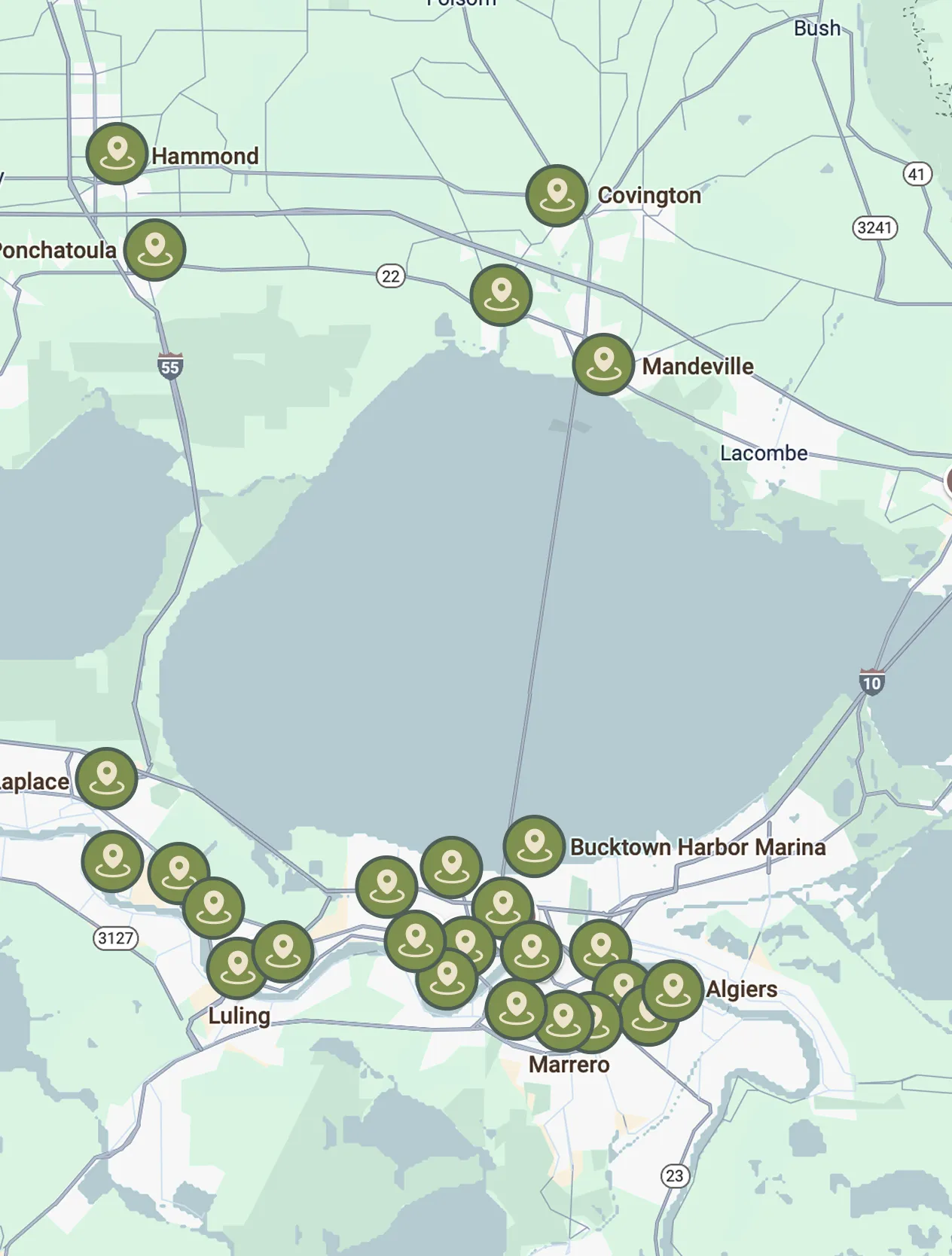
At Cypress Cooling Company, we believe in a simple, honest approach. We are here to diagnose, educate, and guide you through your cooling challenges without high-pressure sales tactics. Whether you are in Covington, Metairie, Kenner, Slidell, or anywhere across South Louisiana, we want to help you make informed decisions about your home's comfort.
If your system is struggling to keep up with the summer heat, let us help you find the right solution. Explore our professional, reliable Cypress Cooling Air Conditioning Services today to get your home back to the cool, comfortable oasis it should be.
OUR CLIENTS HAVE TO SAY ABOUT US


Service areas
Our service areas are designed to meet the diverse needs of our clients. We focus on providing exceptional service and ensuring customer satisfaction in every location we operate.