A Practical Guide to High Humidity and Your AC
.webp)
Why High Humidity in New Orleans Makes Your AC Work So Much Harder
How high humidity in the New Orleans area makes your AC work harder is something every South Louisiana homeowner feels the moment they step inside and the air still feels thick — even with the AC running full blast. New Orleans consistently sees relative humidity above 80% during summer months, and that moisture doesn't just make you uncomfortable. It forces your air conditioner to do two jobs at once: cool the air and pull water vapor out of it. That double workload means longer run times, higher energy bills, and a system that wears out faster than it should.
Here's a quick breakdown of how humidity affects your AC:
• Your AC must remove moisture before it can cool effectively. In humid air, nearly half of your system's energy goes toward moisture removal, not temperature reduction.
• Your home feels warmer than the thermostat reads. High indoor humidity slows sweat evaporation, making 76°F feel like 80°F or more.
• Cooling capacity drops. Under normal conditions, an AC delivers an 18–22 degree temperature drop. In heavy humidity, that can fall to 10 degrees or less.
• You set the thermostat lower to compensate. That means even more runtime — and more strain on the system.
• Short-cycling and oversized units make it worse. A unit that cools too fast never runs long enough to pull moisture out of the air.
The result? Your system runs harder, your bills climb, and your home still feels muggy. The sections below explain exactly why this happens and what you can do about it in 2026.
Understanding How High Humidity in the New Orleans Area Makes Your AC Work Harder
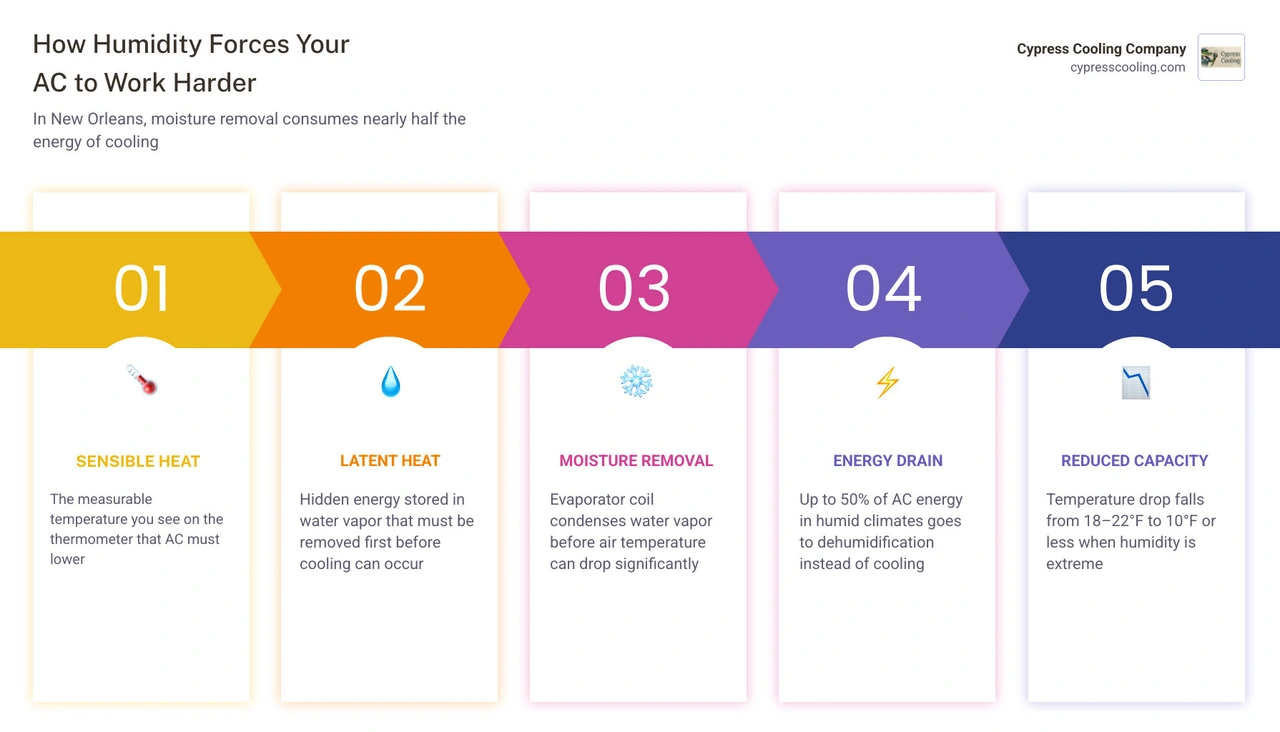
To understand why your Air Conditioning system struggles in May 2026, we have to look at the physics of air. In a dry climate like Arizona, an AC unit has a relatively simple job: lower the temperature of the air. In New Orleans, however, the air is saturated with water. This introduces two different types of heat that your system must battle: sensible heat and latent heat.
Sensible heat is the temperature you can actually see on a thermometer. Latent heat is the energy stored in the moisture within the air. When your AC runs, it doesn't just blow cold air; it acts as a massive dehumidifier. Before the air temperature can drop significantly, the evaporator coil must pull that water vapor out of the air. This process consumes a massive amount of energy. In fact, in Southeast Louisiana, nearly half of your AC’s energy consumption is dedicated solely to "latent cooling"—the removal of moisture.
This constant "double duty" is exactly how high humidity in the New Orleans area makes your AC work harder. Because the system is spending so much effort on moisture removal, it has to run for much longer cycles to reach your desired temperature. This increased runtime places immense strain on the compressor and blower motor, which is why Louisiana heat and humidity affect AC lifespan so drastically. While a system in a drier climate might last 15 to 20 years, a neglected unit in New Orleans might start failing after just 8 to 12 years due to this relentless workload.
Why Latent Heat is the Real Enemy of Comfort
Have you ever wondered why your house feels humid when the AC is running? It usually comes down to the heat index and the dew point. The heat index is a measure of how hot it actually feels to the human body. Our bodies cool down through the evaporation of sweat. When the indoor humidity is high, sweat cannot evaporate into the already-saturated air. This leaves you with that "sticky skin" feeling.
Even if your thermostat says it is 72°F, if the humidity is at 70%, your body will feel like it’s closer to 78°F. This is why many New Orleanians find themselves "cranking down" the AC to 68°F just to feel comfortable. You aren't actually seeking colder air; you are seeking drier air.
How High Humidity in the New Orleans Area Makes Your AC Work Harder by Reducing Cooling Capacity
There is a technical standard in the HVAC world known as the "20-degree rule." Ideally, the air coming out of your vents should be about 18 to 22 degrees cooler than the air going into the return vent. However, when humidity levels are off the charts, that temperature drop (or "delta T") can plummet.
When the air is heavy with moisture, the evaporator coil becomes blanketed in a thick layer of condensation. While this is necessary to remove water, too much moisture can actually act as a temporary insulator, making it harder for the refrigerant inside the coils to absorb heat from the air. In extreme cases, your 20-degree drop can fall to just 10 degrees or less. This means your system has to run twice as long to achieve the same amount of cooling, which is a primary reason to stay on top of your AC Maintenance in New Orleans.
Signs Your System is Struggling with South Louisiana Moisture

Living in places like Metairie, Kenner, or Slidell, we often take humidity for granted. But your home shouldn't feel like the bayou. If you notice any of the following signs, your AC is likely being overwhelmed by moisture:
• Foggy Windows and Damp Surfaces: If you see condensation on the inside of your window panes or notice that your wooden furniture feels slightly "tacky" or damp to the touch, your indoor humidity is likely well above the healthy 50% threshold.
• Musty Odors: High humidity creates a breeding ground for mold and mildew. If you smell a "dirty sock" odor when the vents kick on, moisture is likely trapped in your ductwork or on the evaporator coils.
• Clammy Indoor Air: If you feel cold but "sticky," your AC is lowering the temperature but failing at its second job of dehumidification.
• Visible Mold Growth: High moisture levels can lead to mold on vents, ceilings, or even behind wallpaper. This is a serious Indoor Air Quality | New Orleans, LA concern that needs immediate attention.
To protect your home and health, managing your IAQ is just as important as maintaining the temperature.
The Problem with Oversized Units and Short-Cycling
One of the most common mistakes in South Louisiana is installing an AC unit that is "too big" for the house. You might think a larger unit would cool the house faster, but in New Orleans, that’s actually a recipe for disaster.
An oversized unit will reach the temperature setpoint on your thermostat very quickly—perhaps in just 10 minutes. This is called "short-cycling." The problem is that it takes about 15 to 20 minutes of continuous runtime for an AC to begin effectively removing moisture from the air. If the system shuts off too soon, the air stays humid, even if it's cold. This leads to a "cold and clammy" environment. If you’re experiencing this, you may need an AC Repair in New Orleans to evaluate your system's configuration or sizing.
Professional Solutions for Managing Indoor Humidity
If your current system is struggling, there are several ways to upgrade your comfort. In 2026, the technology available for Southeast Louisiana homeowners is more efficient than ever.
• Single-Stage — Humidity Removal Capability: Low (On/Off only) — Energy Efficiency: Standard — Comfort Level: Moderate (Swings)
• Two-Stage — Humidity Removal Capability: High (Runs longer at 50% power) — Energy Efficiency: High — Comfort Level: Very Good
• Variable-Speed — Humidity Removal Capability: Excellent (Adjusts to exact needs) — Energy Efficiency: Highest — Comfort Level: Superior (Steady)
Variable-speed systems are the gold standard for our climate. Unlike single-stage units that are either 100% on or 100% off, variable-speed units can run at very low levels for long periods. This allows them to constantly pull moisture out of the air without over-cooling the home. This steady operation is far more efficient than the constant starting and stopping of older units.
For those who want total control, installing Whole House Dehumidifiers in New Orleans is often the best move. These units work alongside your AC to target moisture directly, allowing you to keep your thermostat at a higher, more energy-efficient temperature while feeling perfectly dry and cool.
How High Humidity in the New Orleans Area Makes Your AC Work Harder Without a Dehumidifier
A standard, well-functioning AC can remove up to 30 gallons of water per day from your home's air. However, during the "shoulder seasons" (like late spring or early fall), it might not be hot enough for the AC to run long enough to handle the humidity.
This is where 3 ways to reduce moisture in your New Orleans, LA home come into play. Beyond dehumidifiers, you can look into Energy Recovery Ventilators (ERVs). These systems provide fresh air ventilation while pre-dehumidifying the incoming air, ensuring your home stays fresh without the swampy feel.
Maintenance Tips to Keep Your AC Efficient in 2026
Preventative care is the only way to ensure your system survives the New Orleans summer. We recommend a professional AC Tune-Up in New Orleans at least once a year. Here is what you can do to help:
1. Change Your Filters Monthly: In humid climates, filters get dirty faster. A clogged filter restricts airflow, making it even harder for the system to remove moisture. We recommend MERV 8 to 11 filters for the best balance of filtration and airflow.
2. Keep the Outdoor Unit Clear: Ensure there are no plants or debris within two feet of your outdoor condenser. It needs to "breathe" to release the heat it gathered from inside.
3. Flush Your Drain Lines: Because your AC pulls so much water out of the air, the condensate drain lines can easily grow algae and clog. Regular flushing prevents water damage and "Dirty Sock Syndrome."
4. Seal Your Home: Use weatherstripping on doors and windows. Sealing air leaks can reduce humidity intrusion by up to 20%, significantly lowering the workload on your AC.
For comprehensive protection, consider signing up for AC Maintenance Services in New Orleans & Northshore to catch small issues before they become expensive breakdowns.
Frequently Asked Questions about New Orleans Humidity
Should I set my AC fan to 'ON' or 'AUTO' in humid weather?
You should almost always use the AUTO setting. When the fan is set to "ON," it continues to blow air even when the cooling cycle has stopped. This causes the water that was just pulled onto the evaporator coils to evaporate back into the air and blow right back into your living room. The "AUTO" setting allows the moisture to drip off the coils and out of the drain line properly.
What is the ideal indoor humidity level for a Louisiana home?
For the best balance of comfort and health, aim for 45% to 55% relative humidity. Keeping it below 60% is critical for preventing mold growth. If you aren't sure where your home stands, you can pick up a simple digital hygrometer at any hardware store in Harahan or Kenner to monitor your levels.
Do New Orleans residents ever truly acclimate to the humidity?
While we certainly get used to the "thick" air when we're outside at a festival or a Saints game, our bodies still struggle with high humidity indoors. High humidity makes us feel warmer, leading to higher energy use as we lower the thermostat. "Acclimating" usually just means we've learned to appreciate a crisp, dry indoor environment even more!
Conclusion
At Cypress Cooling Company, we’ve spent years helping neighbors from Algiers to Slidell and everywhere in between stay comfortable. We know exactly how high humidity in the New Orleans area makes your AC work harder, and we are here to help you take that burden off your system. Whether you need a simple tune-up, a high-efficiency upgrade, or a whole-house dehumidification solution, our goal is to educate and guide you toward the best choice for your home.
Don't let the South Louisiana moisture wear down your system and your comfort. By sealing your home, maintaining your unit, and choosing the right technology, you can turn your home into the dry, cool sanctuary it’s supposed to be. If you're ready to experience the difference that proper humidity control can make, contact us today for expert Air Conditioning services tailored to our unique climate.
OUR CLIENTS HAVE TO SAY ABOUT US



Service areas
Our service areas are designed to meet the diverse needs of our clients. We focus on providing exceptional service and ensuring customer satisfaction in every location we operate.