
In Depth Guide to How Duct Design Affects AC Performance in High Humidity
.webp)
Why Duct Design Is the Hidden Factor in AC Performance in High Humidity Environments
How duct design affects AC performance in a high humidity environment is one of the most overlooked questions South Louisiana homeowners face — especially when the AC is running constantly but rooms still feel sticky and uncomfortable.
Here is a quick answer:
How duct design affects AC performance in high humidity — at a glance:
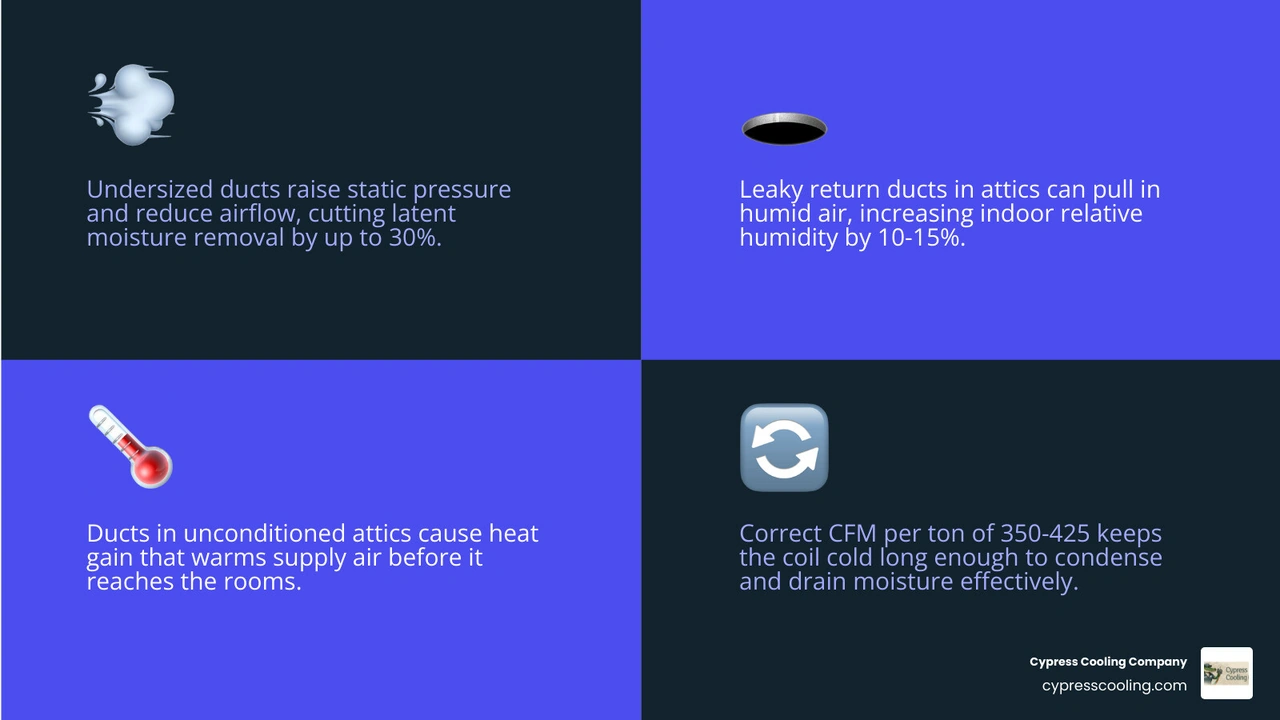
• Undersized ducts — Effect on AC Performance in High Humidity: Raises static pressure, reduces airflow, limits moisture removal
• Leaky return ducts — Effect on AC Performance in High Humidity: Pulls humid attic or crawlspace air directly into the system
• Ducts in unconditioned attics — Effect on AC Performance in High Humidity: Causes duct sweating, heat gain, and moisture infiltration
• Poor supply/return layout — Effect on AC Performance in High Humidity: Creates pressure imbalances and uneven humidity across rooms
• Improper sealing — Effect on AC Performance in High Humidity: Allows humid outside air to bypass the coil entirely
• Correct CFM per ton (350–425) — Effect on AC Performance in High Humidity: Keeps the coil cold long enough to condense and drain moisture
Your air conditioner does two jobs at once: it lowers temperature (sensible cooling) and removes moisture from the air (latent cooling). In a humid climate like South Louisiana, that second job is just as important as the first — and in many homes, it is actually harder to accomplish. Research shows that in very humid conditions, an AC system may dedicate 30–40% of its total capacity just to moisture removal, leaving less capacity for temperature reduction.
The problem is that most homeowners — and even some contractors — focus entirely on the equipment itself. But the duct system is what actually delivers conditioned air to every room. When ducts are the wrong size, poorly sealed, badly insulated, or routed through hot unconditioned spaces, the AC cannot do its job properly — no matter how new or efficient the unit is. A system that short-cycles before the evaporator coil ever reaches the dew point will remove almost no moisture at all, even if the thermostat reads a comfortable temperature.
This guide breaks down exactly how duct design decisions — from sizing and layout to insulation and placement — determine whether your home stays dry and comfortable or stays clammy all summer long.
How Duct Design Affects AC Performance in a High Humidity Environment
At the most basic level, ducts control airflow. Airflow controls what happens at the evaporator coil. And what happens at the coil determines how much moisture your AC can actually remove.
If the duct system is restrictive, the blower has to fight higher static pressure. That usually reduces delivered airflow, changes coil temperature behavior, and can hurt both comfort and dehumidification. If the system is too loose or leaky, humid air can get pulled in from the wrong places and undo the drying your AC is trying to achieve.
A good duct system helps the equipment deliver the right CFM per ton, maintain manageable total external static pressure, and keep enough runtime on a wet coil for water to condense and drain away instead of lingering in the home.

Why airflow and static pressure decide whether your AC removes moisture or just lowers temperature
Air conditioners are often discussed as if they only make air colder. In reality, they must also wring water out of the air. That only happens when warm, humid air spends enough time across a cold enough evaporator coil.
That is where airflow matters.
In many residential systems, a target range of about 350 to 425 CFM per ton is commonly used. In humid climates, airflow closer to the lower end of that range can often improve moisture removal because the air moves more slowly across the coil, increasing contact time and keeping the coil colder. That supports latent capacity.
But this does not mean "less airflow is always better." If airflow drops too much because ducts are undersized, flex is kinked, or filters and coils are dirty, the system can suffer from excessive static pressure, reduced capacity, icing risk, noise, and poor room delivery. There is a sweet spot.
High static pressure is one of the biggest hidden problems we see in humid homes. Undersized trunks, undersized returns, too many tight elbows, sagging flex duct, or crushed duct insulation all add resistance. The blower may still be running hard, but the rooms are not getting what they need. Moisture removal can suffer because actual delivered CFM no longer matches the equipment's intended operating range.
How duct design affects AC performance in a high humidity environment during long run times and short cycles
Humidity control is strongly tied to runtime. An AC does not start draining moisture the instant it turns on at full effect. The coil has to get cold, then wet, then remain wet long enough for condensation to drain away.
Research and field guidance often point to roughly 10 to 12 minutes of continuous operation before meaningful moisture removal is established. If the system shuts off too soon, the house may cool down a little, but very little water leaves the air.
That is why oversized equipment plus bad duct design is such an uncomfortable combo. The thermostat may satisfy quickly, especially in one part of the house, but the home still feels clammy. You might even notice a dry condensate drain line on a day when the house feels damp. That is a classic clue that the system is not staying in a strong latent-removal mode long enough.
Poor duct layout can make this worse by creating hot and cold spots that confuse thermostat operation. One room gets overcooled, another stays muggy, and the equipment cycles based on a narrow slice of the house instead of whole-home comfort.
Common signs your duct system is hurting humidity control
Many humidity complaints are really duct problems wearing a humidity costume.
Watch for signs like:
• Rooms that feel sticky even when the thermostat says 74 to 76 degrees
• Musty odors, especially near vents or after the system shuts off
• Fogged windows or light surface condensation
• Uneven temperatures and uneven humidity room to room
• Weak airflow from some registers
• Higher utility use without better comfort
• Excess dust from leaky returns pulling in attic or crawlspace debris
• Condensation on ducts, boots, or grilles
• Allergy aggravation from damp conditions
Indoor relative humidity above about 50% can increase dust mite levels, and once indoor RH climbs into the 60% range and beyond, the risk of musty odors, microbial growth, and material damage rises. That does not mean every humid house has mold, but it does mean the duct system deserves a closer look.
Duct Sizing, Layout, and Sealing Practices That Help or Hurt Dehumidification
A properly designed duct system is not just a network of tubes. It is an airflow delivery plan. The sizing, path, material, fittings, and sealing all influence whether the equipment can remove sensible and latent heat effectively.
If you want a deeper look at local duct design solutions, see our duct design and installation services.
Duct sizing rules that support moisture removal instead of starving the system
Good sizing starts with the equipment and the room-by-room load, then works outward through the duct design. That is why Manual D principles matter: they match duct sizing to required airflow and acceptable pressure drop.
When ducts are too small, friction goes up. The blower sees more resistance. Airflow falls. The coil and rooms no longer perform as intended.
Common duct sizing problems include:
• Undersized return ducts
• Branch runs that are too long for their diameter
• Too many hard turns
• Collapsed or poorly supported flex duct
• Sharp transitions at plenums
• Supply trunks that narrow too aggressively
Research on hot-humid duct design has also emphasized low-resistance layouts and sensible velocity targets. In practice, we want air moving fast enough for proper delivery but not so fast that pressure, noise, and energy use shoot up. Well-designed plenums and returns help the blower do its job without strain.
Layout choices that improve latent load removal in humid homes
Even if the ducts are "technically sized," a poor layout can still sabotage comfort.
Better layouts typically include:
• Shorter, more direct runs where possible
• Smooth transitions instead of abrupt reductions
• Fewer unnecessary elbows and bends
• Properly stretched and supported flex duct
• Return paths that allow air to get back to the air handler easily
• Room-by-room balancing so one area does not hog airflow
Supply and return paths must work together. If a bedroom has supply air but little return path when the door is closed, that room can become pressurized. Meanwhile, the central area may go negative. Pressure imbalances encourage infiltration, and in South Louisiana that often means more humid outdoor air sneaking in.
Good register throw matters too. Conditioned air should mix with room air instead of dumping cold air in one spot and calling it a day. Humidity comfort is a whole-room issue, not a "right under the vent" issue.
How leaks and poor sealing pull humid air into the system
Duct leakage is a major moisture problem, especially on the return side.
A leaky return can pull hot, humid attic or crawlspace air directly into the system before it even reaches the coil. That adds latent load the equipment never asked for. A leaky supply, meanwhile, can dump conditioned air into an unconditioned space and force the house negative, which pulls outdoor humidity in through the building envelope.
This is why proper sealing matters. Seams, joints, boots, and connections should be sealed with durable materials such as mastic or approved sealing methods, not left to hope and gravity.
For homeowners dealing with suspected leaks, our guide to duct repair, sealing, and leak detection explains what to look for. For technical background, this hot-humid HVAC duct design research is a useful reference.
Duct Insulation and Duct Placement: Why Attics and Crawlspaces Change Humidity Control
Where ducts are located matters almost as much as how they are sized.
When ductwork runs through hot, humid unconditioned spaces, it is constantly fighting the environment around it. That raises energy loss, increases moisture risk, and can reduce delivered comfort.
• Inside conditioned space — Typical Humidity Impact: Lower heat gain, lower moisture risk, more stable delivery
• Unconditioned attic — Typical Humidity Impact: Higher heat gain, possible duct sweating, more leakage risk
• Crawlspace or other humid zone — Typical Humidity Impact: Increased risk of humid air infiltration and insulation damage
What happens when ducts run through hot, humid unconditioned spaces
Picture cold supply air traveling through an attic in August. The attic is hot. The air around the duct may also be very humid. If the duct insulation is inadequate or damaged, the outer jacket temperature can fall below the surrounding dew point. That is when sweating starts.
At that point, several bad things can happen at once:
• Supply air warms before it reaches the room
• Moisture condenses on duct jackets or metal components
• Wet insulation loses effectiveness
• Nearby materials may stay damp long enough for microbial growth
And if the ducts are leaky, the problem gets worse. Now the system is not just losing cooling to the attic; it may also be sucking humid attic air in.
Insulation levels and vapor barriers that reduce condensation risk
Duct insulation does two jobs in humid weather: it slows heat gain and helps keep outer surfaces above dew point.
For that to work, the insulation jacket and vapor retarder have to stay intact. Torn jackets, open seams, compressed insulation, and missing sections all make condensation more likely.
Important insulation details include:
• Adequate duct insulation R-value for the location
• Continuous outer vapor barrier
• Sealed insulation seams
• Proper support so flex insulation is not crushed
• Dry, undamaged insulation throughout the run
A duct can look "insulated" from across the attic and still be performing poorly. We often find problem spots at boots, takeoffs, plenum seams, and low-hanging flex runs where the insulation jacket has been compromised.
Why moving ducts into conditioned space can improve comfort and efficiency
One of the most effective ways to reduce duct-related humidity problems is to place ducts inside the conditioned envelope whenever the home design allows.
Research on hot-humid homes has shown that moving HVAC systems and ducts into conditioned space can reduce source energy use by roughly 4% to 5%, while also helping control losses that commonly occur in unconditioned attics. That same body of work often targets duct leakage to outside at no more than 5%.
Why does this help so much?
• Ducts are no longer baking in a hot attic
• Leakage has less penalty because it stays inside the envelope
• Supply air arrives closer to the intended temperature
• Condensation risk drops significantly
• Comfort becomes more consistent room to room
There are several ways to do this, including soffits, dropped ceilings, interior chases, and other hybrid duct strategies. For related building-science research, see this study on buried ducts and unvented attics in hot, humid climates. You can also learn more about custom ductwork design and installation.
Registers, Returns, and Variable-Speed Airflow Control in Humid Weather
Duct design is not just the hidden stuff above the ceiling. Registers, grilles, returns, and blower control all influence how humidity feels in real rooms.
How variable-speed blowers help humidity control when ducts are designed correctly
Variable-speed blowers can be excellent for humid climates because they can run longer at lower airflow rates. That helps keep the evaporator coil colder and supports more latent removal without blasting the house with excessive airflow.
In plain English: the system has more time to dry the air instead of just chilling it quickly and shutting off.
But there is an important catch. Variable-speed equipment still needs a duct system it can work with. If static pressure is too high, even a smart blower may ramp in ways that are less efficient, noisier, or less effective than intended. Fancy equipment cannot fully overcome bad duct design. It is like putting running shoes on a person standing in wet concrete.
Humidity-sensing controls can also help by allowing the system to prioritize RH, not just temperature.
Register placement and return paths that prevent hot spots and pressure imbalances
Supply registers should be placed and aimed to promote mixing, not create cold stripes on one side of the room and stale air on the other. Return grilles must also be sized and placed so air can get back to the equipment without excessive pressure drop.
Problems often show up when bedroom doors are closed. Without a dedicated return, jumper duct, transfer grille, or undercut door providing a return path, room pressure changes. That can lead to:
• Weak effective airflow
• Uneven temperatures
• Humid outdoor air infiltration into negative-pressure areas
• Comfort complaints that seem mysterious until pressure is measured
Return grille velocity matters too. High return velocity can be noisy and restrictive. Lower-resistance returns usually support better blower performance and more stable dehumidification.
How duct design affects AC performance in a high humidity environment when ventilation and dehumidifiers are added
Ventilation and dehumidification can help indoor air quality and moisture control, but only if they are integrated correctly.
Ventilation should be balanced with the home and HVAC system so it does not accidentally create pressure problems that pull in more humid outdoor air. Building pressure management matters in humid climates.
Whole-house dehumidifiers also need careful duct integration. Research found that ducting a dehumidifier into the central AC return upstream of the evaporator coil can reduce the AC system's latent performance by about 28% when both operate together. It can also cause moisture already sitting on the wet coil to evaporate back into the airstream at roughly 2 to 3 pounds per hour when the AC is off. That is the kind of detail that makes building science nerds gasp and homeowners say, "Wait, my dehumidifier can make things worse?"
Yes, if it is ducted wrong.
For more on that, see this research on whole-house dehumidifier duct configurations and our article on HVAC airflow optimization and balancing.
How Homeowners and Contractors Can Evaluate an Existing Duct System
A humidity problem should not be diagnosed by thermostat guesswork alone. We need measurements.
A practical inspection checklist for humidity-related duct problems
For most homes, an indoor relative humidity range of about 30% to 50% is the comfort target. Once levels stay above that range, especially above 50% to 60%, we start paying much closer attention.
A practical visual and comfort checklist includes:
• Indoor RH consistently above 50%
• Sticky air despite normal thermostat settings
• Musty smell near returns or supply vents
• Weak airflow in one or more rooms
• Disconnected or crushed attic duct runs
• Wet or stained duct insulation
• Rust marks around boots or plenums
• Condensation on grilles or ducts
• Dust buildup that suggests return leakage
• Rooms that become uncomfortable when doors are closed
Tests that reveal whether the duct system is the real problem
Good diagnostics usually include more than one test.
Useful tests include:
• Total external static pressure testing
• Airflow measurement at the air handler or registers
• Room pressure testing with doors open and closed
• Duct leakage testing
• Temperature split across the system
• Wet-bulb and dry-bulb measurements for sensible/latent evaluation
• Condensate behavior and drain inspection
• Filter pressure drop and coil condition checks
These tests help answer the real questions: Is the blower moving enough air? Are the returns restrictive? Are leaks adding latent load? Is the equipment short-cycling because of duct issues, oversizing, or both?
Fixes that reduce short-cycling, energy waste, and mold risk
Once the problem is identified, the fix should match the cause.
Common improvements include:
• Sealing return and supply leaks
• Replacing damaged or poorly routed flex duct
• Resizing restrictive trunks or branch runs
• Adding or enlarging returns
• Improving room return paths
• Rebalancing supply airflow
• Insulating exposed ducts properly
• Reducing unnecessary restrictions and sharp transitions
• Verifying that the equipment and blower settings match the duct system
If the ductwork is damaged, poorly designed, or simply past its useful life, our ductwork repair service information covers next steps.
Frequently Asked Questions About How Duct Design Affects AC Performance in a High Humidity Environment
What indoor humidity level should a home stay at for comfort and mold prevention?
For most homes, the ideal target is about 30% to 50% relative humidity. That range generally supports comfort, helps the AC operate efficiently, and reduces risk factors tied to excess moisture.
Once RH rises above about 50%, dust mite levels can increase. As humidity climbs higher, you are more likely to notice musty odors, clammy rooms, and condensation on cooler surfaces. Surface conditions matter too: mold risk rises when local surface humidity stays high enough for long enough, even if the thermostat looks normal.
Can lowering the thermostat fix humidity problems caused by bad duct design?
Usually not. Lowering the thermostat may make the air feel temporarily cooler, but it does not solve the underlying airflow, leakage, pressure, or insulation issue.
In fact, overcooling can create new problems:
• Higher energy use
• Colder but still damp-feeling rooms
• More condensation on vents or surfaces
• Reduced comfort in already-cool rooms
If the duct system is causing short-cycling, return leakage, or poor airflow, the answer is to correct the duct problem, not turn the house into a walk-in refrigerator.
Is duct cleaning enough if the house still feels humid?
Not by itself.
Duct cleaning may be helpful when there is heavy dust buildup or debris, but humidity problems usually come from one or more of these issues:
• Leaky return ducts
• Poor duct sizing
• High static pressure
• Damaged insulation
• Ducts in hot, humid unconditioned spaces
• Equipment oversizing or short-cycling
• Poor balancing or return paths
So if the house still feels muggy, the next step is a real duct and airflow evaluation, not just a cleaning. If you are weighing that question, our article on duct cleaning in South Louisiana explains where cleaning helps and where it does not.
Conclusion
In South Louisiana, humidity is not a side issue. It is part of the main load your AC has to manage every day. That is why how duct design affects AC performance in a high humidity environment matters so much. The duct system influences airflow, static pressure, runtime, leakage, insulation performance, and room pressure balance - all of which shape whether your home feels dry and comfortable or sticky and frustrating.
The good news is that these problems can be diagnosed. We believe in measuring first, explaining clearly, and guiding homeowners without pressure. At Cypress Cooling Company, we help homeowners across South Louisiana evaluate duct layout, leakage, insulation, airflow, and humidity control so the system works as a complete system, not just a box attached to some tubes.
If you want to learn more about improving comfort, airflow, and moisture control, visit our ductwork services page.
OUR CLIENTS HAVE TO SAY ABOUT US



Service areas
Our service areas are designed to meet the diverse needs of our clients. We focus on providing exceptional service and ensuring customer satisfaction in every location we operate.