
A Practical Guide to Repair vs Replace for 12 to 15 Year Old AC
.webp)
Is a 12 to 15 Year Old AC Worth Fixing in the Greater New Orleans Area?
Is a 12 to 15 year old AC worth fixing in the Greater New Orleans area? The short answer: it depends - but the odds are not in the aging unit's favor.
Here is a quick-reference answer based on local climate realities:
• Unit is 12-15 years old, minor repair needed, no prior issues — Likely Recommendation: Repair may still make sense - get an inspection first
• Unit is 12-15 years old, multiple repairs in past 3 years — Likely Recommendation: Replacement is usually the smarter move
• Unit uses R-22 refrigerant (pre-2010) — Likely Recommendation: Replace - refrigerant is scarce
• Unit is cooling well, bills are stable, passes inspection — Likely Recommendation: You may have a little more time - maintain it closely
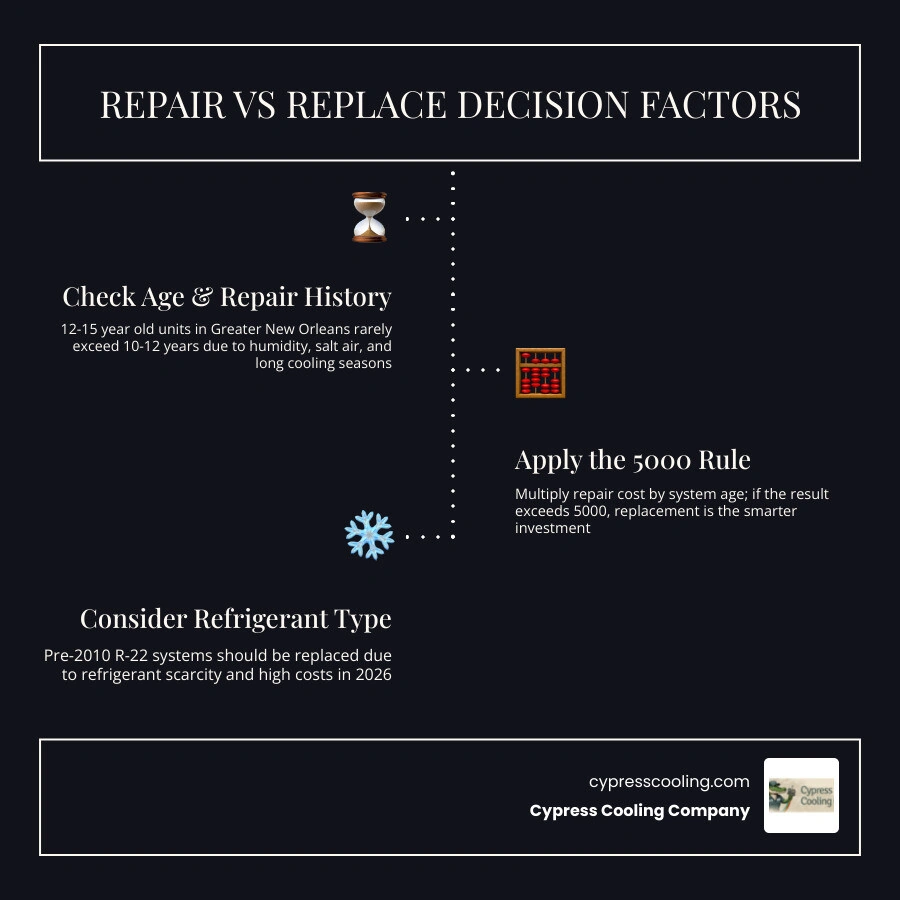
New Orleans is not an average city when it comes to air conditioning. The combination of extreme humidity, salt air, and a cooling season that can stretch from March through October puts enormous strain on AC systems - far more than in most of the country. While the national average lifespan for an AC unit is often described as 12 to 15 years, units in the Greater New Orleans area typically last only 10 to 12 years, and even the best-maintained systems rarely push beyond 15.
If your unit is already in that 12 to 15 year window, you are likely asking the right question at exactly the right time. The sections below will walk you through what to consider so you can make a confident, informed decision without guesswork or pressure.
Simple is a 12 to 15 year old ac worth fixing in the greater new orleans area glossary:
• ac repair vs replace - decision guide
• should i repair or replace my air conditioner in south louisiana
In most of Greater New Orleans, a central AC works harder than the national averages assume. Many systems here run for 8 months or more each year, and they are not just cooling the air. They are also constantly pulling moisture out of it. That extra dehumidification load matters.
A unit that might reasonably last 12 to 15 years in a milder climate often lands closer to 10 to 12 years around New Orleans, Metairie, Kenner, Gretna, Marrero, Harvey, Westwego, River Ridge, and nearby communities. Salt air near water, storm exposure, long runtimes, and high humidity all speed up wear on coils, motors, wiring, and outdoor components.
That does not mean every 12-year-old unit is automatically done for. Some are still worth fixing, especially if:
• The problem is minor
• The system has a strong maintenance history
• It cools evenly and keeps humidity under control
• Your energy bills have stayed relatively steady
• You are planning a proactive replacement soon and just need safe, short-term reliability
But if the system is already showing age in several ways at once, replacement usually becomes the smarter long-term choice.
Why AC systems wear out faster in Greater New Orleans
The local climate gives AC equipment what we might politely call a full-time job with overtime.
Here is why systems age faster here than in many other parts of the country:
• Longer cooling season: AC may run from early spring well into fall
• High humidity: The system must remove moisture as well as heat
• Salt exposure: Outdoor units can corrode faster, especially closer to coastal air
• Storm debris and flooding risk: Severe weather can shorten equipment life
• Duct losses: Leaky or poorly insulated ducts can force the system to run harder
Research from the U.S. Department of Energy on ducts also shows that leaky ducts can waste a meaningful share of cooling performance. So sometimes an old AC is not the only issue. The system around it may be making it look worse.
When is a 12 to 15 year old AC worth fixing in the Greater New Orleans area?
A repair is often worth considering when the unit still has some life left and the issue is isolated rather than systemic.
Repair may make sense if:
• The repair is minor
• This is the first significant issue
• The compressor and coils are in good shape
• The system uses a serviceable refrigerant
• Indoor comfort is still acceptable
• You want to avoid replacing in the middle of a summer emergency
In other words, if your older system has been dependable and just needs a small fix, there may still be a good case for repair. The goal is to diagnose the issue clearly and help you make an informed decision based on the condition of the system.
Warning Signs Your 12-15 Year Old AC May Be Near the End
At 12 to 15 years old, most systems start showing patterns rather than isolated problems. That pattern matters more than any single symptom.
Common warning signs include:
• Poor cooling or warm air from vents
• Uneven temperatures between rooms
• Weak airflow
• Short cycling
• Long run times
• Indoor air that feels sticky
• Unusual noises such as buzzing, rattling, or grinding
• Water around the unit
• Frozen evaporator coil
• Rust or visible corrosion
• Rising electric bills without a major usage change
• Repeat breakdowns during hot weather
If you want to rule out simple issues first, start with our guide on AC troubleshooting before calling a pro.
Performance problems that usually mean more than a simple repair
Some symptoms point to broader system decline rather than one bad part.
For example:
• Warm vents can signal refrigerant problems, airflow restrictions, or compressor trouble
• Very long run times can mean efficiency loss, dirty coils, or declining capacity
• Recurring trips on safety controls may point to overheating or electrical wear
• Repeated service calls often mean multiple components are aging together
Compressor problems are especially serious on older units. Since the compressor is one of the most expensive and important components, failure here often pushes the decision toward replacement.
Age-related issues that make older systems less dependable
Older AC systems tend to develop wear in clusters:
• Capacitors weaken
• Contactors pit and fail
• Blower motors wear down
• Coil leaks develop from corrosion
• Electrical connections loosen
• Control boards age
• Drain issues become more frequent
In South Louisiana, corrosion is a big one. Humidity and salt exposure can create slow, hard-to-see deterioration over time. A unit may look "mostly fine" until leaks, rust, or failing connections start stacking up.
How to Decide: Repair or Replace an Older AC Without Guesswork
A good decision should feel more like a checklist than a coin flip.
The main things to look at are age, repair history, refrigerant type, reliability, energy use, and how long you plan to stay in the home.
Here is a simple comparison:
• Age — Repair Usually Makes Sense: Closer to 12 than 15, with good history — Replacement Usually Makes Sense: Near or past 15, especially in local climate
• Repair history — Repair Usually Makes Sense: Few or no major repairs — Replacement Usually Makes Sense: Multiple repairs in recent years
• Refrigerant — Repair Usually Makes Sense: Modern refrigerant — Replacement Usually Makes Sense: R-22 system
• Comfort — Repair Usually Makes Sense: Cools evenly, controls humidity — Replacement Usually Makes Sense: Hot spots, sticky air, long runtimes
• Reliability — Repair Usually Makes Sense: Rare issues — Replacement Usually Makes Sense: Frequent breakdowns
• Long-term plan — Repair Usually Makes Sense: Short bridge to planned replacement — Replacement Usually Makes Sense: Need dependable cooling for years ahead
Other rules of thumb that matter just as much
The usual age-and-condition guidelines are not the only benchmarks to consider.
Other smart benchmarks include:
• The half-life test: if the system is past half of its expected life and needs a major repair, replacement often makes more sense
• The three repairs rule: if you have had three meaningful repairs in about three years, the system may be in decline
• The reliability test: if you no longer trust it through a South Louisiana summer, that matters
Comfort matters too. Even if an older unit technically runs, poor humidity control, uneven cooling, and constant noise can make "still working" feel like a generous description.
For more context on these repair-versus-replace decisions, see ENERGY STAR guidance on heating and cooling upgrades.
Refrigerant, Efficiency, and Energy Use: The Hidden Costs of Keeping an Old Unit
Even when an older AC can still be repaired, there may be hidden costs in efficiency, comfort, and future serviceability.
Older systems commonly have:
• Lower efficiency ratings
• More single-stage operation
• Weaker humidity control
• Louder operation
• Greater wear on motors and electronics
Research used for this article shows that replacing older heating and cooling equipment with high-efficiency systems can reduce annual energy use by roughly 10 to 30 percent in many cases. Some sources put the upside even higher when replacing very old, inefficient equipment in hot climates.
That said, energy savings alone should not be the only reason to replace a still-reliable unit. In New Orleans area homes, comfort and humidity control are often just as important.
Why R-22 changes the repair decision in 2026
If your system uses R-22 refrigerant, that is a major red flag.
R-22 was phased out years ago, and by 2026 it is scarce enough that leak repairs on those systems often become hard to justify. Any central AC still using R-22 is also, by definition, older equipment. That means you are not just dealing with refrigerant issues. You are also dealing with age.
If an R-22 system develops a leak, the decision often becomes straightforward:
• Refrigerant availability is limited
• The rest of the system is likely old enough to have other wear issues
• Future service gets harder, not easier
You can read more about the phaseout on the U.S. Environmental Protection Agency R-22 overview.
By contrast, R-410A systems are still much more practical to service, although system condition still matters.
How much comfort and efficiency do newer systems improve?
For many South Louisiana homeowners, the biggest upgrade is not the thermostat reading. It is how the home feels.
Newer high-efficiency systems can offer:
• Better humidity removal
• More even temperatures from room to room
• Quieter operation
• Improved airflow control
• Compatibility with smart thermostats
• Stronger warranty protection, often including long parts coverage
Modern variable-speed and two-stage systems are especially good at managing humidity, which matters a lot in the Greater New Orleans area. Older single-stage systems often cycle on and off more abruptly, which can leave the house cool but clammy. Around here, cold and damp is not the comfort goal.
So when homeowners ask us is a 12 to 15 year old ac worth fixing in the greater new orleans area, the answer is not just about whether the old unit can run. It is also about whether it can still deliver the comfort a Louisiana summer demands.
Maintenance, Rebates, and Choosing the Right Contractor in Greater New Orleans
Maintenance can change the story dramatically.
Well-maintained systems in this region may reach 12 to 15 years. Poorly maintained systems often fall into the 8 to 10 year range instead. Some industry research also suggests regular maintenance can reduce emergency repair risk significantly.
That is a big difference.
How maintenance changes lifespan and reliability
A good maintenance routine usually includes:
• Changing filters regularly, often monthly during heavy use
• Cleaning coils as needed
• Checking refrigerant charge
• Inspecting electrical components
• Clearing the condensate drain
• Keeping at least 2 feet of space around the outdoor unit
• Scheduling tune-ups in spring and fall
Service records matter too. If an older unit has had consistent care and only occasional minor issues, repair may still be reasonable. If maintenance has been spotty and breakdowns are becoming annual traditions, replacement often becomes easier to justify.
Incentives and what to look for before you replace
If you do replace, look into available incentives before making a final decision. Depending on system type and efficiency level, homeowners may qualify for the federal Energy Efficient Home Improvement Credit. Research behind this article also notes that certain high-efficiency systems may qualify for tax credits when they meet required standards.
Utility rebates can vary by provider and program year, so it is wise to check current offers through your electric utility before moving forward.
When screening a contractor in Greater New Orleans, ask:
• Are you properly licensed for HVAC work in Louisiana?
• Will you handle permits if replacement is needed?
• Will you perform a load calculation instead of guessing system size?
• Can you explain whether the duct system may be affecting performance?
• What refrigerant does my current system use?
• What warranty coverage applies to new equipment?
• Can you give me a written scope of work?
• Are you recommending repair or replacement based on diagnosis, not pressure?
It is also important to confirm whether the problem is truly the equipment or partly airflow, ductwork, controls, or installation quality. In many older homes across New Orleans, Metairie, Kenner, and nearby areas, those details matter a lot.
For current federal information, review the IRS Energy Efficient Home Improvement Credit page.
Frequently Asked Questions About Is a 12 to 15 Year Old AC Worth Fixing in the Greater New Orleans Area?
Is a 12 to 15 year old AC worth fixing in the Greater New Orleans area if it still cools well?
Sometimes, yes.
If the unit still cools well, humidity feels controlled, bills are stable, and the repair is minor, a repair may be reasonable. We would still recommend a full inspection because older systems can hide bigger issues behind one obvious symptom.
Should I replace my AC before it fails during summer?
Often, yes.
Planned replacement is usually easier than emergency replacement. You get more time to compare options, less stress, and a lower chance of losing cooling during the hottest stretch of the year. In South Louisiana, that is not a small thing.
How do I choose a reputable AC company in South Louisiana?
Look for a company that inspects first, explains clearly, and does not jump straight to a sales pitch. Verify licensing, ask for a written scope, make sure refrigerant handling is done properly, and read local reviews with an eye for communication and follow-through.
For more local guidance, see Should I Repair or Replace My Air Conditioner in South Louisiana.
Conclusion
A 12 to 15 year old AC in Greater New Orleans is not automatically a lost cause, but it is definitely in the decision zone. In our climate, that age range is where repair decisions need to be made carefully, with attention to refrigerant type, repair history, humidity control, and overall reliability.
If your system is showing its age and you want a clear, honest recommendation, explore our air conditioning services.
OUR CLIENTS HAVE TO SAY ABOUT US



Service areas
Our service areas are designed to meet the diverse needs of our clients. We focus on providing exceptional service and ensuring customer satisfaction in every location we operate.