
Why Is My AC Blowing Warm Air? And Other October Heating Startup Issues in Metairie
.webp)
Navigating the First Cold Front: Testing Your HVAC System
Late October finally brings that long-awaited drop in overnight temperatures to South Louisiana, prompting you to switch your thermostat from cooling to heating for the first time in months. When navigating this transition, having a reliable set of home maintenance tips and troubleshooting strategies is essential to ensure your October heating startup goes smoothly. At Cypress Cooling Company, our team regularly fields calls from panicked homeowners who turn on their heater only to be greeted by intense burning smells, sluggish startup times, or unexpected air temperatures blowing from their vents.
For professional assistance preparing your system for the season, explore our HVAC services or schedule an air conditioning repair and installation today.
While some odors and delays are perfectly normal after a long summer, others indicate a serious safety risk that requires immediate professional attention. The sudden shift in weather often reveals hidden issues that developed while your heating components sat dormant. This guide will help you safely evaluate your system's performance, understand what is happening inside your ductwork, and recognize exactly when it is time to call in an expert rather than taking dangerous do-it-yourself risks.
How High Humidity Impacts Dormant Heating Components
To understand why your initial October heating startup can be so dramatic, you have to look at what your system has been doing for the past eight months. In our region, heating elements sit entirely idle from March through October. During this extended cooling season, your system is constantly battling moisture.
The Science of Sticky Dust in the South
In drier climates, the dust that settles on a dormant furnace heat exchanger remains loose and powdery. When the heater turns on, that light dust burns off quickly with a faint smell. However, in our years of servicing HVAC systems across Metairie, we've seen firsthand how the average relative humidity frequently exceeds 70% during the long summer months. This constant flow of humid air through your ductwork causes airborne dust, pet dander, and household particulates to absorb moisture and adhere heavily to your internal heating components.
This caked-on, sticky dust forms a thick layer over heat exchangers, igniters, and flame sensors. When you finally call for heat in late October, the system has to burn through a dense, baked-on layer of debris rather than a light dusting. This is the primary culprit behind the intense burning smell that alarms so many homeowners during their initial startup.
Because this regional climate factor is so severe, local systems require specialized care. If you need dedicated help managing your system's seasonal transitions, professional Metairie AC services can safely clean these components before you ever turn the heater on. Attempting to scrape or clean a heat exchanger yourself can result in microscopic cracks that leak dangerous gases into your home, which is why we always stress that preventative cleaning is strictly a job for licensed technicians.
The 30-Minute Rule: Normal Dust Burn-Off vs. Electrical Hazards
When you encounter a burning smell during your October heating startup, the most critical step is determining whether you are experiencing normal dust burn-off or a hazardous electrical failure. The safest way to evaluate this is by using the 30-minute rule.
Defining the Odors: What Are You Smelling?
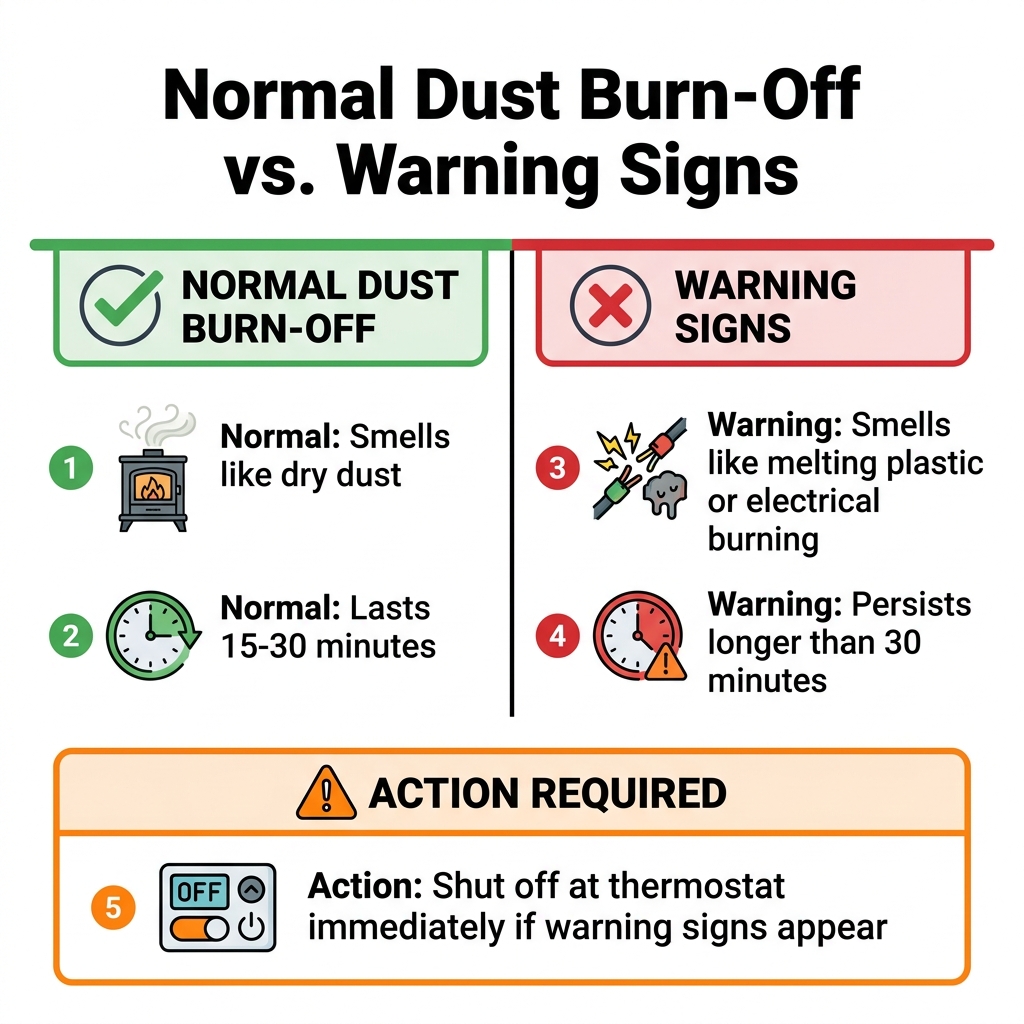
Normal dust burn-off has a distinct scent. It smells like dry, warm dust—similar to the smell of a hair dryer that has been left in a drawer for a few months. This odor should peak within the first ten minutes of operation and completely dissipate within 15 to 30 minutes. If the smell falls into this category and fades quickly, your system is simply clearing its dormant components.
Conversely, dangerous odors have a sharp, acrid quality. If you smell melting plastic, burning rubber, or a fishy electrical odor, you are not smelling dust. These odors indicate overheating wires, failing blower motors, or melting insulation.
When to Take Immediate Action
If a burning smell persists beyond 30 minutes, or if you immediately detect the scent of melting plastic or electrical burning, walk to your thermostat and turn the system off completely. Do not wait to see if it improves. The US Fire Administration advises having residential heating equipment inspected annually by a qualified professional to prevent these exact residential heating hazards.
• Odor Profile — Normal Dust Burn-Off: Dry dust, similar to a warm hair dryer — Warning Sign / Hazard: Acrid, melting plastic, rubber, or fishy electrical smell
• Duration — Normal Dust Burn-Off: Peaks quickly, gone within 15 to 30 minutes — Warning Sign / Hazard: Persists beyond 30 minutes or grows stronger
• Visual Signs — Normal Dust Burn-Off: None; air continues to flow normally — Warning Sign / Hazard: Smoke from vents, tripping circuit breakers, unusual clicking
• Required Action — Normal Dust Burn-Off: Monitor the system until the smell clears — Warning Sign / Hazard: Shut off at the thermostat immediately and call a professional

Thermostat Confusion: Why Is My AC Blowing Warm Air?
A pattern we see often on our fall service routes is a system that seems thoroughly confused about what it is supposed to be doing. You might switch the thermostat to "cool" during an unseasonably warm afternoon, only to find the AC blowing warm air. Alternatively, you might set it to "heat" on a chilly morning and feel nothing but cold air blasting from the vents.
The Role of the Reversing Valve
If your Metairie home utilizes a heat pump rather than a traditional gas furnace, this confusion is often tied to a component called the reversing valve. A heat pump provides both cooling and heating by reversing the flow of chemical refrigerant. Because the system has been locked in cooling mode for over eight months, the reversing valve can sometimes become physically stuck. When you ask the system to heat, the valve fails to shift, causing the system to continue blowing cold air. If you later try to cool the house, a partially stuck valve might result in warm air. Understanding why your AC keeps turning on and off or blowing the wrong temperature often points back to this critical mechanical transition.
Sensor Calibration Delays
Another common cause of transitional temperature issues is sensor calibration. After months of operating in a single mode, the internal sensors that tell the furnace burner to ignite or the blower motor to engage can be sluggish. Sometimes, a furnace will turn on its blower fan before the heat exchanger has actually warmed up, resulting in a blast of cold air for the first few minutes of operation.
How to test your thermostat properly:
• Ensure the thermostat is firmly set to the "Heat" position, not just "Auto."
• Raise the set temperature at least three degrees above the current room temperature to force a call for heat.
• Wait a full five to ten minutes. Modern systems have built-in time delays to protect the compressor and allow safety checks to complete before igniting.
• If the air remains cold after ten minutes, or if the system short-cycles (turns off prematurely), you have a mechanical issue that requires professional diagnosis.
Safe Visual Inspections Before the Cold Arrives
Before you initiate your October heating startup, there are several safe, non-DIY tasks you can perform to ensure your system is ready. It is vital to establish strict safety boundaries: homeowners should never open the furnace cabinet, attempt to clean internal sensors, or adjust electrical wiring. These tasks require specialized training and tools to prevent electrocution, fire hazards, or carbon monoxide leaks. However, you can greatly improve your system's performance by checking the external airflow factors.
Step-by-Step Pre-Flight Check
1. Check and replace the air filter: Heavy summer usage pulls massive amounts of dust into your filter. A clogged filter severely restricts airflow. In a heating system, restricted airflow causes the heat exchanger to overheat rapidly, which will trip the internal safety limit switch and shut the system down. Starting the season with a fresh filter is the easiest way to prevent a sluggish startup.
2. Ensure all indoor vents are open: Over the summer, you may have moved furniture, rugs, or curtains over your floor registers, or manually closed vents in unused rooms. Heating systems require balanced airflow to operate safely. Walk through your home and ensure every single return grille and supply vent is fully open and unblocked.
3. Clear debris from the outdoor unit: If you operate a heat pump, the outdoor condenser unit is just as important in the winter as it is in the summer. Fall leaves, overgrown bushes, and storm debris can choke the outdoor coil. Gently remove any visible debris from the exterior of the unit, maintaining at least two feet of clearance on all sides.
Proactive maintenance prevents sluggish startups and drastically improves overall efficiency. Enrolling in a routine AC maintenance plan ensures that a licensed professional handles the dangerous internal cleaning and safety checks long before the first cold snap arrives.
When to Rely on Emergency HVAC Dispatch
Even with careful visual inspections, hardware failures happen. When troubleshooting reveals a real hazard, knowing when to stop testing and call for backup is crucial. Ignoring warning signs during the initial startup can lead to a total system failure during the much colder winter months ahead.
Definitive Signs You Need a Professional
You should immediately request emergency dispatch if you experience any of the following during your heating startup:
• Persistent burning smells: Any odor of electrical burning or melting plastic, or a dust smell that lasts longer than 30 minutes.
• Failure to ignite: You hear the thermostat click, but the furnace never actually fires up, or the heat pump outdoor unit remains entirely silent.
• Repeated short-cycling: The heater turns on, runs for two minutes, shuts off, and immediately tries to start again. This indicates a severe airflow restriction or a failing flame sensor.
• Unusual noises: Loud banging, scraping metal, or intense rattling that was not present during the cooling season.
The Value of Expert Diagnostics
There is immense psychological reassurance in having a local team ready to respond to electrical or heating failures. For instance, our Cypress Cooling Company technicians recently helped a local homeowner who experienced ongoing performance issues where the system simply couldn't keep the indoor environment comfortable during a temperature shift. Instead of guessing at the problem, they called us for help. Our team diagnosed the root cause, showed the findings firsthand, and offered several clear repair options, smoothly fixing the issue with complete transparency.
Licensed technicians carry the specialized tools required to safely diagnose cracked heat exchangers, measure precise electrical amp draws, and test gas pressures. As a homeowner in the Greater New Orleans area, you benefit from Cypress Cooling Company's 24/7 emergency repair dispatch. This ensures you are never left stranded in an unsafe or uncomfortable home, no matter when your system decides to act up.
Frequently Asked Questions About Fall HVAC Transitions
Is it normal for my heater to smell when I turn it on?
Yes, a brief smell of burning dust is completely normal after months of inactivity, but it should dissipate quickly. During the summer, dust and household particulates settle on the dormant heating elements. When the system fires up for the first time in the fall, those particles burn off, creating a dry, warm odor.
How long should a furnace smell like burning dust?
Typically, the normal dust burn-off smell lasts 15 to 30 minutes. The odor will peak within the first ten minutes of the heating cycle and fade away as the system continues to run. If the smell persists longer than half an hour, or if it smells like electrical burning, you should shut the system down immediately.
Why is my heater sluggish to start in the fall?
Dust buildup on sensors, a clogged air filter, or a sticking reversing valve can easily delay your system's startup. After sitting unused for eight months, moving parts can lose lubrication and safety sensors can become coated in grime. A professional tune-up cleans these components so the system can ignite quickly and safely.
Can dust in a heater cause a fire?
While rare, excessive debris or compromised internal components do pose a fire risk, which is why annual inspections are highly recommended. A light coating of dust will safely burn away, but severe neglect, blocked vents, or failing electrical components can lead to dangerous overheating inside the furnace cabinet.
Why is my AC blowing warm air when I try to switch modes?
If you have a heat pump, blowing the wrong temperature often means the reversing valve is stuck after operating in a single mode all summer. It can also indicate a thermostat calibration issue or a delay in the system's internal safety checks. Give the system ten minutes to adjust; if it still blows the wrong temperature, a technician will need to test the valve and refrigerant levels.
Ensure a Safe, Comfortable Home This Season
Monitoring your first heating cycle carefully is the best way to catch minor transitional issues before they turn into mid-winter emergencies. From recognizing the difference between normal dust burn-off and a serious electrical hazard, to understanding why your system might briefly blow the wrong temperature, being informed keeps your household safe.
True peace of mind comes from knowing your equipment operates exactly as the manufacturer intended. If you have any doubts about your system's performance, unusual smells, or sluggish startup times this October, do not hesitate to reach out. Schedule a professional inspection with our Cypress Cooling Company team today to ensure your Metairie home remains safe, efficient, and perfectly comfortable all season long.
OUR CLIENTS HAVE TO SAY ABOUT US



Service areas
Our service areas are designed to meet the diverse needs of our clients. We focus on providing exceptional service and ensuring customer satisfaction in every location we operate.

