
AC Repair vs Replace: Decision Guide
.webp)
Is It Time to Repair or Replace Your AC? A Clear Decision Guide for South Louisiana Homeowners
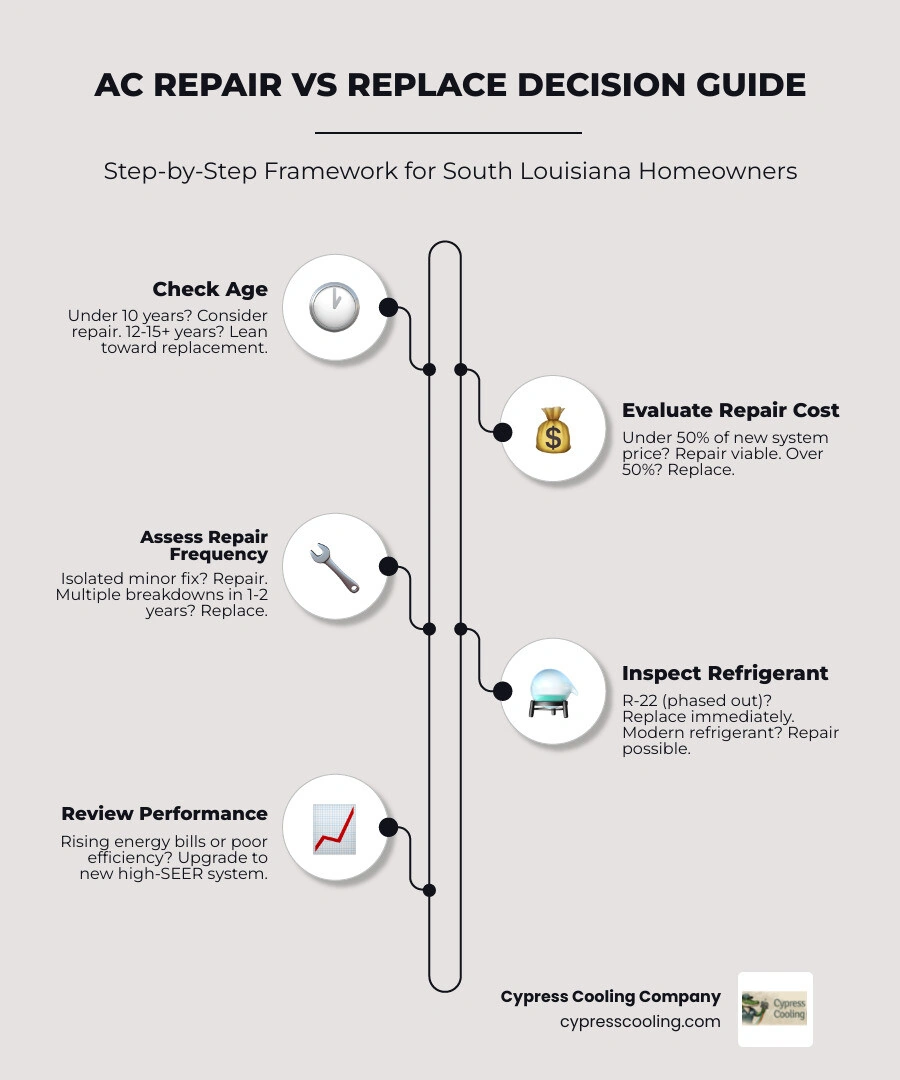
If you're searching for an ac repair vs replace — decision guide, here's the short answer:
Repair your AC if:
• The unit is under 10 years old
• The repair is minor and isolated
• The repair cost is less than 50% of a new system's price
• The system has been well maintained
Replace your AC if:
• The unit is 12–15+ years old
• You've had multiple breakdowns in the past 1–2 years
• The unit runs on R-22 refrigerant (phased out since 2020)
• Repair costs exceed 50% of a new system's price
• Your energy bills keep climbing despite repairs
That decision feels simple on paper — but in real life, it rarely is. Your AC quits during a South Louisiana heat wave. A technician gives you a repair estimate. And suddenly you're trying to figure out if fixing it makes any financial sense, or if you're just delaying the inevitable.
Most central AC systems last between 10 and 15 years with proper maintenance. But South Louisiana's heat, humidity, and long cooling seasons put extra strain on equipment — meaning your system may wear out faster than average. The stakes are high: a wrong call either wastes money on a dying unit or triggers a premature replacement you didn't need.
This guide walks you through the key factors — age, cost rules, efficiency, refrigerant type, and comfort performance — so you can make a confident, informed decision.
The Core Framework: AC Repair vs Replace — Decision Guide
When we step into a home in Metairie or Kenner to evaluate a struggling system, we don't just look at the broken part. We look at the big picture. Making an informed choice requires looking at several overlapping factors. While a single repair might seem affordable today, it’s the cumulative impact of age, frequency of breakdowns, and performance limits that truly dictates the best path forward.
In South Louisiana, our systems work overtime. While the national average lifespan for an HVAC system is often cited as 15–20 years, the reality in humid, coastal environments is closer to 10–12 years. Salt air, extreme humidity, and nearly ten months of cooling demand per year mean our equipment ages in "dog years."
To help you visualize this, consider the following comparison:
• System Age — Lean Toward Repair: Under 10 years — Lean Toward Replacement: Over 12–15 years
• Repair History — Lean Toward Repair: First major issue — Lean Toward Replacement: 2+ repairs in the last year
• Refrigerant — Lean Toward Repair: R-410A or R-454B — Lean Toward Replacement: R-22 (Freon)
• Warranty — Lean Toward Repair: Still under manufacturer coverage — Lean Toward Replacement: Warranty has expired
• Comfort — Lean Toward Repair: Cools evenly and manages humidity — Lean Toward Replacement: Uneven temps and "sticky" indoor air
• Energy Bills — Lean Toward Repair: Consistent with previous years — Lean Toward Replacement: Rising 15%+ year-over-year
For a deeper dive into local considerations, check out our guide on Should I Repair or Replace My Air Conditioner in South Louisiana?
Applying the $5,000 Rule to Your AC Repair vs Replace — Decision Guide
One of the most reliable mathematical tools we use is the "$5,000 Rule." This formula takes the emotion out of the decision by focusing purely on the economic threshold of your system.
The Formula: Multiply the age of your unit by the cost of the repair. If the total exceeds $5,000, it is generally considered a better financial investment to replace the unit.
• Example A: You have a 6-year-old unit that needs a $400 repair. (6 x 400 = 2,400). Since 2,400 is less than 5,000, repairing is the logical choice.
• Example B: You have a 12-year-old unit that needs a $600 repair. (12 x 600 = 7,200). Since 7,200 exceeds 5,000, you are likely pouring money into a "sunk cost."
This rule is particularly helpful because it accounts for the "remaining life" of the equipment. Spending $600 on a unit that might only last another year is much more expensive than spending $600 on a unit that has another decade of life ahead of it. For more on these heuristics, you can read about AC Repair vs. Replace: Rules of Thumb That Actually Make Sense.
Using the 50% Rule for Your AC Repair vs Replace — Decision Guide
Another industry standard is the "50% Rule." This rule states that if the cost of a single repair exceeds 50% of the value of a brand-new system, replacement is almost always the superior option.
Major component failures — such as a cracked heat exchanger, a grounded compressor, or a severely leaking evaporator coil — often come with repair estimates that approach this 50% threshold. When you reach this point, you aren't just paying for a part; you're paying to keep an old, inefficient, and likely out-of-warranty machine on life support. A new system provides immediate benefits like a fresh manufacturer's warranty, significantly higher energy efficiency, and modern reliability that an old unit simply cannot match.
When to Choose Repair for Your Cooling System
Despite the benefits of new technology, replacement isn't always the answer. We often find that a well-maintained system has plenty of life left in it. If your unit is under 10 years old, it is statistically likely that a repair is the more cost-effective route.
One of the biggest "green lights" for repair is an active manufacturer warranty. Most major brands provide a 5- or 10-year warranty on parts. If your compressor or motor fails while under warranty, you may only be responsible for the labor costs, making the repair much more palatable.
Common scenarios where we recommend repair include:
• Minor Electrical Issues: A blown capacitor or a faulty contactor is a common, affordable fix that can get a system back up and running in minutes.
• Parts Availability: If your system uses modern refrigerants and components that are readily available in our service areas like AC Repair in New Orleans, LA or AC Repair in Kenner, LA, repairs are usually quick and effective.
• Isolated Incidents: If the system has a perfect track record and this is the first time it has ever broken down, it’s worth fixing.
Minor Components and Maintenance
Sometimes, what looks like a total system failure is actually a simple maintenance oversight. Before you panic about a replacement, we always check the "low-hanging fruit."
• Thermostat Calibration: If your home feels too hot, it might just be a thermostat that needs new batteries or a recalibration.
• Clogged Condensate Drains: In humid places like Laplace or Luling, algae and sludge can build up in your drain line. This triggers a safety switch that shuts the whole system down. A simple clearing of the line solves the problem.
• Air Filter Replacement: A severely clogged filter can cause the evaporator coil to freeze, leading to zero airflow.
Common repairable parts that don't require a system overhaul include:
• Capacitors and contactors
• Fan motors (indoor or outdoor)
• Clogged drain lines
• Faulty thermostats
• Blown fuses or tripped breakers
Signs It’s Time for a Full AC Replacement
There comes a time when "one more repair" is one too many. In May 2026, we are seeing many homeowners reach the end of the road with systems installed in the early 2010s. If you are experiencing frequent service calls — meaning a technician has been to your house twice or more in the last two seasons — your system is sending you a message.
One of the most critical signs is evaporator coil corrosion. In our South Louisiana climate, moisture stays on the coils constantly, leading to "pitting" and refrigerant leaks. Once a system starts leaking refrigerant, the clock is ticking.
For a detailed look at when to pull the trigger, see this Repair vs. Replace AC Guide | Ace HVAC Cleveland. If you're in the Northshore area, you can find specific local insights regarding AC Replacement in Slidell, LA.
Environmental and Regulatory Factors
Regulatory changes often make the repair vs. replace decision for you. The most significant of these is the R-22 refrigerant phase-out. As of 2020, R-22 (often called Freon) is no longer produced or imported in the U.S.
If your unit was built before 2010, it almost certainly uses R-22. By 2026, the remaining stockpiles of this refrigerant are extremely scarce and incredibly expensive. If an R-22 system develops a leak, the cost to "recharge" the system, combined with the cost of the repair, almost always exceeds the value of the unit. In these cases, we strongly advise against repair.
Furthermore, EPA regulations continue to push for higher efficiency standards. Older units are often SEER 10 or 13, whereas modern units start much higher, offering massive savings on cooling costs. Residents in areas like Bucktown can learn more about these transitions here: More info about AC Replacement in Bucktown, LA.
Evaluating Efficiency and Long-Term Performance
When you replace an old AC, you aren't just buying "cold air" — you're buying a lower monthly overhead. Modern systems use SEER2 (Seasonal Energy Efficiency Ratio) ratings to measure efficiency. Upgrading from an old 10-SEER unit to a modern 16 or 18-SEER2 system can reduce your cooling costs by 20% to 40%.
Variable-speed technology is another game-changer for South Louisiana. Traditional ACs are either "on" or "off." Variable-speed systems can throttle down to 30% or 40% capacity, running longer at a lower speed. This doesn't just save energy; it provides superior humidity control. By running longer at a lower speed, the system removes significantly more moisture from the air, making your home feel comfortable at 75 degrees instead of having to crank it down to 68 to get rid of the "stickiness."
Benefits of a new system include:
• Lower Utility Bills: Immediate reduction in monthly energy consumption.
• Enhanced Warranty: Usually 10 years of protection on major parts.
• Improved Air Quality: Modern systems have better filtration options and humidity management.
• Quiet Operation: Newer compressors and fan blades are designed to be whisper-quiet.
• Environmentally Friendly: Uses modern refrigerants with zero ozone depletion potential.
Comfort and Air Quality Issues
Sometimes a system "works" but it doesn't provide comfort. This is a subtle but important part of the ac repair vs replace — decision guide. If you have rooms that are always five degrees warmer than the rest of the house, or if your indoor humidity stays above 60%, your system is failing you even if it’s still blowing air.
Short cycling — where the unit turns on and off every few minutes — is another red flag. It puts immense strain on the compressor and prevents the system from ever reaching its peak efficiency or dehumidification potential. If you're in Laplace and noticing these issues, check out More info about AC Repair in Laplace, LA to see if a repair can solve it or if a replacement is needed to fix the underlying sizing or technology issues.
Frequently Asked Questions about AC Repair vs Replace
What is the average lifespan of an AC unit in South Louisiana?
While the national average is 15–20 years, the heavy workload and high humidity in South Louisiana typically limit an AC unit's lifespan to 10–12 years. Units that receive annual professional maintenance can sometimes push toward the 15-year mark, while neglected units often fail before they hit age 10.
Should I replace my AC if it still uses R-22 refrigerant?
In 2026, the answer is almost always yes. Because R-22 is no longer manufactured, even a minor leak can result in a repair bill that is a significant percentage of a new system's cost. Furthermore, a system old enough to use R-22 is likely well past its expected lifespan and operating at very low efficiency.
How does a new AC system affect my monthly utility bills?
A new high-efficiency system can reduce your cooling costs by 20% to 40%. For many homeowners in our area, the monthly savings on the utility bill can significantly offset the investment of the new system over its lifespan.
Conclusion
At Cypress Cooling Company, we understand that the ac repair vs replace — decision guide isn't just about numbers; it's about your family's comfort and your peace of mind. Our philosophy is simple: we diagnose, we educate, and we guide. We aren't here to "sell" you a new unit you don't need, nor are we here to patch up a "zombie" system that will just break down again next month.
Whether you are in Algiers, Slidell, Harvey, or New Orleans, our team of professionals is ready to provide a transparent, honest evaluation of your HVAC system. We’ll help you apply the $5,000 rule, check your warranty status, and look at your energy trends to find the solution that makes the most sense for your home and your budget.
Don't spend another night in a sweltering house or another month overpaying the utility company. Schedule your air conditioning evaluation today and let us help you make the right call for your home.
OUR CLIENTS HAVE TO SAY ABOUT US



Service areas
Our service areas are designed to meet the diverse needs of our clients. We focus on providing exceptional service and ensuring customer satisfaction in every location we operate.