How to Prevent Capacitor Failure in Extreme Louisiana Heat
.webp)
Why AC Capacitors Fail in Extreme Louisiana Heat — And What It Means for Your Home
Why do AC capacitors fail in extreme louisiana heat is one of the most common questions homeowners ask when their system suddenly stops cooling in the middle of July. The short answer: Louisiana summers push AC systems harder than almost anywhere else in the country, and the capacitor is usually the first component to show the strain.
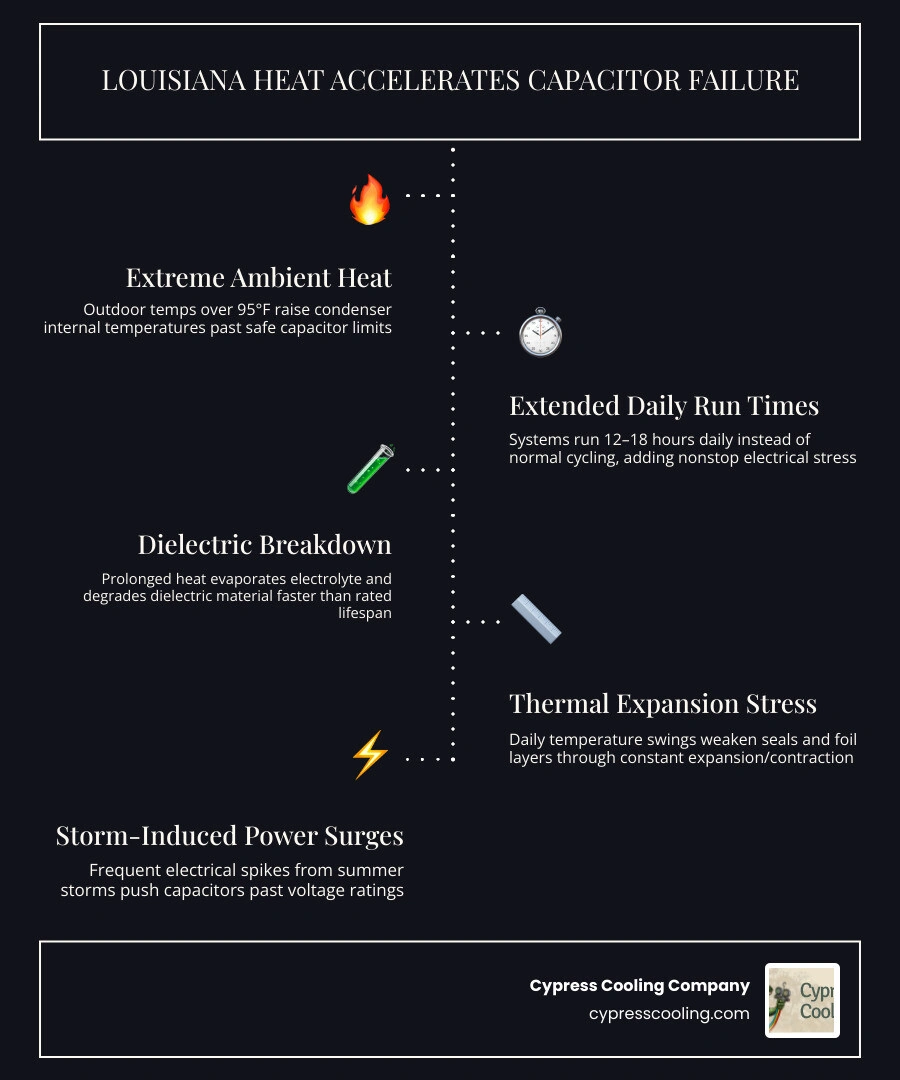
Here is a quick breakdown of the main reasons capacitors fail in Louisiana's extreme heat:
Top Causes of AC Capacitor Failure in Louisiana Heat
1. High ambient temperatures — Outdoor temperatures regularly exceed 95°F, raising the internal temperature of the condenser unit well beyond what capacitors are designed to handle long-term.
2. Extended run times — Louisiana AC systems often run 12 to 18 hours a day during summer, far beyond the cycling patterns seen in milder climates.
3. Chemical breakdown — Prolonged heat causes the dielectric material and electrolyte fluid inside the capacitor to degrade faster than normal.
4. Thermal expansion stress — Daily temperature swings cause the capacitor's internal components to expand and contract repeatedly, weakening seals and foil layers over time.
5. Power surges and voltage fluctuations — Louisiana's frequent summer thunderstorms cause electrical spikes that accelerate capacitor wear.
6. High humidity — Moisture in the air can cause corrosion on capacitor terminals and internal components, shortening lifespan further.
While a capacitor in a moderate climate might last anywhere from 10 to 20 years, the combination of intense heat, humidity, long daily run times, and storm-related power surges in South Louisiana can cut that lifespan down to just 2 to 5 years. That is not a defect — it is simply what this climate does to electrical components that are working at their absolute limit every single day of the summer.
Glossary for why do ac capacitors fail in extreme louisiana heat:
• ac leaking water from ceiling what causes it in a louisiana home
• most common ac repairs in south louisiana
• signs your ac compressor is going bad in a gulf coast climate
What Is an AC Capacitor and How Does It Work?
To understand why these little metal cylinders fail so frequently when the South Louisiana heat rolls in, we first need to look at what they actually do.
Think of your air conditioner's capacitor as a highly specialized, temporary battery. While a standard battery is designed to release its stored energy slowly over a long period, a capacitor does the exact opposite. It stores up electrical energy from your home’s electrical panel and releases it in short, incredibly powerful bursts.
Your home's standard electrical system simply doesn't provide enough raw electrical power to kickstart the heavy-duty motors inside your air conditioning system. When your thermostat calls for cooling, the capacitor delivers a massive jolt of electricity to get these motors spinning. Once the motors are running, the capacitor continues to provide a steady, modulated flow of electrical current to keep them operating efficiently.
In a standard central air conditioning system, capacitors are responsible for powering three critical motors:
• The Compressor Motor: This is the heart of your outdoor unit. It pumps refrigerant through the system to heat and cool your home. It requires more starting power than any other component.
• The Outdoor Fan Motor: This motor spins the fan blades in your condenser unit, releasing the heat pulled from your home into the outdoor air.
• The Blower Motor: Located in your indoor air handler or furnace, this motor distributes the newly cooled air throughout your ductwork.
Without a functioning capacitor, none of these motors can start or stay running. When a capacitor begins to weaken, your motors have to work significantly harder to do their jobs, which can lead to a host of performance issues. If you notice your system struggle to start up or run continuously without cooling your home, you can Learn more about common system issues to help narrow down the root cause.
Start Capacitors vs. Run Capacitors
Air conditioning systems rely on two distinct types of capacitors to manage electrical loads: start capacitors and run capacitors. In many modern residential systems, these two components are housed inside a single metal casing known as a "dual-run capacitor," but they still perform two very different functions.
Start CapacitorsA start capacitor is designed solely to provide the initial electrical boost required to get a motor spinning from a dead stop. It delivers a high-voltage burst of energy (measured in microfarads, or MFD) for a fraction of a second and then immediately drops out of the electrical circuit once the motor reaches about 75% of its operating speed. Because they only operate for a brief moment during startup, start capacitors do not experience the same continuous heat buildup as run capacitors, though they are still highly susceptible to damage from frequent on-off cycling.
Run CapacitorsA run capacitor stays engaged in the electrical circuit the entire time the motor is running. Its job is to continuously modulate the voltage and phase of the electrical current entering the motor. This continuous voltage modulation ensures that the motor spins smoothly, runs at the correct speed, and operates with maximum energy efficiency.
Because run capacitors operate continuously, they generate their own internal heat while simultaneously absorbing heat from the surrounding outdoor air. This double exposure to heat makes run capacitors the most common point of failure in South Louisiana HVAC systems. If you want to dive deeper into how these components function and break down over time, you can read more about motor capacitors on Wikipedia.
Why Do AC Capacitors Fail in Extreme Louisiana Heat?
Now that we know how these components work, let's explore why South Louisiana's brutal summers are so incredibly destructive to them.
The outdoor condenser cabinet is designed to protect your AC’s electrical components from rain, debris, and pests. However, during a typical July or August afternoon in places like Metairie, Kenner, or Slidell, that metal cabinet essentially becomes an oven.
When the outdoor ambient temperature is 95°F, the temperature inside your condenser's electrical access panel can easily climb past 130°F. If your system is located in direct sunlight, that temperature can jump another 10 to 15 degrees.
This extreme environment triggers a series of physical and chemical reactions that lead directly to capacitor failure:
• Extended Run Times: During a severe heatwave, your AC doesn't get much of a break. Instead of cycling on and off every 15 to 20 minutes, your system may run continuously for hours. This constant operation means the run capacitor never has a chance to cool down, leading to rapid heat accumulation.
• Thermal Expansion and Contraction: As the capacitor heats up during the day and cools down at night, its metal casing and internal foil layers expand and contract. Over time, this repeated physical movement weakens the structural integrity of the capacitor, eventually causing its internal seals to rupture.
• Chemical Breakdown: Heat is the ultimate enemy of the sensitive materials inside a capacitor, accelerating the degradation of the delicate components that hold the electrical charge.
When these factors combine, your system must work overtime just to keep your home comfortable. You can read about How constant operation affects your system to see how this extended run time impacts your entire HVAC setup.
The Science of Heat and why do ac capacitors fail in extreme louisiana heat
To truly understand why do ac capacitors fail in extreme louisiana heat, we have to look at the chemistry and physics taking place inside these small metal cylinders.
An AC capacitor consists of two layers of thin metal foil separated by a non-conductive insulating material called a dielectric. The entire assembly is immersed in a liquid or gel electrolyte fluid that helps conduct and store the electrical charge.
Most standard residential AC capacitors are rated for maximum operating temperatures of up to 85°C (185°F). Under ideal conditions, an 85°C-rated capacitor has an engineered lifetime of up to 20,000 operating hours. However, this rating assumes the component is operating within its normal temperature limits.
According to Arrhenius' Law—a fundamental principle of chemical kinetics—the rate of chemical reactions doubles for every 10°C (18°F) increase in temperature. When applied to capacitors, this means that every 10-degree rise in operating temperature effectively cuts the component's remaining lifespan in half.
As extreme heat bakes the outdoor unit, the liquid electrolyte fluid inside the capacitor begins to evaporate and vent through the unit's built-in safety seals. As the fluid level drops, the capacitor loses its ability to hold a charge. Once the capacitance drops out of its specified range (usually more than +/- 5% to 6% of its rated MFD value), the motor it powers will begin to struggle, overheat, and eventually fail to start altogether. For more context on keeping your system running efficiently during these peak periods, you can learn more about maintaining your air conditioner from Energy.gov.
Humidity, Power Surges, and why do ac capacitors fail in extreme louisiana heat
While dry heat is bad enough, South Louisiana brings two additional elements to the table that make capacitor survival even more difficult: extreme humidity and frequent summer storms.
Our local humidity doesn't just make the outdoor air feel heavier; it also creates a highly corrosive environment for electrical connections. High moisture levels in areas like New Orleans, Mandeville, and Destrehan can lead to rapid oxidation and corrosion on the capacitor's terminal spade connectors. This corrosion increases electrical resistance, forcing the capacitor to draw more amperage and generate even more internal heat.
Furthermore, Louisiana summers are famous for sudden afternoon thunderstorms. These storms frequently cause voltage fluctuations and power surges across the Entergy Louisiana grid. A single major power surge can instantly puncture the delicate dielectric film inside a capacitor, causing an immediate short circuit. Even minor, recurring voltage drops can force the capacitor to work harder to maintain the necessary voltage for your AC's motors, slowly degrading the component over time.
Finally, dirty condenser coils can trap heat inside your outdoor unit, further elevating the ambient temperature around your electrical components. To see how restricted airflow compounds this issue, read about The impact of dirty condenser coils.
Warning Signs Your AC Capacitor Is Failing
Fortunately, AC capacitors rarely fail completely without dropping a few hints first. By learning to recognize the early warning signs of capacitor degradation, you can address the issue before it turns into a complete system breakdown on a 98-degree afternoon.
Here are the most common symptoms of a failing AC capacitor:
• Clicking or Humming Noises: If you hear a rapid clicking sound when your AC tries to turn on, followed by a loud, continuous humming noise from the outdoor unit, your start capacitor is likely failing. The humming is the sound of the motor trying to start without the necessary electrical boost to turn the blades or compress the refrigerant.
• Hard-Starting: If your air conditioner seems to stutter, hesitate, or take several seconds to fully start up when a cooling cycle begins, this is known as "hard-starting." This is a classic sign of a weak capacitor that is struggling to deliver a sufficient charge.
• Warm Air Blowing from Vents: If your indoor blower fan is running but the outdoor compressor fails to start due to a bad capacitor, your system will simply circulate warm air throughout your home.
• Unexplained Spikes in Your Energy Bill: When a run capacitor weakens, the compressor and fan motors must draw significantly more electrical current (amperage) to operate. This struggling performance can increase your system's energy consumption by 30% or more.
• Visible Physical Damage: A healthy capacitor has a perfectly flat top and straight metal sides. As internal gases build up from heat and chemical breakdown, the top of the capacitor will begin to bulge, swell, or dome upward. In severe cases, you may even see oily fluid leaking from the top seals.
• Visual Appearance — Healthy Capacitor: Flat top, clean metal casing, no leaks — Failing Capacitor: Bulging or domed top, swelling, oily residue
• Startup Behavior — Healthy Capacitor: Quick, smooth startup within 1-2 seconds — Failing Capacitor: Hesitation, clicking, stuttering (hard-starting)
• System Sounds — Healthy Capacitor: Quiet, normal operational hum — Failing Capacitor: Loud humming, clicking, buzzing without starting
• Air Temperature — Healthy Capacitor: Consistent, cool air from vents — Failing Capacitor: Warm or room-temperature air blowing
• Energy Consumption — Healthy Capacitor: Normal, consistent monthly utility bills — Failing Capacitor: Sudden, unexplained increase in electrical usage
How to Prevent Capacitor Failure and Protect Your AC
While you can't change the South Louisiana climate, there are several highly effective steps you can take to protect your air conditioner's electrical components and significantly extend the lifespan of your capacitor.
1. Schedule Regular Professional MaintenanceThe single best way to prevent an emergency summer breakdown is to have your system professionally inspected and cleaned twice a year. During a routine maintenance visit, a technician will use a digital multimeter to measure the exact capacitance (MFD) of your capacitors. If a capacitor rated for 45 MFD is testing at 38 MFD, we can replace it proactively before it fails completely and leaves you without cooling.
2. Keep Your Condenser Coils CleanWhen your outdoor condenser coils are caked with dirt, pollen, and grass clippings, your system cannot shed heat efficiently. This trapped heat raises the temperature inside the entire outdoor cabinet, directly baking your electrical components. Regularly washing your outdoor coils with a gentle spray from a garden hose can dramatically lower internal operating temperatures.
3. Provide Shade for Your Outdoor UnitIf your outdoor condenser is located on the south or west side of your home, it is likely absorbing direct sunlight during the hottest parts of the day. Installing a simple awning or planting tall shrubs at least two to three feet away from the unit can provide valuable shade, lowering the ambient temperature around the cabinet by 10 to 15 degrees. Just make sure not to block the airflow leaving the top of the unit.
4. Change Your Indoor Air Filters RegularlyA clogged indoor air filter restricts airflow across your evaporator coil, forcing your blower motor and compressor to work much harder and run for longer periods. By changing your filters on schedule, you reduce the overall run time of your system, giving your capacitors a chance to cool down between cycles.
5. Consider Upgrading to Heavy-Duty ComponentsWhen it does come time to replace a weak capacitor, ask about upgrading to a heavy-duty, high-temperature rated model. Many premium aftermarket capacitors are rated for up to 70°C (158°F) ambient temperatures and feature superior internal construction designed specifically for harsh, hot climates.
To learn more about what goes into keeping your system running smoothly, you can Discover what is included in a professional maintenance visit.
Frequently Asked Questions About AC Capacitors
We hear many of the same questions from homeowners across South Louisiana regarding their AC's electrical parts. Here are some of the most common inquiries we receive:
How long does an AC capacitor last in South Louisiana?
While manufacturers often state that an AC capacitor should last between 10 and 20 years under normal operating conditions, the reality in South Louisiana is quite different.
Because of our extreme summer heat, high humidity, frequent electrical storms, and exceptionally long cooling seasons, a standard capacitor in our region typically lasts between 2 and 5 years. In systems that are older, poorly maintained, or running constantly due to restricted airflow, capacitors can sometimes fail in as little as 1 to 2 years.
Proactive replacement during routine spring maintenance is often the smartest way to avoid emergency service calls during the peak of summer. You can read more about what to expect from your system's overall longevity by reviewing the Typical lifespan of South Louisiana AC units.
Can I run my AC with a bad capacitor?
You should never run your air conditioner if you suspect the capacitor is failing or has already died.
When a capacitor is weak or dead, the motors it powers will still attempt to start. Because they lack the electrical boost needed to spin, they will sit idle while drawing massive amounts of electrical current. This quickly causes the motor windings to overheat, which can lead to permanent motor burnout.
Running an AC with a bad capacitor can turn a simple, straightforward repair into an incredibly expensive compressor or fan motor replacement. If you hear your outdoor unit humming but the fan isn't spinning, turn the system off at your thermostat immediately. For more details on what happens when these heavy-duty components fail, check out the Signs your compressor is failing.
Why is DIY capacitor replacement unsafe for homeowners?
With the rise of online tutorials, many homeowners are tempted to purchase a cheap capacitor online and attempt to replace it themselves. We strongly advise against this for several critical safety and performance reasons:
• High-Voltage Electrical Shock: Capacitors are designed to store massive amounts of electrical energy. Even if you have turned off the power at your home's main circuit breaker and pulled the outdoor electrical disconnect, a capacitor can still hold a lethal electrical charge. Handling a charged capacitor without properly discharging it first can result in severe electrical shock or death.
• Risk of System Damage: Capacitors must be matched exactly to your system's specifications. Installing a capacitor with the wrong microfarad (MFD) or voltage rating can permanently damage your compressor or fan motor. Additionally, wiring a dual-run capacitor incorrectly can instantly destroy your system's control board or compressor windings when the power is turned back on.
• Warranty Voiding: Most major HVAC manufacturers explicitly require that all electrical repairs be performed by a licensed, certified technician. Attempting a DIY repair can instantly void your remaining equipment warranty.
Conclusion
In the unique climate of South Louisiana, your air conditioner is easily the hardest-working appliance in your home. The extreme summer heat, high humidity, and frequent storms create a perfect storm of environmental stress that pushes critical electrical components like AC capacitors to their absolute limits.
At Cypress Cooling Company, our philosophy is built entirely on diagnosing, educating, and guiding our clients without pushy sales tactics. We believe in helping you understand how your system works so you can make informed decisions about your home's comfort and safety. Whether you live in Metairie, New Orleans, Kenner, Slidell, or any of our other South Louisiana service areas, we are always here to provide honest, professional diagnostics and reliable solutions.
If your air conditioner is struggling to start, making unusual humming noises, or simply blowing warm air, don't wait for a complete system breakdown to occur. You can Schedule expert AC repair in Metairie, LA to have one of our experienced, friendly technicians safely test and service your system's electrical components. For any other questions about keeping your home cool and comfortable all summer long, please Contact Cypress Cooling Company for all your air conditioning needs.
OUR CLIENTS HAVE TO SAY ABOUT US


Service areas
Our service areas are designed to meet the diverse needs of our clients. We focus on providing exceptional service and ensuring customer satisfaction in every location we operate.