Signs Your 10-Year-Old AC Is Nearing End of Life in Louisiana
.webp)

Is Your 10-Year-Old AC Sending You Warning Signs? Here's What Louisiana Homeowners Need to Know
If you're noticing signs your 10-year-old AC is nearing end of life in Louisiana, you're not imagining things — and you're not alone. Louisiana's brutal combination of heat, humidity, and a cooling season that stretches from March through October puts enormous stress on air conditioning systems. A unit that might last 15 to 20 years in a milder northern climate often starts showing serious wear right around the 10-year mark here in the South.
Here's a quick look at the most common warning signs:
• Your home feels humid even with the AC running — a sign the system has lost its ability to remove moisture effectively
• Energy bills are climbing without any lifestyle change — aging equipment works harder and uses more electricity to deliver the same cooling
• You've called for repairs more than once this season — repeated breakdowns signal compressor or electrical components wearing out
• Rooms that used to cool down now stay warm — uneven cooling points to declining system capacity
• Your system uses R-22 refrigerant — production of this refrigerant was banned in 2020, making repairs far more expensive
• You're hearing new noises — grinding, clicking, or banging sounds during operation indicate mechanical stress
• The system is short-cycling — turning on and off frequently without completing a full cooling cycle is a red flag
Understanding these signs early gives you time to make a planned decision rather than an emergency one in the middle of a July heat wave.
Easy signs your 10 year old ac is nearing end of life in louisiana word list:
• average lifespan of a central air conditioner in a hot humid climate
• how long does ac last in south louisiana
• how maintenance extends ac life in south louisiana heat
Why Southern Louisiana Climates Shorten AC Lifespan
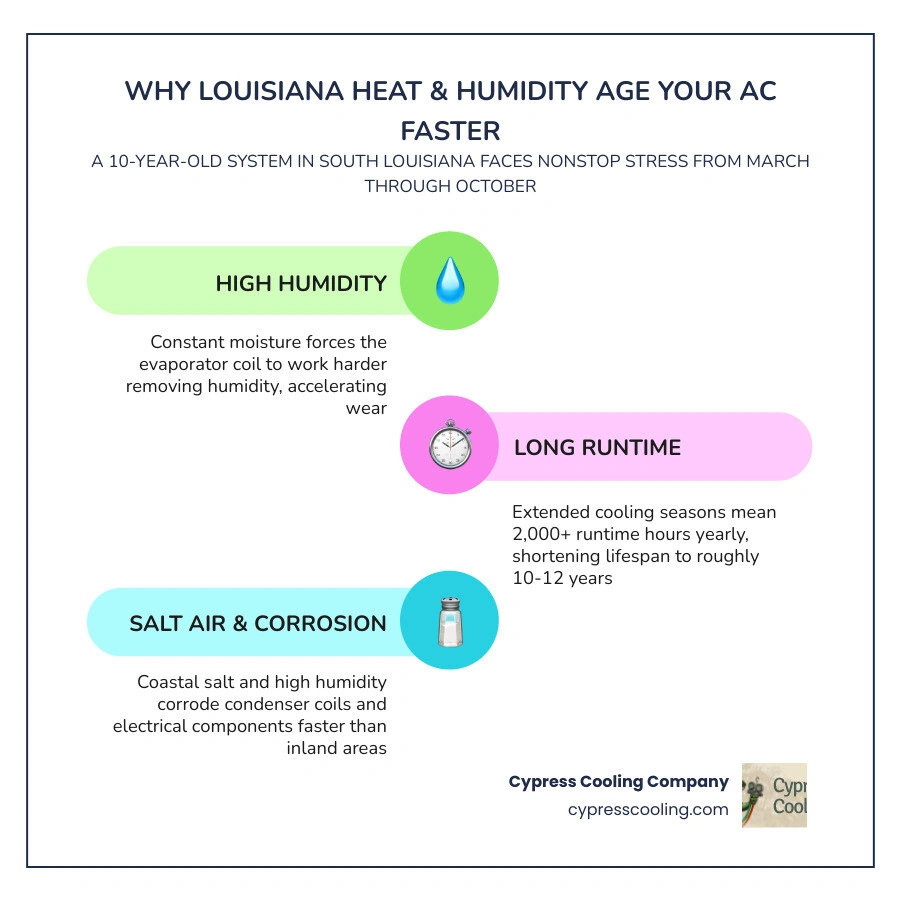
When we talk about the lifespan of an air conditioner, we have to look at "mechanical miles" rather than just the age on the calendar. In milder states, an air conditioner might only run for 1,000 to 1,500 hours a year. Here in South Louisiana — from the historic streets of New Orleans and the busy neighborhoods of Metairie and Kenner, to the Northshore communities of Covington, Mandeville, and Slidell — our systems routinely log 3,000 to 4,000 runtime hours annually.
This near-constant operation means a 10-year-old system in our region has worked as hard as a 20-year-old system in the Midwest.
Our unique environment presents several stressors that accelerate this wear:
• Extreme Cooling Degree Days: Louisiana experiences between 2,800 and 3,200 cooling degree days every year. This massive cooling load keeps systems running almost 10 months out of the year, leaving very little downtime for components to rest.
• Corrosive Salt Air: If you live anywhere near the coast or major water bodies — including Luling, Destrehan, or River Ridge — wind-blown salt air travels inland. This salt air combines with moisture to create a corrosive brine that pits aluminum and copper condenser coils, leading to pinhole refrigerant leaks.
• Constant High Humidity: Relative humidity levels in South Louisiana frequently hover above 70% to 80%. Your air conditioner is not just a cooling machine; it is a giant dehumidifier. Extracting gallons of water from the air daily places a continuous physical load on the fan motor, compressor, and condensate system.
Because of these factors, the Average Lifespan of a Central Air Conditioner in a Hot, Humid Climate is typically only 10 to 15 years, compared to the national average of 15 to 20 years. In fact, many local systems start entering their twilight years right around the decade mark. For a deeper look at this reality, you can read more about How Long Does AC Last in South Louisiana and compare regional expectations via The Average Lifespan of an Air Conditioner in New Orleans! .
Key signs your 10 year old ac is nearing end of life in louisiana
Recognizing the early warning signs that your system is struggling can save you from a hot, sleepless night. When an air conditioner is on its last leg, it rarely fails silently. Instead, it leaves a trail of clues.
Persistent Humidity: One of the Clear signs your 10 year old ac is nearing end of life in louisiana
Have you noticed your home feels sticky or clammy even when the thermostat says it is 72 degrees? That is because your aging AC is losing its dehumidification capacity.
The heart of moisture removal is the evaporator coil. As warm, humid indoor air passes over the cold coil, water vapor condenses on the metal and drains away. However, as a system reaches the end of its life, several issues can disrupt this process:
• The compressor may lose its compression ratio, preventing the refrigerant from reaching the optimal cold temperature needed for maximum condensation.
• Slow refrigerant leaks reduce the overall cooling capacity, causing the coil to stay too warm to pull water out of the air effectively.
• Corrosion and dirt buildup on the coils act as an insulating barrier, preventing efficient heat and moisture exchange.
When this happens, the air blowing out of your vents remains saturated with moisture. This high indoor relative humidity doesn't just make you uncomfortable; it can lead to musty odors and mold growth in your home. If your system is failing to keep indoor humidity levels in check, it is a strong indicator that the system is struggling to perform its primary functions. You can find more details on these performance drops in this guide on Signs your AC Unit is at the End of its Life Cycle - Seth Energy .
Frequent Breakdowns: Another of the signs your 10 year old ac is nearing end of life in louisiana
If you feel like you have your local HVAC technician on speed dial, your system is likely trying to tell you something. A single repair on a well-maintained system is normal, but a pattern of multiple breakdowns over two consecutive seasons is a clear sign of systemic wear.
As motors, capacitors, and compressors age, they draw more electrical current to start up. This extra strain can cause:
• Frequent Short-Cycling: The unit turns on, runs for a few minutes, shuts off, and repeats. This places immense physical stress on the compressor and fan motors.
• Blown Capacitors and Tripped Breakers: Weakening electrical components draw high amperage, frequently tripping your home's circuit breaker or burning out dual-run capacitors.
• Compressor Failure: The compressor is the heart of your system. If it begins to fail, you may notice loud clicking sounds when the unit tries to start, or the outdoor unit may hum without the fan spinning.
For homeowners along the Gulf Coast, recognizing these compressor issues early is critical. Learn more about identifying these specific warnings in our article on the Signs Your AC Compressor Is Going Bad in a Gulf Coast Climate.
3. Unexplained Spikes in Monthly Energy Bills
As your air conditioning system ages, its internal components naturally degrade. Friction increases in the fan motors, the compressor loses mechanical tolerance, and the heat transfer surfaces of the coils corrode. This means the system must run longer and consume more electricity to achieve the exact same level of cooling it delivered years ago.
An older AC system can easily lose significant efficiency over its lifespan. If you notice your energy bills climbing month after month during the summer, but your family's daily habits haven't changed, your 10-year-old AC is likely the culprit.
Upgrading an old system to a modern unit built under current SEER2 (Seasonal Energy Efficiency Ratio 2) standards can make a substantial difference. Modern high-efficiency systems use advanced variable-speed blowers and multi-stage compressors that adjust their output to match the exact cooling needs of your home. This prevents the constant, power-hungry on-and-off cycles of older single-stage units.
To see how these monthly savings can help balance out the investment of a new system over time, explore our guide on How Energy Savings From a New AC Offset Replacement in Louisiana. For additional indicators of declining system efficiency, you can also consult Top 4 Signs It's Time for AC Replacement - Trane® .
4. Outdated R-22 Freon Refrigerant Use
If your air conditioner was installed around or before 2010, or if it has been serviced and identified as an R-22 (Freon) system, you are dealing with an outdated technology. The Environmental Protection Agency (EPA) phased out the production and import of R-22 refrigerant entirely by January 1, 2020, due to its ozone-depleting properties.
While it is still legal to operate an R-22 system, servicing one has become incredibly difficult and expensive. Because the supply of R-22 is limited to recycled and reclaimed quantities, the cost to repair a refrigerant leak and recharge an older system can be very high.
If a 10-year-old system develops a refrigerant leak in the evaporator or condenser coils, patching the leak and refilling it with R-22 is rarely a wise investment. The high cost of the reclaimed chemical, combined with the reality that other components in the aging system are likely nearing their end of life, makes replacement the more logical choice. Modern systems use environmentally friendly alternatives that are readily available and far less expensive to service.
You can read more about how outdated refrigerants impact your home comfort and maintenance decisions in 8 Warning Signs That You Need to Replace Your Air Conditioner .
The Repair vs. Replace Decision Matrix for Older Systems
When your air conditioner breaks down, you are faced with a choice: do you patch it up one more time, or do you invest in a new system? To take the guesswork out of this decision, professional technicians use two reliable guidelines: the 50% Rule and the $5,000 Rule (sometimes called the Multiplication Rule).
• The 50% Rule: If the cost of a single repair exceeds 50% of the value of a brand-new, equivalent-capacity system, you should always replace the unit. Investing heavily in a system that still contains older, worn-out parts is rarely cost-effective.
• The $5,000 Rule: Multiply the age of your system by the repair estimate. If the result is greater than $5,000, replacement is highly recommended. For example:
— A 12-year-old system needing a $500 repair ($500 x 12 = $6,000) is a strong candidate for replacement.
— A 5-year-old system needing a $500 repair ($500 x 5 = $2,500) is well below the threshold, making a repair the smarter choice.
To help you visualize where your system stands, refer to this quick comparison table:
• System Age — Lean Toward Repair: Under 8-10 years — Lean Toward Replacement: 10-15+ years (in Louisiana climate)
• Refrigerant Type — Lean Toward Repair: Modern Refrigerant — Lean Toward Replacement: Outdated R-22 Freon
• Repair Cost vs. Age — Lean Toward Repair: Age x Repair Cost is under $5,000 — Lean Toward Replacement: Age x Repair Cost is over $5,000
• Breakdown Frequency — Lean Toward Repair: First major issue in several years — Lean Toward Replacement: Multiple service calls in the last 2 seasons
• Dehumidification — Lean Toward Repair: Keeps home dry and comfortable — Lean Toward Replacement: Home feels sticky, damp, or clammy
• Energy Bills — Lean Toward Repair: Consistent with seasonal changes — Lean Toward Replacement: Unexplained, steady increases
By applying these objective rules, you can protect your household budget from "death by a thousand cuts" — where small, consecutive repairs quickly add up to the cost of a new, reliable system. For a comprehensive breakdown of these financial strategies, check out our AC Repair vs. Replace Decision Guide.
Frequently Asked Questions About Louisiana AC Lifespans
How long does a central air conditioner typically last in South Louisiana?
While the national average lifespan for a central air conditioner is 15 to 20 years, a system in South Louisiana typically lasts between 10 and 15 years. The combination of high runtime hours (3,000 to 4,000 hours per year), salt air corrosion near water bodies, and the heavy dehumidification load means local systems age roughly twice as fast as units in milder climates.
What are the benefits of planning an AC replacement in the fall?
Replacing your AC during the "shoulder season" (typically October through November) offers several major advantages:
• No Summer Emergencies: You avoid the stress of a total system failure during a 95-degree July heat wave.
• Flexible Scheduling: HVAC companies are less busy than they are during peak summer, meaning you can easily book an installation at a time that works best for you.
• Mild Weather Testing: You can test and balance your new system in comfortable weather, ensuring everything is running perfectly before the next major heat wave arrives.
What efficiency standards should I look for in a new system?
As of January 2023, the Department of Energy requires all new split-system central air conditioners installed in the southern region of the United States to meet a minimum efficiency rating of 15 SEER2. When selecting a new system, look for units with high SEER2 ratings and ENERGY STAR certification, which can help lower your monthly energy bills and may qualify you for federal tax credits.
Conclusion
Your air conditioner is the most important mechanical system in your Louisiana home. Recognizing the signs your 10-year-old AC is nearing end of life in Louisiana — whether it's rising energy bills, persistent indoor humidity, or frequent calls for repairs — gives you the power to plan ahead.
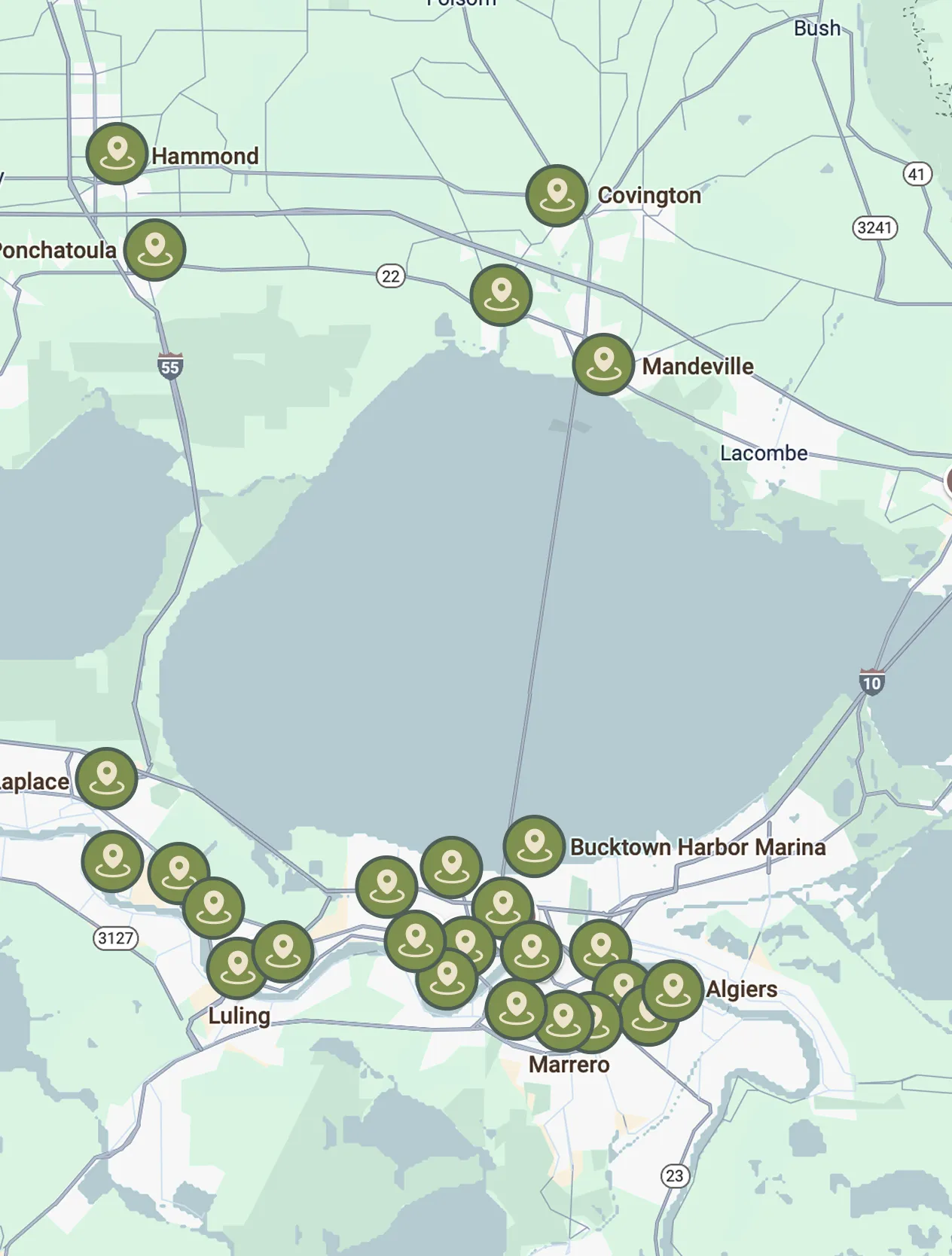
At Cypress Cooling Company, we believe in a straightforward, honest approach. We provide expert air conditioning, heating, and indoor air quality services across South Louisiana, including Algiers, Bucktown, Harahan, Kenner, Metairie, New Orleans, and the Northshore. Our philosophy is simple: we diagnose, educate, and guide you through your options without high-pressure sales tactics. We want to help you make the best decision for your home, your comfort, and your budget.
If your 10-year-old air conditioner is struggling to keep up with the Louisiana heat, let us help you evaluate its health. Schedule an air conditioning consultation with our experienced team today, and enjoy peace of mind knowing your home comfort is in good hands.
OUR CLIENTS HAVE TO SAY ABOUT US


Service areas
Our service areas are designed to meet the diverse needs of our clients. We focus on providing exceptional service and ensuring customer satisfaction in every location we operate.