
Ultimate Guide to Average Lifespan of a Central Air Conditioner in a Hot Humid Climate
.webp)

How Long Does a Central AC Actually Last in South Louisiana's Heat and Humidity?
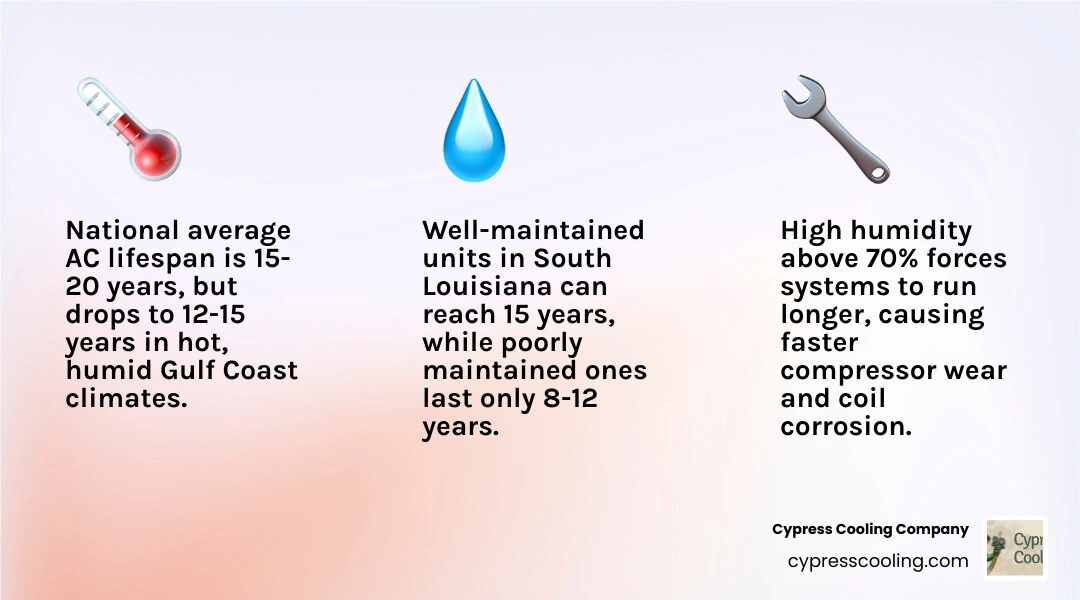
The average lifespan of a central air conditioner in a hot humid climate like South Louisiana is significantly shorter than what most manufacturers advertise. While the U.S. Department of Energy puts the national average at 15 to 20 years, homeowners in humid subtropical regions like the Gulf Coast routinely see their systems wear out in 10 to 15 years — and sometimes sooner.
Here is a quick breakdown of what to expect based on where you live and how well you maintain your system:
• National average (all climates) — Expected Lifespan: 15-20 years
• Hot, humid climate (well-maintained) — Expected Lifespan: 12-15 years
• Hot, humid climate (minimal maintenance) — Expected Lifespan: 8-12 years
• Coastal installation (salt air exposure) — Expected Lifespan: 7-12 years
• South Louisiana with annual professional care — Expected Lifespan: Up to 15 years
The core reason for the gap is simple: in places like Covington, Mandeville, or the Greater New Orleans area, your AC does not get a break. High humidity forces the system to work harder and longer than units in cooler, drier states — compressors wear out faster, coils corrode earlier, and the constant moisture creates the perfect environment for biological growth inside the system.
If your unit is approaching the 10-year mark and starting to show signs of strain, you are not imagining it. South Louisiana's climate is genuinely harder on HVAC equipment than almost anywhere else in the country.
This guide walks you through exactly why that happens, what warning signs to watch for, and how to get the most life out of your system before replacement becomes unavoidable.
Understanding the Average Lifespan of a Central Air Conditioner in a Hot Humid Climate
To understand why the average lifespan of a central air conditioner in a hot humid climate is so much shorter than the national average, we have to look at how climate zones dictate the physical limits of mechanical equipment. The federal government and organizations like ASHRAE group geographic regions into distinct climate zones. South Louisiana—including communities like Metairie, Kenner, Slidell, and Laplace—falls squarely within IECC Climate Zone 2. This zone is characterized by extremely high ambient temperatures and sustained high relative humidity, which regularly exceeds 70% to 80% during the summer months.
When you look at national HVAC benchmarks, they are heavily weighted by homes in temperate zones where air conditioners only run for three to four months out of the year. In South Louisiana, our cooling season easily stretches from late March through November. This means our systems accumulate wear and tear at double or triple the rate of a system in the Midwest or Northeast.
To help visualize this contrast, let’s look at how the local climate compares to drier, more moderate regions of the country:
• Hot & Humid (e.g., New Orleans, Gretna, Destrehan) — Typical Summer Humidity: 70% – 90% — Average Cooling Season Length: 8 to 9 months — Average System Lifespan: 10 – 15 years
• Hot & Dry (e.g., Arizona, West Texas) — Typical Summer Humidity: 10% – 30% — Average Cooling Season Length: 6 to 8 months — Average System Lifespan: 12 – 16 years
• Moderate/Temperate (e.g., Midwest, Northeast) — Typical Summer Humidity: 40% – 60% — Average Cooling Season Length: 3 to 4 months — Average System Lifespan: 15 – 20 years
For more details on standard operating baselines and national efficiency recommendations, you can consult the Energy.gov Air Conditioning Guide.
National Averages vs. Gulf Coast Reality
The math behind the "Gulf Coast Reality" comes down to pure operating hours. In a moderate northern climate, a central air conditioner might run for 500 to 800 hours per year. Down here on the Gulf Coast—whether you are in Covington, Mandeville, or Algiers—an air conditioner regularly logs 2,500 to 3,500 operating hours annually.
By the time a central air conditioner in South Louisiana reaches its eighth birthday, it has logged more active operating hours than a northern air conditioner would accumulate in nearly 25 years of service!
This massive difference in runtime is why local HVAC professionals view a 10-year-old system as a "senior citizen." While manufacturers design components to be highly durable, no mechanical system can escape the reality of physical wear under such heavy usage. For a deeper look at how runtimes and environmental wear affect components over time, you can read more about How Long Do Air Conditioners Last.
How System Types Compare in High-Moisture Environments
Not all air conditioning systems handle South Louisiana's heavy moisture loads in the same way. The type of system you have installed in your home plays a direct role in how well it holds up over time:
• Central Split Systems: This is the most common residential configuration in our area, featuring an indoor evaporator coil (often in an attic or closet) and an outdoor condenser unit. These systems typically last 10 to 15 years in our climate. Because the most sensitive electrical components and the compressor are housed outside, they bear the brunt of our humid, salty air.
• Air-Source Heat Pumps: Heat pumps look identical to split-system air conditioners but handle both heating and cooling. Because they run year-round—cooling you all summer and reversing to heat your home during our brief winter cold snaps—they accumulate hours even faster. Consequently, their lifespan in humid zones is slightly lower, averaging 10 to 13 years.
• Ductless Mini-Splits: These systems are highly efficient and do not rely on ductwork, making them popular in older homes in neighborhoods like Carrollton or Algiers. Because they utilize inverter technology (which allows the system to run continuously at lower speeds), they experience fewer "hard starts." A well-maintained mini-split can last 12 to 16 years in our climate.
• Package Units: Commonly installed on flat roofs or concrete pads next to commercial properties and some residential homes, package units house all mechanical components in a single outdoor cabinet. Because the entire system is constantly exposed to South Louisiana's rain, humidity, and heat, package units have the shortest average lifespan, typically lasting 8 to 12 years.
Why High Heat and Humidity Accelerate AC Wear
An air conditioner’s job is not just to lower the temperature of your home; it is also designed to remove moisture. In physics terms, this is the difference between sensible cooling (lowering the actual air temperature) and latent cooling (removing water vapor from the air).
In South Louisiana, our air is packed with latent heat. When warm, humid air passes over your indoor evaporator coil, the moisture condenses onto the cold metal surfaces and drains away. This process requires an immense amount of energy. In fact, during peak summer, your AC may spend up to 50% of its cooling capacity simply extracting water from the air before it can even begin to lower the indoor temperature. This continuous, heavy latent load places sustained physical stress on every single component in your system.
Compressor Stress and Thermal Cycling
The compressor is the heart of your air conditioning system, pumping refrigerant between the indoor and outdoor coils. In our climate, high outdoor temperatures mean the compressor must work against elevated pressures to release heat.
When relative humidity inside the home is high, the system must run longer cycles to dehumidify the space. However, if a system is oversized or if air filters are clogged, it can fall victim to "short-cycling"—turning on and off rapidly. Every time an air conditioner starts up, it experiences a massive surge of electrical current and physical torque. This "hard starting" generates intense heat within the compressor motor windings, eventually degrading the insulation and leading to premature motor failure.
To learn more about why systems get stuck running continuously or cycling rapidly in our region, check out our guide on the AC running constantly in Gulf Coast heat and humidity.
Coil Corrosion and Microbial Growth

The constant presence of moisture on your indoor evaporator coil creates a perfect storm for two major system killers: corrosion and biological growth.
• Formicary Corrosion: This is a highly specific type of corrosion that occurs when copper tubes react with moisture and trace organic acids found in household air (often from cleaning products, paints, or building materials). It creates microscopic, needle-like tunnels through the copper tubing, leading to hard-to-find refrigerant leaks.
• Galvanic Corrosion: Your outdoor condenser coil is made of dissimilar metals—usually copper tubing fed through aluminum fins. In a highly humid, salt-tinged environment like the areas surrounding Lake Pontchartrain (such as Bucktown, Mandeville, or Slidell), moisture acts as an electrolyte. This triggers an electrochemical reaction that causes the aluminum fins to degrade, crumble, and separate from the copper tubes, destroying the unit's ability to shed heat.
• Microbial Growth: The damp, dark environment of your indoor evaporator coil and condensate pan is highly hospitable to mold and algae. Over time, this biological growth can form a thick barrier over the coils, insulating them and forcing the system to work harder. It can also clog your condensate drain line, leading to water overflows that damage your home's ceilings or floors.
To understand how these issues present themselves during service calls, explore the most common AC repairs in South Louisiana.
Warning Signs Your AC is Nearing End-of-Life in South Louisiana
Recognizing that your system is entering its final years can save you from a middle-of-July emergency breakdown when local technicians are booked solid. While some issues can be resolved with a simple repair, a combination of several warning signs usually points to an impending system failure. For a comprehensive list of these warning indicators, you can reference the 8 Warning Signs That You Need to Replace Your Air Conditioner.
Declining Efficiency and Constant Operation
Have you noticed your monthly utility bills creeping higher and higher compared to the same month in previous years, even though your usage habits haven't changed? As an air conditioner ages, its mechanical efficiency naturally degrades. The compressor loses compression efficiency, and corroded coils cannot transfer heat as effectively.
This loss of efficiency causes the system to run longer and longer to satisfy the thermostat. You might also notice that the air blowing from your vents in Metairie or Slidell doesn't feel as crisp and cold as it used to, or that the second floor of your home remains uncomfortably warm and muggy while the downstairs is freezing. This inability to maintain consistent temperatures and control indoor humidity is a classic sign of an aging, failing system.
Frequent Breakdowns and Outdated Refrigerants
If you find yourself calling for service multiple times a season to replace failing capacitors, fan motors, or contactors, your system is trying to tell you something. The components of an HVAC system wear out at a similar rate; once major parts begin to fail in rapid succession, a complete system breakdown is often just around the corner.
Furthermore, the type of refrigerant your system uses is a major factor in its long-term viability:
• R-22 (Freon): If your system was installed before 2010, it likely runs on R-22. The EPA completely banned the production and import of R-22 in 2020. Today, only expensive, recycled supplies are available. If an older R-22 system develops a refrigerant leak, the cost of repairing the leak and recharging the system is rarely a wise investment.
• R-410A (Puron): While R-410A replaced R-22, it is also undergoing a multi-year federal phasedown to make way for newer, low-GWP (Global Warming Potential) refrigerants. As production of R-410A decreases throughout the late 2020s, the cost of servicing these systems will naturally rise, making replacement of older R-410A units increasingly practical.
Repair vs. Replace: Making the Decision for Your Home
When your air conditioner breaks down on a humid, 95-degree afternoon in Harahan or Gretna, you are forced to make a quick decision: do you pay for a repair, or is it time to invest in a complete system replacement? Making this decision under pressure can be stressful, which is why we always recommend having a clear decision framework in mind beforehand. To help you navigate this choice, we have put together an in-depth should I repair or replace my air conditioner in South Louisiana guide.
Evaluating the Average Lifespan of a Central Air Conditioner in a Hot Humid Climate
The age of your system should always be the starting point for your evaluation. In South Louisiana's climate, an air conditioner that is 10 to 12 years old is already in the final third of its expected operational life. At this stage, even if a repair is relatively minor, you must consider the likelihood of another component failing shortly after.
Investing significant money into a system that is past its prime often only delays the inevitable. If you are wondering whether it makes sense to keep patching up an older unit, read our local analysis on whether is a 12 to 15 year old AC worth fixing in the Greater New Orleans area.
Applying Decision Rules for Aging Systems
To take the emotion out of the decision, HVAC professionals rely on a couple of time-tested rules of thumb, adjusted for our local climate:
• The 50% Rule: If the cost of a single repair exceeds 50% of the cost of a brand-new, modern system, replacement is almost always the smarter financial move.
• The $5,000 Rule (The Age-Repair Formula): Take the age of your system and multiply it by the cost of the proposed repair. If the result is greater than $5,000, you should strongly consider replacing the unit.
Let’s look at two real-world examples:
1. Scenario A: Your 6-year-old system in Kenner needs a new blower motor that costs $600 to replace. $$\text{Calculation: } 6 \text{ years} \times \$600 = \$3,600$$Since \$3,600 is well below the \$5,000 threshold, repairing the system is highly recommended.
2. Scenario B: Your 12-year-old system in Slidell has a failed compressor, and the repair estimate is $1,200.$$\text{Calculation: } 12 \text{ years} \times \$1,200 = \$14,400$$Since \$14,400 vastly exceeds \$5,000, investing that money into an aging machine is not recommended. Your money would be far better spent on a replacement.
For a step-by-step breakdown of how to weigh these factors, consult our AC repair vs replace decision guide.
Proactive Strategies to Extend Your System's Longevity
While South Louisiana’s climate is undeniably tough on air conditioners, you are not completely powerless. The single most effective way to protect your investment and push your system toward the upper limit of its lifespan is through consistent, proactive maintenance. To see exactly how regular care keeps your system running efficiently, explore our guide on how maintenance extends AC life in South Louisiana heat.
Essential Homeowner Maintenance Tasks
There are several simple, highly effective maintenance tasks that you can perform yourself to protect your system:
• The 30-to-60-Day Filter Rule: In a humid climate, air filters get dirty faster because damp air carries more airborne particles that stick to the filter fibers. A clogged filter restricts airflow, forcing your system to run longer and causing the evaporator coil to freeze. Check your filter every 30 days during the summer, and replace it as soon as it looks grey or dusty.
• Keep the Condenser Clear: Your outdoor unit needs room to breathe. Maintain at least two feet of clear space around the condenser by trimming back bushes, weeds, and low-hanging branches.
• Flush the Condensate Drain: Once a month during the cooling season, pour a cup of distilled white vinegar down your condensate drain line access port. This helps prevent algae and mold from building up and creating a clog.
• Rinse the Condenser Coils: If you live near Lake Pontchartrain or in a coastal area, gently rinse your outdoor condenser coils with a garden hose (never use a pressure washer, which can bend the delicate fins) once a month to wash away salt residue and dirt.
Maximizing the Average Lifespan of a Central Air Conditioner in a Hot Humid Climate
While DIY tasks are incredibly helpful, they cannot replace the specialized tools and diagnostic expertise of a professional technician. A comprehensive annual tune-up includes deep-cleaning the evaporator and condenser coils, checking refrigerant levels, testing electrical connections, and inspecting the condensate drain system.
Catching a tiny issue—like a failing capacitor or a minor refrigerant leak—during a spring tune-up prevents that issue from cascading into a major component failure in the middle of August. If you are located on the Northshore, you can learn more about scheduling your annual HVAC maintenance in Covington.
Frequently Asked Questions about AC Lifespan
Does coastal salt air shorten AC lifespan?
Yes, absolutely. If you live within 5 to 10 miles of saltwater—including neighborhoods near Lake Pontchartrain like Mandeville, Madisonville, Slidell, or Bucktown—coastal salt air can shorten your outdoor condenser's lifespan by 2 to 4 years.
Salt spray accelerates galvanic corrosion between the copper tubing and aluminum fins of your condenser coil. Over time, this corrosion causes the fins to crumble away, severely reducing the system’s ability to release heat. To combat this, we recommend choosing systems with specialized anti-corrosive coil coatings (like epoxy or polyurethane coatings) and rinsing your outdoor unit with fresh water monthly.
Can a whole-home dehumidifier extend AC life?
Yes, it can. A whole-home dehumidifier works alongside your central air conditioner to handle the latent load (moisture removal) independently.
By removing excess moisture before it reaches your AC, the dehumidifier allows your air conditioner to focus solely on lowering the air temperature (sensible cooling). This significantly reduces the runtime of your AC compressor, prevents short-cycling, and allows you to set your thermostat a few degrees higher while maintaining the same level of comfort. Over time, this reduced workload can add 2 to 3 years to the lifespan of your central AC.
How often should I change my air filters in a humid climate?
In South Louisiana's humid climate, you should check your air filters every 30 days during the peak cooling season (May through October).
High indoor humidity can make filter fibers slightly damp, causing dust, pet dander, and pollen to stick and clog the filter much faster than in drier climates. If you have pets, allergies, or a large household, you will likely need to replace the filter every month. In milder months, you can stretch this to every 60 to 90 days.
Conclusion
At Cypress Cooling Company, we understand that your air conditioner is the most important appliance in your South Louisiana home. Our climate demands a lot from your cooling system, and knowing the average lifespan of a central air conditioner in a hot humid climate helps you plan ahead so you are never left stranded in the sweltering heat.
When the time comes to transition to a newer system, the energy savings alone can make a massive difference. Modern, high-efficiency systems use up to 30% to 50% less energy than units built just a decade ago, helping to offset the investment over time. You can learn more about how this works by reading our guide on how energy savings from a new AC offset replacement in Louisiana.
Whether you need a routine maintenance tune-up to keep your current system running smoothly, a repair for a stubborn issue, or a honest, pressure-free evaluation of an older unit, we are here to help. We pride ourselves on our unique approach: we diagnose, educate, and guide without high-pressure sales tactics.
If you have questions about your system's health or want to explore your options, we invite you to learn more about Cypress Cooling Company's air conditioning services today. We proudly serve homeowners across South Louisiana, from Covington and Mandeville to Metairie, Kenner, and the Greater New Orleans area.
OUR CLIENTS HAVE TO SAY ABOUT US



Service areas
Our service areas are designed to meet the diverse needs of our clients. We focus on providing exceptional service and ensuring customer satisfaction in every location we operate.

