Is Your Hammond Restaurant's Commercial AC Struggling? The Exhaust Hood Connection
.webp)
The Hidden Culprit Behind Hot Restaurant Dining Rooms in Hammond
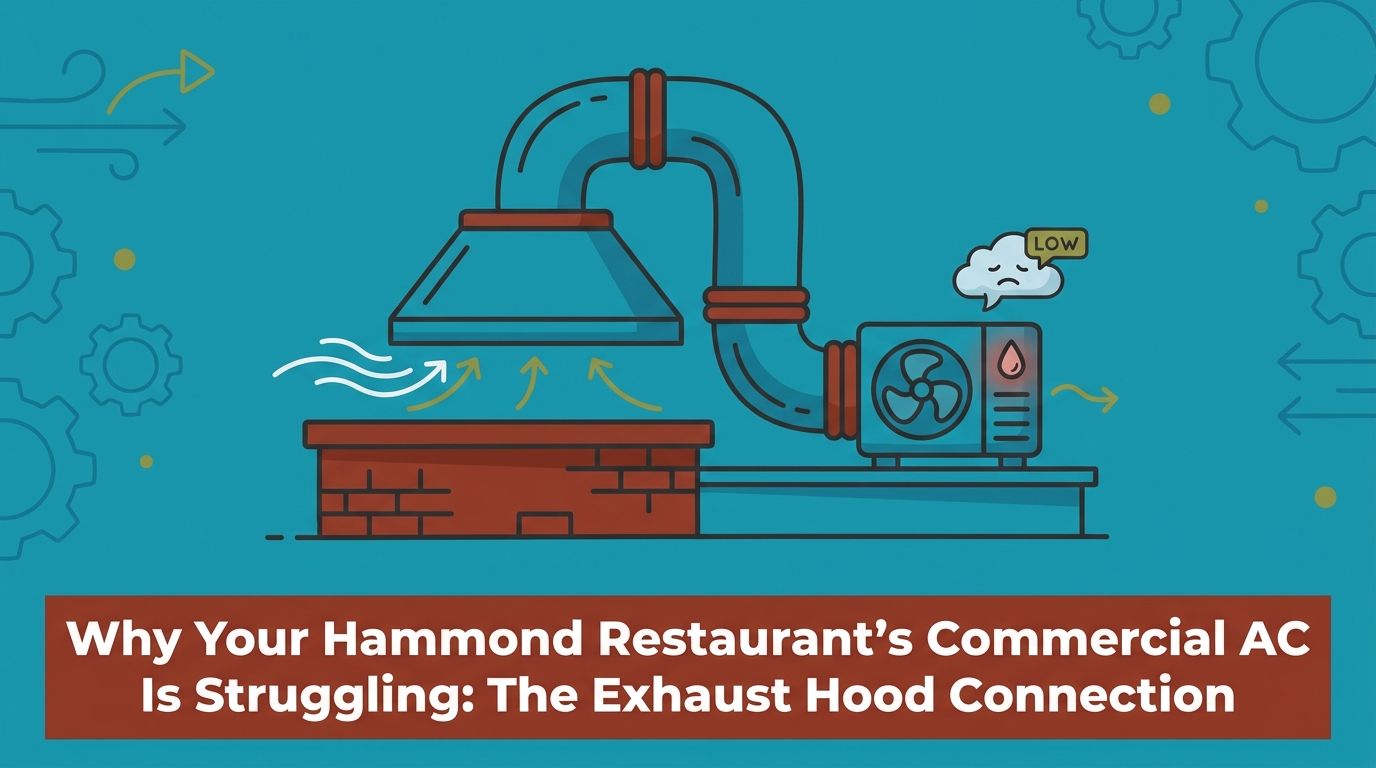
If you are wondering, is your Hammond restaurant's commercial AC struggling? The exhaust hood connection is likely the hidden culprit causing your dining room to feel uncomfortably warm. You know the exact scenario: it is a busy Friday evening during peak July summer heat, the kitchen is operating at full capacity, and the dining room temperature continues to rise. Your thermostat might be set to 70 degrees, but the air inside feels heavy, stagnant, and entirely unconditioned. The immediate assumption is usually a failing air conditioning unit. At Cypress Cooling Company, we regularly field emergency service calls for equipment breakdowns that do not actually exist simply because of this invisible issue.
For immediate assistance with your commercial air conditioning needs, explore our Hammond HVAC services.
This frustrating cycle happens when the symptom is treated rather than the source. While your rooftop units might be running continuously, they are fighting a battle they cannot win. The true issue lies in the mechanical relationship between your kitchen's exhaust system and the building's overall airflow. When an industrial kitchen exhaust hood is operating, it removes massive volumes of smoke, grease, and heat. However, if the air being pulled out of the building is not properly replaced, the hood will simply steal the conditioned air right out of your dining room. Guests are left sweating, your energy bills skyrocket, and the cooling equipment takes the blame for an airflow imbalance.
Understanding this mechanical relationship is the first step toward restoring comfort to your restaurant. Instead of repeatedly paying for basic tune-ups that yield no results, restaurant owners must look at the building as a single, interconnected pressure system.
The Mechanics of Negative Pressure in Commercial Kitchens
To understand why a dining room in Hammond suddenly loses its cooling capacity, you have to look at the sheer volume of air moving through a commercial kitchen. Industrial exhaust hoods are powerful machines designed to extract thousands of cubic feet per minute (CFM) of air. This rapid extraction is necessary to keep the kitchen safe, clear of smoke, and compliant with fire codes. However, basic physics dictates that every cubic foot of air pushed out of the building must be replaced by a new cubic foot of air coming in.
This replacement air is known as make-up air (MUA). According to commercial building standards set by ASHRAE, a properly balanced make-up air system must replace roughly 80% to 90% of the air exhausted by the hood. The remaining 10% to 20% is intentionally drawn from the dining room to ensure that kitchen odors flow inward toward the hood rather than outward into the guest seating area.
When the make-up air unit fails, operates with a broken belt, or is undersized for the exhaust hood, the building experiences a severe deficit. The exhaust hood continues to pull thousands of CFM, creating a powerful vacuum inside the restaurant. This vacuum is known as negative pressure. Because the hood must pull air from somewhere, it forcefully extracts the cooled, conditioned air directly from the dining room, completely overriding your commercial AC system.
Understanding CFM and Airflow Balance
The math behind this airflow balance highlights why an AC unit cannot overcome negative pressure on its own. A standard commercial air conditioning system is sized to handle the specific heat load of the building based on square footage, occupancy, and insulation. It supplies a set amount of CFM to keep the space comfortable.
The physical toll of the vacuum effect includes:
• Overpowered supply ducts: A high-capacity exhaust hood can easily pull 4,000 CFM. If the make-up air unit is offline, the hood will extract air faster than the AC can supply it.
• Building envelope strain: The vacuum effect physically pulls against the structure of the building, seeking any available air source to satisfy the exhaust hood's demand.
• Wasted energy: The AC unit runs continuously, dumping freshly cooled air into the dining room only for it to be immediately sucked into the kitchen and blown out the roof.
No matter how new or efficient your air conditioner is, it cannot cool a room if the air is being violently extracted the moment it leaves the supply registers.


How South Louisiana Humidity Amplifies the Problem
Negative pressure is a mechanical issue in any climate, but in South Louisiana, extreme heat and high humidity turn a slight airflow imbalance into an immediate crisis. When the kitchen exhaust hood creates a vacuum, the building must pull air from outside to equalize the pressure. This means the vacuum sucks heavy, moisture-laden outdoor air in through front doors, poorly sealed windows, microscopic gaps in the building envelope, and even down through the plumbing vents.
In our region, the outdoor air during peak July summer heat is thick with moisture. When this unconditioned air rushes into the dining room, it introduces a massive latent heat load. The commercial AC is now forced to constantly cool waves of hot outdoor air, which is an impossible task. The immediate result is a sticky, uncomfortable dining environment that drives customers away.
The sudden influx of humidity causes severe secondary symptoms throughout the property. In our years of keeping local restaurants comfortable, the Cypress Cooling Company team frequently sees extreme cases where the building becomes so hot and humid during the day that the floors begin sweating and the indoor temperatures become highly inconsistent. In residential properties, a severe duct disconnect might require a technician to reattach attic venting and recommend an upgraded air filter before performance dramatically improves. In a commercial restaurant, the fix requires stopping the unconditioned outdoor air from rushing in. You can learn more about the mechanics of moisture control by reading about how duct design affects AC performance in a high humidity environment.
Common humidity-driven symptoms of negative pressure include:
• Condensation on ceiling vents: Hot, humid outdoor air hitting cold metal supply registers causes water to form and drip onto tables.
• Slippery, sweating floors: Moisture settling on cool tile creates a severe slip-and-fall hazard for staff and guests.
• Warped woodwork: Continuous exposure to high indoor humidity can damage expensive dining room finishes and furniture.
Why Standard AC Repairs Won't Fix an Airflow Imbalance
When the dining room is hot, the standard response is to call a technician to check the air conditioner. If the technician is not trained in whole-building commercial airflow diagnostics—a standard we strictly enforce at Cypress Cooling Company—they will likely treat the symptoms rather than the root cause. This leads to a costly cycle of misdiagnosis. Constantly adding refrigerant, cleaning coils, or replacing minor electrical components will not resolve a systemic negative pressure issue.
The continuous strain of fighting an unwinnable battle against the kitchen exhaust hood takes a massive toll on cooling equipment. Because the thermostat never reaches its set point, the AC compressor runs 24/7 without a break. Overworked compressors overheat and fail prematurely. The system may also freeze up entirely due to the extreme continuous load. If this happens, a technician will need to replace the evaporator coil in a timely and cost-effective manner to restore basic function. However, installing a brand-new coil without addressing the make-up air deficit guarantees the new component will face the exact same destructive conditions.
Stopping this cycle of symptom treatment requires a proactive approach. Regular commercial HVAC maintenance is highly effective for keeping equipment running efficiently, but it must be paired with an accurate diagnosis of the building's overall airflow. Paying for repeated emergency repairs on a system that is fundamentally unbalanced is a drain on restaurant profitability.
Identifying the Signs of a Make-Up Air Deficit
Restaurant owners and managers do not need specialized tools to identify a make-up air deficit. When our commercial HVAC experts walk into a struggling Hammond restaurant, the physical signs of negative pressure are highly noticeable before we even unpack our gauges. Because the exhaust hood is pulling air from every available opening, the building itself will tell you that it is starving for air.
The most common and obvious sign is the condition of the front entrance. If customers struggle to pull the front doors open, or if the doors slam shut violently on their own, the building is in a state of severe negative pressure. The vacuum created by the kitchen hood is literally holding the doors shut against the outside air.
Key symptoms to watch for in your restaurant:
• Noticeable entrance drafts: A rush of hot outdoor air hits guests in the face the moment the front door is opened.
• Migrating kitchen odors: Smells from the fryers and grills drift into the dining room instead of being pulled up into the hood.
• Whistling noises: Air forcefully squeezing through small gaps in windows or drop ceilings creates a distinct whistling sound.
• Continuous AC cycling: The cooling system runs non-stop from open to close without ever satisfying the thermostat.
• Warm air blowing from vents — Standard AC Failure: Highly likely (refrigerant leak or compressor issue) — Negative Pressure / Airflow Deficit: Unlikely (air is cold, but immediately sucked away)
• Front doors hard to open — Standard AC Failure: Never — Negative Pressure / Airflow Deficit: Highly likely (vacuum effect)
• Kitchen smoke in dining room — Standard AC Failure: Never — Negative Pressure / Airflow Deficit: Highly likely (improper directional airflow)
• AC runs continuously — Standard AC Failure: Possible (struggling to cool) — Negative Pressure / Airflow Deficit: Highly likely (fighting the exhaust hood)
The Role of 24/7 Commercial HVAC Services in Hammond
When cooling fails during peak dinner service, the immediate priority is keeping the doors open and the guests comfortable. A hot dining room leads to walked tabs, negative reviews, and spoiled inventory. In these critical moments, an emergency response from a qualified commercial technician is necessary to triage the system, prevent complete equipment failure, and restore temporary function.
However, an emergency visit is only the first step. While a technician can reset a tripped breaker, thaw a frozen coil, or temporarily lower the temperature, long-term stability requires a comprehensive load balancing strategy. The goal is not just to survive the weekend, but to ensure the restaurant operates efficiently through the hottest months of the year without constant breakdowns.
Partnering with a team equipped for complex commercial diagnostics provides a significant advantage. Whether you are dealing with a sudden breakdown or planning an AC installation in Hammond, having professionals who understand the specific demands of restaurant environments ensures the equipment is sized correctly for the actual load of a balanced building. This level of expertise prevents the costly mistake of installing a larger, more expensive air conditioner to fight a problem that should be solved by fixing the make-up air unit.
The Professional Airflow and Make-Up Air Audit
Resolving a negative pressure issue permanently requires a professional airflow and make-up air audit. This is not a task for general handymen or standard residential technicians. It involves precise measurements and a deep understanding of commercial kitchen ventilation codes. Cypress Cooling Company's advanced diagnostic capabilities allow our technicians to identify complex airflow and load balancing issues that go far beyond basic AC repair. It is a pattern we see often, and properly diagnosing it saves our clients from wasting money on unnecessary equipment replacements.
During a professional audit, technicians measure the exact CFM being extracted by the kitchen exhaust hood. They then measure the CFM being supplied by the make-up air unit and the rooftop air conditioners. By comparing these numbers, they can determine the exact deficit causing the negative pressure.
The audit and balancing process typically includes:
• Testing building pressure differentials: Using specialized manometers to measure the pressure differences between the kitchen, the dining room, and the outdoors.
• Inspecting the Make-Up Air unit: Checking for broken belts, burned-out motors, clogged intake filters, or disabled interlocks that prevent the MUA from turning on with the hood.
• Adjusting fan speeds: Calibrating the blower pulleys to ensure the MUA delivers the precise 80% to 90% replacement air required by commercial standards.
• Verifying thermostat placement: Ensuring the dining room thermostats are not located in areas heavily affected by kitchen drafts or direct sunlight.
Once the make-up air and exhaust hood are perfectly balanced, the vacuum effect disappears. The front doors open easily, the kitchen odors stay in the kitchen, and the commercial AC can finally do its job. The dining room will cool down rapidly, and the cooling equipment will cycle normally, saving massive amounts of energy and extending the lifespan of the system.
Frequently Asked Questions
Why does my restaurant get hot when the exhaust hood is on?
Your restaurant gets hot because the exhaust hood is pulling conditioned air out of the dining room. When the hood extracts air without a functioning make-up air unit to replace it, it creates a vacuum that sucks the cold air away from your guests and pulls hot outdoor air inside.
How do I know if my restaurant has negative pressure?
The most common sign of negative pressure is front doors that are unusually difficult to pull open. You may also notice ghost drafts, whistling sounds near windows, kitchen odors drifting into the seating area, and an air conditioner that runs continuously without cooling the room.
What is make-up air for a commercial kitchen?
Make-up air is unconditioned or tempered outdoor air brought into the building specifically to replace the air exhausted by the kitchen hood. Commercial building standards require the make-up air system to replace roughly 80% to 90% of the exhausted air to keep the building pressure balanced.
Does a kitchen exhaust hood pull out air conditioning?
Yes, if the make-up air system is not working correctly, the exhaust hood will forcefully pull your air conditioning out of the building. The hood requires a massive volume of air to operate, and it will take it from the dining room if no other air source is provided.
Can negative pressure cause condensation and sweating floors in Louisiana restaurants?
Yes, negative pressure pulls heavy, moisture-laden outdoor air through the building envelope. When this extreme South Louisiana humidity hits the cold surfaces inside your restaurant, such as floor tiles and metal supply vents, it rapidly condenses into water, causing slippery floors and dripping ceilings.
Restore Comfort to Your Dining Room Today
Stop paying for standard repairs that fail to address the root cause of your cooling problems. If an unbalanced exhaust hood is pulling the comfort right out of your restaurant, it is time for a professional airflow audit. Schedule your commercial diagnostics today to balance your building, protect your equipment, and ensure your guests enjoy a perfectly cooled dining experience all summer long.
OUR CLIENTS HAVE TO SAY ABOUT US


Service areas
Our service areas are designed to meet the diverse needs of our clients. We focus on providing exceptional service and ensuring customer satisfaction in every location we operate.