
The Myth of Closing Vents to Save Energy in Your Kenner Home
.webp)
The Tempting Myth of Closing Vents During the Hottest Months
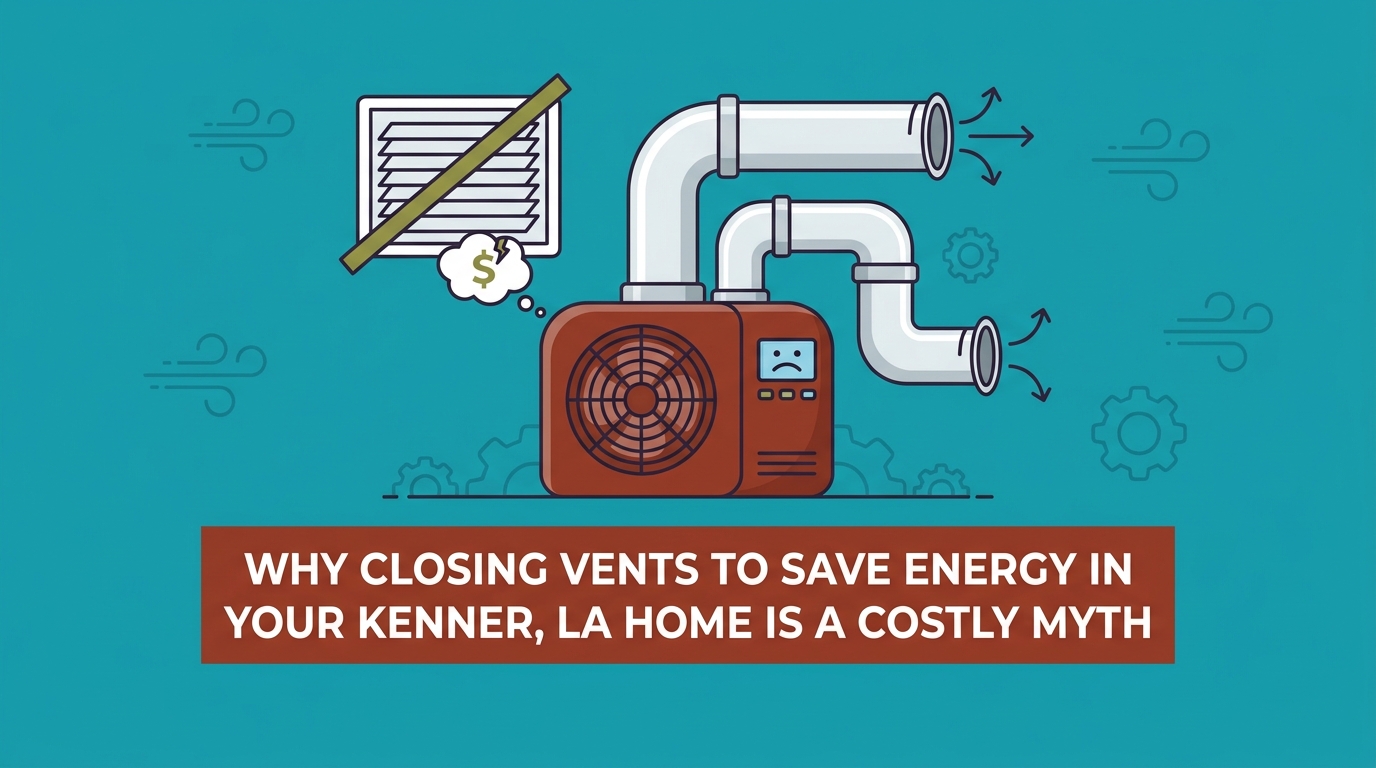
Closing off unused guest rooms doesn't actually lower your utility bills, despite what generations of homeowners have been taught. At Cypress Cooling Company, we often have to explain that The Myth of Closing Vents to Save Energy in Your Kenner Home is one of the most persistent misunderstandings in cooling, especially when you are trying to cut costs during the brutal August late-summer heat as the kids head back to school. It seems entirely logical at first glance: if you aren't using a spare bedroom or a formal dining room, shutting the air registers should redirect that cold air to the rooms you actually use, saving you money in the process.
If you are struggling with uneven temperatures, our team recommends having a professional evaluate your air conditioning system rather than blocking off registers.
The reality of modern HVAC design tells a completely different story. Today's central cooling systems are not simply blowing air blindly into a house; they are carefully engineered and balanced to move a very specific volume of air throughout the entire ductwork network. When you restrict this carefully calculated airflow by shutting registers, you disrupt the entire balance of the system. This restriction leads to severe mechanical strain on the equipment, particularly during peak cooling demand when the system is already working its hardest.
Understanding the physics of how air moves through your home is crucial. By learning why this common practice backfires, you can make informed decisions that prevent sudden, end-of-season breakdowns and keep your system running efficiently.
Understanding Static Pressure and HVAC System Balance
To understand why shutting registers causes so much trouble, you first have to understand a concept called static pressure. In the HVAC industry, static pressure refers to the resistance to airflow within your duct system. Your air conditioner must push against this resistance to deliver cold air into your living spaces.
The Garden Hose Analogy
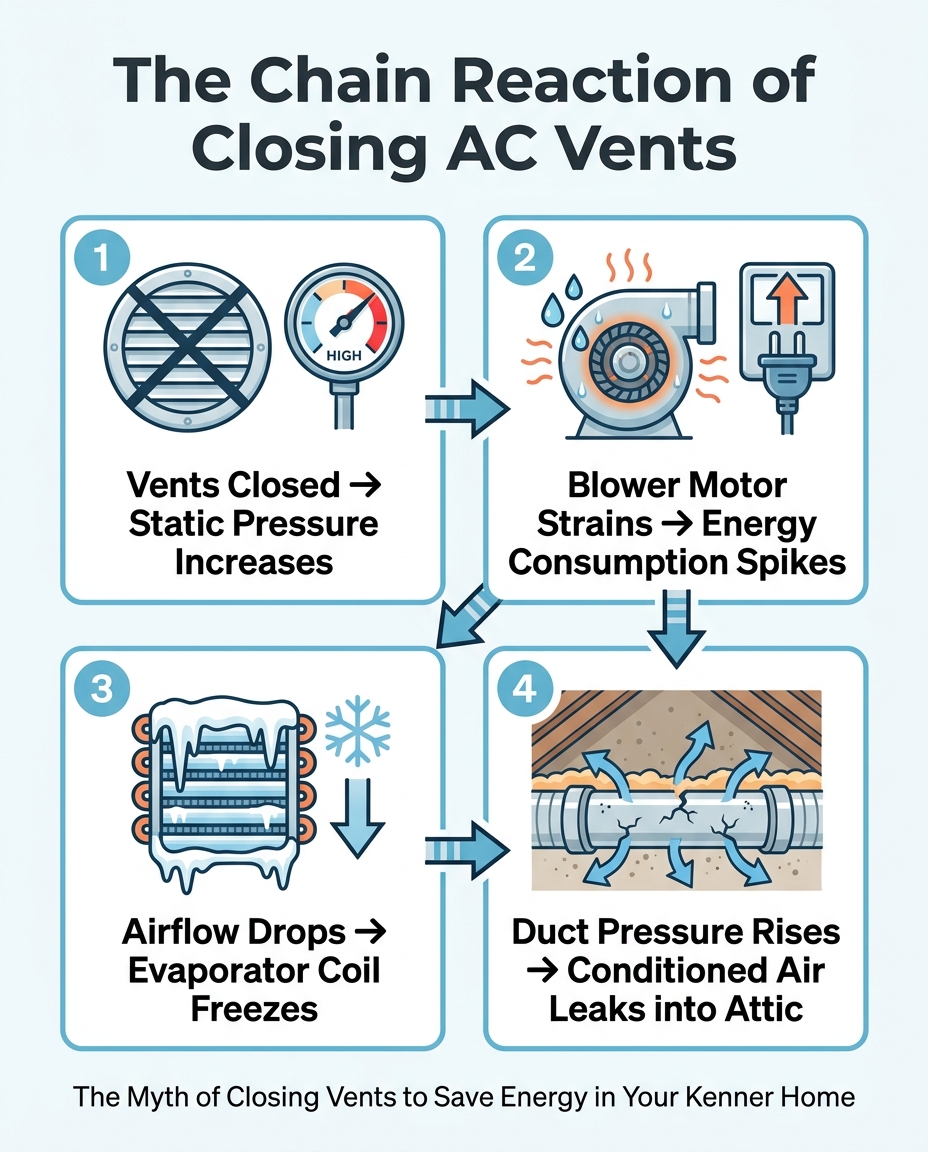
Think of your ductwork like a garden hose and the air as the water flowing through it. If you turn on the spigot, water flows freely out the end. But if you place your thumb over half of the nozzle, the water doesn't stop flowing—instead, the pressure inside the hose builds up dramatically, and the water sprays out much harder. Closing a vent in your Kenner home does the exact same thing to your air conditioner. It acts like a kink in the hose, increasing the internal pressure of the ductwork rather than saving any energy.
Cubic Feet per Minute (CFM) Explained
Your cooling system is specifically sized to push a certain amount of air, measured in Cubic Feet per Minute (CFM). The internal blower, the size of the ducts, and the number of vents are all mathematically matched to handle this precise CFM. When you shut a register, the system doesn't magically produce less air. It still attempts to push the exact same CFM through a smaller number of openings.
This imbalance directly affects both performance and comfort. For a deeper look at how this balance works, understanding how duct design affects AC performance is a great next step. When the static pressure rises too high, the entire cooling cycle is thrown off, setting the stage for mechanical failures.
How Restricted Airflow Strains Your Blower Motor
The blower motor is the heart of your home's air circulation. Its primary job is to pull warm air from the house through the return ducts, push it over the cold coils, and then distribute the newly cooled air back through the supply vents. It is a hardworking component, but it has limits.
When static pressure increases because vents are shut, the blower motor is forced to work significantly harder to push the same amount of air through the remaining open registers. It is the equivalent of forcing a runner to breathe through a straw during a marathon. This added strain causes the motor to run hotter and work longer cycles, which rapidly accelerates normal wear and tear. Over time, this constant fatigue leads to premature motor failure, often striking right in the middle of the August late-summer heat when the system is already running non-stop.
The consequences of disrupted airflow are very real. Just recently, a local homeowner reached out to our Cypress Cooling Company dispatch when their floors started sweating and the thermostat simply couldn't keep up with the house's actual temperature. While they had an older AC unit, the root cause was an airflow blockage. Our technician discovered a detached vent in the attic that was severely disrupting the system's static pressure and airflow balance. Once the vent was properly reattached and a fresh filter was installed, the correct airflow was restored. The system immediately began cooling effectively again, making the house chilly and restoring energy efficiency. Whether a vent is detached by accident or closed on purpose, the mechanical strain on the system is identical.
Proper airflow, facilitated by fully connected and open vents, is absolutely essential for maintaining correct indoor temperatures and preventing your equipment from working itself to death.

Frozen Coils: The Consequence of Poor Airflow in High Humidity
Restricting airflow doesn't just damage the blower motor; it directly threatens the component that actually cools your air: the evaporator coil.
The Problem
The evaporator coil sits inside your indoor unit and gets extremely cold during operation. It relies on a constant, steady flow of warm return air from your house blowing across it. This warm air prevents the coil from dropping below the freezing point while simultaneously allowing the refrigerant inside to absorb heat.
The Cause
When you close vents, you drastically reduce the volume of warm air passing over that coil. In our years of servicing air conditioners across the Metairie and Kenner areas, we've seen firsthand how South Louisiana's hot and highly humid climate demands optimal airflow for proper dehumidification. The air inside a Kenner home holds a massive amount of moisture. When that heavy, humid air hits a starved, below-freezing evaporator coil, the condensation doesn't just drip away into the drain pan—it instantly turns to ice.
The Solution
This creates a dangerous cascading effect. A thin layer of frost quickly grows into a solid block of ice that encases the entire coil. Once the coil is frozen solid, it blocks airflow entirely, completely stopping the cooling process and potentially sending liquid refrigerant back to the outdoor compressor—a fatal blow to the system. The only solution is to turn the system completely off, let the ice melt, and ensure every vent in the home is wide open so continuous airflow can safely remove moisture without freezing the equipment.
Why ECM Blower Motors Consume More Energy When Vents Are Closed
There is a major content gap in how most people understand energy savings, and it comes down to the type of blower motor inside your unit. The myth of saving money by shutting registers is completely shattered when you look at modern HVAC technology.
Older systems used single-speed motors. They blew air at one constant speed, no matter what. If you closed a vent, the air simply backed up, airflow dropped, and the motor kept spinning at its normal pace until it eventually burned out.
Modern systems, however, use Electronically Commutated Motors (ECM), also known as variable-speed motors. These are highly advanced, computerized motors programmed with a specific goal: to maintain a precise CFM of airflow regardless of the resistance they face.
• Single-Speed Motor — Reaction to Closed Vents: Airflow drops, system struggles to push air. — Energy Impact: Runs longer cycles, increasing overall daily power use.
• ECM (Variable Speed) — Reaction to Closed Vents: Detects high pressure and automatically ramps up RPMs. — Energy Impact: Spikes electricity usage instantly to fight the resistance.
When you close vents with an ECM system, the motor senses the drop in airflow. To compensate, it automatically ramps up its RPMs, spinning faster and harder to force the air through the remaining open vents. Because it is working so much harder, an ECM motor will consume significantly MORE electricity when vents are closed. Your attempt to save energy during the August late-summer heat actually results in higher utility bills, completely defeating the purpose.
The Impact of Increased Static Pressure on Duct Leakage
Even if your blower motor manages to survive the extra strain, the increased static pressure is quietly wreaking havoc on your ductwork. According to Department of Energy (DOE) guidelines on duct sealing and airflow, the average home already loses a significant percentage of its conditioned air to minor duct leaks. Closing vents makes this problem exponentially worse.
Air behaves like water; it always seeks the path of least resistance. When you shut the registers in your spare rooms, the pressure inside the main duct trunks skyrockets. That highly pressurized cold air has to go somewhere. Instead of flowing smoothly into your living spaces, it gets forced out through tiny seams, joints, and microscopic tears in the ductwork.
Where does that air go? Usually straight into unconditioned spaces like your attic, crawlspace, or between the walls. When our installation crews are up in local attics during the late summer, we routinely see temperatures easily reaching 140 degrees. When high static pressure forces your 55-degree conditioned air out through duct seams, you are essentially paying your utility company to air condition your blazing hot attic instead of your living room.
If you suspect your system is losing air before it reaches your rooms, investing in professional ductwork and airflow solutions is a far more effective way to lower your bills than blocking off registers. Keep in mind that generic energy efficiency rebates or federal tax credits may apply to qualifying duct sealing and HVAC upgrades, making professional solutions more accessible—always verify current programs with your utility provider or tax professional.
Frequently Asked Questions About AC Vents and Energy Savings
Because this myth is so widespread, homeowners naturally have a lot of questions about the best way to handle their vents. Here are the facts our team shares to help protect your system.
Does closing vents save money on AC?
No, as we regularly explain to our customers, it almost always increases your energy costs. Modern HVAC systems are forced to work much harder to overcome the artificial pressure created by closed vents. Variable-speed motors will actually draw more electricity to fight the resistance, and the increased pressure forces cold air out of duct leaks into your attic, wasting the air you just paid to cool.
Will closing vents damage my air conditioner?
Yes, over time it can cause significant and permanent damage. The added static pressure severely strains the blower motor, leading to premature failure right when you need it most during the August late-summer heat. Furthermore, it can cause the compressor to fail completely due to liquid slugging if the evaporator coil freezes over.
How many vents can I safely close in my house?
As HVAC professionals, our team strongly recommends keeping all vents fully open and unobstructed. Closing even 10 to 20 percent of your home's vents is enough to severely disrupt the system's static pressure balance. If certain rooms receive too much air, the system should be balanced at the plenum using dampers by a professional, rather than by shutting the room registers.
Why does my AC freeze up when I close vents?
The evaporator coil inside your unit requires a constant, heavy flow of warm household air to absorb heat and prevent freezing. Restricted airflow means the coil temperature drops below freezing. The natural condensation on the coil then turns to ice, which eventually blocks airflow entirely and stops the system from cooling.
What is the best way to cool an unused room without wasting energy?
The safest method is to keep the door to the unused room closed, but leave the AC vent fully open. This maintains the system's airflow balance while keeping the room conditioned. If you truly want to stop cooling specific zones of your home, consult a professional about upgrading your insulation, sealing windows, or installing a properly designed zoned HVAC system.
Safe, Effective Ways to Optimize Cooling and Protect Your System
Now that you know closing vents is off the table, what can you actually do to manage your comfort and efficiency? There are several safe, effective alternatives that won't put your equipment at risk.
• Keep all vents fully open: Walk through your home and ensure every single register is open. Check that no heavy furniture, rugs, or curtains are blocking the airflow from the vents.
• Utilize ceiling fans: Fans do not lower the temperature of a room, but they create a wind-chill effect on your skin. Running a ceiling fan allows you to bump your thermostat up a few degrees while feeling just as cool, which safely saves energy.
• Address the root causes: If one room is always too hot and another is freezing, the answer isn't blocking vents. You likely have underlying issues with duct sizing, poor insulation, or leaky windows that need to be addressed directly.
• Rely on professional airflow diagnostics: Resolving hot and cold spots requires technical expertise. By relying on Kenner HVAC professionals who specialize in diagnosing complex airflow and static pressure issues, you can balance your home's comfort without risking an expensive blower motor replacement.
Keep Your Vents Open and Your HVAC System Protected
The idea that shutting a few registers will lower your utility bills is a myth that ultimately costs you money and damages your equipment. From spiking static pressure to freezing evaporator coils, restricting your system's airflow goes against the very physics of how modern air conditioning is designed to operate.
Maintaining balanced, unrestricted airflow is the single most important thing you can do for the longevity of your cooling system. If you are experiencing uncomfortable rooms, weak airflow, or cooling imbalances in your Kenner home, do not reach for the vent lever. Instead, schedule a professional inspection with our Cypress Cooling Company team to identify and solve the real problem safely. By keeping your vents open and your airflow strong, you ensure your system runs efficiently, safely, and reliably for years to come.
OUR CLIENTS HAVE TO SAY ABOUT US



Service areas
Our service areas are designed to meet the diverse needs of our clients. We focus on providing exceptional service and ensuring customer satisfaction in every location we operate.

