The Role of MERV 11 Filters in Managing Late-Summer Pollen and Dust in Kenner
.webp)
The Hidden Danger of Upgrading Your AC Filter During August Allergy Season
Your allergies are flaring up, the indoor air feels heavy, and you are trying to understand the role of MERV 11 filters in managing late-summer pollen and dust in Kenner without breaking your cooling system. At Cypress Cooling Company, we see a common pattern: as the August late-summer pollen and dust transition begins and kids start heading back to school, homeowners rush to the hardware store and grab the highest-rated, thickest air filter they can find on the shelf. The intention is good, but our technicians frequently see the result—a suffocated HVAC system right in the middle of peak cooling season.
Finding the right balance between breathing cleaner air and keeping your air conditioner running smoothly is a delicate mechanical decision. If you are looking to upgrade your home's filtration, exploring professional indoor air quality solutions is the safest way to ensure you get results without damaging your equipment.
The concrete problem we see most homeowners face is inadvertently choking off their system's airflow. High-efficiency filters are incredibly dense. When you install an overly restrictive filter in an attempt to block microscopic allergens, the blower motor has to work exponentially harder to pull air through that tight woven material. In our experience, this restriction often leads to suffocated blower motors, overheating components, and severe cooling failures just when you need your AC the most. The critical decision point is selecting the exact filter specification that improves your indoor air quality without causing a complete mechanical breakdown.
Why High-MERV Filters and South Louisiana Humidity Are a Risky Combination
Living in the Greater New Orleans area means dealing with a very specific set of climate challenges. With average August high temperatures sitting at 91 degrees and relative humidity frequently pushing past 90 percent, our team knows firsthand that your air conditioner is doing much more than just lowering the temperature in your Kenner residential home. It is acting as a massive dehumidifier, pulling gallons of moisture out of the air every single day. That dehumidification process relies entirely on a steady, unobstructed volume of airflow moving across the indoor evaporator coil.
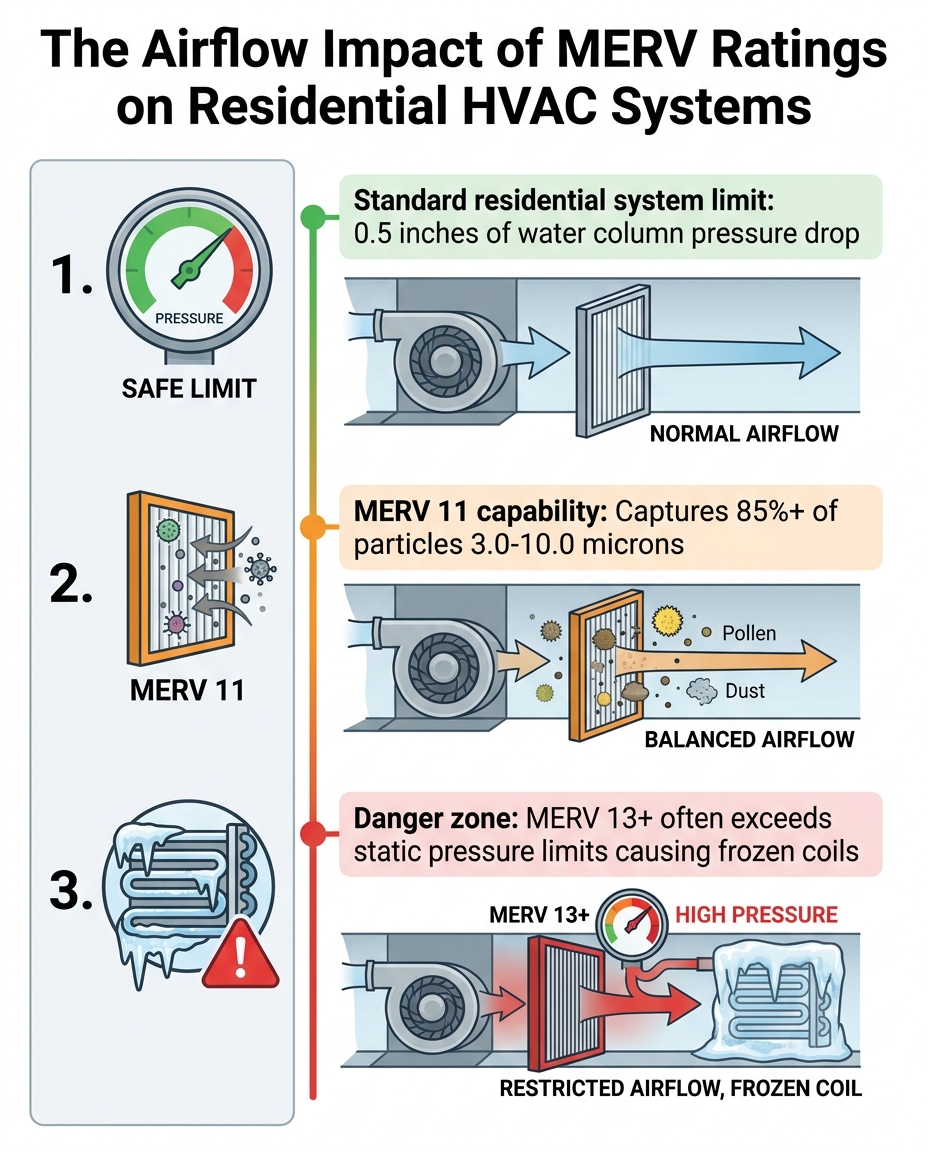
Big-box retail stores market MERV 13, MERV 14, and even MERV 16 filters as universal upgrades for allergy sufferers. What their marketing materials fail to mention is that these dense filters are completely inappropriate for standard residential systems in a high-humidity environment. When we get called out to repair a malfunctioning unit, we often find that installing a highly restrictive filter triggered a dangerous mechanical chain reaction. First, the dense media drastically reduces the amount of warm, unconditioned air reaching the indoor coil. Because there is less warm air blowing over the cold refrigerant, the coil temperature drops below freezing.
Once the coil drops below freezing, the extreme South Louisiana humidity in the air condenses and immediately turns to ice on the equipment. Within hours, your indoor unit can become encased in a solid block of ice, stopping all airflow and potentially damaging the compressor outside. Upgrading your IAQ equipment requires a careful understanding of these mechanical limits. Standard residential HVAC systems are typically designed to handle a maximum filter pressure drop of 0.5 inches of water column. Dense, high-MERV filters easily exceed this limit, pushing the system past its breaking point.
• MERV 8 — Primary Targets: Pollen, dust mites, lint — Airflow Restriction Level: Low (Safe for most systems) — South Louisiana Suitability: Excellent for standard cooling, but minimal allergy relief
• MERV 11 — Primary Targets: Ragweed, pet dander, smog — Airflow Restriction Level: Moderate (The sweet spot) — South Louisiana Suitability: Ideal balance of allergy control and safe moisture removal
• MERV 13+ — Primary Targets: Bacteria, virus carriers, smoke — Airflow Restriction Level: High (Dangerously restrictive) — South Louisiana Suitability: High risk of frozen coils unless system is specially modified
The Physics of Airflow: Understanding Static Pressure in Your HVAC System
In our daily service calls across Metairie and Kenner, we find that to understand why filter selection matters so much, you have to understand static pressure. In accessible terms, static pressure is the resistance to airflow within your HVAC system. Think of it like blood pressure for your air conditioner. If the resistance is too high, the "heart" of the system—the blower motor—has to strain itself to keep the air circulating. Every component in your ductwork adds a little bit of resistance, but the air filter is usually the single largest source of static pressure in the entire setup.
When a blower motor is forced to pull air through a dense, restrictive filter medium, it struggles to deliver the required volume of air, measured in Cubic Feet per Minute (CFM). A typical 3-ton air conditioner needs to move about 1,200 CFM of air to function correctly. If a thick filter drops that volume down to 800 CFM, the system cannot absorb enough heat from the house. Ignoring MERV 11 airflow restriction limits and opting for something denser is a guaranteed way to cause burnt-out blower motors right at the end of the cooling season.
Understanding how airflow and duct design affect AC performance in high humidity is essential before making any filtration changes. The ductwork, the return grilles, and the filter all work together as a single breathing apparatus. If you choke off the intake, the entire house suffers the consequences.
How Blower Motors React to Restriction
Different types of HVAC systems react differently when faced with high static pressure from a restrictive filter. The reaction depends entirely on the type of blower motor inside your furnace or air handler:
• Standard PSC Motors: Permanent Split Capacitor (PSC) motors are common in older or basic systems. When they face a restrictive filter, they simply move less air. The motor continues spinning at its set speed, but the dense filter blocks the airflow, leading directly to poor cooling, high humidity indoors, and frozen evaporator coils.
• Variable-Speed ECM Motors: Electronically Commutated Motors (ECM) are designed to maintain a specific airflow volume. If you install a restrictive filter, an ECM will automatically ramp up its speed to overcome the resistance. While this keeps the air flowing, it causes the motor to consume massive amounts of electricity, run incredibly hot, and eventually burn out prematurely due to the constant strain.

MERV 11: The Sweet Spot for Pollen Removal and System Health
If MERV 8 doesn't catch enough allergens and MERV 13 destroys your equipment, what is the solution? For the vast majority of residential systems we service, MERV 11 is the exact sweet spot. It provides rigorous filtration capabilities without crossing the dangerous threshold of airflow restriction. The American Society of Heating, Refrigerating and Air-Conditioning Engineers (ASHRAE) sets the testing standards for these filters, and the data for MERV 11 is highly compelling for allergy sufferers.
Here is exactly how our team sees a MERV 11 filter protecting your home during the August late-summer pollen and dust transition:
1. Captures Large Allergens: Testing shows that MERV 11 filters capture 85 percent or better of particles sized 3.0 to 10.0 microns. This range includes heavy dust mites, pet dander, and mold spores that settle in carpets and furniture.
2. Traps Late-Summer Pollen: Ragweed pollen, which typically peaks in August and September, falls perfectly into the size category that MERV 11 excels at trapping. It pulls these irritants out of the air before they can circulate through your living room.
3. Filters Fine Particles: MERV 11 also captures between 65 and 79 percent of finer particles sized 1.0 to 3.0 microns, such as auto emissions and fine dust, noticeably improving overall indoor air quality.
4. Maintains Safe Static Pressure: Most importantly, the pleat design and media density of a standard MERV 11 filter allow the blower motor to pull sufficient air, keeping the pressure drop well within the safe 0.5 inches of water column limit.
By upgrading to this specific rating, you successfully balance the need for cleaner, breathable air with the strict mechanical requirements of your air conditioning equipment.
Warning Signs Your Current Filter is Suffocating Your AC
Sometimes the damage of a restrictive filter isn't obvious until the system completely shuts down. Real-world symptoms often masquerade as other mechanical failures. Just last late-summer, our Cypress Cooling Company technicians responded to a local homeowner whose floors started sweating and the indoor temperature simply would not match the thermostat setting. The house remained uncomfortably hot during the day. An inspection by our team revealed that a disconnected attic vent was pulling in extreme heat, but the system was also struggling with airflow. Once the vent was reattached and we recommended the correct, breathable air filter, the AC cooled the house effectively, making it chilly during the day.
If you recently installed a high-efficiency filter to combat seasonal allergies, watch closely for these observable symptoms that indicate your system is suffocating:
• Warm air from vents: If the thermostat is set low but the air coming out of your registers feels lukewarm, the system is likely lacking the airflow needed to extract heat properly.
• Unusual condensation: Sweating floors, heavy moisture on windows, or excessive water pooling around the indoor unit means the system is failing to dehumidify the air.
• Constant running: If the AC runs continuously for hours without ever satisfying the thermostat, a dense filter may be preventing enough conditioned air from reaching the living spaces.
• Ice formation: The most severe warning sign our technicians encounter is visible frost or solid ice forming on the copper refrigerant lines outside or on the indoor evaporator coil. Turn the system off immediately if you see this.
How Ductwork Condition Impacts Your Filter's Performance
It is important to remember that the air filter is only one part of your home's respiratory system. Even the most perfectly designed MERV 11 filter cannot compensate for leaky, aging, or poorly designed ductwork. If your air distribution system has compromised seals, you will continue to struggle with indoor air quality regardless of what filter you buy.
Our installation crews frequently discover that in many Kenner residential homes, unsealed return ducts run through intensely hot, dusty attics. If there is a leak in the return ductwork before the air reaches the filter, the system will actively suck in fiberglass insulation particles, extreme heat, and heavy humidity from the attic space. In some cases, leaks occur after the filter housing, meaning the dirty attic air completely bypasses your brand-new MERV 11 filter and blows directly into your bedrooms.
When upgrading your filtration strategy, we always recommend evaluating the entire air distribution system. Professional ductwork inspections can identify these hidden leaks. Sealing the ductwork ensures that 100 percent of the air circulating through your home is actually being forced through the filter, maximizing your indoor air quality and keeping the system running efficiently.
Navigating Late-Summer IAQ Challenges with Local Expertise
Taking advice from a generic national hardware store chain can be a costly mistake when dealing with regional climate extremes. National marketing campaigns push the highest MERV ratings available because they sound impressive on a box, but those campaigns do not account for the extreme Southern humidity that defines our late summers.
Balancing indoor air quality upgrades with the mechanical realities of running an AC in South Louisiana requires localized knowledge. Working with our team at Cypress Cooling Company means you get recommendations rooted in local expertise. We understand how a 91-degree August afternoon with 90 percent humidity impacts a residential blower motor, and we prioritize your HVAC system's health alongside your air quality goals.
Every home's duct design, unit size, and age is different. Rather than guessing which filter might work, it pays to seek guidance tailored to your specific setup. Professional AC services in Kenner ensure that you get the allergy relief you need without inadvertently destroying your cooling equipment just before the fall weather finally arrives.
Frequently Asked Questions About Air Filters and Humidity
Will MERV 11 restrict airflow in my AC?
In our experience, a standard MERV 11 filter will not severely restrict airflow in a properly designed residential AC system. It provides the ideal balance of capturing microscopic allergens while allowing enough air to pass through to keep the blower motor running safely. However, if your system is very old or your ductwork is undersized, even a MERV 11 could cause minor restriction, which is why our technicians highly recommend monitoring performance after an upgrade.
What happens if my AC filter MERV rating is too high?
If your MERV rating is too high, the dense filter material blocks the necessary volume of air from reaching the indoor coil. This causes the evaporator coil to drop below freezing, turning the humidity in the air into solid ice on the equipment. Eventually, the restricted airflow can cause the blower motor to overheat and burn out, leading to a complete system failure.
Is MERV 11 good enough for late-summer allergies and ragweed?
Yes, MERV 11 is highly effective at capturing late-summer allergens like ragweed. Ragweed pollen particles are typically between 10 and 15 microns in size, and a MERV 11 filter is tested to capture 85 percent or better of particles sized 3.0 to 10.0 microns. It easily traps these large irritants before they can circulate through your home's air vents.
Can I use a MERV 13 filter in my house?
Our team generally does not recommend using a MERV 13 filter in a standard residential HVAC system without professional modifications. MERV 13 filters are highly restrictive and are typically designed for commercial buildings or specialized residential systems with heavy-duty blower motors. Installing one in a standard home often leads to frozen coils and high static pressure issues.
How often should I change a MERV 11 filter in high humidity?
During peak cooling months with high humidity, we advise checking a MERV 11 filter every 30 days and replacing it at least every 60 to 90 days. Because it traps more particles than a standard cheap filter, it will clog faster. In a humid environment, a clogged filter quickly leads to poor moisture removal and an uncomfortable, sticky feeling inside the house.
Why does my AC coil freeze when I use a high-efficiency filter?
Your AC coil freezes because the high-efficiency filter blocks warm air from flowing over the cold refrigerant inside the coil. Without that constant flow of warm air to absorb the cooling energy, the temperature of the coil drops below the freezing point of water. The natural humidity in the air then condenses on the freezing metal and turns to ice.
Protect Your Home's Air Quality and AC System Today
Managing indoor air quality during the heavy pollen months doesn't have to mean putting your cooling system at risk. By understanding MERV 11 airflow restriction limits and static pressure, you can successfully achieve cleaner air without risking a frozen coil or a burnt-out motor. For most Kenner residential homes, our technicians consistently recommend MERV 11 as the maximum to keep both your lungs and your equipment healthy. If you are struggling with heavy dust, sweaty floors, or persistent allergies, reaching out to Cypress Cooling Company for a professional evaluation of your entire filtration and duct system is the smartest next step.
OUR CLIENTS HAVE TO SAY ABOUT US



Service areas
Our service areas are designed to meet the diverse needs of our clients. We focus on providing exceptional service and ensuring customer satisfaction in every location we operate.