
A Practical Guide to Heat Pump Servicing Frequency in Gulf Coast
.webp)
Why Heat Pump Servicing Frequency Matters More on the Gulf Coast
If you've been wondering how often should a heat pump be serviced in a hot humid Gulf Coast climate, here's the direct answer:
Recommended Heat Pump Service Schedule for Gulf Coast Homeowners
• New (0-7 years) — Recommended Professional Service Frequency: Twice per year (spring + fall)
• Older (7-10 years) — Recommended Professional Service Frequency: Twice per year (minimum)
• 10+ years — Recommended Professional Service Frequency: Two to three times per year
Plus these DIY tasks every month:
• Check and replace air filters
• Clear debris from around the outdoor unit
• Inspect condensate drain lines for clogs
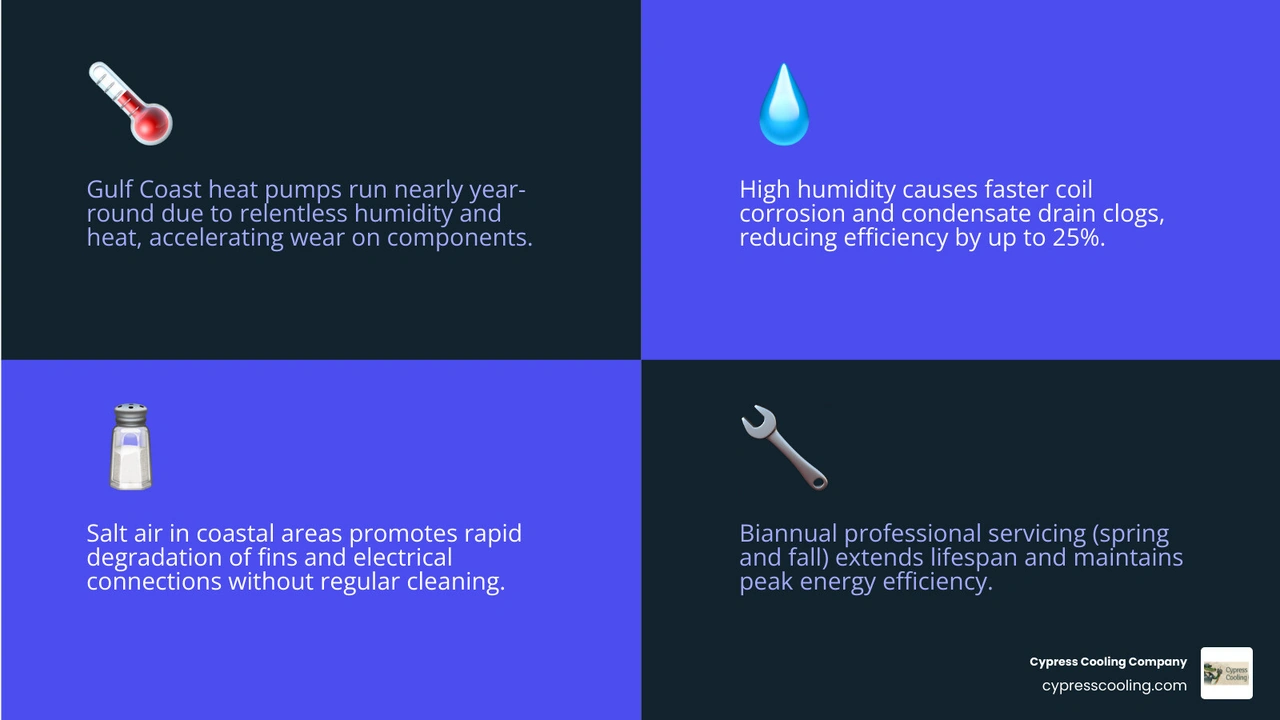
Living in South Louisiana means your heat pump never really gets a break. Unlike systems in cooler or drier parts of the country, a Gulf Coast heat pump runs hard nearly every month of the year — fighting relentless humidity, scorching summer heat, and salty coastal air all at once. That kind of workload adds up fast, and a system that gets skipped on maintenance can lose up to 25% of its energy efficiency and fail years ahead of schedule.
The good news is that a straightforward twice-yearly service routine — one visit before summer and one before the mild winter season — goes a long way toward keeping your system running reliably and your energy bills under control.
How often should a heat pump be serviced in a hot humid gulf coast climate?
When we talk to our neighbors from Metairie to Mandeville, the most common question we get is about the "standard" advice they see online. You might read on a national website that an annual checkup is plenty. While that might fly in a place with four distinct, mild seasons, it simply isn't enough for the South Louisiana heat.
In our neck of the woods, the answer to how often should a heat pump be serviced in a hot humid gulf coast climate is twice a year. We recommend scheduling these visits during the "shoulder" seasons: once in the spring and once in the fall.
The spring service is all about preparing for the onslaught of a Louisiana summer. We want to ensure your coils are clean and your refrigerant levels are perfect before the heat index hits triple digits. The fall service is equally critical because it focuses on the heating components and the defrost cycle—features that often sit dormant for months and need a professional eye before the first damp chill rolls in from the Gulf.
According to the Department of Energy, a well-maintained heat pump can consume 10% to 25% less energy than a neglected one. In a climate where the AC runs almost 24/7, those savings add up to a significant chunk of change over a single season. If you want to dive deeper into what these visits entail, you can explore our full range of Heat Pump Services.
Determining how often should a heat pump be serviced in a hot humid gulf coast climate for older units
Just like a truck that’s seen a few too many trips to the fishing camp, an older heat pump needs a little more TLC. We generally see a "wear threshold" around the seven-year mark. Once your system hits this age, the components—like the compressor and the fan motor—have logged thousands of hours of runtime in high-humidity conditions.
For systems between 7 and 10 years old, sticking strictly to that biannual schedule is non-negotiable. If you skip even one season, you’re essentially gambling with the system’s remaining lifespan. Once a unit passes the 10-year mark, we often suggest a third "wellness check" during the peak of summer. This allows us to catch minor issues like a failing capacitor before it leaves you sweating in the middle of a July afternoon.
Maintaining an older system isn't just about comfort; it's about protecting your investment. We’ve seen neglected systems in places like Covington give up the ghost after just 5 to 8 years, whereas a properly maintained unit can easily last 15 to 20 years. For those living in the Northshore area, keeping up with Annual HVAC Maintenance in Covington is the best way to ensure your older unit doesn't retire prematurely.
Homeowner checklists: how often should a heat pump be serviced in a hot humid gulf coast climate for peak efficiency
While we handle the heavy lifting, there are several things you can do between our visits to keep things humming. Think of professional service as your doctor’s checkup and DIY maintenance as your daily vitamins.
1. The 30-Day Filter Rule: In the Gulf Coast, "check your filter every three months" is bad advice. Between the high humidity that can make filters soggy and the pollen we deal with, you should check your filter every 30 days. If it looks gray or fuzzy, swap it out.
2. The Two-Foot Buffer: Grass grows fast in Louisiana. Make sure there is at least a two-foot clearance around your outdoor unit. High weeds and debris restrict airflow, forcing the compressor to work harder and hotter.
3. Visual Inspections: Take a quick walk around your unit once a month. Look for any signs of "icing" on the copper lines or pooling water that shouldn't be there.
For homeowners in the Kenner area, staying on top of these small tasks makes our Heat Pump Tune-Up in Kenner much more effective, as we can focus on deep-system optimization rather than just clearing out old leaves.
Environmental Factors Impacting Gulf Coast Systems
Why is the Gulf Coast so much harder on equipment than, say, the Midwest? It comes down to three main culprits: salt, soup-thick air, and non-stop runtimes.
If you live in New Orleans or anywhere near Lake Pontchartrain, you’re dealing with salt air. Salt is incredibly corrosive to the delicate aluminum fins on your outdoor coils. Over time, salt causes the metal to pit and flake away, a process known as "white rust." This corrosion restricts heat transfer, meaning your heat pump has to run longer to achieve the same cooling effect.
Then there’s the humidity. Our air is so saturated with moisture that your heat pump spends a massive amount of its energy just dehumidifying your home before it can even start lowering the temperature. This "latent heat" load is why many Florida-based experts, as noted in this look at How Often Should I Service My Heat Pump in Florida?, emphasize that coastal systems face unique stresses.
We’ve put together a specialized guide on Optimizing Heat Pump Performance in South Louisiana that breaks down how we combat these local environmental factors to keep your home comfortable.
Managing salt air and moisture in coastal regions
Moisture is the enemy of electrical components and metal surfaces. In humid coastal regions, the condensate drain—the pipe that carries squeezed-out moisture away from your indoor unit—is a prime breeding ground for algae and "slime." If this drain clogs, water backs up into your home, potentially causing thousands in floor and ceiling damage.
During a professional service, we don't just "check" the drain; we clear it. We also inspect the coils for signs of salt damage. In some cases, we can apply protective coatings to the coils to help them resist the salty breeze. For those of us living in the heart of the city, our Heat Pump Service in New Orleans is specifically designed to address these "urban-coastal" challenges, ensuring that moisture stays outside where it belongs.
Essential Professional Maintenance Tasks
There is a big difference between a "quick look" and a professional tune-up. When we come out to your home, we follow a rigorous checklist that goes far beyond what a homeowner can safely do.
• Filter Replacement — DIY: Yes — Professional: Yes — Why It Matters: Protects airflow and indoor air quality.
• Clear Debris — DIY: Yes — Professional: Yes — Why It Matters: Prevents the system from overheating.
• Refrigerant Check — DIY: No — Professional: Yes — Why It Matters: Low levels indicate leaks; high levels damage the compressor.
• Electrical Tightening — DIY: No — Professional: Yes — Why It Matters: Prevents fire hazards and component failure.
• Reversing Valve Test — DIY: No — Professional: Yes — Why It Matters: Ensures the system can switch from cooling to heating.
• Defrost Cycle Test — DIY: No — Professional: Yes — Why It Matters: Prevents the outdoor unit from turning into a block of ice in winter.
• Coil Cleaning — DIY: No — Professional: Yes — Why It Matters: Professional chemicals remove "baked-on" grime without damaging fins.
One of the most critical parts of our job is testing the reversing valve. This is the "brain" of the heat pump that tells the refrigerant which way to flow. If it sticks, you might find yourself with a heater that won't turn on during a rare freeze or an AC that blows hot air in July. For our neighbors in Metairie, our Heat Pump Maintenance in Metairie includes a full diagnostic of these moving parts.
Ensuring reliable performance during South Louisiana summers
During the peak of a South Louisiana summer, your heat pump is under immense pressure. The electrical connections can actually loosen over time due to the constant vibration of the unit running. Loose connections lead to "arcing," which can melt wires or fry your expensive control board.
We also focus heavily on airflow optimization. If your ducts are leaky or your blower motor is dragging, you aren't getting the full cooling capacity you’re paying for. In Mandeville, where many homes have large, complex duct systems, our Heat Pump Maintenance in Mandeville ensures that every room gets its fair share of cold air. We check the "static pressure" of the system to make sure the air is moving exactly as the manufacturer intended.
The Risks of Neglecting Regular Servicing
It’s easy to think, "If it ain't broke, don't fix it." But with heat pumps, by the time it feels broken, the damage is often done. Neglecting your service schedule doesn't just lead to a sudden breakdown; it leads to a slow, expensive decline.
First, there’s the "Efficiency Tax." As dirt builds up on the coils and the refrigerant charge drifts away from the factory specs, the system has to run longer to do the same job. This can cause your energy consumption to spike by 25%. You might not notice it in one month, but over a year, you’re essentially throwing away hundreds of dollars.
Second, neglect kills compressors. The compressor is the "heart" of your system and the most expensive part to replace. When the system is dirty or low on refrigerant, the compressor runs hotter than it was designed to. This "heat stress" breaks down the internal oil, leading to mechanical failure. As noted in this guide on How Often Should Heat Pumps Be Serviced for Optimal Performance?, regular maintenance is the only way to avoid these catastrophic failures.
Finally, skipping service can void your warranty. Most major manufacturers require proof of annual or biannual professional maintenance to honor a warranty claim. If your compressor fails in year eight but you have no service records, you could be on the hook for the full cost of a new unit.
Frequently Asked Questions about Gulf Coast Heat Pump Care
Does high humidity require more frequent filter changes?
Absolutely. In South Louisiana, the humidity makes everything "sticky." Dust and pet dander that might otherwise float through a dry house tend to clump together and stick to your filter fibers much faster here. Furthermore, if a filter gets damp from high indoor humidity, it can actually grow mold. We recommend checking your filter every month. Signs you need a change include:
• Visible gray or black dust buildup.
• A "musty" smell when the unit kicks on.
• Longer than usual runtimes.
• Dust accumulating on your furniture faster than usual.
What are the signs my heat pump needs immediate service?
Don't wait for the system to stop blowing air entirely. Call us if you notice:
• Strange Noises: Grinding, squealing, or loud "clunking" sounds.
• Short-Cycling: The unit turns on and off every few minutes without finishing a cooling cycle.
• Ice Formation: If you see ice on the outdoor copper lines or the indoor coil (even in summer!), something is wrong.
• Uneven Cooling: One room is an ice box while the other is a sauna.
Is a heat pump service different from a standard AC tune-up?
Yes, it is more comprehensive. A standard AC tune-up only looks at the cooling side. A heat pump service must include:
• Reversing Valve Check: Testing the switch between heating and cooling.
• Defrost Control Testing: Making sure the unit can melt its own frost in the winter.
• Supplemental Heat Inspection: Checking the "heat strips" (electric backup heat) to ensure they work safely and don't turn on when they aren't needed (which would skyrocket your bill).
Conclusion
At Cypress Cooling Company, we understand the unique challenges of living in South Louisiana. We aren't just technicians; we’re your neighbors in Algiers, Gretna, and Slidell. We know that a functioning heat pump isn't a luxury here—it’s a necessity for your health and your home's integrity.
Our philosophy is simple: we diagnose, we educate, and we guide. We don't believe in high-pressure sales. We believe in showing you exactly what’s going on with your system so you can make the best decision for your family. Whether you need Heat Pump Service in Covington or a quick checkup in New Orleans, we’re here to help.
Don't wait for the next record-breaking heat wave or a sudden winter damp spell to find out your system is struggling. Take control of your comfort and your energy bills today.
Schedule your professional heat pump service today with Cypress Cooling Company and breathe easier knowing your system is ready for whatever the Gulf Coast throws its way.
OUR CLIENTS HAVE TO SAY ABOUT US



Service areas
Our service areas are designed to meet the diverse needs of our clients. We focus on providing exceptional service and ensuring customer satisfaction in every location we operate.