
A Practical Guide to How Humidity Affects Heat Pump Performance
.webp)
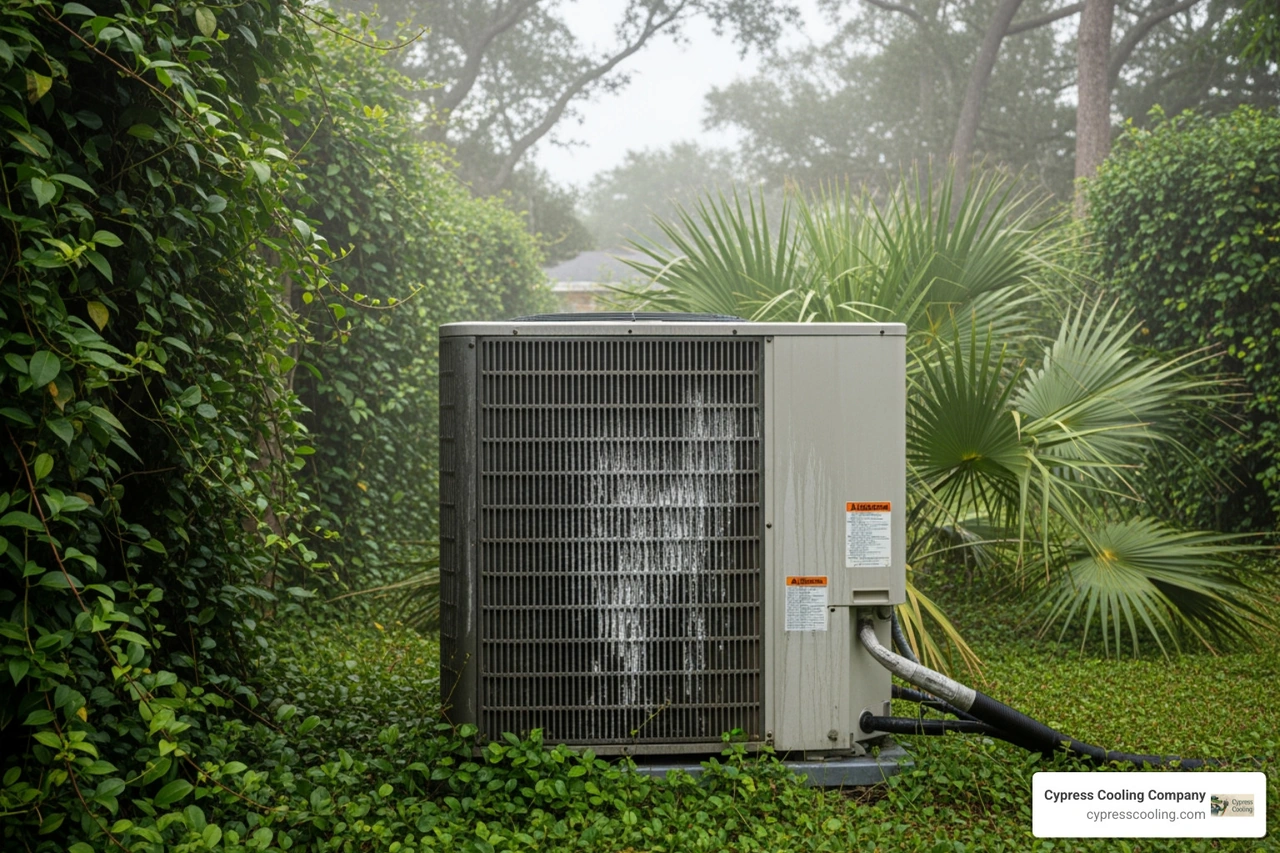
Why Humidity Is the Biggest Challenge for Heat Pumps on the Gulf Coast
How humidity affects heat pump performance on the Gulf Coast is one of the most important things South Louisiana homeowners need to understand before their system struggles through another brutal summer. Down here, the air is thick, wet, and relentless — and that changes everything about how your heat pump works.
Quick answer: How humidity affects Gulf Coast heat pump performance
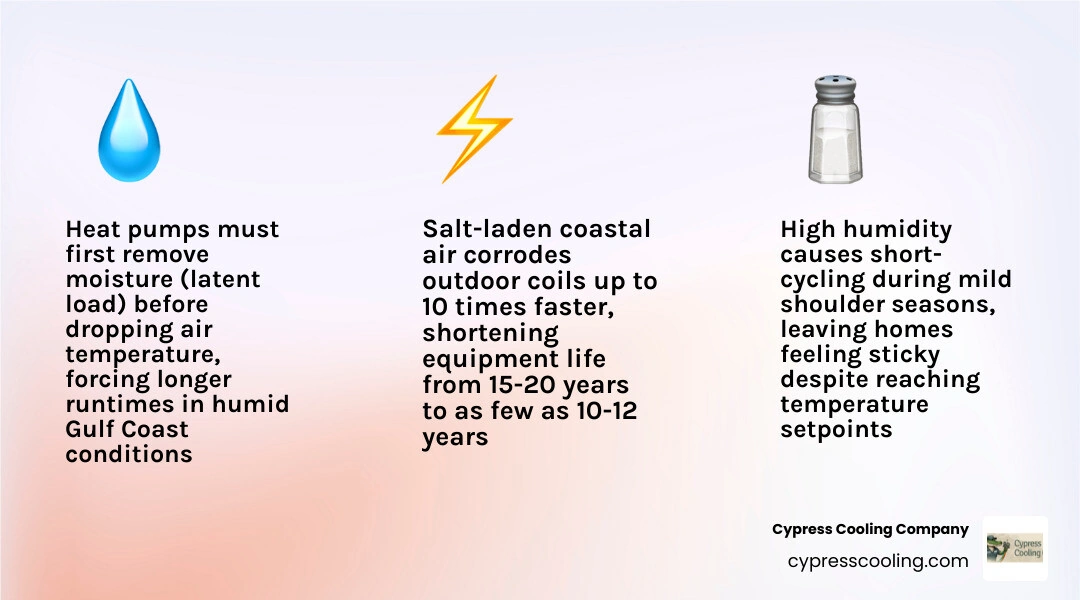
• Forces longer runtimes — Your system must remove moisture from the air (latent heat) before it can cool the temperature down (sensible heat), so it runs longer and uses more energy
• Causes short-cycling in mild weather — In spring and fall, systems cool the air quickly but shut off before removing enough moisture, leaving your home feeling sticky
• Accelerates corrosion — Salt-laden Gulf air corrodes outdoor coils and components up to 10 times faster than inland environments, cutting equipment lifespan from 15–20 years down to as few as 10–12 years
• Strains drain lines — A typical central system can pull several gallons of water from the air daily, clogging condensate drains far faster than in dry climates
• Increases winter defrost cycles — High winter humidity causes frost to build up on outdoor coils more frequently, triggering more defrost cycles and energy spikes
Most homeowners think of their heat pump as a temperature machine. On the Gulf Coast, it's really a moisture machine that also happens to cool your home. That distinction matters — a lot — when it comes to comfort, energy bills, and how long your equipment lasts.
The Science of Latent Heat: How Humidity Affects Heat Pump Performance on the Gulf Coast
To understand how humidity affects heat pump performance on the Gulf Coast, we have to separate two jobs your system performs:
• Sensible cooling lowers air temperature
• Latent cooling removes moisture from the air
In South Louisiana, latent cooling often steals the show.
When outdoor air is heavy with moisture, your indoor coil has to condense water vapor out of the air before the house starts feeling truly comfortable. That means some of your heat pump's capacity is spent drying the air instead of dropping the thermostat reading. The result is simple:
• Longer run times
• Higher energy use
• More condensate production
• More wear on components
This is why a home can technically hit the set temperature and still feel clammy. The thermostat only measures temperature. It does not feel the "wet blanket" effect the way your skin does.
Research on hot-humid climate controls shows that humidity management depends heavily on airflow, coil temperature, and runtime. In these conditions, lower airflow and longer cycles often improve moisture removal because they keep the evaporator coil cold enough to condense more water. The Advanced HVAC Humidity Control for Hot-Humid Climates report found that improved control strategies can significantly increase latent capacity during part-load conditions, which is exactly where many Gulf Coast homes struggle in spring and fall.
Another issue is evaporator saturation. When the indoor coil stays wet for long stretches, it is doing its job, but it also becomes part of the maintenance story. A constantly wet coil can support biological growth if filtration, drainage, and airflow are not kept in check. If you have ever wondered why a system seems to run constantly in a Louisiana summer, our guide on AC Running Constantly in Gulf Coast Heat and Humidity explains why that is often normal here.
For many homes, several gallons of water can be removed from the air in a single summer day. That is great for comfort when everything is working correctly. It is not so great when the drain line starts behaving like a swamp science experiment.
Why Variable-Speed Units Change How Humidity Affects Heat Pump Performance on the Gulf Coast
Variable-speed and inverter-driven heat pumps are usually better suited to Gulf Coast humidity than basic single-stage systems because they can run longer at lower speeds instead of blasting on and off.
That matters because dehumidification improves with steady runtime.
A single-stage unit tends to:
• Turn on at full output
• Satisfy temperature quickly
• Shut off sooner
• Leave more moisture behind during mild but humid weather
A variable-speed unit can:
• Operate at lower capacity for longer periods
• Maintain colder coil conditions when needed
• Remove more moisture without overcooling the house
• Deliver steadier comfort room to room
A warm-humid climate study comparing variable-speed and single-speed operation found that variable-speed mode maintained lower indoor relative humidity and removed more water per kilowatt-hour than standard single-speed operation. In summer conditions, variable-speed performance reached about 2.4 L/kWh versus about 2.0 L/kWh for normal single-speed mode, while also holding indoor RH closer to the low-50% range. You can review that research here: Research on variable speed heat pump performance.
That does not mean every single-stage system is hopeless. Proper setup, airflow adjustment, and control strategy still matter a lot. The technical report above also shows that even conventional equipment can manage humidity better when configured correctly. But if year-round dehumidification is a major priority in South Louisiana, variable-speed technology gives us more control.
When homeowners ask us what to look for in a replacement system, we usually point them toward:
• Variable-speed or inverter compressor technology
• Strong humidity-control settings
• Proper Manual J based sizing
• Coastal corrosion protection
• Solid SEER2 performance for long cooling seasons
If you are comparing options, our Heat Pump Services page is a good place to start.
Salt Air and Corrosion: Protecting Your System’s Lifespan
Humidity is only half the Gulf Coast story. The other half is salt.
Even if you are not directly on the beach, salt-laden air can travel inland and settle on outdoor equipment. Once that salty moisture lands on metal surfaces, corrosion speeds up fast. In coastal environments, metals can corrode up to ten times faster than in typical inland conditions.

For heat pumps, that is bad news because the outdoor unit contains many exposed parts that hate salt:
• Condenser coils
• Fan blades and fan guards
• Fasteners and cabinet panels
• Electrical contacts and terminals
• Capacitors and control components
Salt and moisture can trigger galvanic corrosion, especially where different metals meet. Over time, coils lose heat-transfer ability, electrical resistance rises, and tiny leaks can develop. A corroded coil does not just look rough. It insulates the metal surface and makes heat exchange less effective, which hurts performance.
Inland systems may last 15 to 20 years under favorable conditions. On the Gulf Coast, the same style of equipment may only last 10 to 12 years, and unprotected standard units in harsher coastal exposure can fail much sooner. Research in your source set notes examples of standard units lasting around 5 years in salt-heavy conditions, while better protected coastal-rated models may reach 10 to 15 years.
That is why coastal-rated equipment matters. We recommend looking for features such as:
• Factory-applied coil coatings such as epoxy or phenolic protection
• Corrosion-resistant fasteners and hardware
• Better-protected electrical compartments
• Durable coil designs intended for marine or coastal exposure
Corrosion protection does not make a unit invincible, but it can slow the damage significantly.
Maintenance Strategies for High-Humidity Environments
In South Louisiana, maintenance is not optional "nice to have" stuff. It is survival.
The most effective protection plan for a Gulf Coast heat pump includes simple, repeatable steps that address both moisture and salt exposure.
Monthly outdoor rinsing
Fresh water rinsing helps remove salt crystals before they bond to the coil and cabinet. For homes exposed to Gulf air, a gentle low-pressure rinse about once a month during heavy cooling season is one of the easiest ways to protect the outdoor unit.
Research in your source set notes that monthly cleanings may extend coil life by as much as 30%. The key word is gentle. High-pressure washing can bend fins and create its own problems.
More frequent filter changes
Humidity, long runtimes, and local debris mean filters load up faster here than they do in dry climates. Dirty filters reduce airflow, and poor airflow hurts both sensible and latent performance.
For many South Louisiana homes, we recommend checking filters monthly and replacing them as needed, especially during peak cooling months.
Condensate drain cleaning
Because systems remove so much water in humid weather, drain lines can clog faster with algae, sludge, and debris. A backed-up drain can lead to:
• System shutdowns
• Water damage
• Musty odors
• Higher indoor humidity
At minimum, drain lines should be inspected and cleaned regularly, with professional attention at least twice a year in our climate.
Coil inspection and cleaning
Indoor evaporator coils and outdoor condenser coils both need regular inspection. Dirty indoor coils reduce heat transfer and can worsen moisture issues. Dirty or corroded outdoor coils force the system to work harder in an already demanding environment.
Protective coatings and component checks
For outdoor units, periodic review of coil coating condition, cabinet wear, rust spots, and electrical oxidation is important. If coastal protection is failing, catching it early is far better than discovering it after a leak or major breakdown.
For a climate-specific overview, see Optimizing Heat Pump Performance in South Louisiana.
Standard vs coastal maintenance schedule
• Check air filter — Typical inland schedule: Every 2-3 months — Better Gulf Coast schedule: Monthly
• Replace air filter — Typical inland schedule: Every 1-3 months — Better Gulf Coast schedule: Often monthly in peak season, as needed
• Rinse outdoor unit — Typical inland schedule: Occasional — Better Gulf Coast schedule: Monthly with low-pressure fresh water
• Professional tune-up — Typical inland schedule: Once a year — Better Gulf Coast schedule: Twice a year
• Drain line cleaning — Typical inland schedule: Annual — Better Gulf Coast schedule: At least twice a year
• Coil inspection — Typical inland schedule: Annual — Better Gulf Coast schedule: Twice a year or more if heavily exposed
Managing Seasonal Challenges: Short-Cycling and Defrost Cycles
A lot of homeowners think humidity problems only show up in July and August. Not true. Some of the most frustrating comfort issues happen during shoulder season, when it is warm enough to need cooling but not hot enough to keep the system running long.
That is the perfect setup for short-cycling humidity problems.
On mild but damp spring or fall days, an oversized or single-stage system may cool the air quickly and shut off before removing enough moisture. The thermostat says everything is fine. Your skin strongly disagrees.
Signs of shoulder-season humidity trouble include:
• Indoor air feels sticky at normal thermostat settings
• Musty smells
• Uneven comfort from room to room
• Windows or supply grilles showing condensation
• Higher indoor RH even though the system is cooling
This is where proper sizing becomes critical. Bigger is not better for Gulf Coast comfort. A unit that is too large may satisfy temperature too fast and miss the latent load almost entirely.
Solutions can include:
• Correct equipment sizing
• Variable-speed operation
• Thermostat and blower settings that support dehumidification
• Fan set to Auto instead of On
• Supplemental dehumidification
Whole-home humidity control is often the missing piece, especially in tighter homes or homes with lower sensible loads. If the house does not need much temperature reduction but still has a big moisture load from outdoor air, occupants, cooking, bathing, or ventilation, a dedicated dehumidifier can stabilize comfort without overcooling the house. Learn more about Indoor Air Quality Solutions and Whole-House Dehumidifiers.
Managing Winter Defrost Cycles and How Humidity Affects Heat Pump Performance on the Gulf Coast
Yes, humidity can even mess with your heat pump in winter.
During heating mode, the outdoor coil gets cold enough that moisture from humid outdoor air can freeze on it. The system then has to enter defrost mode to melt that frost and keep airflow moving across the coil.
In humid Gulf Coast winters, this can happen more often than homeowners expect.
More frequent defrost cycles can lead to:
• Temporary drops in heating output
• Short bursts of steam from the outdoor unit
• More auxiliary heat use
• Noticeable energy spikes
A little steam during defrost is usually normal. Panic is optional.
What matters is whether defrost is happening at a reasonable frequency and whether the system is operating efficiently between cycles. Excessive frost buildup can point to airflow restrictions, sensor problems, refrigerant issues, or control faults.
For some homes, hybrid configurations can improve cold-weather efficiency and comfort strategy. If that is relevant to your home, our guide to South Louisiana Hybrid HVAC Systems is worth a read.
Frequently Asked Questions about Coastal Heat Pumps
Why does my heat pump run when it is only 75 degrees outside?
Because temperature is only part of the job. On a humid South Louisiana day, your system may need to remove a large latent load even when outdoor temperature is moderate. If the air inside feels sticky, the heat pump may keep running to pull moisture out of the air.
That is especially common if:
• Indoor humidity is high
• The home has outdoor air infiltration
• The system is properly trying to dehumidify
• The thermostat or controls support humidity management
So yes, it can be normal. The key question is whether it is controlling humidity effectively, not just whether it is running.
How often should I rinse my outdoor unit if I live near the Gulf?
A gentle fresh-water rinse about once a month is a smart baseline for many Gulf-exposed homes, especially during long cooling months. Use low pressure only. The goal is to wash away salt, not flatten the fins.
If your home has heavier exposure, we may recommend even closer inspection during routine maintenance. Monthly rinsing is one of the simplest habits that can help reduce corrosion and preserve coil life.
Is a whole-house dehumidifier necessary with a new heat pump?
Not always, but sometimes absolutely yes.
A modern heat pump, especially a variable-speed model, can do a much better job with humidity than an older single-stage system. But some homes still need dedicated dehumidification, including:
• Tight homes with low sensible load
• Homes with persistent RH above 55% to 60%
• Homes that feel clammy in spring and fall
• Homes with ventilation-related moisture loads
• Homes where overcooling is being used to fight humidity
ASHRAE guidance and hot-humid climate research generally support keeping indoor RH below 60%, with many homeowners feeling best closer to 45% to 55%. If your heat pump can hit temperature but not humidity, a whole-house dehumidifier can be the tool that finally solves the problem without turning your living room into a meat locker.
Conclusion
On the Gulf Coast, heat pumps do not just battle heat. They battle moisture, salt, long cooling seasons, and winter humidity too. That is why how humidity affects heat pump performance on the Gulf Coast is really a comfort, efficiency, maintenance, and equipment-life issue all rolled into one.
At Cypress Cooling Company, we believe homeowners deserve clear answers, not pressure. We diagnose, educate, and guide so you can make smart decisions for your home in South Louisiana.
If you want help choosing the right coastal-rated system, improving humidity control, or protecting the heat pump you already have, explore our More info about Heat Pump Services.
OUR CLIENTS HAVE TO SAY ABOUT US



Service areas
Our service areas are designed to meet the diverse needs of our clients. We focus on providing exceptional service and ensuring customer satisfaction in every location we operate.

