
Everything You Need to Know About Heat Pump vs Separate AC and Heating System
.webp)
Heat Pump vs Separate AC and Heating System for a South Louisiana Home: What You Need to Know First
Choosing between a heat pump vs separate AC and heating system for a South Louisiana home is one of the most important decisions you'll make for your home's comfort and energy costs. South Louisiana's brutal summers, sticky humidity, and mild-but-unpredictable winters create a very specific set of demands that most generic HVAC guides simply don't address.
Here's a quick comparison to answer the core question:
• Function — Heat Pump: Heats and cools with one system — Separate AC + Heating System: Separate units for heating and cooling
• Best for — Heat Pump: Mild winters, all-electric homes — Separate AC + Heating System: Homes with natural gas access
• Heating efficiency — Heat Pump: Up to 300% efficient (moves heat) — Separate AC + Heating System: Gas furnace up to 98% efficient
• Cooling efficiency — Heat Pump: Same as equivalent AC (SEER2 rating) — Separate AC + Heating System: Same as equivalent heat pump
• Humidity control — Heat Pump: Better with variable-speed models — Separate AC + Heating System: Depends on system sizing
• Upfront cost — Heat Pump: Slightly higher — Separate AC + Heating System: Slightly lower
• Long-term savings — Heat Pump: Higher for electric heating — Separate AC + Heating System: Higher if gas is cheap locally
• Ideal Louisiana use — Heat Pump: Most South Louisiana homes — Separate AC + Heating System: Homes with gas and occasional cold snaps
In South Louisiana, cooling dominates — your system runs hard from March through November. That reality changes how you should think about this decision compared to homeowners in colder states. A heat pump that works brilliantly in Minnesota looks very different from one sized and configured for Metairie or Houma.
The good news: South Louisiana's climate — with only around 15 to 20 nights per year dropping below 40°F — is actually one of the most heat-pump-friendly regions in the country. But that doesn't automatically make it the right choice for every home or every homeowner.
This guide breaks down exactly what you need to know to make a confident, informed decision.
Understanding the Core Differences: Heat Pump vs Separate AC and Heating System for a South Louisiana Home
To understand which system is right for your property in New Orleans, Metairie, or Kenner, we first have to look at the underlying technology. While they look nearly identical from the outside, the way they handle your indoor climate is fundamentally different.
A traditional central air conditioner and a heat pump both rely on the exact same refrigeration cycle to cool your home. They use a compressor, an outdoor condenser coil, an indoor evaporator coil, and chemical refrigerant to absorb heat from inside your house and dump it outdoors.
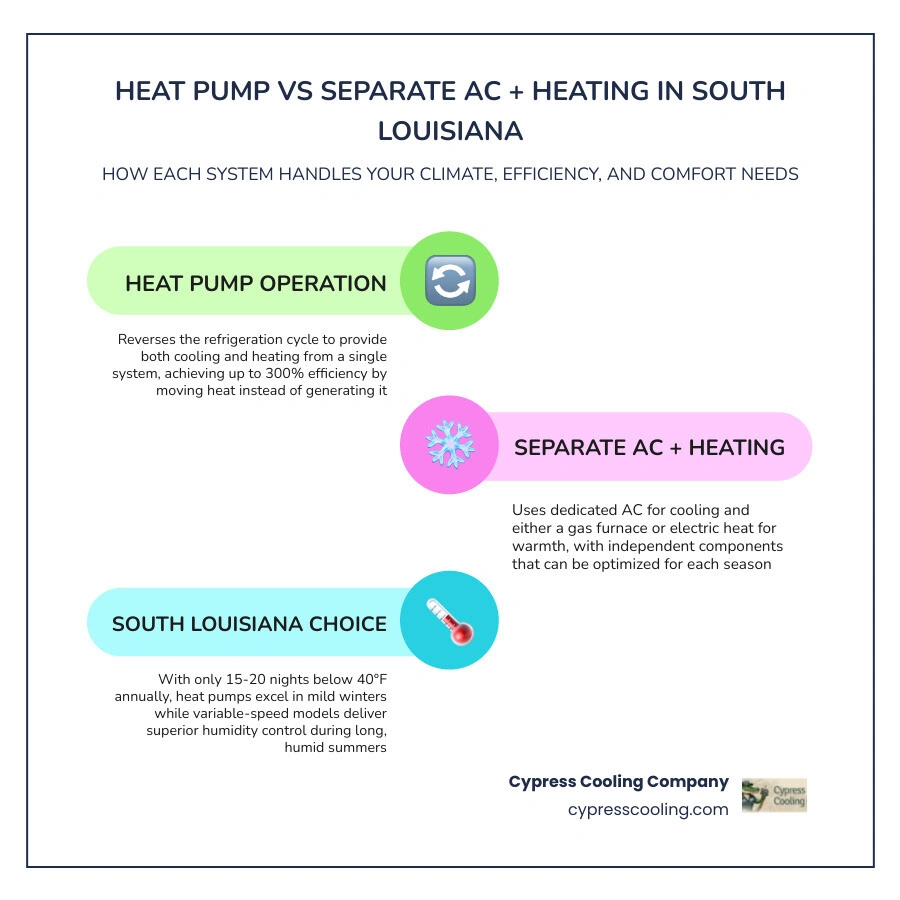
The magic of a heat pump lies in a small but incredibly important component called the reversing valve. This valve allows the heat pump to reverse the flow of refrigerant. In the summer, it pumps heat out of your home. In the winter, it reverses the process, extracting ambient heat from the outdoor air and pumping it inside.
Because it moves heat rather than generating it, a heat pump operates with incredible thermodynamic efficiency. In fact, a heat pump can achieve up to 300% efficiency in heating mode. This means it delivers up to three times more heat energy than the electrical energy it consumes. By comparison, even the most efficient gas furnace maxes out at about 98% efficiency because it must burn fossil fuels to create heat.
If you want to dive deeper into how these mechanical systems operate, you can learn more about air conditioning systems or explore heating options designed for our unique climate. For a visual breakdown of this process, you can also watch this video on heat pump vs furnace operation.
How a Heat Pump Operates Year-Round
During our long, grueling South Louisiana summers, a heat pump acts as a standard, high-efficiency central air conditioner. It absorbs the heavy, humid indoor heat and transfers it outside, leaving your home cool and dry.
When our brief winter arrives in places like Slidell, Mandeville, or Marrero, you don't need a massive, fuel-burning furnace to stay warm. The heat pump simply flips its reversing valve. Even when it feels chilly outside, there is still a tremendous amount of heat energy present in the outdoor air. The heat pump captures this heat, compresses the refrigerant to raise its temperature, and uses it to warm your indoor air.
This dual-functionality means you only have one outdoor unit to maintain, simplify your home's mechanical footprint. If you're curious about the exact mechanics of this process, you can discover how heat pumps work in our detailed guide. Fun fact: your kitchen refrigerator actually works on this exact same heat-transfer principle, just on a much smaller scale!
How Traditional Separate Systems Work
A traditional separate setup — often called a split system — relies on two independent heating and cooling components. For cooling, you have an outdoor condensing unit paired with an indoor evaporator coil. For heating, you typically have a completely separate gas-fired furnace or an electric resistance heating element built into your air handler.
In this setup, the air conditioner only knows how to do one job: cool. When winter hits, the air conditioner shuts down entirely, and the furnace takes over. If you have a gas furnace, it burns natural gas to heat a metal component called a heat exchanger, which then warms the air blown through your ducts. If you have an electric furnace, it passes electricity through high-resistance metal coils (similar to a giant hair dryer) to generate heat. While reliable, electric resistance heating is highly inefficient compared to heat transfer.
Climate Performance: How Heat Pumps Handle South Louisiana's Humidity and Mild Winters
South Louisiana sits squarely in ASHRAE Climate Zone 2A, which is classified as a hot-humid climate. This means we face two distinct challenges: extreme, lingering humidity for most of the year, and mild winters punctuated by sudden, unpredictable cold snaps.
Dehumidification and Moisture Control in Humid Climates
In cities like Covington, Destrehan, and Luling, humidity control isn't just a matter of comfort — it's a matter of protecting your home from mold and structural moisture damage. When comparing a heat pump vs separate ac and heating system for a south louisiana home, many homeowners worry that a heat pump won't dehumidify as effectively as a traditional AC.
The truth is, in cooling mode, a heat pump and a traditional air conditioner perform identically when it comes to moisture removal. Both systems condense water vapor out of the air as it passes over the cold indoor coil.
However, because heat pumps are frequently paired with advanced variable-speed blowers and compressors, they often excel at humidity control. A variable-speed system can run at lower, steadier speeds for longer periods. These long run times allow the system to continuously pull moisture out of the air without overcooling your home. An oversized, single-stage traditional AC will turn on, blast cold air quickly, and shut off before it has a chance to properly dehumidify, leaving your home feeling clammy. To see how these systems stack up side-by-side, you can compare heat pumps and traditional air conditioners in depth.
Winter Performance of a Heat Pump vs Separate AC and Heating System for a South Louisiana Home
Historically, heat pumps had a reputation for struggling when temperatures dropped below freezing. While that remains a concern in northern states, it is rarely an issue in South Louisiana. In areas like Metairie, Kenner, and New Orleans, we only experience about 15 to 20 nights per year where the temperature drops below 40°F.
Modern heat pumps can easily operate at peak efficiency down to 25°F or 30°F, and many variable-capacity systems continue to provide efficient heat well below that. Because our winters are so mild, a heat pump will spend almost all of its heating run-time in its ultra-efficient sweet spot.
By switching from electric resistance heat to a heat pump, South Louisiana homeowners can cut their heating energy consumption by 50% to 65%. You get all the warmth you need during our brief chilly spells without the massive spike in your winter electric bill.
Financial and Efficiency Comparison: Upfront Investment vs. Long-Term Utility Savings
When deciding on a new HVAC system, it is essential to look at both the immediate installation costs and the long-term operational impact on your monthly utility bills.
• High-Efficiency Heat Pump — Cooling Efficiency (SEER2): 16 to 22+ SEER2 — Heating Efficiency (HSPF2 / AFUE): 8.5 to 10+ HSPF2 — Average Lifespan in LA: 15 to 20 Years
• Standard Heat Pump — Cooling Efficiency (SEER2): 15.2 SEER2 — Heating Efficiency (HSPF2 / AFUE): 7.5 to 8.2 HSPF2 — Average Lifespan in LA: 15 to 20 Years
• Separate AC + Gas Furnace — Cooling Efficiency (SEER2): 15.2 to 22+ SEER2 — Heating Efficiency (HSPF2 / AFUE): 80% to 98% AFUE — Average Lifespan in LA: 15 to 20 Years (AC) / 20+ (Furnace)
• Separate AC + Electric Heat — Cooling Efficiency (SEER2): 15.2 to 22+ SEER2 — Heating Efficiency (HSPF2 / AFUE): 100% (Electric Resistance) — Average Lifespan in LA: 15 to 20 Years
Upfront Investment and Installation Considerations
Generally, a heat pump system carries a slightly higher upfront equipment cost compared to an equivalent-efficiency traditional split system. However, this comparison can be misleading if you need to replace both your aging air conditioner and your furnace at the same time.
If your home in Harvey or Terrytown currently uses an electric furnace (resistance heat), replacing it with a heat pump is incredibly straightforward. It uses your existing ductwork and electrical infrastructure. If you are replacing a separate AC and gas furnace combo, you have to consider whether you want to stick with gas heating or transition to an all-electric heat pump.
If you're trying to decide whether it's time to repair your current unit or transition to a new system entirely, you can read our AC repair vs replace decision guide for professional clarity.
Long-Term Energy Savings and Rebates
Because a heat pump moves heat instead of creating it, the operational savings can be substantial, especially if you are upgrading from old electric resistance heating. Homeowners switching to a heat pump typically cut their heating electricity use by up to 50% compared to traditional electric heaters.
Additionally, there are significant financial incentives available to help offset the transition to a heat pump. Under the federal 25C tax credit, Louisiana homeowners can access tax credits of up to $2,000 for qualifying high-efficiency heat pumps. Many local utility providers across South Louisiana also offer targeted rebates for installing Energy Star-certified heat pump systems.
To help determine if a full system upgrade makes sense for your specific situation, check out our guide: Should I repair or replace my air conditioner in South Louisiana?.
Choosing the Right Setup: Standalone, Hybrid, and Ductless Options
Every home in South Louisiana is unique. A historic raised cottage in Carrollton has vastly different heating and cooling needs than a modern brick ranch in Slidell or a townhouse in Algiers. Fortunately, heat pump technology is highly adaptable.
Standalone Heat Pump vs Separate AC and Heating System for a South Louisiana Home
A standalone, all-electric heat pump is an exceptional choice for homes that do not have existing natural gas lines, or for homeowners who want to transition away from fossil fuels entirely. Because our winters are so mild, a standalone heat pump is more than capable of keeping your home comfortable year-round without the need for a separate furnace. It simplifies your mechanical systems, leaving you with just one outdoor unit and one indoor air handler to maintain.
Hybrid (Dual-Fuel) Systems for Unpredictable Cold Snaps
For homeowners who already have natural gas access and want the absolute best of both worlds, a hybrid (or dual-fuel) system is highly attractive. A hybrid system pairs an electric heat pump with a gas furnace.
Using a smart thermostat, the system automatically switches between the two heat sources based on efficiency. During mild winter days, the heat pump handles the heating with incredible electrical efficiency. If a rare polar vortex drops temperatures below freezing, the system seamlessly switches to the gas furnace to provide rapid, cozy warmth. A hybrid HVAC system can cut total heating and cooling costs by 30% to 50% in South Louisiana homes while ensuring you are prepared for any weather extreme.
Ducted vs. Ductless Mini-Split Heat Pumps
If you live in a historic home in New Orleans or a property without traditional ductwork, a ductless mini-split heat pump is a game-changer. Rather than tearing open plaster walls to install bulky ducts, mini-splits use small, unobtrusive indoor air handlers connected to an outdoor condenser via thin refrigerant lines.
Mini-splits offer incredible energy efficiency because they eliminate the energy losses associated with ductwork (which can account for up to 30% of a system's energy consumption). They also allow for precise, room-by-room zoning, meaning you don't have to waste money cooling empty guest rooms or formal dining areas. If you are considering this path, you can learn about New Orleans heat pump replacement options designed specifically for historic and ductless properties.
Frequently Asked Questions About South Louisiana HVAC Systems
Do heat pumps last as long as traditional separate systems in coastal climates?
Yes, with proper care. In South Louisiana's salty, humid coastal air, any outdoor HVAC unit is subject to corrosion and wear. A heat pump typically lasts 15 to 20 years with proper maintenance. Because a heat pump operates year-round (cooling in summer, heating in winter), its compressor accumulates more run-hours than a traditional AC that sits idle all winter. However, regular professional maintenance and coil cleanings will ensure your heat pump matches the lifespan of any high-quality traditional system.
Can a heat pump keep my home warm during rare Louisiana freezes?
Absolutely. Modern heat pumps are engineered to extract heat from outdoor air even when temperatures drop well below freezing. For those rare nights when the temperature plummets, heat pumps are equipped with auxiliary electric heating strips. If the outdoor temperature drops below the heat pump's optimal operating limit, these auxiliary coils automatically kick in to assist, ensuring your family stays perfectly warm.
Is a hybrid dual-fuel system necessary for South Louisiana?
While a hybrid system offers fantastic flexibility and comfort, it is not strictly necessary for most South Louisiana homes. Because our winters are incredibly mild, a standard standalone heat pump can easily handle our heating needs without ever needing a gas backup. A hybrid system is best suited for homeowners who already have natural gas infrastructure, prefer the "hotter" feel of furnace heat, and want maximum utility flexibility.
Conclusion
Deciding between a heat pump vs separate ac and heating system for a south louisiana home ultimately comes down to your home's construction, your existing utility connections, and your long-term comfort goals. Whether you are looking to lower your winter electric bills, transition to an all-electric home, or find a creative cooling solution for an older home without ductwork, there is a perfect system configuration for you.
At Cypress Cooling Company, our philosophy is simple: we diagnose, educate, and guide without selling. We don't believe in high-pressure sales tactics or one-size-fits-all solutions. Instead, we want to help you understand your options so you can make the absolute best choice for your home and your budget.
If you are ready for honest, professional guidance and a personalized home comfort assessment in Metairie, Kenner, Slidell, or anywhere in the greater New Orleans area, we are here to help. Schedule a consultation for your South Louisiana home with our friendly team today!
OUR CLIENTS HAVE TO SAY ABOUT US



Service areas
Our service areas are designed to meet the diverse needs of our clients. We focus on providing exceptional service and ensuring customer satisfaction in every location we operate.

