
Why Your Westwego AC Smells Like Mildew (And How We Fix the Drain Pan)
.webp)
The Late-Summer Nuisance: When Your AC Starts Smelling Like Mildew
You walk into your living room after a long day in the heat, expecting a blast of refreshing air, but instead, you are greeted by a sour, musty odor. If you are wondering why your Westwego AC smells like mildew (and how we fix the drain pan), you are dealing with one of the most frustrating symptoms of the August late-summer cooling season. Your air conditioner is running constantly to keep up with the intense heat, but every time the blower motor kicks on, that unmistakable swampy smell floods your living space.
For comprehensive solutions, explore our Air Conditioning services or protect your system year-round with an AC maintenance plan.
At this point in the year, homeowners face a critical decision point: continue masking the odor with temporary air fresheners and sprays, or address the actual mechanical drainage issue causing the stench. The root of the problem rarely has anything to do with your air filter or your ductwork. Instead, it almost always traces back to a hidden component inside your indoor air handler: the condensate drain pan. When this pan fails to manage the massive amount of moisture your system extracts from the air, it creates the perfect environment for biological growth.
The Reality of Late-Summer AC Strain
By the time late August arrives, your HVAC system has likely been running non-stop for months. This continuous operation means the internal components of your air handler have been perpetually cold, wet, and dark. While air conditioners are designed to handle moisture, they rely on a delicate balance of gravity and airflow to move that moisture out of your home. When that balance is disrupted, the sensory evidence is immediate.
• The initial symptom: A faint, damp smell that only occurs during the first few minutes of a cooling cycle.
• The progression: A persistent odor that lingers in the home even after the system cycles off.
• The breaking point: A smell so strong it mimics a wet dog or dirty laundry, prompting homeowners to seek immediate relief.
Understanding why this happens requires looking past the vents and examining the biological processes occurring deep inside your ductwork and air handler.
What Causes the 'Dirty Sock' Odor in Your Vents?
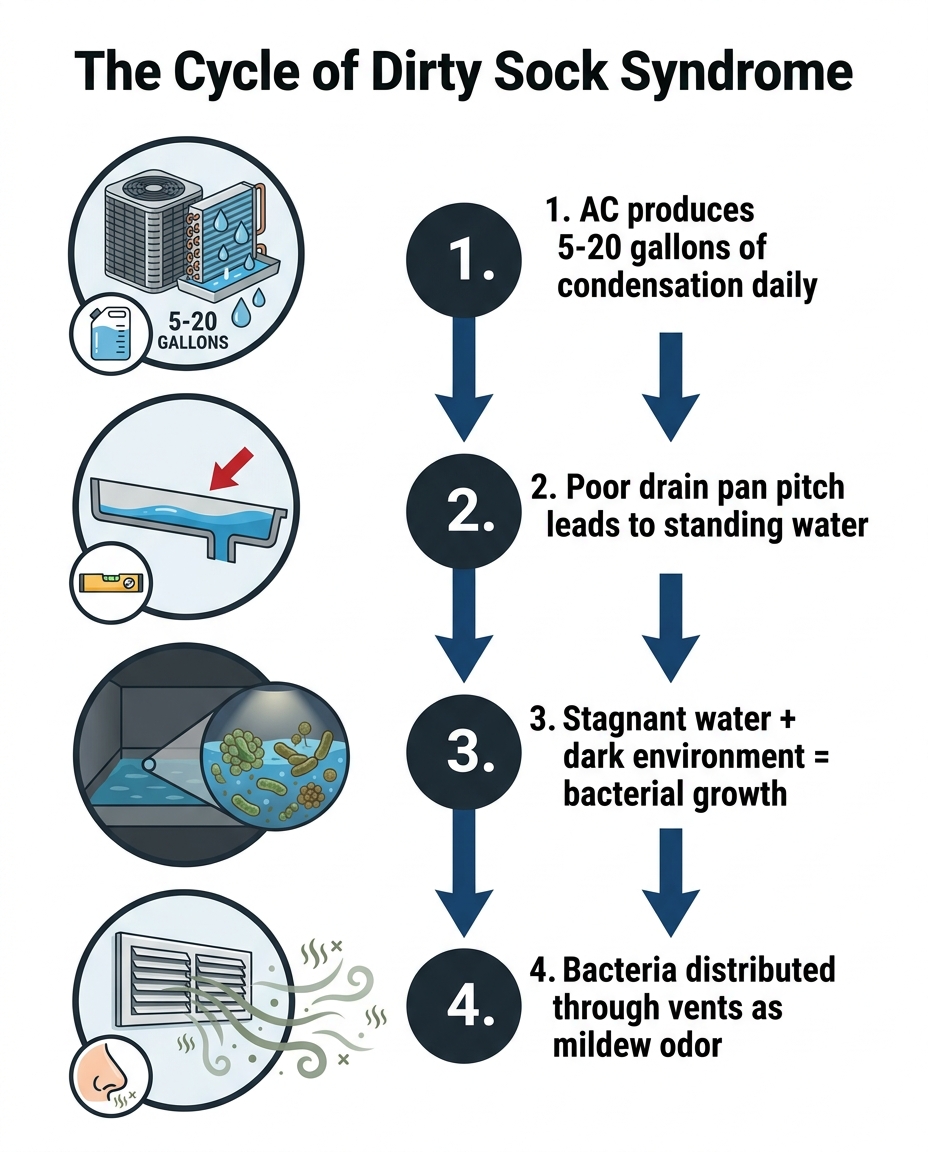
The HVAC industry has a highly specific, albeit unpleasant, name for this phenomenon: "dirty sock syndrome." This is a biological nuisance caused by a rapid buildup of bacteria, mold spores, and microbes thriving in the dark, damp environments within your heating and cooling system. While it impacts indoor air quality significantly, the odor itself is a byproduct of the life cycle of these microscopic organisms.
The Biological Breeding Ground
Your air conditioner cools your home by pulling warm indoor air over a freezing-cold evaporator coil. As the air cools, the humidity inside that air condenses into liquid water—just like droplets forming on the outside of a cold glass of iced tea. This water drips off the aluminum or copper fins of the coil and falls into a plastic or metal collection tray situated directly underneath.
In a properly functioning Westwego home, this water immediately exits the tray. However, when water sits stagnant, it combines with microscopic dust particles that bypass your air filter. This mixture of organic material and standing water creates a nutrient-rich slime. The bacteria that feed on this slime release volatile organic compounds (VOCs) as they digest the organic matter. These VOCs are the exact source of the foul, mildew-like odor.
How the Odor Travels Through Your Home
The smell does not simply waft out of the air handler; it is actively distributed by the mechanics of your system. Here is the typical pattern we see when diagnosing odor complaints:
1. Blower Activation: The thermostat calls for cooling, and the indoor blower motor spins up, creating a strong negative pressure inside the air handler cabinet.
2. Odor Extraction: This pressure pulls the VOCs off the surface of the stagnant water in the drain pan and mixes them with the conditioned air.
3. Ductwork Distribution: The blower forces this tainted air through your supply ducts, pushing the mildew smell into every room of the house simultaneously.
4. Residual Lingering: Even after the blower shuts off, the heavy, damp air remains suspended in the living space.
Because the odor is distributed so efficiently, homeowners often mistakenly believe their entire ductwork system is contaminated. In reality, the biological growth is usually isolated to a single, highly concentrated area: the stagnant water pooling beneath the evaporator coil.
The Hidden Culprit: Poor Drain Pan Pitch and Stagnant Water
To permanently resolve dirty sock syndrome, we have to bridge the biological symptom (the bacteria) to the mechanical root cause (the drain pan pitch). The condensate drain pan is not just a bucket; it is an engineered component designed to utilize gravity to remove water from your home. When this component is structurally compromised or improperly aligned, biological growth is inevitable.
The Physics of Proper Condensate Drainage
A standard drain pan features a primary drain port connected to a PVC pipe that routes water outside your house or into your plumbing system. For this water to flow correctly, the pan must be perfectly pitched—meaning it must have a slight, deliberate slope toward the drain port. Industry standards typically require a pitch of about 1/4 inch per foot of horizontal run.
When the pitch is correct, water hits the pan and immediately flows out. When the pitch is off—whether due to poor initial installation, the house settling over time, or a warped plastic pan—water pools in the back or corners of the tray. This is where the mechanical flaw creates the biological hazard.
Symptom Comparison: Mechanical Flaw vs. Routine Maintenance
Homeowners often confuse a drainage failure with a simple need for a filter change. Understanding the difference is crucial for choosing the right solution.
• Odor Profile — Standard Dirty Filter Issue: Dusty, stale, or slightly burnt smell — Poor Drain Pan Pitch Issue: Heavy, sour mildew, wet dog, or dirty laundry smell
• Airflow Strength — Standard Dirty Filter Issue: Noticeably reduced or weak airflow from vents — Poor Drain Pan Pitch Issue: Normal airflow, but the air smells foul
• System Cycling — Standard Dirty Filter Issue: Longer cycles or system freezing up — Poor Drain Pan Pitch Issue: System runs normally but odor persists constantly
• Visible Water — Standard Dirty Filter Issue: None visible around the indoor unit — Poor Drain Pan Pitch Issue: Potential pooling in the secondary pan or water damage
The critical takeaway: A foul odor with normal airflow strongly indicates a mechanical drainage failure, not just a dirty system. If the water cannot reach the exit port due to a lack of gravity slope, it will sit there until it evaporates—which, in a dark, sealed, highly humid cabinet, can take days or weeks.

How South Louisiana Humidity Accelerates Condensation
The severity of dirty sock syndrome is heavily influenced by regional climate factors. What might be a minor, barely noticeable issue in a dry climate becomes a severe nuisance in a humid environment. In South Louisiana, the sheer volume of water your air conditioner processes daily is staggering.
The 20-Gallon Daily Load
A residential air conditioner is essentially a massive, whole-home dehumidifier. As it cools the air, it aggressively strips moisture from your indoor environment. Depending on the size of your home and the efficiency of your system, a standard AC unit can produce between 5 and 20 gallons of condensation every single day.
To put that into perspective, 20 gallons of water is roughly equivalent to a small bathtub filled halfway. Every drop of that water must safely land in the drain pan, travel down the slope, enter the PVC line, and exit the building.
Cumulative Late-Summer Stress
The Greater New Orleans and Westwego area average August humidity levels frequently exceed 75%, resulting in maximum condensate load on residential HVAC systems. During this peak season, the air handler is constantly wet.
This extreme environmental load means that even a microscopic pitch error in the drain pan leads to rapid, severe bacterial pooling. If the pan is tilted backwards by just a fraction of an inch, a half-gallon of water might remain trapped in the corner of the tray after every cooling cycle. Under these high-humidity conditions, that stagnant water never has a chance to evaporate before the next cycle begins, creating a permanent, undisrupted breeding ground for the microbes causing the mildew smell.
Why Chemical Sprays Won't Solve the Underlying Drainage Issue
When faced with a foul odor coming from the vents, the most common homeowner instinct is to attempt a DIY cleaning. Hardware stores and online retailers offer dozens of foaming coil cleaners, chemical masking sprays, and scented vent clips promising to eliminate dirty sock syndrome. While these products may offer temporary relief, they fundamentally misunderstand the nature of the problem.
The Temporary Illusion of Masking Sprays
Spraying a chemical disinfectant into your return vent or directly onto the evaporator coil might successfully kill the top layer of bacteria currently producing the odor. For 24 to 48 hours, your home may smell like citrus or pine instead of mildew. However, this is a chemical solution applied to a mechanical problem.
• The water remains: Sprays do not alter the pitch of the drain pan or remove the stagnant water trapped in the corner.
• Rapid recolonization: As soon as the chemical dissipates, new airborne spores (which are naturally present in all homes) will land in the stagnant water.
• The cycle restarts: Because the dark, damp, nutrient-rich environment is still completely intact, the bacterial colony will rebuild rapidly, and the odor will return within days.
The Danger of Ignoring Stagnant Water
Relying on sprays or DIY vinegar treatments doesn't just waste time and effort; it allows a mechanical failure to persist. Stagnant water in a poorly pitched pan is a warning sign. Over time, that pooled water can cause metal pans to rust through completely, or cause the biological slime to thicken into a jelly-like substance that fully clogs the primary drain line.
When the line clogs, the water level rises until it triggers a safety float switch (shutting down your AC entirely) or overflows the pan, causing severe water damage to your ceilings, floors, or drywall. A permanent fix requires addressing the mechanical drainage capability of the pan itself.
Diagnosing and Correcting Your AC Drain Pan
Fixing a poorly pitched or damaged drain pan is not a weekend DIY project. The pan is located directly underneath the evaporator coil, which is tightly sealed inside the air handler cabinet and connected to highly pressurized refrigerant lines. Attempting to move, shim, or replace this pan without professional training can easily result in a cracked refrigerant line, leading to a catastrophic system failure.
A typical pattern we see in Westwego involves severe drainage failures that require immediate professional intervention. For example, one local homeowner recently discovered water dripping from their ceiling due to a completely failed drip pan. A technician responded quickly, diagnosed the structural issue with the pan, ordered the replacement, and installed it the same day—ensuring the home wasn't left without cooling for a second day while permanently resolving the risk of a ceiling collapse. (If you are dealing with a similar emergency, read more about AC dripping water from your ceiling).
The Professional Diagnostic Process
At Cypress Cooling Company, we don't just mask the smell; the focus is on diagnosing the root mechanical cause of the poor drainage to permanently solve the issue. Here is how a licensed professional approaches the correction:
1. Visual Inspection and Leveling: The technician removes the access panels to expose the evaporator coil and drain pan. Using a specialized torpedo level, they measure the exact pitch of the pan across multiple axes to determine where the water is pooling.
2. Clearing the Condensate Line: Before making structural adjustments, the technician ensures the PVC drain line is completely free of biological blockages. This often involves using specialized vacuums or pressurized nitrogen to blow out years of accumulated sludge.
3. Evaluating the Pan's Integrity: If the pan is cracked, heavily rusted, or permanently warped (common with older plastic pans exposed to high heat in attics), re-pitching won't work. The pan must be condemned.
4. Re-pitching or Replacement: If the pan is structurally sound, the technician will carefully adjust the internal supports or the overall stance of the air handler to restore the critical 1/4-inch per foot gravity slope. If the pan is damaged, they will safely lift the evaporator coil, remove the faulty tray, and slide a custom-fit replacement into place.
5. Verification: Finally, water is manually poured into the top of the coil to simulate condensation. The technician watches the flow to verify that every drop exits the pan rapidly, leaving no standing water behind.
By restoring proper gravity drainage, the environment where bacteria thrive is permanently eliminated, curing dirty sock syndrome at its source.
Eliminate AC Odors at the Source
Living with a foul, musty odor every time your air conditioner runs is not something you have to accept as a normal part of late summer. Masking the smell won't fix the underlying mechanical flaw, and ignoring it can lead to larger water damage issues down the road. Restoring the proper pitch to your drain pan requires precision and professional expertise to ensure your system drains flawlessly, no matter how humid it gets outside. If you are ready to breathe clean, fresh air again, explore our comprehensive Westwego AC services to get your system inspected and corrected today.
Frequently Asked Questions
Why does my AC smell like mildew?
A mildew smell from your AC is usually caused by stagnant water pooling inside the indoor unit's drain pan. When this water sits in a dark, damp environment, it breeds bacteria and mold spores. As the blower motor runs, it pushes the odors generated by these microbes through your ductwork and into your living spaces.
How do you fix dirty sock syndrome?
Fixing dirty sock syndrome requires eliminating the stagnant water where the bacteria breed. This is achieved by having a professional inspect and correct the pitch of your condensate drain pan so that water flows out via gravity. Chemical sprays only offer temporary relief and will not permanently solve the mechanical drainage issue.
Why is there standing water in my AC drain pan?
Standing water occurs when the drain pan is improperly pitched, warped, or when the connected condensate drain line is clogged. Without a continuous downward slope, gravity cannot pull the condensation out of the system. This mechanical flaw traps the water, leading to biological growth and potential overflow issues.
Is it safe to run the AC if it smells like mildew?
While running an AC that smells like mildew will not immediately break the equipment, it does negatively impact your indoor air quality by circulating bacterial odors. Additionally, the smell indicates a drainage failure; ignoring it could eventually lead to the drain pan overflowing and causing water damage to your home.
Can a clogged drain line cause indoor air quality issues?
Yes, a clogged drain line causes water to back up into the drain pan, creating a permanent pool of stagnant water. This moisture allows biological contaminants to thrive inside your air handler. The volatile organic compounds (VOCs) produced by this growth are then blown directly into your home, reducing overall air quality.
OUR CLIENTS HAVE TO SAY ABOUT US



Service areas
Our service areas are designed to meet the diverse needs of our clients. We focus on providing exceptional service and ensuring customer satisfaction in every location we operate.