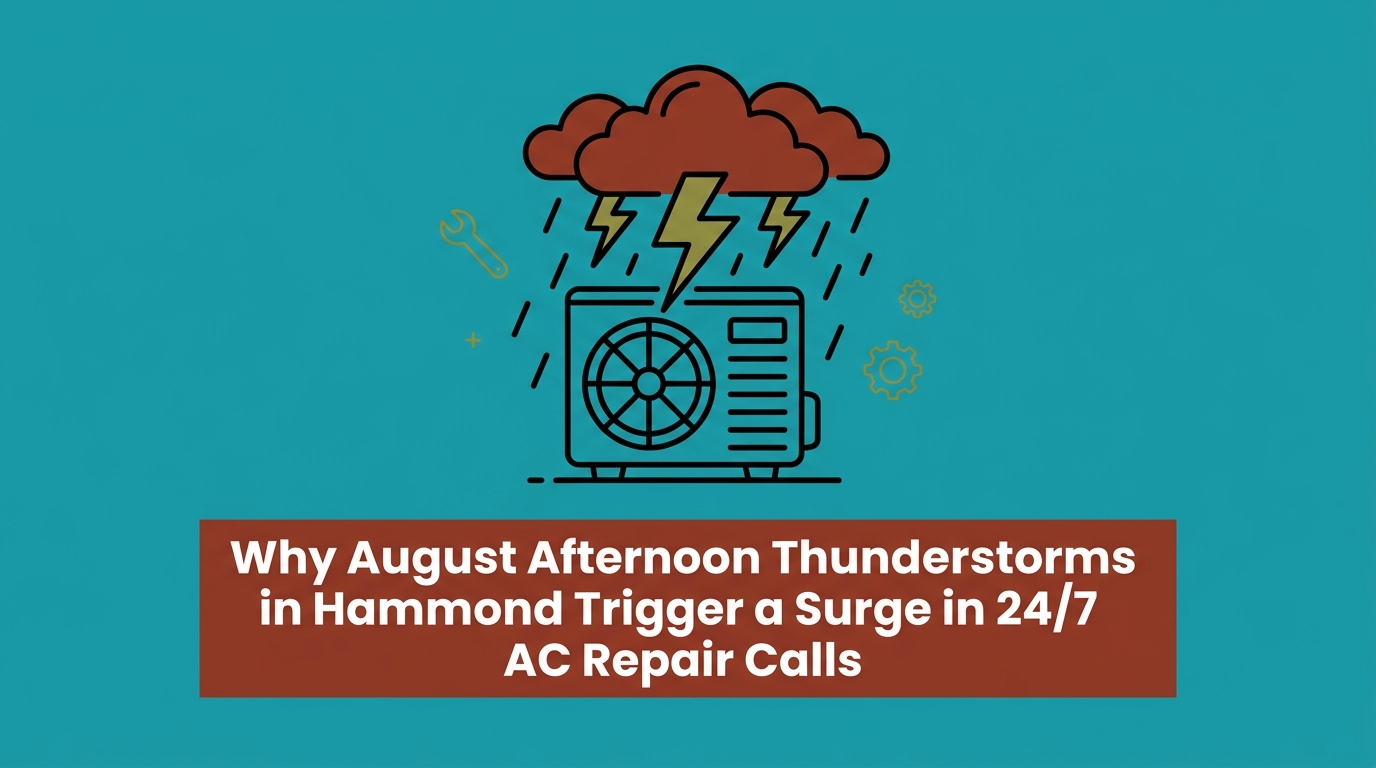
Why 24/7 AC Repair Calls in Hammond Surge During August Afternoon Thunderstorms
.webp)
When the Sky Darkens: The Immediate Impact of Late-Summer Storms on Your Cooling System
Late summer in South Louisiana brings a familiar pattern: sweltering, oppressive heat that suddenly breaks when the sky darkens and the wind picks up. At Cypress Cooling Company, we know firsthand that it is exactly this rapid weather shift that explains why 24/7 AC repair calls in Hammond surge during August afternoon thunderstorms. The sudden drop in temperature outside offers a brief reprieve, but the real crisis begins when the storm passes, the humidity spikes back up, and your cooling system refuses to turn back on. If your system remains completely silent after the clouds clear, you need professional air conditioning services to diagnose the electrical damage safely.
Our team typically sees this sudden loss of cooling as a widespread, shared experience across the local grid. When severe weather rolls through the region, it brings intense lightning and rapid power fluctuations. Homeowners are often left wondering if their system simply needs a reset or if they are facing a catastrophic electrical failure that requires emergency intervention. As families prepare for the back-to-school transition, the oppressive heat and humidity typical of South Louisiana in August mean that a broken air conditioner is not just a minor inconvenience—it is an urgent, uncomfortable emergency that compromises the safety of your home.
The Anatomy of a Localized Power Surge
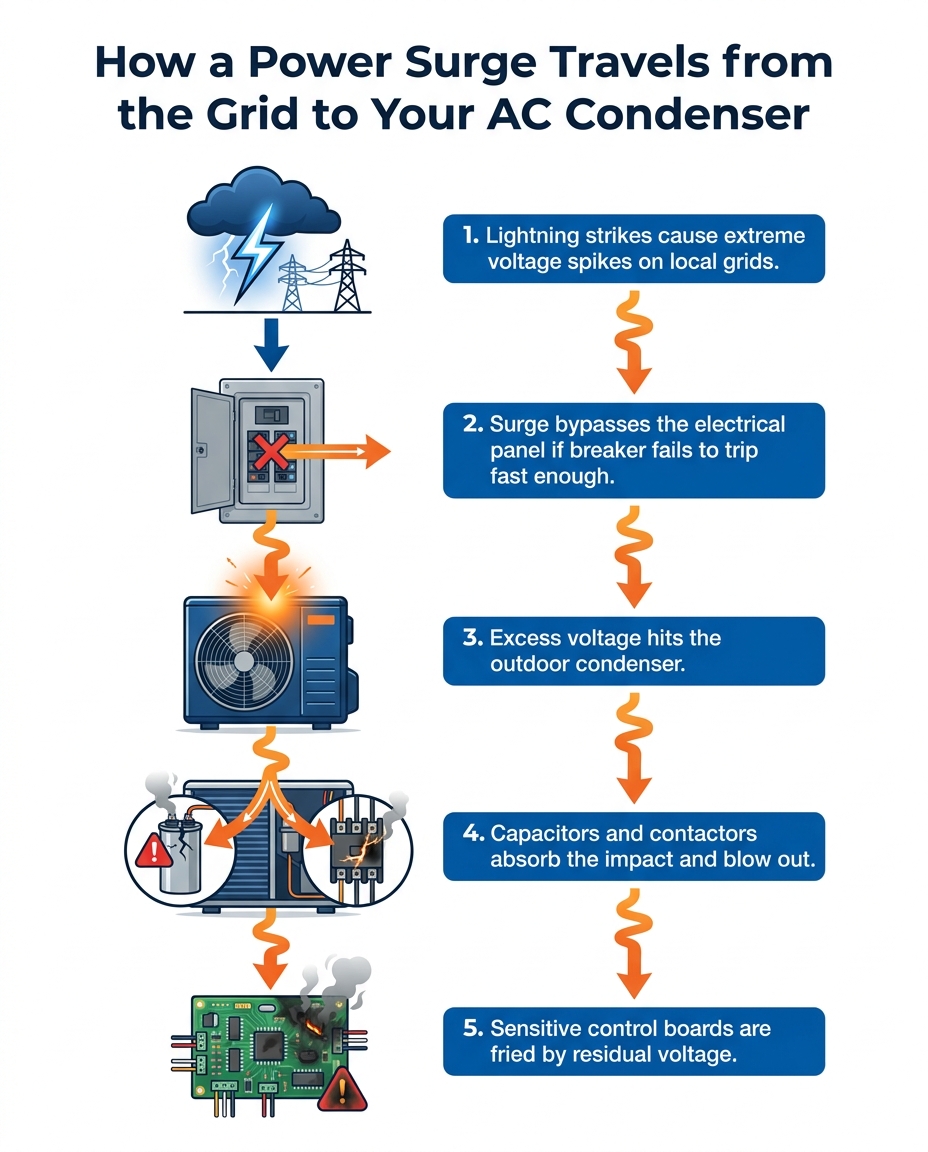
Understanding what happens to your outdoor condenser during a storm requires looking at the invisible forces traveling through your local power lines. Lightning strikes do not need to hit your home directly to cause severe damage. When lightning strikes a nearby transformer or power line, it sends thousands of volts surging through the localized electrical grid. These voltage spikes travel rapidly into residential electrical panels, seeking a path to the ground.
Your outdoor AC condenser is typically designed to operate on a standard 240-volt circuit. When a surge pushes a massive wave of excess voltage through those lines in a fraction of a second, the electrical components inside your HVAC system are subjected to extreme stress.
• Normal Operation — Voltage Level: 240 Volts — Impact on HVAC Equipment: System runs efficiently; components operate within safe thermal limits.
• Minor Grid Fluctuation — Voltage Level: 250 - 270 Volts — Impact on HVAC Equipment: Brief strain on capacitors; potential for slight overheating over time.
• Severe Lightning Surge — Voltage Level: 1,000+ Volts — Impact on HVAC Equipment: Instant destruction of sensitive microprocessors; blown capacitors; welded contactors.
This massive influx of energy is simply too much for standard residential HVAC equipment to handle. The immediate stress placed on the system is exactly why our technicians see so many units fail simultaneously across the same neighborhood after a heavy August downpour.

Tripped Breaker or Fried Component? Navigating the Post-Storm Silence
When the storm clears and your house begins to warm up, the first line of defense against electrical surges is your home's circuit breaker panel. The breaker is designed to detect abnormal electrical flow and sever the connection before a fire can start. If your AC system is unresponsive, checking the electrical panel is the safest initial step a homeowner can take.
However, navigating the aftermath of a severe storm requires caution. A tripped breaker is a symptom, not the root cause. If you discover a circuit breaker tripping when your AC turns on, it is a clear indicator that the system is pulling far more amperage than is safe.
Safe Visual Checks for Homeowners:
1. Locate the main electrical panel: Open the door and look for the dedicated double-pole breaker labeled for the air conditioner.
2. Check the breaker position: A tripped breaker will sit in the middle position, neither fully ON nor fully OFF.
3. Perform a single reset: Firmly push the breaker to the OFF position until it clicks, then push it back to the ON position.
4. Listen to the system: If the breaker immediately trips again with a loud pop, or if the outdoor unit makes a harsh buzzing sound, stop immediately.
The Danger of Repeated Resets: Our team strictly advises that you must never repeatedly reset a breaker that continues to trip. A breaker that refuses to stay on indicates a severe short circuit or a grounded component within the outdoor unit. Forcing power back into a compromised system can turn a localized component failure into a catastrophic compressor burnout or an electrical fire. This is the absolute threshold where basic homeowner troubleshooting ends and professional diagnostics must begin.
Visual Signs of Severe Electrical Damage
Without ever opening an access panel or touching a wire, you can look for visual and olfactory clues at the outdoor unit. Walk outside and inspect the condenser. Do you smell a sharp, metallic odor similar to ozone or burnt plastic? Do you see visible scorch marks on the exterior casing near where the electrical whip connects to the unit?
If you notice any of these signs, stay away from the equipment. The outdoor unit utilizes 240 volts of alternating current, which is extremely dangerous and potentially lethal. Diagnosing internal electrical faults, testing live wires, and replacing damaged components post-storm is strictly reserved for licensed HVAC professionals with the proper insulated tools and training.
Why Contactors and Capacitors Act as the "Weakest Link"
During intense August late-summer afternoon thunderstorms, the raw power components inside your outdoor unit take the brunt of the electrical assault. Specifically, the contactor and the capacitor act as the "weakest links" in the chain, frequently sacrificing themselves to protect the much more expensive compressor.
• The Contactor: This is the high-voltage switch responsible for sending power to the compressor and the condenser fan motor. When your thermostat calls for cooling, a low-voltage signal pulls the contactor closed, allowing 240 volts to flow. During a power surge, the excessive heat can literally weld the metal contacts together, causing the system to run continuously, or it can pit and burn the contacts so severely that they fail to close at all.
• The Capacitor: This component acts as a high-voltage energy storage device, similar to a powerful battery. It provides the massive jolt of torque required to start the compressor and the fan motor. Capacitors are highly sensitive to voltage spikes and heat. A surge will often cause the internal materials to boil and expand, resulting in a swollen, ruptured, or completely blown capacitor.
When a capacitor blows, you will typically hear a loud humming or buzzing sound coming from the outdoor unit, but the fan blades will not be spinning. We recently had a Hammond homeowner reach out to us late on a Saturday night when their outdoor unit started buzzing loudly after a storm. One of our technicians arrived Sunday morning, diagnosed a blown capacitor, and used an alternate part to temporarily restore cooling so the family could get out of the heat until the exact OEM replacement arrived.
The Ripple Effect of a Blown Capacitor
A failing capacitor does more than just stop your AC from working; it creates a dangerous ripple effect throughout the system. Without the starting torque provided by the capacitor, the compressor struggles to turn on. It begins pulling what is known as "Locked Rotor Amps" (LRA)—a massive amount of electrical current that causes the compressor to overheat rapidly.
If the system is left running in this state, the internal windings of the compressor will eventually melt and short out. Replacing a blown capacitor promptly is critical to saving the compressor. A capacitor is a relatively standard repair, but a grounded compressor requires a complete, labor-intensive system replacement. Prompt professional diagnosis stops this destructive chain reaction in its tracks.
The Hidden Danger of Fried Control Boards
While capacitors and contactors deal with raw, high-voltage power, modern air conditioners also rely on highly sensitive electronics. The control boards and defrost boards act as the brain of the system, coordinating the timing of the fan motors, the compressor, and the communication with your indoor thermostat.
These microprocessors are instantly destroyed by even minor voltage spikes that manage to bypass the breaker panel. Unlike a capacitor, which might swell visibly when it fails, a fried control board often shows no obvious physical damage. Technicians must use specialized multimeters to trace low-voltage shorts and verify that the board is no longer sending or receiving signals.
During a recent late-summer swelter, just as families were prepping for the new school year, our dispatch team helped a local customer who faced a complete system shutdown after a severe weather event. Our technician arrived promptly, diagnosed the complex electrical failure, and not only replaced the damaged components but performed preventive maintenance to secure the system against the next wave of storms. This level of diagnostic work underscores the strict prohibition on DIY control board replacement. The complex wiring harnesses and high-voltage risks make it a job exclusively for trained experts.
Temporary vs. Permanent Fixes
When a proprietary control board is fried by an August afternoon thunderstorm, the exact manufacturer replacement part may need to be ordered from a supply house. In emergency situations, our technicians sometimes use universal control boards or alternative components to temporarily restore cooling. The primary goal is always to get your family out of the dangerous heat safely while waiting for the permanent, OEM components to arrive.
Why Immediate Emergency Response is Critical in Sweltering Heat
Electrical damage from severe weather does not respect normal business hours. A storm can roll through Hammond at 4:00 PM on a Friday, leaving your home without air conditioning heading into the weekend. In South Louisiana, the urgency of this situation cannot be overstated. The oppressive humidity combined with ambient temperatures pushing past 90 degrees can make a house uninhabitable within a matter of hours.
When an upstairs AC unit died overnight on a sweltering late-summer weekend, one of our local customers submitted a Sunday morning service request. The Cypress Cooling dispatch team responded within 20 minutes, getting a technician on-site to diagnose the fatal electrical damage and coordinate a complete system replacement by Tuesday. This rapid response is why having access to 24/7 emergency dispatch availability is so crucial. Residents cannot afford to be left stranded overnight or over a long weekend when indoor temperatures are rising to dangerous levels.
To combat these sudden failures, you need a team capable of dispatching fully stocked trucks. Our technicians arrive equipped with a wide range of universal capacitors, contactors, and diagnostic tools to resolve the most common storm-related electrical failures on the spot. If you find yourself sweating through a post-storm blackout, reaching out for Hammond AC repair ensures that a professional is en route to restore your comfort.
Restoring Comfort When Minutes Count
The timeline of a rapid-response emergency call is designed to minimize your discomfort. From the moment our dispatch team receives your call, the focus shifts to getting a qualified technician to your driveway as safely and quickly as possible. The peace of mind that comes from having a professional diagnose and resolve a severe electrical issue within hours—even on a Sunday morning—is invaluable when your home feels like an oven.
Proactive Defense: Shielding Your System from the Next Storm
While rapid emergency repair is essential, pivoting toward a proactive defense can save you from the stress of a sudden breakdown. You cannot control the intense August late-summer afternoon thunderstorms, but you can control how your HVAC system handles the resulting power grid fluctuations.
We highly recommend the installation of a whole-home surge protector at your main electrical panel, coupled with a dedicated HVAC surge protector installed directly at the outdoor condenser. These devices act as electrical bouncers; they detect incoming voltage spikes and shunt the excess energy safely into the ground before it can reach your sensitive control boards and contactors.
Proactive Measures to Protect Your System:
• Install dedicated HVAC surge protection: Safeguards the specific microprocessors inside your condenser and furnace.
• Schedule seasonal check-ups: Allows technicians to spot weakened components before a storm pushes them over the edge.
• Maintain proper grounding: Ensures that if a surge occurs, the excess electricity has a clear, safe path to the earth.
• Clear debris around the unit: Prevents physical damage to the wiring and fan blades during high winds.
Ongoing care extends the lifespan of your equipment despite the harsh regional weather. By keeping up with preventative AC maintenance, you ensure your system is resilient enough to handle the demands of a South Louisiana summer.
The Value of Routine Electrical Inspections
During a routine maintenance visit, our technicians do much more than just change filters. We use specialized meters to measure the exact microfarads your capacitor is producing. If a capacitor is rated for 45 microfarads but is only producing 38, it is already failing and highly susceptible to blowing out during the next minor power surge. Technicians also inspect the high-voltage contactor for signs of pitting and carbon buildup. Preemptively replacing a weak, inexpensive component on a Tuesday afternoon prevents a massive emergency breakdown during a severe thunderstorm on a Saturday night.
Frequently Asked Questions About Storm-Damaged ACs
How do I know if a power surge ruined my AC?
The most obvious sign is a system that remains completely unresponsive after the power returns. You may also notice a tripped breaker that immediately trips again when reset, a loud humming noise from the outdoor unit with a fan that won't spin, or a distinct burning plastic smell near the equipment. Any of these symptoms require a professional diagnostic.
Why is my AC breaker tripping after a thunderstorm?
Your AC breaker trips to protect your home from an electrical fire when the system pulls too much current. After a thunderstorm, a tripping breaker usually indicates a short circuit, a grounded compressor, or a melted contactor caused by a power surge. Never repeatedly reset a breaker that continues to trip.
Can a lightning strike damage an air conditioner without a direct hit?
Yes, absolutely. Lightning does not need to strike your home directly to cause severe damage. A strike to a nearby power pole or transformer sends a massive voltage spike through the local electrical grid, which travels directly into your home's wiring and can instantly fry your AC's sensitive control boards.
How long should I wait to turn my AC back on after a power outage?
Our team recommends waiting at least 15 to 20 minutes before turning your AC back on after a power outage. This waiting period allows the refrigerant pressures inside the system to equalize. Forcing the compressor to start against unequal pressure puts immense strain on the motor and can lead to premature failure.
What does a blown AC contactor look or sound like?
A blown contactor often has visible black scorch marks, melted plastic housing, or metal contacts that are physically welded together. Sound-wise, you might hear a rapid clicking or chattering noise from the outdoor unit, or the system might run continuously without ever shutting off because the switch is stuck in the closed position.
Don't Let a Power Surge Leave You Stranded in the Heat
A silent air conditioner following a heavy Hammond thunderstorm is not just a nuisance; it is a serious electrical issue that requires immediate attention. When voltage spikes compromise your contactors, capacitors, or control boards, the damage is done, and the system cannot heal itself. Validating that you need professional help is the first step toward restoring the safety and comfort of your home.
Attempting to diagnose high-voltage electrical failures on your own is incredibly dangerous. Calling for emergency replacement of fried components is the correct, safe next step. Reach out to the local experts at Cypress Cooling Company who understand the unique impacts of regional weather on HVAC equipment, and get the immediate diagnostic help you need to get your family back into a cool, comfortable environment.
OUR CLIENTS HAVE TO SAY ABOUT US



Service areas
Our service areas are designed to meet the diverse needs of our clients. We focus on providing exceptional service and ensuring customer satisfaction in every location we operate.