Why Your AC is Running Constantly But Not Cooling Your Westwego Sunroom
.webp)
Is Your AC Losing the Battle Against Your Sunroom?
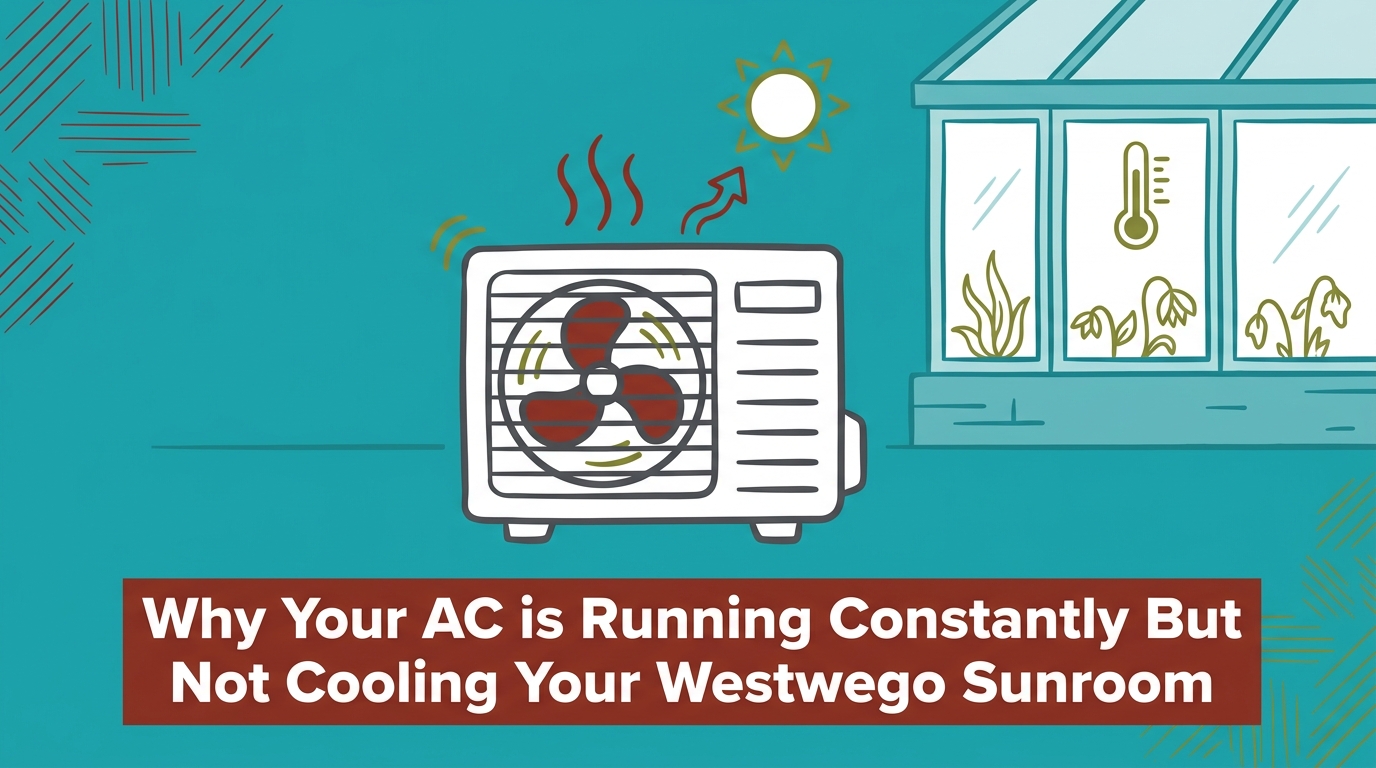
The late August heat load is unforgiving, and if you are wondering why your AC is running constantly but not cooling your Westwego sunroom, you are experiencing a common structural capacity mismatch. At Cypress Cooling Company, our team regularly sees this exact scenario as local families deal with the end-of-season back-to-school heat. Your main central cooling unit is likely operating exactly as designed, yet the thermostat simply cannot satisfy the demand of that specific room. The air blowing from the sunroom registers might feel weak, or it might feel cold but lack the volume necessary to drop the ambient temperature. Meanwhile, the outdoor compressor continues to run non-stop, attempting to overcome a thermal barrier it was never engineered to handle.
This situation presents a critical decision point for homeowners. You can keep pushing the central AC to its absolute limits—risking an end-of-season breakdown when the equipment is already fatigued—or you can accept that the sunroom requires a dedicated supplemental cooling strategy. Validating this issue requires understanding that a hot sunroom is rarely a sign of a broken air conditioner; rather, it is a sign of a fundamental architectural difference between the addition and the rest of your home. If you are concerned about the health of your air conditioning system, professional assessment is the safest next step.
Common signs of a capacity mismatch include:
• Continuous operation: The outdoor compressor runs for hours without cycling off during the heat of the day.
• Temperature disparities: The main living areas become freezing cold while the sunroom remains uncomfortably warm.
• Weak airflow: The volume of air reaching the sunroom vents is noticeably lower than in rooms closer to the indoor air handler.
• Rising utility bills: Energy consumption spikes because the system never reaches the target temperature to trigger a shut-off.
The Thermal Dynamics of Westwego Sunroom Additions
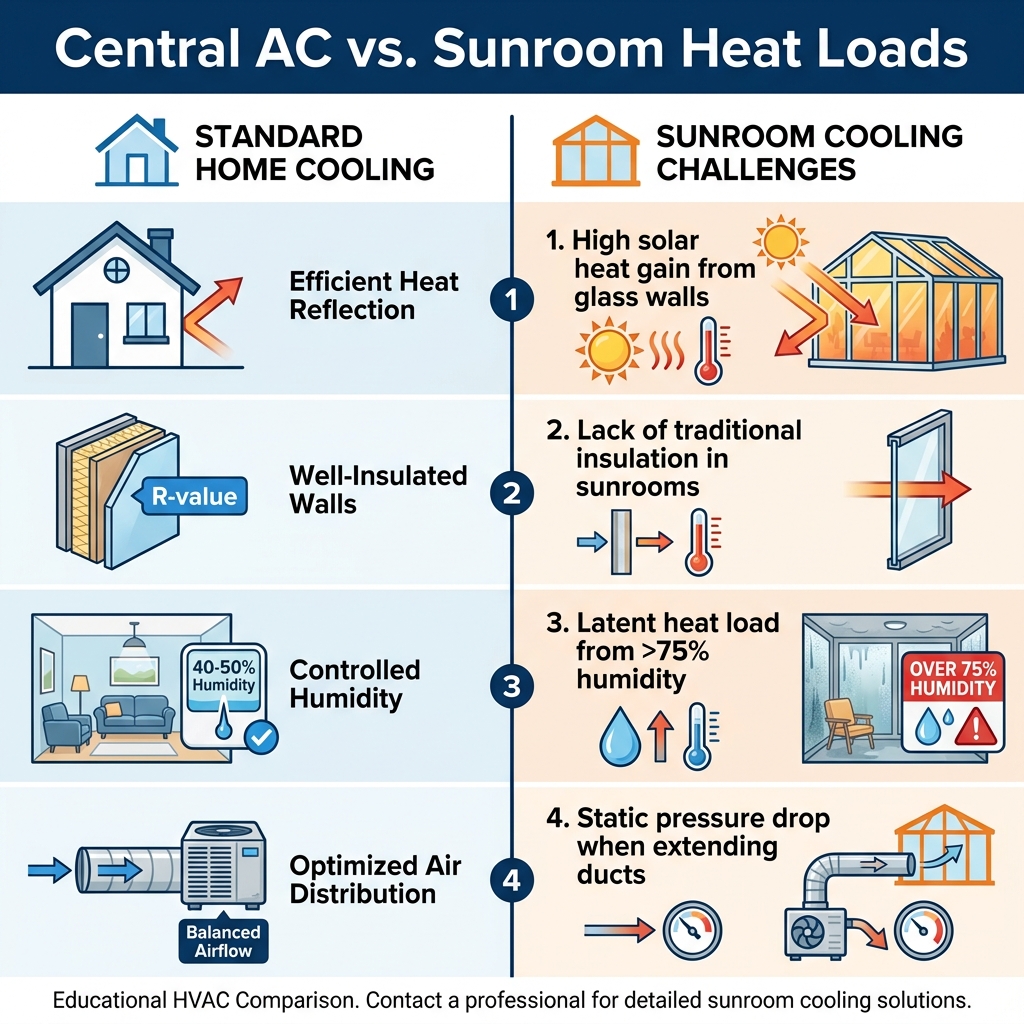
To understand why an otherwise healthy central unit cannot overcome the heat in a sunroom, you have to look at the physics of the space. Westwego sunroom additions are typically constructed with high glass-to-wall ratios. Standard interior rooms are surrounded by insulated walls, covered by an insulated attic, and shaded by a roof overhang. Sunrooms lack these thermal barriers, resulting in drastically different solar heat gain coefficients. Solar radiation penetrates the glass, strikes the floors and furniture, and converts into sensible heat that becomes trapped inside the room.
When the original home was built, the HVAC system was sized using a strict mathematical formula known as a Manual J calculation. This calculation dictates the exact tonnage required to cool a specific square footage based on insulation values, window placement, and ceiling height. Because Westwego sunroom additions are typically retrofitted onto existing slabs or decks long after the central AC was installed, their extreme thermal load was never factored into that original math.
Comparing Thermal Loads: Standard Room vs. Sunroom
• Insulation Barrier — Standard Interior Room: R-13 to R-19 in walls, R-30+ in attic — Sunroom Addition: Minimal wall space, often no traditional attic
• Solar Heat Gain — Standard Interior Room: Low (limited window area, shaded by eaves) — Sunroom Addition: Extremely High (expansive glass, direct sunlight)
• Cooling Design — Standard Interior Room: Accounted for in original Manual J load calculation — Sunroom Addition: Added later; not factored into central AC capacity
• Airflow Resistance — Standard Interior Room: Short, direct duct runs from the air handler — Sunroom Addition: Long, extended duct runs with pressure loss
Because the central unit lacks the raw capacity to absorb this massive influx of heat, many homeowners ultimately find that a dedicated ductless mini-split installation is the most effective way to restore comfort without modifying the original ductwork.

How Extreme South Louisiana Humidity Amplifies Sunroom Heat
Temperature on a thermometer only tells half the story. The other half is latent heat, which refers to the moisture content in the air. Weave in the reality of late-summer South Louisiana weather, where humidity levels frequently exceed 75%, and you have an environment that places maximum strain on residential cooling systems. When humidity infiltrates poorly sealed additions, it drastically changes how the room feels and how the equipment must operate to cool it.
Air conditioners do not just lower sensible heat (the actual temperature); they also remove latent heat by drawing warm, moist air across a freezing cold evaporator coil. The moisture condenses into water and drains away, leaving drier air to be circulated back into the room. However, when the August heat load pushes indoor humidity to extreme levels, a central AC struggles to dehumidify a glass-heavy room efficiently. The system ends up running constantly to remove the moisture, which inadvertently overcools the rest of the house. You are left with a freezing living room and a sunroom that still feels sticky and warm.
The Latent Heat Challenge:
• Infiltration: Sunrooms with multiple sliding doors and expansive windows often have higher rates of air leakage, allowing heavy, humid outdoor air to seep in constantly.
• Evaporator Coil Overload: The indoor coil becomes saturated trying to condense excessive moisture, reducing its ability to lower the actual air temperature.
• The "Sticky" Feeling: High humidity prevents human sweat from evaporating, making an 80-degree sunroom feel like it is 90 degrees.
Understanding why your AC runs constantly in Gulf Coast heat requires recognizing that managing moisture is just as critical as managing temperature, and central systems are rarely zoned to handle one extremely humid room independently.
The Hidden Trap of Extending Existing Ductwork
When faced with a hot sunroom, a common DIY impulse is to simply cut a hole in the main trunk line and run a cheap vent extension into the new space. While this seems logical, it almost always fails to solve the problem and frequently creates new ones. Central systems are engineered as closed loops, sized precisely for the original floor plan's static pressure. Static pressure is the resistance to airflow within the ducts; it ensures that air is pushed evenly to every room in the house.
Tapping into existing ducts to feed Westwego sunroom additions is like poking a hole in a pressurized water hose. The pressure drops everywhere. The new sunroom vent barely trickles out cool air because it is at the end of a long, unpressurized run, while the rest of the house suffers from reduced airflow. This creates severe hot and cold spots throughout the original floor plan and places immense strain on the blower motor, which now has to work harder against an unbalanced system.
Our technicians at Cypress Cooling Company recently helped a local homeowner who experienced a situation where their house was uncomfortably hot during the day, and the indoor temperature simply could not match the thermostat settings. The root cause we discovered in the attic was a detached vent bleeding conditioned air into the unconditioned space, destroying the system's static pressure. Once our team reattached the vent and restored the closed loop, the AC's performance dramatically improved, cooling the house effectively again. This perfectly illustrates how sensitive duct systems are to pressure changes. Without recalculating static pressure and utilizing custom ductwork design, DIY vent extensions are a waste of energy.
The Mechanical Risks of Non-Stop AC Operation
Allowing your central air conditioner to run continuously to cool a sunroom is not just inefficient; it is mechanically dangerous. HVAC systems are designed to cycle on and off. When the late-summer heat load forces the system to run non-stop for 12 to 16 hours a day, the internal components are pushed far beyond their intended duty cycles. This excessive wear and tear accelerates the degradation of critical electrical and moving parts.
The first components to suffer are typically the capacitors and contactors. A capacitor stores the electrical energy needed to jump-start the compressor and fan motors. Constant operation overheats these cylindrical devices, causing them to bulge, leak, and eventually fail. When a capacitor fails, the motors cannot start, leaving you without any air conditioning. More severely, continuous operation prevents the compressor—the heart of the entire system—from resting and cooling down. A compressor that runs non-stop in extreme heat is highly susceptible to thermal overload and catastrophic failure.
Mechanical dangers of continuous operation:
• Overheated Capacitors: Constant electrical draw degrades the internal components, leading to sudden starting failures.
• Pitted Contactors: The electrical switches that control the high-voltage components wear out rapidly from constant electrical arcing.
• Blower Motor Strain: Pushing air continuously against compromised static pressure burns out the indoor fan motor.
• Compressor Burnout: The outdoor compressor overheats and seizes, resulting in a total system failure during the hottest part of the year.
The risk of complete compressor failure during peak cooling season is a valid concern. The disruption to your home and the necessity for emergency Westwego AC repair and service far outweigh the effort of implementing a proper supplemental cooling strategy for the addition.
Comprehensive FAQ: Troubleshooting Your Sunroom Cooling Issues
Why is my AC running but not cooling my house?
When an AC runs constantly but fails to cool, it usually indicates a capacity mismatch, restricted airflow, or a heavy latent heat load. If you have recently added Westwego sunroom additions, the central unit is likely undersized for the new total square footage. The system is absorbing too much heat from the addition, preventing the thermostat from ever reaching its set point and causing continuous operation.
Can a central AC cool a sunroom effectively?
Generally, a standard central AC cannot cool a sunroom effectively unless it was specifically oversized and zoned for that space during construction. Oversizing a central unit to accommodate a sunroom usually causes short-cycling in the main house, leaving the rest of the home damp and uncomfortable. Dedicated zoning or independent supplemental units are required for glass-heavy additions.
How do you cool a sunroom in high humidity?
Cooling a sunroom in high humidity requires dedicated dehumidification capabilities that operate independently from the main house. Ductless mini-split systems are highly effective because they handle both sensible cooling and aggressive moisture removal within that specific zone. Relying on ceiling fans is insufficient, as fans only move air and do not remove the latent heat (moisture) from the room.
Does closing vents in other rooms help cool an addition?
No, closing vents in unused rooms does not push more cold air into an addition and can actually severely damage your system. Closing vents increases the static pressure inside the ductwork, which strains the blower motor and reduces overall airflow over the indoor evaporator coil. This restriction frequently leads to frozen coils and subsequent compressor damage.
What is the best way to cool a sunroom in the summer?
The best way to cool a sunroom is to install a dedicated ductless mini-split system. These units provide independent temperature control, allowing you to manage the extreme solar heat gain of the sunroom without freezing out the rest of the house. They are highly energy-efficient and prevent your central AC from overworking itself into premature failure.
Why does my AC run constantly in high humidity?
Air conditioners run constantly in high humidity because they must remove the moisture (latent heat) from the air before the thermostat registers a drop in actual temperature (sensible heat). If a sunroom is poorly sealed, humid outdoor air constantly infiltrates the space, forcing the AC to run continuously in a futile attempt to dehumidify the room.
Professional Solutions for Lasting Sunroom Comfort
When a central system fails to cool a specific architectural space because of fundamental design differences, the right next step is implementing a dedicated, professional solution. Relying on window units or portable floor air conditioners might offer temporary relief, but they are noisy, inefficient, and often struggle against the heavy latent heat loads typical of the region. A permanent supplemental cooling strategy, such as a ductless mini-split, is the optimal choice. It operates independently, providing precise comfort control for the sunroom while allowing the main central AC to return to its normal, efficient duty cycle.
Protecting your primary central unit from premature failure requires professional intervention. A qualified technician will not just guess at the required cooling capacity; they will perform professional capacity load calculations tailored to the unique dimensions, glass exposure, and insulation levels of Westwego sunroom additions. This specialized approach ensures that the new equipment is perfectly sized to handle the extreme solar heat gain without short-cycling.
Working with our team at Cypress Cooling Company ensures you have professionals who possess deep local expertise in diagnosing airflow, static pressure, and capacity load calculations throughout Metairie and Westwego. We understand firsthand that a sunroom acts like a greenhouse and requires a different approach than a standard bedroom. Our professional evaluation will assess the integrity of your current ductwork, measure the static pressure, and determine exactly how much supplemental cooling is necessary to make the space usable year-round.
Stop Overworking Your AC and Start Enjoying Your Sunroom
There is immense relief in securing a clear, technical solution rather than guessing with DIY duct modifications or temporary fans. Ending the constant, non-stop operation of your central unit protects your primary investment from the brutal late-summer heat load and prevents costly end-of-season breakdowns. You deserve a clear technical explanation of why central air isn't designed for sunroom heat loads and a definitive path forward. Reach out to a local expert to evaluate your space, calculate the true thermal load, and explore professional supplemental cooling alternatives so you can finally enjoy your addition in total comfort.
OUR CLIENTS HAVE TO SAY ABOUT US


Service areas
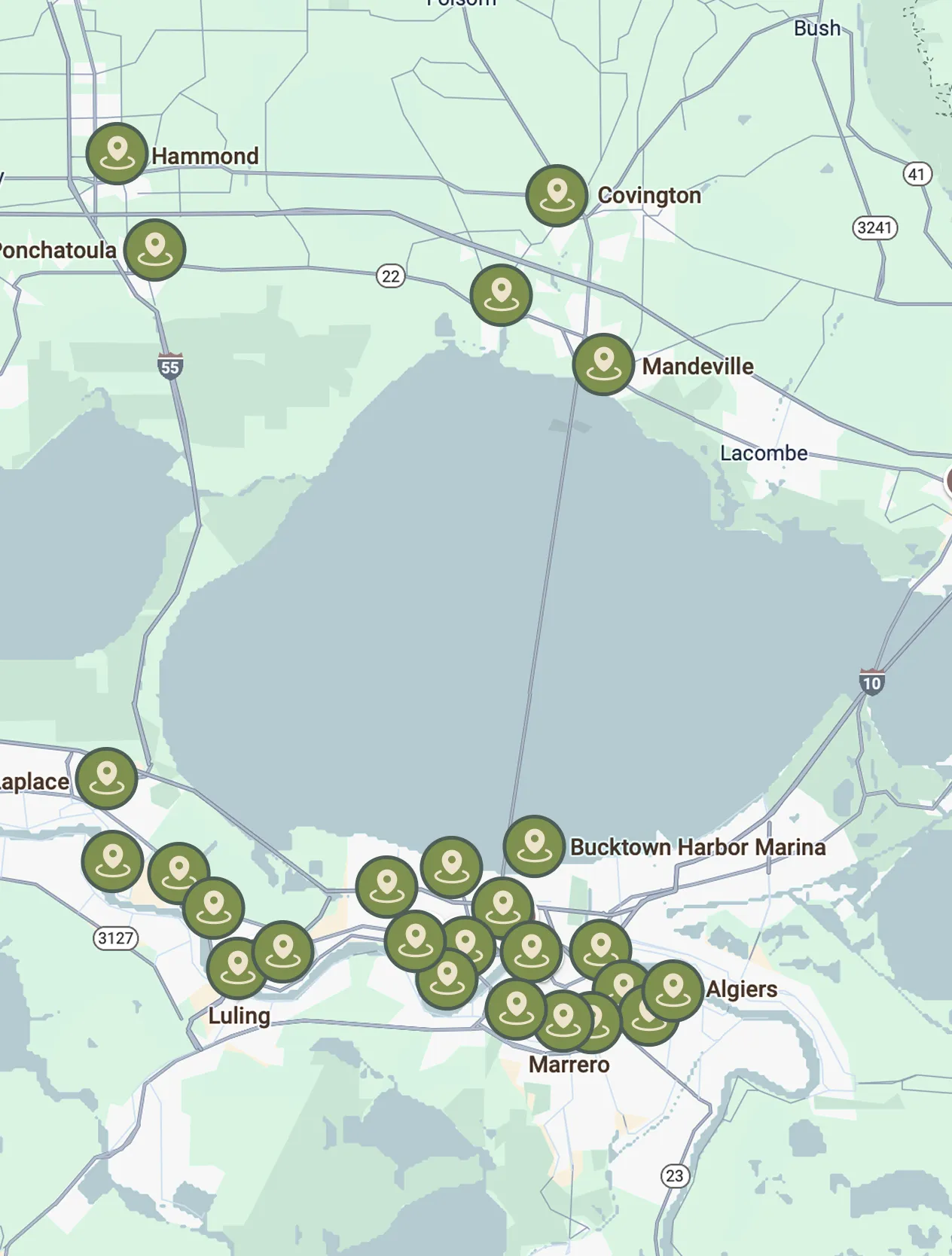
Our service areas are designed to meet the diverse needs of our clients. We focus on providing exceptional service and ensuring customer satisfaction in every location we operate.