
Evaluating the Lifespan of Rooftop Commercial HVAC Units in Hammond's Industrial Parks
.webp)
The Reality of Rooftop HVAC Degradation in Hammond Industrial Parks
When you are evaluating the lifespan of rooftop commercial HVAC units in Hammond's industrial parks, you quickly realize that standard rulebooks do not always apply. Your commercial building's air conditioning is running nonstop, but the warehouse floor still feels uncomfortably warm. That strange mechanical whining from the roof is not going away on its own, and your energy bills are steadily climbing. As a facility manager, you are facing a critical decision: do you patch a struggling, sun-beaten unit to limp through the rest of the season, or is it time for a full replacement before total failure halts your business operations?
For comprehensive support, explore our air conditioning services to keep your commercial facility running smoothly.
Commercial units located in Hammond Industrial Parks operate under immense environmental stress. At Cypress Cooling Company, our technicians see firsthand how South Louisiana summers bring a unique combination of intense heat radiation and extreme ultraviolet (UV) exposure that acts as a catalyst for accelerated mechanical wear. While a standard rooftop unit (RTU) might hum along happily for decades in a mild climate, the local microclimate here forces compressors, condenser fans, and electrical components to work at their absolute limits.
This relentless environment means that standard manufacturer guidelines often fall short. A facility manager cannot simply look at a generic chart to determine if a rooftop unit is going to survive another brutal summer. Instead, you need an educational, localized framework to make informed decisions—which is exactly what our team provides during every commercial consultation. Understanding the specific forces degrading your equipment is the first step in knowing whether an emergency patch will hold, or if a planned replacement is the only way to protect your inventory and your workforce.
Why Standard ASHRAE Lifespan Charts Don't Apply in South Louisiana
The problem: National averages suggest a long, predictable life for commercial cooling equipment, but we regularly see local units fail years ahead of schedule. The cause: Generic charts do not account for regional extremes. The solution: Adjusting your expectations and maintenance schedules based on the realities of the Gulf Coast climate.
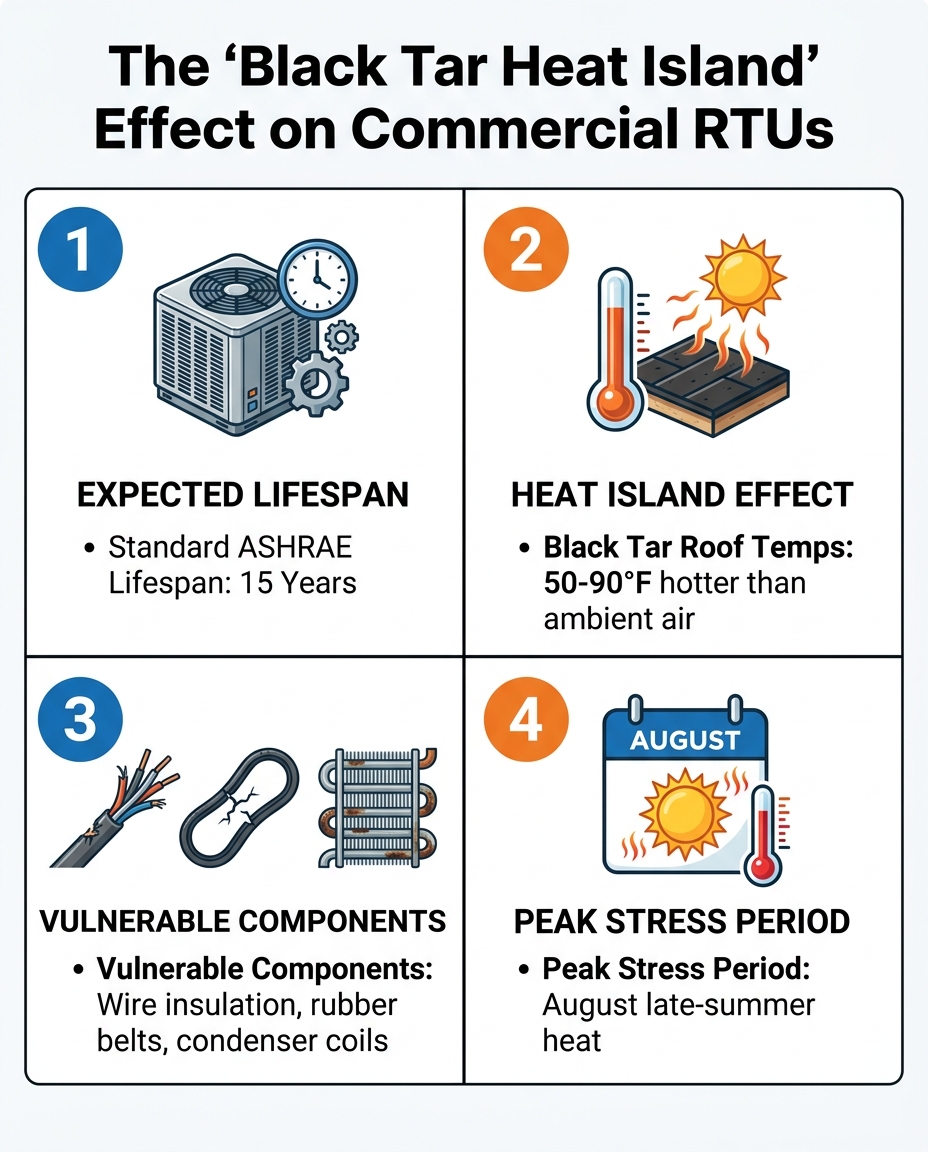
The American Society of Heating, Refrigerating and Air-Conditioning Engineers (ASHRAE) sets the industry standard for equipment life expectancy. According to their widely referenced charts, the estimated lifespan of a standard commercial packaged rooftop unit is approximately 15 years. This 15-year baseline is used by accountants for depreciation and by facility managers for capital planning across the country. However, this number assumes moderate climates, standard operational loads, and predictable seasonal cooldowns.
When our team contrasts these national averages with the reality of how long AC units last in South Louisiana, a stark difference emerges. In our region, the August late-summer heat brings a punishing mix of high ambient temperatures and thick humidity. A unit that is rated to last 15 years in Ohio might start showing signs of severe terminal decline at year 10 or 11 down here. The concept of localized microclimates is crucial; the environment immediately surrounding your rooftop unit accelerates cumulative wear far beyond what national averages predict.
The Gap Between Manufacturer Testing and Real-World Application
Manufacturer testing environments are highly controlled. Engineers run units in test chambers to simulate aging, but these chambers rarely replicate the intense, prolonged humidity and heat combinations found locally. A test chamber might cycle through heat and cold, but it does not factor in a month-long stretch where the nighttime temperature never drops below 80 degrees, giving the compressor zero time to truly cool down.
In our years of servicing commercial facilities across Metairie and Hammond, we have noticed that continuous high-load operation drastically reduces the practical lifespan of compressors and motors. When an RTU runs constantly to fight off the August late-summer heat, the internal motor windings run hotter, the lubricating oils break down faster, and the contactors arc more frequently. This constant stress means the gap between what the manufacturer promises on paper and what you experience on your roof is significant.
The 'Black Tar Heat Island' Effect on Commercial RTUs
One of the most significant factors our installation crews encounter driving accelerated wear in Hammond Industrial Parks is the roofing material itself. Many commercial facilities utilize dark, flat roofs coated in black tar, modified bitumen, or dark EPDM rubber. These materials are incredibly durable against rain, but they are highly problematic for thermal management.
Dark commercial roofs absorb rather than reflect solar radiation. While a white or reflective roof bounces the sun's energy back into the atmosphere, a black tar roof acts like a massive thermal battery, soaking up the heat all day long. Department of Energy (DOE) data indicates that dark roofs can reach temperatures 50 to 90 degrees hotter than the surrounding ambient air. On a day when the weather forecast says it is 95 degrees outside, the surface temperature of your commercial roof could easily exceed 160 degrees.
This extreme temperature creates a localized 'heat island' directly around the rooftop unit. Air conditioning works on the principle of heat transfer; the system absorbs heat from inside the building and rejects it outside through the condenser coil. However, for the condenser to reject heat efficiently, the outside air must be cooler than the refrigerant inside the coil.
When the RTU is sitting in a 160-degree heat island, the strain placed on the condenser is immense. The system is forced to reject heat into an already superheated environment. This causes the refrigerant head pressure to spike, forcing the compressor to work twice as hard just to achieve the same amount of cooling. Over time, we see this daily thermal punishment bake the internal components, leading to premature mechanical failure and skyrocketing energy consumption.

UV Degradation: How Sun Exposure Destroys Wires and Belts
Beyond the ambient heat, the sheer intensity of the sun's ultraviolet rays plays a massive role in equipment breakdown. UV degradation is a slow, invisible process that fundamentally alters the physical properties of the materials inside your HVAC system.
Here is a step-by-step look at how our technicians observe UV exposure systematically destroying vital components:
1. Chemical Bond Breakdown: UV rays carry high amounts of energy. When this light hits the polymers in your system, it breaks the chemical bonds that keep plastics and rubbers flexible. Over months of exposure during the August late-summer heat, these materials lose their elasticity.
2. Wire Insulation Embrittlement: The protective casing around electrical wires is highly vulnerable. As the UV rays bake the insulation, it becomes brittle, shrinks, and eventually cracks open. This exposes the bare copper wiring underneath to moisture and metal casing.
3. Rubber Belt Snapping: In commercial RTUs that utilize belt-driven blower motors, the rubber belts are subjected to intense thermal and UV stress. The rubber dries out, glazes over, and develops micro-fissures. Eventually, the weakened belt snaps under the torque of the motor.
4. Condenser Component Degradation: Plastic fan blades, zip ties holding wiring harnesses, and rubber isolation pads under the compressor all degrade. When isolation pads flatten and harden, the unit vibrates more, which can lead to cracked refrigerant lines.
The operational risks of UV degradation are severe. Exposed wiring easily leads to electrical shorts, blown fuses, and blown capacitors, while snapped belts cause immediate system failures and frozen evaporator coils. Facility managers can often spot the visual signs of UV degradation during a basic visual inspection—look for faded, chalky plastics, cracked rubber hoses, and wiring that looks stiff or splintered—but our technicians are trained to evaluate the deeper impact during routine maintenance.
Assessing Cumulative Wear: The Impact of August Heat
The problem: Units that ran perfectly in May suddenly fail in late summer. The cause: Cumulative wear-and-tear that builds up invisibly over the preceding months. The solution: Evaluating performance drops carefully with a professional to determine if the system is just dirty, or if it is dying.
August is historically one of the most demanding months for cooling loads. By the time the back-to-school transition arrives, your rooftop units have been fighting high temperatures non-stop for over 90 days. The damage we see in late summer is rarely the result of a single day's heat; it is the concept of cumulative wear-and-tear. The microscopic degradation of bearings, the slow thinning of electrical contact pads, and the gradual breakdown of capacitor fluids all build up invisibly over May, June, and July.
As these components degrade, efficiency loss compounds. A worn motor draws more amperage to do the same amount of work. A dirty, sun-baked condenser coil rejects less heat. This leads to longer run times, which in turn causes more wear, creating a vicious cycle that results in higher utility bills and diminished cooling capacity inside the building. Recognizing this pattern provides our clients with a framework for evaluating end-of-summer performance drops versus catastrophic failure.
The 50% Rule in a Local Context
Facility managers often rely on the traditional 50% rule: if the cost of a repair exceeds 50% of the unit's current value, it is time to replace it. However, we always advise our clients to adjust this rule for facilities in our region. When factoring in the accelerated degradation curve of sun-beaten units during the August late-summer heat, a unit that is 10 years old might have the operational wear of a 15-year-old unit elsewhere.
If a major component like a compressor fails on an older unit, paying for a massive repair is often a poor investment. The new compressor will be pushing refrigerant through old, degraded coils, and running alongside brittle wiring. In a harsh microclimate, the 50% rule should often be tightened—if a repair approaches even 30% to 40% of replacement value on a heavily degraded unit, replacement is usually the smarter financial move.
Emergency Patching vs. Planned Replacement: Making the Call
The primary decision point for any facility manager facing a broken RTU is whether to patch it or replace it. There are times when an emergency patch makes strategic business sense. For instance, if you are simply trying to bridge the gap to a planned off-season replacement, a temporary fix is highly logical. Keeping the warehouse operational for six more weeks until the weather cools down allows you to schedule a full replacement without disrupting peak business hours.
When you need immediate, temporary fixes to keep operations running, having access to dependable 247 commercial hvac services hammond is critical. Just recently, our dispatch team helped a local customer who experienced a capacitor failure on a Saturday night during a major heat wave. By utilizing our reliable 247 commercial hvac repairs hammond, one of our technicians responded on Sunday morning and used a universal temporary part to restore function immediately. This strategic emergency patch kept the building out of the heat and operational until the exact factory replacement part arrived later that week.
However, there are severe risks to patching a severely degraded unit. Here is a breakdown of how we help our clients make the call:
• Age and Condition — When to Patch (Repair): Unit is under 8 years old and in generally good physical condition. — When to Replace: Unit is over 10 years old, showing severe rust and UV degradation.
• Type of Failure — When to Patch (Repair): Minor electrical (capacitor, contactor) or simple mechanical (belt, fan motor). — When to Replace: Major systemic failure (compressor burnout, severe refrigerant leak in coils).
• Business Continuity — When to Patch (Repair): Need an immediate bridge to keep inventory safe until a planned swap. — When to Replace: Repeated downtime is costing more in lost productivity than a new unit.
• Financial Impact — When to Patch (Repair): Repair cost is well below the 50% threshold of the unit's remaining value. — When to Replace: Repair is expensive, and energy bills are already surging due to inefficiency.
Establishing clear indicators that a unit is beyond patching requires honest, on-the-ground assessments. By leveraging our local expertise, Cypress Cooling Company technicians can advise you when a patch is a smart bridge strategy versus when it is just throwing money at a dying unit. If the unit in Hammond Industrial Parks has a crumbling wiring harness, a leaking coil, and a struggling compressor, full replacement is required before total failure halts your business entirely.
Proactive Strategies to Extend Your Commercial Unit's Viability
While you cannot control the sun or the temperature of a black tar roof, you can implement preventative solutions to mitigate the environmental damage. In our experience, the critical role of a specialized HVAC maintenance plan cannot be overstated when combating microclimate wear. Proactive care is the only way to ensure your units reach their maximum possible lifespan.
Specific preventative actions make a massive difference. Our technicians can apply UV protectants to exposed wiring harnesses to keep the insulation flexible. Clearing condenser coils of industrial debris, dust, and pollen ensures the system can reject heat efficiently, lowering the head pressure and reducing strain on the compressor. Regularly monitoring and adjusting belt tension prevents snapping and ensures optimal airflow through your ductwork.
Regular end-of-season and pre-season inspections catch degradation before it causes an emergency shutdown. Having a professional evaluate the system after the August late-summer heat allows you to spot weakened capacitors or frayed belts while the unit is still running. The long-term return on investment (ROI) of proactive care in harsh environments is undeniable. It lowers monthly utility costs, prevents catastrophic weekday breakdowns, and extends the timeline before capital expenditure is required for a replacement.
Frequently Asked Questions About Commercial HVAC Lifespans in Louisiana
How long do commercial rooftop HVAC units last in Louisiana?
In South Louisiana, our team typically sees commercial rooftop units last between 10 to 15 years. While national averages suggest up to 20 years, the intense heat, high humidity, and extreme UV exposure significantly accelerate mechanical wear. Units located in harsh microclimates, like Hammond Industrial Parks, often fall on the shorter end of that spectrum without meticulous maintenance.
When should you replace a commercial AC unit?
We recommend replacing a commercial AC unit when repair costs exceed 40% to 50% of the unit's remaining value, or when breakdowns become frequent enough to disrupt business operations. Additionally, if the unit is over 12 years old, uses outdated R-22 refrigerant, and shows signs of severe coil corrosion, replacement is the most cost-effective long-term choice.
What is the life expectancy of a packaged rooftop unit?
The standard ASHRAE life expectancy for a packaged rooftop unit is 15 years under normal conditions. However, constant exposure to extreme heat radiation from dark commercial roofs can reduce this expectancy. Regular preventative maintenance from a qualified technician is required to help the unit reach this 15-year benchmark in a southern climate.
Can you patch a commercial RTU to get through the summer?
Yes, patching a commercial RTU is often a viable strategy to bridge the gap through the end of the summer season. Minor repairs like replacing a capacitor, swapping a fan motor, or sealing a small leak can keep the building cool temporarily. This allows facility managers to plan and budget for a full replacement during the milder off-season.
How does a black tar roof affect commercial HVAC efficiency?
A black tar roof absorbs solar radiation, creating a localized heat island that can be 50 to 90 degrees hotter than the ambient air. This extreme heat forces the rooftop unit's condenser to work much harder to reject heat from the building. The increased strain lowers the system's cooling efficiency, increases energy consumption, and accelerates component wear.
Is it better to repair or replace a commercial HVAC unit?
In our professional opinion, it is better to repair if the unit is relatively young, the breakdown is a minor component, and the system is otherwise well-maintained. It is better to replace if the unit is past its warranty, suffers from major failures like a dead compressor, or if repeated emergency service calls are draining your maintenance budget.
Make a Confident Decision for Your Hammond Facility
Ultimately, localized environmental factors demand a localized evaluation approach. Standard lifespan charts simply cannot account for the brutal realities of black tar roofs and relentless UV exposure in Hammond Industrial Parks. Deciding whether to patch or replace your commercial cooling equipment should always be based on actual cumulative wear, the condition of the internal components, and the strategic needs of your business.
Do not wait for a catastrophic failure to force your hand. At Cypress Cooling Company, we encourage facility managers to seek professional, honest assessments to secure their operations before the heat takes its final toll. For expert guidance and reliable Hammond HVAC services, reach out to our trusted local team that understands exactly what it takes to keep your commercial building comfortable, efficient, and fully operational year-round.
OUR CLIENTS HAVE TO SAY ABOUT US



Service areas
Our service areas are designed to meet the diverse needs of our clients. We focus on providing exceptional service and ensuring customer satisfaction in every location we operate.

