
Preparing Your Hammond Commercial Building's Boiler for Winter Operations
.webp)
The Critical Window for Commercial Heating Diagnostics
September is the critical transition month for local facilities, and Preparing Your Hammond Commercial Building's Boiler for Winter Operations requires far more than just turning up the thermostat. Before the first major fall temperature drop arrives, facility managers face a very concrete problem: ensuring that massive commercial heating systems are actually ready to handle the load safely. At Cypress Cooling Company, we consistently remind our clients that after sitting idle throughout the long, hot summer, commercial boilers need their water pressure, pump operation, and safety limits rigorously validated. Skipping this September pre-heating-season transition phase often leads to the exact emergency shutdowns we are called out to fix right when your building needs reliable heat the most.
To secure your building's comfort and operational stability, explore our heating services or consider establishing a formalized preventative maintenance plan before the cold weather sets in.
The core decision point for any building owner or facility manager is understanding exactly which pre-season checks require a licensed commercial HVAC professional versus what your in-house facility staff can safely monitor on a daily basis. Commercial boilers are highly pressurized, complex pieces of industrial equipment. While visual inspections are a vital part of daily facility management, the actual testing, calibration, and validation of boiler safety mechanisms demand specialized tools and licensing. Approaching this transition with a professional, safety-first mindset is the most effective way we've found to manage risk, protect your infrastructure, and keep your business running without interruption.
Thermal Shock and the Louisiana Climate Challenge
The Problem: In our years of maintaining commercial HVAC systems across Metairie and Hammond, we've seen firsthand how the climate in our region presents a unique set of challenges for heavy-duty heating equipment. Mild fall periods frequently interrupted by sudden, sharp cold snaps put immense expansion and contraction stress on commercial boiler systems. When a massive cast-iron or steel boiler sits at room temperature and is suddenly forced to fire at maximum capacity to combat a rapid freeze, the structural integrity of the metal is tested.
The Cause: This rapid temperature fluctuation can lead to a phenomenon known as thermal shock. Thermal shock occurs in improperly maintained boilers when cold return water hits a blazing hot heat exchanger, causing the metal to contract unevenly and violently. In Hammond commercial districts, where retail centers, business parks, and office buildings rely on consistent environmental control, our technicians frequently observe how this sudden stress can literally crack boiler sections. The risk is compounded if the system's water flow or pressure controls are out of calibration after a long summer slumber.
The Solution: Preventative, highly technical diagnostics mitigate these climate-induced risks entirely. By gradually testing and validating the system during the mild September pre-heating-season transition, our professionals ensure that mixing valves, pressure regulators, and temperature controls are operating exactly as designed. This allows the boiler to heat up evenly and safely, absorbing the unpredictable mild-to-freezing temperature shifts without sustaining internal damage. Proper preparation transforms an unpredictable weather event into a routine operational day for your facility.
Facility Staff Visual Monitoring vs. Licensed Professional Diagnostics
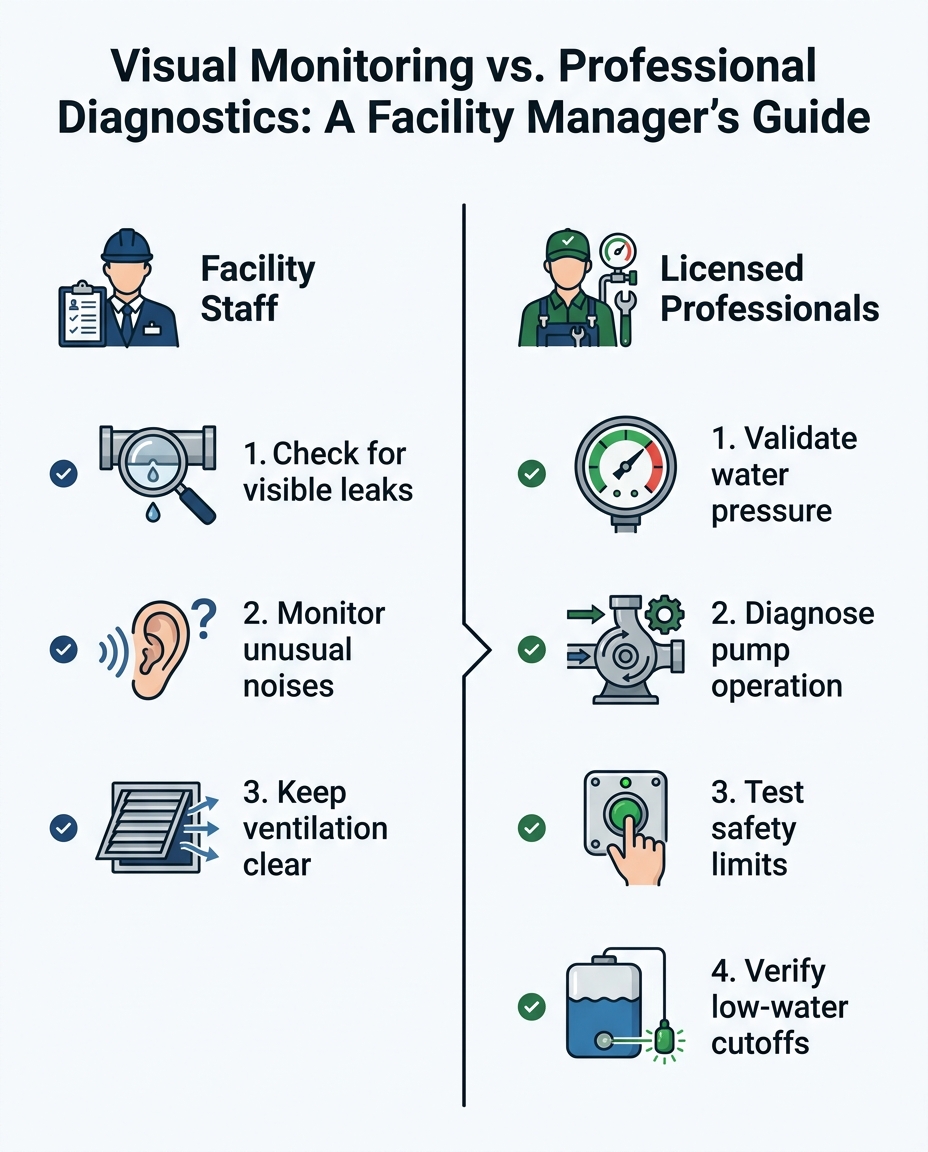
Clearly delineating the responsibilities between your in-house facility team and licensed HVAC technicians is crucial for building safety. A commercial boiler room is not the place for guesswork. Knowing exactly what to look for—and exactly when to call in specialized help—protects both your staff and your equipment.
When our licensed Cypress Cooling Company technicians arrive on-site, the critical professional boiler checks we perform include:
• Water pressure validation: Calibrating pressure-reducing valves and verifying expansion tank integrity.
• Pump operation diagnostics: Testing circulator pumps for proper voltage, amperage, and flow rates.
• Safety limit testing: Forcing the system to hit high-limit thresholds to ensure automatic shutoffs engage.
• Low-water cutoff verification: Blowing down the system to confirm the boiler will not dry-fire if water levels drop.
Partnering with experts for Hammond commercial HVAC services ensures these critical risk-management steps are handled safely and thoroughly.
Daily and Weekly Visual Inspections
Your on-site maintenance staff plays an essential role in keeping the boiler system secure between professional visits. Facility managers should train their teams to conduct daily or weekly visual walkthroughs of the boiler room. Staff should check for visible signs of trouble, such as pooling water around the base of the unit, fresh soot marks near the burners, or unusual grinding or whistling noises. Logging baseline gauge readings on a clipboard is also a great practice. However, the golden rule of visual monitoring is simple: observe and document, but never adjust. Staff should record the pressure and temperature readings without ever attempting to turn a valve or modify a setting.
The Scope of Licensed Interventions
Internal component testing and calibration strictly require professional licensing and specialized tools. Modern commercial boilers in Hammond commercial districts operate under immense pressure and utilize highly sensitive electronic controls. Attempting to bypass a safety limit, adjust a pressure relief valve, or bleed a massive commercial expansion tank without the proper credentials can lead to catastrophic system failure or severe injury. Professional diagnostics should be viewed as a necessary risk-management investment, establishing a documented baseline of safety before the heating season begins.

Validating System Water Pressure and Expansion Tanks
Water pressure is the driving force that ensures efficient heat distribution across a large commercial footprint. If the pressure is incorrect, the heated water cannot properly circulate to the furthest reaches of your building, leaving certain zones freezing while others overheat. Validating this pressure is a highly technical process that must be completed during the September pre-heating-season transition.
• Pressure Too High — System Symptoms: Relief valve constantly discharging water, gauge pegged near maximum. — Long-Term Risks: Severe stress on pipe joints, premature valve failure, potential system rupture.
• Pressure Too Low — System Symptoms: Poor heat circulation to upper floors, system lockouts, strange gurgling noises. — Long-Term Risks: Boiler short-cycling, localized freezing in remote pipes, uneven facility heating.
Our commercial HVAC technicians utilize calibrated gauges to verify that the pressure-reducing valves are feeding the correct amount of makeup water into the system. They also perform a rigorous verification of the expansion tank. If the expansion tank has lost its internal air charge or the internal bladder has ruptured over the summer, the system has no way to absorb the natural expansion of heated water. Re-establishing this balance requires draining specific zones, injecting the correct air charge, and meticulously bringing the system back online.
The Mechanics of Commercial Boiler Pressure
The science behind commercial boiler pressure is rooted in thermodynamics. As water heats up, its volume expands. In a closed-loop commercial heating system, that expanding water needs somewhere to go, or the pressure will spike dangerously high. The expansion tank acts as a critical shock absorber, utilizing a cushion of air to compress and make room for the expanding water. Verifying the integrity of this tank is non-negotiable. If the tank is waterlogged, the boiler's pressure relief valve will blow every time the system fires, flooding your mechanical room and forcing an emergency shutdown.
Evaluating Pump Operation and Circulation Integrity
The massive heat generated by a commercial boiler is completely useless if it cannot be moved efficiently throughout the building. This is the primary function of the circulator pumps. These heavy-duty industrial pumps push thousands of gallons of heated water through miles of piping in Hammond commercial districts, ensuring that every office, retail floor, and warehouse zone remains at a comfortable, stable temperature. Evaluating these pumps before the winter rush is a critical step in preventative diagnostics.
The risks of idle equipment: When a commercial heating system sits idle for six to eight months, the pumps are highly vulnerable. Seals can dry out and crack, bearings can lose their lubrication, and stagnant water can cause minor internal corrosion. If a pump suffers from cavitation—a condition where air bubbles rapidly form and collapse inside the pump casing—it can destroy the pump's impeller in a matter of days. Our team mitigates these risks during our fall tune-ups by measuring the electrical voltage and amperage drawn by each pump. A pump pulling too many amps is working too hard, indicating a failing bearing or a restriction in the line.
Diagnosing Idle-System Wear
Pumps are particularly vulnerable to seizing up after months of inactivity. A licensed technician uses specialized multimeters and flow-measuring devices to safely test these moving parts. They verify that the motor shaft spins freely, lubricate the bearing assemblies if required, and check the coupling alignments. Connecting healthy pump operation to consistent, reliable heating is straightforward: if the pumps fail, the heat stops moving. Protecting these circulation mechanisms directly protects your building occupants, your inventory, and your daily operations.
Testing Boiler Safety Limits and Low-Water Cut-Offs
Commercial boilers are equipped with a series of fail-safes designed to shut the equipment down before a catastrophic failure can occur. However, these safety mechanisms are mechanical and electronic devices that can degrade over time. Low-water conditions and safety limit failures are the leading causes of catastrophic commercial boiler damage nationwide. This is precisely why ASHRAE Standard 180 guidelines mandate rigorous, professional inspections of these specific controls at least once a year.
At Cypress Cooling Company, our team takes a highly technical, rigorous approach to these safety tests, prioritizing your business continuity over basic visual checks. A licensed technician will intentionally push the boiler toward its high-temperature limit to verify that the automatic shutoff engages exactly when it should. They will also test the pressure relief valves to ensure they are not seized shut with scale or calcium buildup. Framing these tests as the ultimate safeguard against facility downtime is accurate; a failed safety limit can result in a destroyed boiler, tens of thousands of dollars in emergency replacement costs, and weeks of freezing conditions inside your facility.
The Role of the Low-Water Cut-Off (LWCO)
The Low-Water Cut-Off (LWCO) is arguably the most important safety device on your entire boiler system. Its sole job is to prevent the boiler from dry-firing. If a pipe bursts or a hidden leak drains the water out of the boiler, the burners must shut off immediately. If cast iron or steel is heated to extreme temperatures without water to absorb the heat, the metal will warp, crack, and potentially fail explosively. The professional protocol for testing the LWCO during the September pre-heating-season transition involves safely blowing down the water column, watching the water level drop, and physically verifying that the burner circuit is instantly interrupted.
Prioritizing Business Continuity Through Preventative Maintenance
Synthesizing all these technical checks reveals one clear truth: professional boiler diagnostics are not just about equipment maintenance; they are about business continuity. Validating water pressure, ensuring smooth pump operation, and meticulously testing safety limits directly correlates to uninterrupted business operations. When the first major freeze hits Hammond commercial districts, our dispatch center inevitably fields frantic emergency service calls from facilities that skipped their fall diagnostics, leaving them to deal with shivering employees and face potential inventory damage from freezing pipes.
The logistical nightmare of a mid-winter boiler failure for a commercial property is immense. Sourcing industrial parts, scheduling emergency heavy-duty repairs, and managing the fallout from a cold building can disrupt your operations for days. By establishing a formalized maintenance schedule before the first freeze, facility managers take control of their environment. Reinforcing the value of partnering with specialized commercial HVAC experts ensures that your building's infrastructure is treated with the technical respect it demands. For more insights on protecting your bottom line, review the reality of commercial heating maintenance for Hammond retail stores.
Securing Your Facility for the Winter Ahead
A clear, technical overview of what a professional pre-season boiler check entails—specifically regarding water pressure, pump operation, and safety limits—ensures you know your building is ready for winter. Knowing your facility is secure allows you to focus entirely on your core business operations without worrying about infrastructure failures. To get ahead of the cold weather, reach out today to establish your customized preventative maintenance plan.
Frequently Asked Questions
What is included in commercial boiler maintenance?
Commercial boiler maintenance includes a comprehensive technical validation of the entire heating system. A licensed professional will calibrate water pressure, test circulator pumps, clean burner assemblies, and verify all electronic safety limits. This process also involves checking the expansion tanks and ensuring the low-water cut-off mechanisms are functioning perfectly.
Why are boiler safety limits and low-water cut-offs important?
These devices are the primary safeguards against catastrophic equipment failure and building damage. If a boiler loses water, the low-water cut-off instantly shuts down the burners to prevent the metal from dry-firing and cracking. Safety limits ensure the system automatically powers down if pressure or temperatures exceed safe operational thresholds.
How do professionals check commercial boiler water pressure?
Professionals check commercial boiler water pressure using calibrated industrial gauges attached directly to the system's supply and return lines. They compare these live readings against the manufacturer's specifications and the building's height requirements. If the pressure is off, they will carefully adjust the pressure-reducing valves and verify the air charge in the expansion tanks.
What happens if commercial boiler pressure is too high?
If commercial boiler pressure is too high, the system will force the pressure relief valve to open, discharging scalding water into your mechanical room. Chronically high pressure puts immense stress on pipe joints, valve seals, and the boiler vessel itself. Over time, this stress can lead to major leaks, premature component failure, and costly emergency shutdowns.
How often should commercial boilers be inspected according to ASHRAE standards?
According to ASHRAE Standard 180 guidelines, commercial boilers require at least one comprehensive professional inspection annually. This yearly diagnostic is typically scheduled in the early fall, right before the heating season begins. Regular, documented inspections are crucial for maintaining safety compliance and ensuring reliable winter operation.
What is the best month to schedule commercial boiler maintenance in Louisiana?
September is widely considered the best month to schedule commercial boiler maintenance in Louisiana. This early fall window allows technicians to validate pressure, pumps, and safety limits before the first unpredictable cold snap arrives. Pre-season scheduling ensures your facility avoids the emergency rush when winter weather officially hits.
OUR CLIENTS HAVE TO SAY ABOUT US



Service areas
Our service areas are designed to meet the diverse needs of our clients. We focus on providing exceptional service and ensuring customer satisfaction in every location we operate.

