
The Reality of Commercial Heating Maintenance for Hammond Retail Stores
.webp)
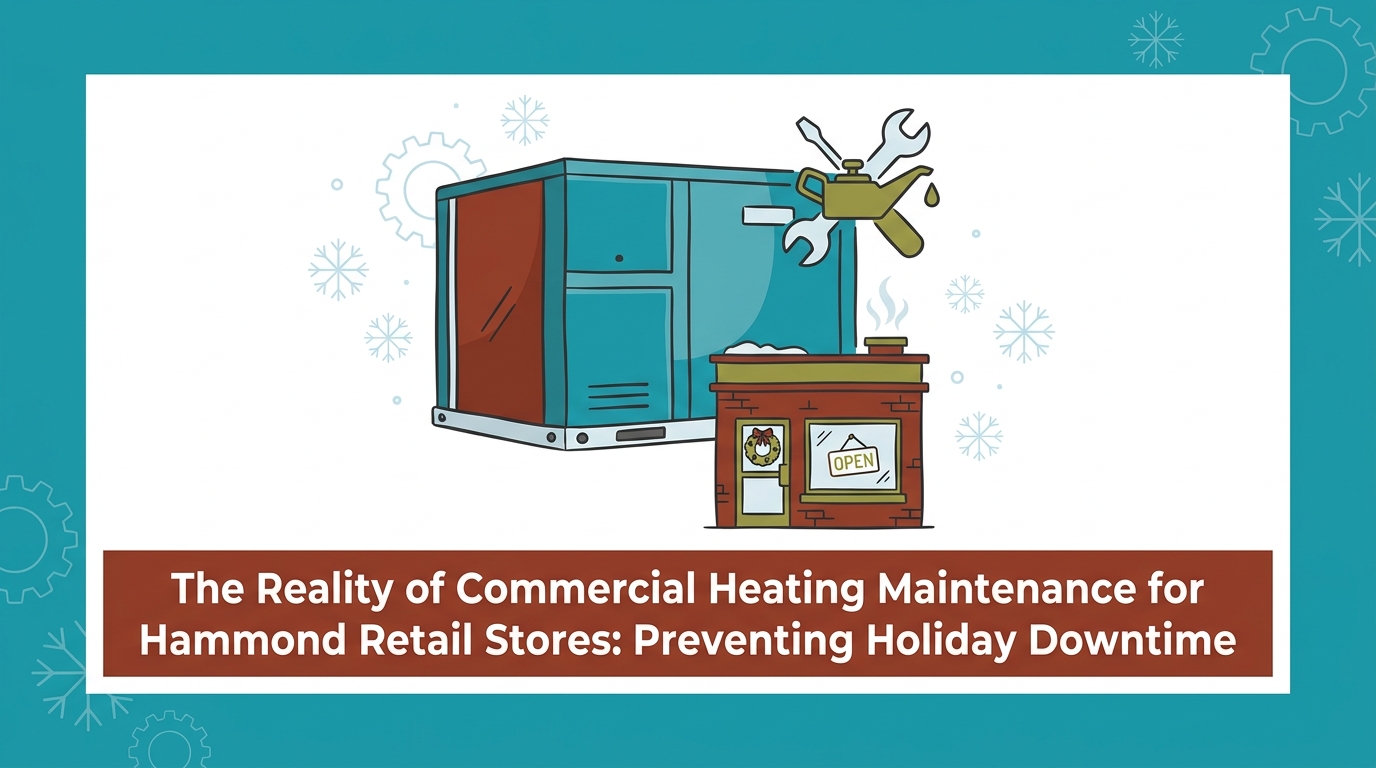
The Hidden Threat to Your Q4 Sales: Dormant Rooftop Units
Your retail store is prepping for the Q4 holiday rush, but a hidden mechanical failure might shut your doors on the busiest day of the year. The reality of commercial heating maintenance for Hammond retail stores is that the biggest threats to your business continuity develop quietly while your heating system sits idle. When the sudden cold snaps hit and you need your commercial rooftop gas heaters (RTUs) to perform, those underlying issues suddenly become catastrophic failures.
To protect your facility and your bottom line, securing professional commercial heating systems support is your first line of defense.
During the September pre-heating season, property managers face a critical decision point. You can either schedule a proactive early-fall inspection right now, or you can wait for the inevitable, business-halting breakdown later in the year. The approaching holiday shopping season means foot traffic will soon be at its peak. Your HVAC system is not just a mechanical asset on your roof; it is a vital component of your retail operation. Treating heating maintenance as a strategic liability prevention measure ensures that your doors stay open, your staff stays productive, and your shoppers stay comfortable.
How Louisiana's Humid Summers Damage Commercial Rooftop Gas Heaters (RTUs)
The problem: When the first real chill arrives in late fall, many property managers turn on their commercial rooftop gas heaters (RTUs) only to find the system blowing cold air, making strange noises, or failing to ignite entirely. The cause: Hammond's specific climate. Long, humid summers create the perfect environment for slow, hidden deterioration inside dormant equipment. The solution: Professional remediation and cleaning before the system is forced to operate under a heavy load.
The Impact of Dormancy and Humidity
For months on end, your heating components sit unused while the Louisiana humidity continuously cycles through the unit. This constant exposure to moisture takes a heavy toll on the internal mechanics.
• Condensation buildup: High ambient humidity causes moisture to collect on heavy metal components, pooling in areas that are difficult to dry out naturally.
• Accelerated oxidation: That trapped moisture rapidly accelerates rust scaling on sensitive parts, particularly the burner assemblies and heat exchangers.
• Electrical degradation: Constant humidity corrodes electrical connections, leading to voltage drops, blown fuses, and communication failures between your thermostat and the RTU.
Pest Intrusion in Rooftop Units
Beyond moisture, dormant commercial rooftop gas heaters (RTUs) provide an attractive, sheltered home for local wildlife. Birds, rodents, and insects frequently seek refuge inside the metal casing during the summer.
• Blocked airflow: Nests built inside exhaust flues and intake vents choke off the critical oxygen supply required for safe combustion.
• Electrical shorts: Rodents are notorious for chewing through control wiring, creating massive electrical shorts that prevent the system from firing up.
• Fire hazards: Dry nesting materials, leaves, and debris packed against the burner assemblies create an immediate and severe fire hazard upon the first ignition of the season.
• High Ambient Humidity — Hidden Damage: Rust scaling on metal components — Fall Consequence: Weakened structural integrity and component failure
• Dormant Equipment — Hidden Damage: Corrosion on electrical contacts — Fall Consequence: System fails to receive thermostat signals
• Unused Exhaust Flues — Hidden Damage: Bird and rodent nesting — Fall Consequence: Blocked ventilation and severe fire hazards
The Silent Danger: What Happens When a Heat Exchanger Cracks?
The heat exchanger is the most critical safety component inside your commercial rooftop gas heaters (RTUs). Its primary job is to safely separate the toxic combustion gases created by the burners from the breathable air supply that is pushed into your retail store. As the burners generate heat, the metal walls of the exchanger get extremely hot. The blower fan then pushes indoor air over the outside of these hot metal walls, warming the air before returning it to your storefront.
During the humid summer months, rust and corrosion slowly eat away at the metal of the heat exchanger, creating microscopic weak points. When the first cold snap hits and you turn on the heat, those weakened metal walls are suddenly subjected to intense, rapid temperature changes. The thermal expansion causes the rusted, weakened metal to flex and ultimately crack under the stress.
Once a stress fracture occurs, the barrier between the toxic combustion gases and your breathable air is broken. These microscopic cracks expand significantly as the metal heats up, allowing dangerous exhaust fumes to mix directly with the air circulating through your store. Understanding the lifespan of rooftop commercial HVAC units is critical because older units with heavy summer rust are at a much higher risk for this specific failure.
Inspecting for these cracks requires specialized tools and a licensed professional. Because the cracks often remain tightly closed when the metal is cold, a visual inspection by an untrained eye will miss them entirely. Professional technicians use combustion analyzers and specialized cameras to detect these dangerous fractures, making DIY checks impossible and highly dangerous.
Business Risks of Skipping Fall RTU Maintenance
Neglecting your commercial heating system during the September pre-heating season carries steep consequences for your retail operation. Waiting for a breakdown during the approaching holiday shopping rush exposes your business to several major risks:
• Unexpected facility closures: A total heating failure during peak shopping hours forces you to close your doors, directly impacting your Q4 revenue targets.
• Emergency repair premiums: When a unit fails on a holiday weekend or during a widespread cold snap, you face extended downtime while waiting for commercial-grade parts to be shipped and installed.
• Severe liability issues: Operating a malfunctioning gas heater creates immense safety hazards, including poor indoor air quality and potential fire risks that endanger your staff and customers.
• Decreased productivity: A freezing retail environment drastically reduces employee productivity and drives shoppers out of your store, leading to immediate lost retail sales.
• Avoidable breakdowns: Routine maintenance is a proven preventative measure. Industry data shows that professional tune-ups can reduce these unexpected breakdowns by up to 70-75%.
The Business Impact of Skipping Fall RTU Maintenance
70-75% Reduction in Breakdowns: Routine professional maintenance significantly drops the rate of unexpected commercial heating failures.
Immediate Evacuation Risks: Undetected CO exposure from cracked heat exchangers mandates sudden facility evacuations and emergency responses.
Severe Revenue Loss: Unplanned closures during the critical Q4 holiday shopping season directly impact your bottom line.
Carbon Monoxide Liability: Protecting Hammond Retail Storefronts
When a heat exchanger cracks, the primary danger introduced into your building is carbon monoxide (CO). Carbon monoxide is a colorless, odorless, and tasteless gas that is a natural byproduct of burning fuel. In a healthy commercial heating system, this gas is safely vented out through the roof. In a compromised system, it is pumped directly into your retail space.
For Hammond retail storefronts, the legal and ethical stakes are incredibly high. OSHA guidelines strictly mandate that employers provide a safe working environment, which includes maintaining proper indoor air quality. Exposing your employees and shoppers to carbon monoxide is a direct violation of these safety standards.
A CO leak in a retail setting leads to immediate facility evacuation. Once emergency responders are involved, your store will be shut down until the source of the leak is identified and completely resolved by a licensed professional. Beyond the immediate loss of sales, the severe liability issues stemming from customer or employee illness can be devastating to your business.
Because carbon monoxide cannot be detected without specialized equipment, framing professional heating inspections as a non-negotiable risk management strategy is essential. Property managers must prioritize early-fall inspections to verify the structural integrity of every heat exchanger on the roof before the heating season begins.
Why 24/7 Commercial HVAC Services in Hammond Are a Retail Safety Net
Hammond's weather is notoriously unpredictable. Sudden, sharp cold snaps in late October or November place immediate, heavy loads on heating systems that have been sitting dormant for months. When hundreds of commercial units across the city are fired up simultaneously, the stress inevitably triggers a wave of sudden RTU failures.
Having a reliable partner for 247 commercial hvac services hammond is critical for minimizing your revenue loss during these sudden weather shifts. Heating emergencies rarely happen during standard business hours. They happen overnight, on weekends, and right before major sales events. When weekend emergencies threaten to shut down your store during peak shopping days, you need immediate access to 247 heating repair hammond to keep your doors open.
Prompt 247 commercial hvac repairs hammond can mean the difference between a minor inconvenience and a completely lost weekend of sales. Fast response times are crucial when dealing with commercial equipment. For example, one Hammond customer reached out late on a Saturday night when an upstairs unit died overnight. A technician responded within 20 minutes on a Sunday morning, diagnosed the issue, and had a new system installed and running by Tuesday. That level of urgency is exactly what retail businesses require.
Working with Cypress Cooling Company provides the ultimate safety net for Hammond retail storefronts. Our 24/7 commercial HVAC availability ensures that when your rooftop unit fails, you have a dedicated team ready to restore your facility's comfort and protect your Q4 revenue.
For immediate assistance or to establish a reliable service partnership, explore our Hammond commercial HVAC services.
Securing Your Store Ahead of the Holiday Shopping Season
The transition from summer cooling to winter heating requires more than just flipping a switch on your thermostat. A comprehensive early-fall pre-heating-season tune-up is a detailed, multi-point process designed to verify the safety and efficiency of your commercial equipment. Implementing a proactive HVAC maintenance plan shifts your business from reactive emergency spending to predictable operational budgeting.
Here is what a professional pre-season tune-up entails for your commercial RTU:
1. Heat Exchanger Inspection: Technicians utilize combustion analyzers and visual tools to verify the absolute integrity of the heat exchanger, ensuring no cracks or rust scaling threaten your indoor air quality.
2. Burner Assembly Cleaning: All summer dust, debris, and potential nesting materials are carefully removed from the burner area to prevent fire hazards and ensure clean ignition.
3. Electrical Connection Verification: Every wire, terminal, and contact is inspected and tightened. Technicians check for voltage drops and ensure the system communicates flawlessly with your commercial thermostats.
4. Airflow and Ventilation Testing: The blower motor is calibrated, belts are checked for tension and wear, and the exhaust flues are cleared of any obstructions to guarantee safe venting of combustion gases.
5. Safety Control Calibration: High-limit switches and flame sensors are tested to ensure the unit will automatically shut down if unsafe conditions are detected.
September is the critical window to act. If you wait until the weather turns, you will be competing with hundreds of other businesses for limited service appointments. Cypress Cooling Company's proactive maintenance plans are specifically designed to prevent costly retail downtime, and we work directly with property managers to schedule these vital inspections around your store hours, avoiding any disruption to your shoppers.
Secure your facility today by setting up a proactive HVAC maintenance plan before the holiday rush begins.
Frequently Asked Questions
What causes a cracked heat exchanger in a commercial rooftop unit?
The short answer is thermal stress combined with corrosion. During the long summer months, humidity causes condensation to build up inside the dormant rooftop unit, leading to rust on the metal heat exchanger. When the unit is finally turned on and heats up rapidly in the fall, the rusted, weakened metal expands and cracks under the sudden temperature change.
Why is carbon monoxide dangerous in retail stores?
Carbon monoxide (CO) is a toxic, colorless, and odorless gas that cannot be detected by human senses. If a commercial heater leaks CO into a retail store, shoppers and employees can quickly suffer from headaches, dizziness, and severe illness. This creates an immediate safety hazard, forces emergency facility evacuations, and exposes the business owner to massive liability.
When should Hammond businesses schedule commercial heating maintenance?
September is the ideal time to schedule your commercial heating maintenance. Booking an inspection during the early fall ensures your rooftop units are cleaned, tested, and repaired before the first unpredictable Louisiana cold snap hits. This proactive timing guarantees your store remains comfortable and fully operational as the busy holiday shopping season begins.
How long do commercial rooftop units last?
Most commercial rooftop units (RTUs) last between 15 and 20 years with proper maintenance. However, units exposed to heavy coastal humidity, extreme heat, and skipped seasonal tune-ups often fail much sooner. Regular professional inspections and prompt repairs of minor issues are the best ways to maximize the lifespan of your commercial equipment.
What are the signs of a bad heat exchanger on a rooftop unit?
You may notice strange smells, soot buildup around the registers, or the system frequently shutting down prematurely. Because the heat exchanger is hidden deep inside the unit, visual signs are rare for the average user. The most definitive sign is a failed combustion analysis test performed by a licensed HVAC technician using specialized diagnostic tools.
Can a cracked heat exchanger be patched, or does the commercial unit require replacement?
A cracked heat exchanger can never be safely patched or welded. Because the metal expands and contracts constantly during operation, any patch will inevitably fail and leak dangerous carbon monoxide. If the heat exchanger is cracked, the specific component must be completely replaced, or, if the unit is older, the entire rooftop unit will need to be replaced.
Protect Your Q4 Revenue Today
Don't let a hidden mechanical failure derail your most profitable season. Securing a professional inspection during the September pre-heating season is the smartest way to protect your Hammond retail storefront from unexpected closures and severe carbon monoxide liability. Schedule your proactive maintenance today so you can focus on serving your customers with confidence.
OUR CLIENTS HAVE TO SAY ABOUT US



Service areas
Our service areas are designed to meet the diverse needs of our clients. We focus on providing exceptional service and ensuring customer satisfaction in every location we operate.