
The Metairie Homeowner's Dilemma: Patching a Leaky Coil vs. Full System Replacement
.webp)
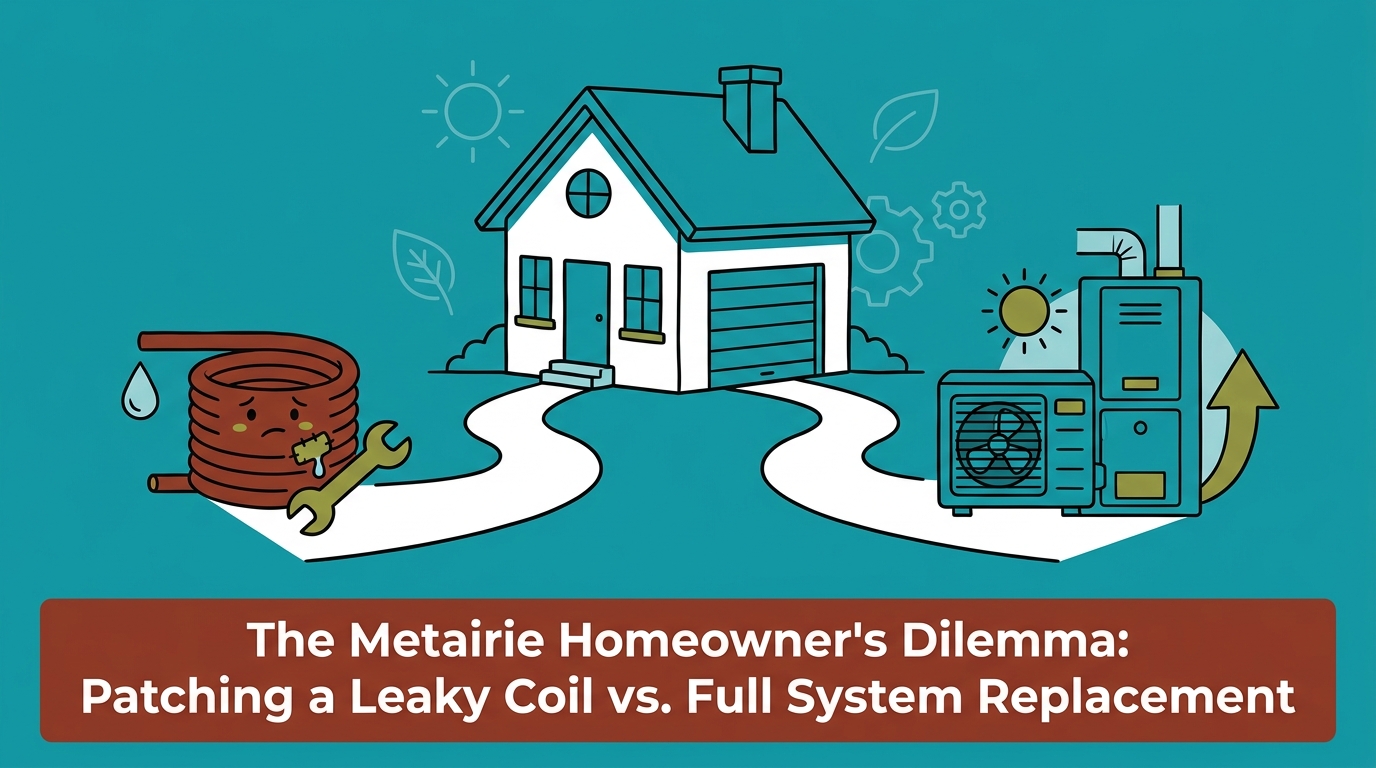
Facing a Major Coil Leak During Metairie's August Peak
Are you suddenly facing The Metairie Homeowner's Dilemma: Patching a Leaky Coil vs. Full System Replacement right when the summer heat is at its absolute worst? At Cypress Cooling Company, we find this is a question that usually strikes at the most inconvenient time possible. You notice your air conditioner is running non-stop, yet the house feels sticky, warm, and distinctly uncomfortable. You call for a diagnostic, hoping for a simple fix like a clogged drain line or a blown capacitor. Instead, our technicians deliver the frustrating news: your aging air conditioner has a major evaporator coil leak. During the August late-summer cooling season, this is one of the most stressful situations a homeowner can face.
When you are sweating through the peak of summer, the instinct is often to authorize whatever repair will get the cold air flowing again as quickly as possible. However, discovering a leaking evaporator coil on an older unit is not just a standard maintenance issue—it is a critical crossroads for your home's long-term comfort and energy efficiency. A major component failure forces you to evaluate the overall health of your system. If you need professional guidance to navigate this exact situation, reaching out to our team for comprehensive HVAC services can provide the objective assessment you need.
This decision should never be made under the pressure of a sweltering afternoon. It requires a clear, objective framework. You have to weigh the immediate relief of a patch job against the long-term reliability of a full system upgrade. By understanding how your system operates, the unique toll the local climate takes on its components, and the hidden risks of pairing new parts with old machinery, you can make a confident investment choice that protects your home and your peace of mind.
The Impact of South Louisiana Humidity on Aging Evaporator Coils
To understand why this specific failure is so common—and so devastating to an older system—you have to look at the environment. In our years of servicing Metairie, we know that intense heat and high humidity require air conditioners to run nearly continuously. Your system is not just lowering the temperature; it is actively pulling gallons of moisture out of the indoor air every single day. The evaporator coil is the exact place where this heavy moisture removal happens.
Near-continuous operation in subtropical climates puts maximum stress on HVAC components. The constant cycle of condensation, temperature fluctuation, and moisture exposure creates the perfect recipe for accelerated coil corrosion over time. If you want to dive deeper into the mechanics of this process, understanding what causes a frozen evaporator coil can shed light on how moisture and airflow issues compound into major failures.
When our team inspects an aging coil operating in this environment, we see a predictable process of deterioration:
1. Continuous Condensation: The coil remains perpetually wet as it extracts humidity from the warm indoor air.
2. Micro-Corrosion: Over years of operation, this constant moisture, combined with airborne volatile organic compounds (VOCs) from household cleaners and materials, begins to corrode the metal.
3. Formicary Corrosion: Microscopic pinhole leaks develop in the copper or aluminum tubing, allowing precious refrigerant to slowly escape.
4. Efficiency Collapse: As refrigerant levels drop, the system loses its ability to absorb heat and dehumidify the air, forcing the compressor to run longer and harder just to maintain a baseline temperature.
Why Late Summer is the Danger Zone for Coil Failures
By the time August arrives and families are gearing up for the back-to-school transition, your air conditioning system has already endured months of grueling, uninterrupted operation. This cumulative wear and tear means the system is operating at a deficit. The physical toll of constant condensation on older metal components reaches a breaking point. When a leak finally opens up late in the season, it is rarely an isolated incident—it is usually a symptom of systemic fatigue across the entire unit. A failing coil directly translates to massive efficiency loss, skyrocketing energy consumption, and a home that feels damp even when the thermostat says it is cool.
When Does Replacing Just the Coil Make Sense?
Despite the severity of a coil leak, we assure our customers there are absolutely scenarios where a targeted repair is the most logical and financially sound choice. Not every major component failure requires a trip to the scrap yard. The key is evaluating the overall vitality of the surrounding equipment.
A focused repair makes sense when the rest of the system is healthy enough to support the new component for years to come. For instance, our technicians recently helped a local homeowner who experienced water dripping from their ceiling due to a faulty drip pan this past spring. Because their system was relatively new and otherwise robust, we were able to diagnose the problem, order the specific component, and install it the same day, preventing further water damage without the need for a full replacement. The same logic applies to evaporator coils.
If you are considering repairing the coil, we recommend checking your situation against these criteria:
• The system is relatively new: Typically, if the unit is under eight to ten years old, it still has plenty of life left to justify a major repair.
• Active manufacturer warranty: If the unit is still under a manufacturer parts warranty, the cost of the replacement coil itself is covered, significantly lowering your overall investment.
• Strong performance history: The overall unit has a solid track record with no other major component failures, such as a struggling compressor or a failing blower motor.
• Modern refrigerant compatibility: The current equipment uses modern, readily available refrigerant (like R-410A) rather than obsolete, phased-out chemicals.
• Fast local execution: The repair can be executed quickly by our qualified Metairie AC repair team to restore your comfort without overcapitalizing on a unit that is already on its last legs.
If your system meets most of these criteria, replacing the evaporator coil is a smart, targeted fix that restores your home's comfort and gets your system back to peak efficiency.
The Hidden Risks of Patching an Older HVAC System
On the other side of the dilemma, patching a coil on a system that is well past its prime carries significant hidden risks. Based on the patterns we see during the August late-summer cooling season, the most critical thing to understand is the "band-aid" effect: fixing the evaporator coil does not reset the clock on an aging compressor, a worn-out blower motor, or degraded electrical contactors. These older components are already stressed to their limits.
One of the most pressing risks involves obsolete refrigerants. If your older system still runs on phased-out refrigerants like R-22, a leaky coil is a financial sinkhole. Because this older refrigerant is no longer manufactured, any leak leads to exorbitant, recurring recharge costs. Simply patching the leak and refilling the system is a temporary measure that delays the inevitable, often at a steep premium.
Furthermore, we often find that patched coils in high-humidity climates struggle to dehumidify effectively if the rest of the system is fatigued. If the blower motor isn't pushing air at the optimal speed, or the aging compressor isn't pumping refrigerant efficiently, the new coil won't perform to its specifications. You end up with a system that runs constantly but leaves the house feeling clammy and uncomfortable.
The Mismatched Efficiency Problem
When you install a brand-new, highly efficient evaporator coil and pair it with an old, fatigued outdoor condenser, you create a mismatched system. The new coil is designed to operate at modern efficiency standards, but it is bottlenecked by the older outdoor unit. This mismatch limits the performance of both components. The struggle to maintain indoor comfort and humidity control becomes highly noticeable, and the unequal workload often accelerates the failure of the older outdoor compressor. Instead of solving the problem, a mismatched repair often just moves the strain to the next weakest link in the chain.
Why Upgrading to a Full System Often Yields Better Long-Term ROI
When an older system suffers a catastrophic coil failure, redirecting the funds from a major, risky repair into a reliable, long-term home investment is frequently the wiser choice. Air conditioners in coastal and southern climates typically have a shorter lifespan—averaging 10 to 12 years—compared to the national average of 15 to 20 years. If your system is approaching or has passed this milestone, a full replacement offers benefits that a patch simply cannot match.
Consider the peace of mind that comes with a complete upgrade. For example, our team recently answered a late-night call from a local family whose upstairs AC died in the middle of a hot Saturday night during the summer. Because the unit was well past its prime and had a history of issues, they chose to upgrade rather than attempt another stressful repair. A Cypress Cooling Company technician diagnosed the fatal issue on Sunday morning, and we had the entire unit replaced and functioning perfectly by Tuesday, securing their comfort for the next decade.
Upgrading to a full system provides several distinct advantages:
• Superior Moisture Removal: Modern equipment must meet updated SEER2 efficiency standards, which offer significantly better dehumidification capabilities—a crucial benefit for surviving humid Louisiana summers.
• Comprehensive Warranty Coverage: A new system resets your warranty clock entirely, covering the compressor, coils, and all internal parts, protecting you from unexpected out-of-pocket expenses.
• Elimination of Cascading Failures: Replacing the entire system means you aren't waiting for the next old component to fail. The indoor and outdoor units are perfectly matched to operate at peak efficiency.
• Consultative Decision Making: Working with a team like ours that offers a consultative approach means you get help weighing long-term ROI rather than just being pushed into a quick, expensive fix.
If you are leaning toward starting fresh, exploring your options for a complete air conditioning replacement ensures that your home is equipped to handle the intense heat efficiently and reliably for years to come.
A Metairie Homeowner's Framework for the Repair vs. Replace Decision
Making the right choice requires an objective evaluation of your specific situation. When you are standing in a warm house in Metairie, our experts recommend using this framework to clarify your path forward.
First, consider the age of the system. The critical threshold in southern climates is the 10-to-12-year mark. If your system is younger than this, repair is often viable. If it is older, replacement becomes highly recommended. Second, evaluate the performance history. Have you had to call for repairs frequently over the last two years? Does the system struggle to keep the humidity down even when it is running? Past performance is a strong indicator of future reliability.
Our team often suggests conceptually applying the "5,000 Rule." This involves multiplying the age of your equipment by the estimated severity of the repair. If the resulting number exceeds a certain threshold, it strongly suggests that pouring more resources into the old unit is a poor investment, and replacement is the more economically sound choice. Finally, consider your future plans. If you plan to stay in the property for more than five years, the energy savings and warranty protection of a new system will heavily outweigh the short-term savings of a repair.
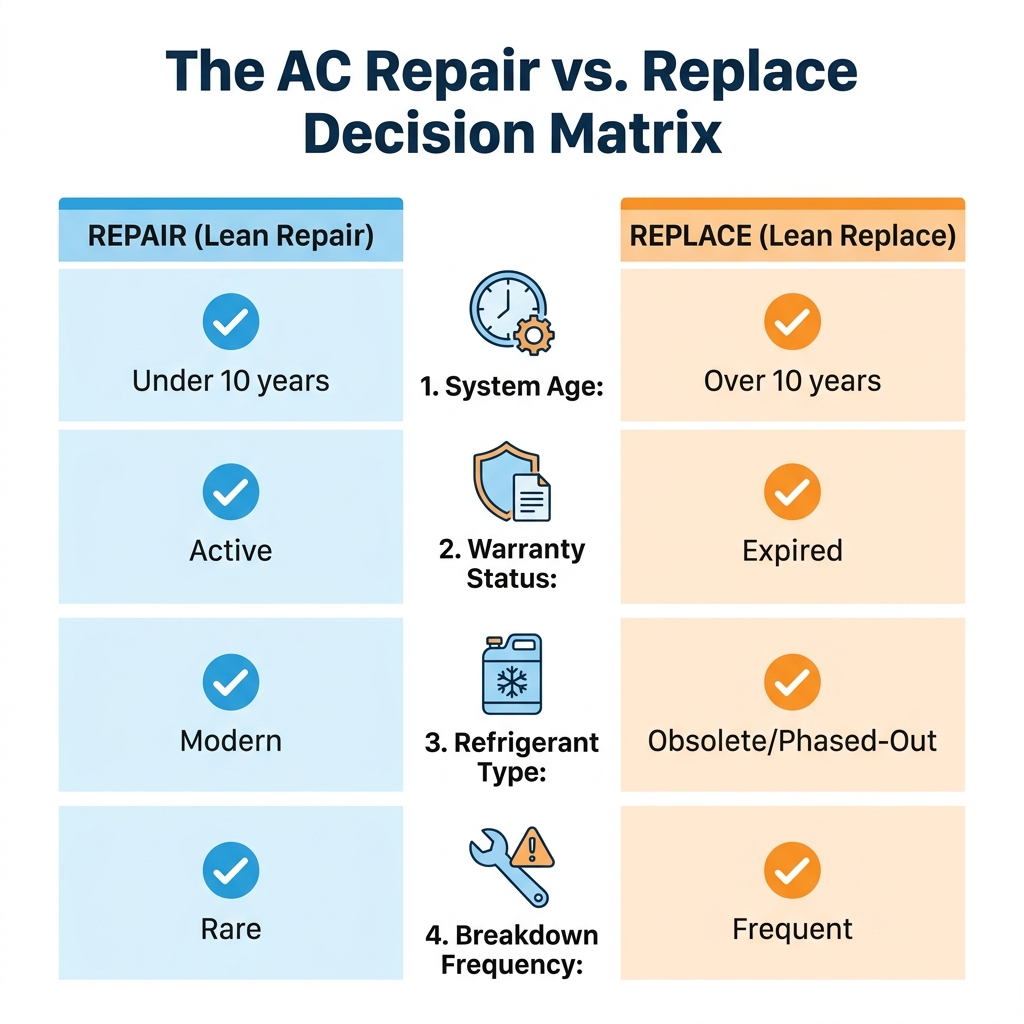
Side-by-Side: Repair vs. Replace
To simplify the decision, compare the two paths directly based on the most critical factors of your current HVAC system.
• System Age — When to Choose Repair: Under 8-10 years old — When to Choose Replacement: Over 10-12 years old
• Warranty Status — When to Choose Repair: Active manufacturer parts warranty — When to Choose Replacement: Expired warranty
• Refrigerant Type — When to Choose Repair: Modern, available refrigerant (R-410A) — When to Choose Replacement: Obsolete, phased-out refrigerant (R-22)
• Breakdown Frequency — When to Choose Repair: Rare; this is the first major issue — When to Choose Replacement: Frequent; multiple service calls recently
• Humidity Control — When to Choose Repair: System usually dehumidifies well — When to Choose Replacement: Home often feels damp and clammy

Navigating Efficiency Upgrades and Financial Incentives
It is no secret that upgrading to a full system is a significant investment. However, when you factor in the long-term operational costs, the math often shifts in favor of replacement. Modern SEER2 equipment operates so much more efficiently than systems built a decade ago that the month-to-month energy savings can meaningfully offset the initial investment over the lifespan of the unit.
Furthermore, you do not have to shoulder the entire burden alone. Generic federal tax credits or local utility rebates may apply to qualifying high-efficiency installations. These programs are designed to encourage homeowners to adopt energy-saving technology. We always advise consulting with our HVAC professionals and a tax professional to verify which current eligible programs you might qualify for, as these incentives can make a high-end system much more accessible.
If the upfront commitment is a concern, modern financing options for a new system can make a full upgrade highly manageable. Breaking the investment into predictable monthly payments is often far less stressful than draining your savings for an unexpected, out-of-pocket major repair on a system that might just break down again next season.
Make the Right Choice for Your Metairie Home
Deciding between patching an aging coil and upgrading your entire unit requires an objective, honest evaluation of your system's overall health. There is no single right answer for everyone, but understanding the toll the local climate takes on older equipment is the first step toward making an informed choice. When you are facing The Metairie Homeowner's Dilemma: Patching a Leaky Coil vs. Full System Replacement, you deserve transparency.
It is vital to work with a local team like Cypress Cooling Company that prioritizes your home's long-term comfort over a quick, temporary fix. Do not let the stress of a late-summer breakdown force you into a poor investment. Schedule a comprehensive system evaluation with us today to get a clear, honest assessment of your equipment, so you can restore your comfort with absolute confidence.
Frequently Asked Questions
Is it worth replacing an evaporator coil on an old AC?
Replacing an evaporator coil on an older AC is generally only worth it if the system is under ten years old and still covered by a manufacturer warranty. If the unit uses obsolete refrigerant or has a history of compressor issues, the repair is often a poor investment. Our technicians find that an aging system will likely experience cascading failures, meaning your expensive new coil could be dragged down by a failing outdoor unit.
Should I replace my AC coil or the whole unit?
We recommend replacing the whole unit if your system is over 10 to 12 years old, requires frequent repairs, or struggles to control indoor humidity. Replacing just the coil makes sense if the unit is relatively young, uses modern refrigerant, and has a strong history of reliable performance. Weighing the age and overall health of the system is the best way to determine your long-term return on investment.
How long does an AC unit last after replacing the coil?
If the rest of the system is in excellent condition, an AC unit can last another five to eight years after a coil replacement. However, if the outdoor compressor is already fatigued, our team frequently sees systems that only last a season or two before suffering another major breakdown. The lifespan heavily depends on how well the new coil matches the efficiency and capacity of the existing components.
What are the signs of an evaporator coil refrigerant leak?
The most common signs of a refrigerant leak include the AC running constantly without cooling the house, ice forming on the indoor coil or outdoor refrigerant lines, and a noticeable increase in indoor humidity. You might also hear a faint hissing sound near the indoor unit or notice your energy bills spiking unexpectedly. If you observe these symptoms, a professional diagnostic is required immediately to prevent compressor damage.
Does high humidity cause evaporator coils to fail faster?
Yes, high humidity forces the evaporator coil to extract massive amounts of moisture from the air, keeping the metal components perpetually wet. This constant exposure to condensation accelerates corrosion and rust, eventually leading to microscopic pinhole leaks. In subtropical climates, this continuous heavy workload is a primary reason why air conditioning components have a shorter overall lifespan than in drier regions.
OUR CLIENTS HAVE TO SAY ABOUT US



Service areas
Our service areas are designed to meet the diverse needs of our clients. We focus on providing exceptional service and ensuring customer satisfaction in every location we operate.