Navigating HOA Rules for New AC Installations in Metairie Neighborhoods
.webp)
The Urgency of AC Replacement and HOA Red Tape
Your AC is running constantly, but the house is still sweltering, and now you are facing a complete system failure right in the middle of late August end-of-season cooling demands. To make matters worse, navigating HOA rules for new AC installations in Metairie neighborhoods feels like hitting a bureaucratic brick wall just when you need relief the most. At Cypress Cooling Company, our team typically sees that replacing a failing AC condenser in a strict Metairie subdivision isn't just about picking out new equipment; it requires anticipating and satisfying architectural review committees on the first try. You have to balance the immediate need for home comfort with community guidelines dictating specific boundary setbacks, noise decibel limits, and visual screening. If you are looking for professional air conditioning replacement, partnering with a local contractor who understands these specific regulations is the only way to ensure the project moves forward without administrative roadblocks.
A failing condenser during severe summer heat requires immediate action to protect your home's comfort and safety. With late summer heat in Louisiana frequently pushing temperatures above 90 degrees alongside oppressive humidity, any delay in restoring your cooling system becomes dangerous. Homeowners in regulated neighborhoods face an incredibly stressful dual challenge: fixing the immediate cooling crisis while simultaneously satisfying the strict demands of their local architectural review committees.
The risks of bypassing your neighborhood association:
• Steep financial penalties: Unapproved exterior modifications often trigger immediate, compounding fines from the association.
• Stop-work orders: Board members can halt your installation mid-project, leaving you without a functioning cooling system.
• Forced removal: If the installed unit violates noise or setback rules, the board can legally force you to tear out the brand-new equipment at your own expense.
• Delayed home sales: Unpermitted exterior changes can create liens or compliance issues that complicate future property sales.
When you are staring down a late August end-of-season cooling emergency, you do not have the luxury of trial and error. You need a streamlined approach that satisfies the board immediately so your family can get back to a comfortable, safe indoor environment.
Understanding the Architectural Review Process for HVAC Upgrades
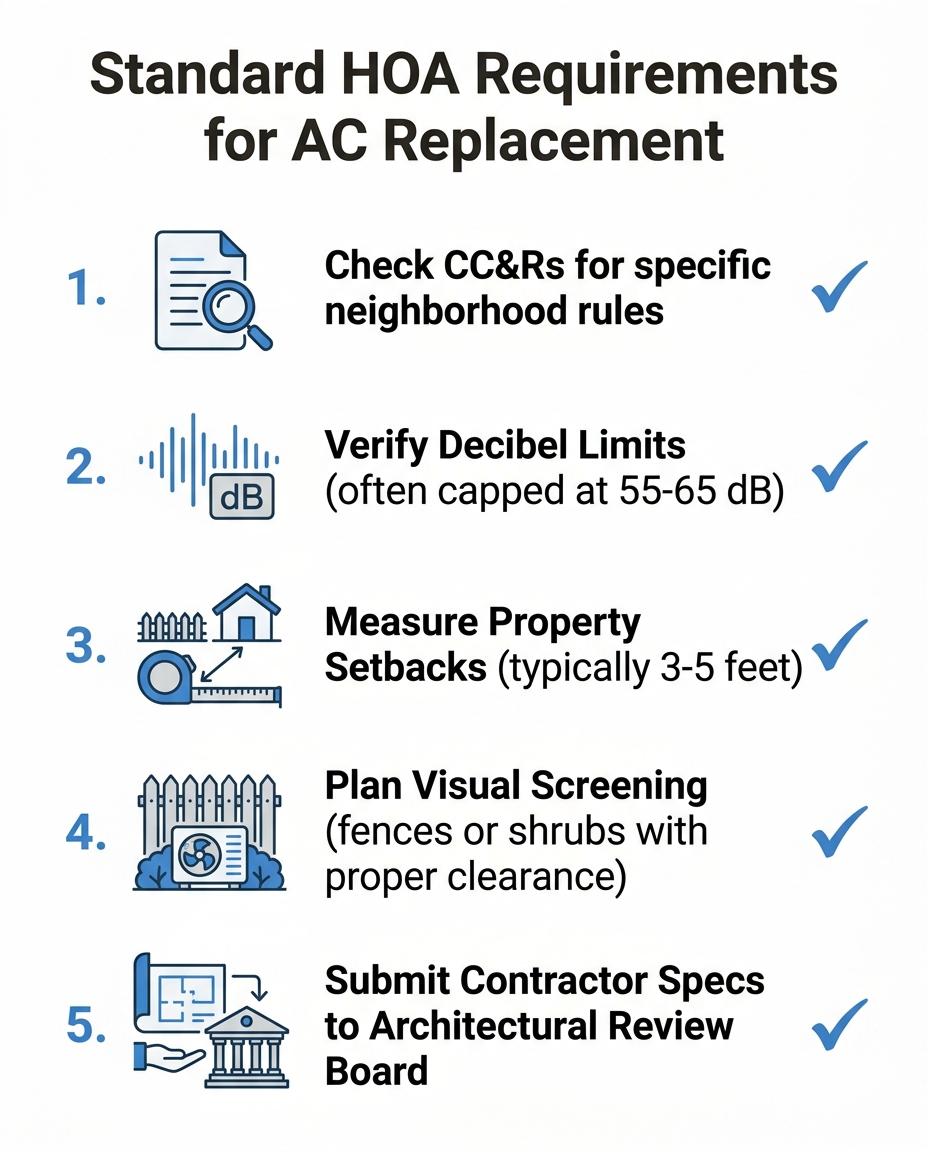
Most Covenants, Conditions, and Restrictions (CC&Rs) governing strict Metairie subdivisions require formal, written approval for any exterior home modification. Because the outdoor condenser is a highly visible piece of mechanical equipment, it falls squarely under these architectural guidelines. You cannot simply swap out an old unit for a new one without notifying the board, even if the new unit sits in the exact same location.
Review boards typically require a comprehensive packet of information before they will even add your request to their meeting agenda. This packet usually includes detailed manufacturer specification sheets, a drawn site plan showing exact property lines, and certified sound ratings for the proposed equipment. Gathering this documentation takes time, and standard review periods can stretch for weeks—a timeline that is entirely unacceptable during a summer cooling emergency.
Standard steps in the architectural review process:
1. Document gathering: Collecting the exact make, model, dimensions, and decibel ratings of the proposed equipment.
2. Site plan submission: Providing a map of your property that clearly illustrates where the unit will sit relative to property lines and neighboring homes.
3. Screening proposal: Detailing how the unit will be hidden from street view using fencing or landscaping.
4. Committee review: Waiting for the board to meet, review the technical specifications, and vote on the approval.
To expedite this process, proactive communication is essential. When you schedule an AC installation in Metairie with our team, we provide pre-approved spec sheets and detailed site plans on day one. By handing the architectural review committee exactly what they need in the format they prefer, we can often help you secure emergency approvals and bypass the standard waiting period.

Navigating Property Line Setbacks and Condenser Placement
One of the most rigid rules we encounter in strict Metairie subdivisions revolves around property line setbacks. These spatial rules govern exactly where an outdoor unit can be installed relative to your property boundaries, easements, and neighboring structures. The goal of these regulations is to prevent noise pollution from spilling into your neighbor's yard and to maintain clear access for emergency personnel and utility workers.
Jefferson Parish zoning codes establish the baseline residential rules for the area, but local subdivision CC&Rs are almost always much stricter. While the parish might allow a unit relatively close to a boundary line, your neighborhood association might require significantly more buffer space.
• Municipal Zoning (Baseline) — Typical Setback Requirement: General property line adherence — Primary Purpose: Utility access and fire safety
• HOA Guidelines (Strict) — Typical Setback Requirement: 3 to 5 feet from property lines — Primary Purpose: Noise reduction and visual spacing
• Easement Restrictions — Typical Setback Requirement: Complete clearance required — Primary Purpose: Underground pipe and wire access
Upgrading to higher-efficiency units often complicates existing pad placements. Modern, high-efficiency condensers require larger internal coils to dissipate heat effectively, which means the physical footprint of the outdoor unit is often significantly wider and taller than the system you are replacing. If your old unit was grandfathered in or barely met the setback requirements, a larger new unit might cross the invisible boundary line.
To ensure full compliance without restricting the critical airflow the system needs to function, our technicians carefully measure the available space. In many cases, this means relocating the equipment pad entirely. Moving the pad requires extending refrigerant lines and electrical connections, which adds a layer of complexity to the installation but guarantees that your new system won't trigger a violation notice from the neighborhood association.
Meeting Strict Noise Ordinances and Decibel Limits
Noise complaints are a primary reason neighborhood associations heavily regulate outdoor mechanical equipment. When houses are built close together, a loud, rattling condenser can quickly become a nuisance for the entire block. To combat this, many associations cap the allowable operational noise for new installations, requiring homeowners to submit official manufacturer decibel (dB) ratings before any work begins.
In strict Metairie subdivisions, these acoustic limits are strictly enforced. A standard older AC unit can easily generate 75 to 80 decibels of noise—roughly equivalent to a garbage disposal running continuously. If you attempt to install a budget-tier, single-stage unit that operates at this volume, the architectural review committee will almost certainly reject your application.
Fortunately, modern HVAC technology has evolved dramatically. Modern equipment operates at significantly lower sound levels, often running as quietly as 55 to 65 decibels. This is closer to the volume of a normal conversation or the hum of a modern refrigerator. Selecting ultra-quiet technology not only satisfies the architectural committee's strict requirements but also drastically improves your own backyard comfort. For areas where traditional ducted condensers simply cannot meet decibel or space requirements, we frequently recommend homeowners explore ductless mini-split systems as a whisper-quiet alternative.
Why Variable-Speed Technology Solves Noise Complaints
The secret to meeting strict noise ordinances lies in the compressor technology. Traditional single-stage units only have one speed: 100% capacity. When the thermostat calls for cooling, the system slams on with a loud, disruptive "clunk" and runs at full blast until the target temperature is reached. This sudden, jarring noise is what typically triggers neighbor complaints.
Variable-speed compressors, on the other hand, operate much like the accelerator pedal in a car. They run continuously at much lower capacities—often as low as 25% or 30%—rather than loudly cycling on and off. This steady, low-and-slow operation eliminates the loud startup clunk entirely. The system gently ramps up and down to maintain the temperature, resulting in a continuous, quiet hum that easily passes even the strictest neighborhood noise regulations.
Visual Screening Requirements: Hiding Your Condenser Safely
Even if your new system meets all the setback and noise requirements, you still have to address the visual impact. Many neighborhoods require outdoor units to be completely hidden from street view. The rules typically mandate the use of specific fencing, lattice structures, or approved landscaping shrubs to camouflage the equipment.
The problem: Homeowners and neighborhood boards often prioritize aesthetics over mechanical function. They want the unit completely boxed in so it cannot be seen from the sidewalk or the neighbor's driveway.
The cause of failure: Air conditioners do not create cold air; they remove heat from your home and exhaust it outside. To do this effectively, the outdoor condenser needs massive amounts of unobstructed airflow. Blocking a condenser with dense, solid fencing or planting heavy shrubs too close chokes off this air supply. The system ends up recycling its own hot exhaust air, causing the compressor to overheat, run constantly, and ultimately fail years before its time.
The compliant solution: The critical challenge is balancing aesthetic compliance with the unit's need for adequate airflow. In our experience working on Metairie properties, proper installation requires maintaining strict manufacturer-recommended clearances—typically a minimum of 24 inches of totally clear space on all sides, and 60 inches of clearance above the unit. To satisfy strict Metairie subdivisions while protecting your equipment, we recommend using louvered fencing that allows air to pass through, or planting approved shrubs far enough back that they provide a visual screen without acting as an airflow blockade.
How Local Expertise Expedites the Approval Process
Navigating the paperwork, site plans, and decibel ratings shouldn't fall entirely on your shoulders, especially during a late August end-of-season cooling crisis. When your home is actively heating up and your family is uncomfortable, the last thing you want to do is argue with a review board over property line measurements or acoustic data.
This is where hiring a contractor with deep community roots makes all the difference. An experienced team anticipates exactly what the review board needs before they even ask. By providing exact dimensions, certified dB ratings, and detailed placement maps on day one, a knowledgeable contractor prevents the back-and-forth delays that typically stall neighborhood approvals.
Just recently, a Metairie homeowner reached out to us during a brutal stretch of summer heat when their upstairs AC unit died in the middle of the night on a Saturday. One of our technicians called within 20 minutes of their Sunday morning request and arrived within the hour. By navigating the necessary equipment specs and local approvals quickly, our team had the new unit diagnosed, approved, and fully replaced by Tuesday. This proactive approach turns a potentially weeks-long bureaucratic delay into a swift, compliant installation.
Working with Cypress Cooling Company means leveraging our extensive local experience working within the guidelines of strict subdivisions, ensuring you avoid setbacks, rejections, or community fines. Because upgrading to compliant, high-efficiency equipment can sometimes involve unexpected upfront costs, exploring flexible HVAC financing options can help you secure the right system without compromising on quality or compliance.
Balancing Compliance with Long-Term Efficiency
While overcoming the initial red tape of an architectural review is stressful, there is a significant silver lining. The strict rules imposed by neighborhood associations regarding noise and placement often force homeowners to choose better, more advanced equipment than they might have otherwise considered.
When you are required to install a variable-speed, low-decibel unit to meet community guidelines, you are inherently installing a top-tier system. The result is a quieter, far more efficient cooling system that provides vastly superior comfort. These advanced units excel at dehumidification, pulling the sticky, uncomfortable moisture out of the Louisiana air much more effectively than standard units.
Furthermore, modern, compliant units consume significantly less power. Because they run at lower speeds for longer periods, they avoid the massive electrical spikes associated with single-stage systems turning on and off. This steady operation provides substantial financial relief on your monthly utility bills. Over time, the energy savings from a new AC—along with any generally applicable federal tax credits or local utility incentive programs for qualifying high-efficiency installations—can help offset the initial investment required to meet the neighborhood's rigorous standards. Properly sized, legally placed, and well-ventilated systems simply last longer and require fewer emergency repairs, giving you peace of mind long after the late August end-of-season cooling rush has passed.
Frequently Asked Questions About HOA HVAC Rules
Do I need HOA approval to replace my AC in Metairie?
Yes, in almost all strict Metairie subdivisions, you must obtain formal approval before replacing your AC. Neighborhood covenants consider the outdoor condenser an exterior modification, which requires review by the architectural committee. Even if you are placing the new unit in the exact same spot as the old one, you still need to submit the new unit's specifications for approval. Skipping this step can result in immediate fines or stop-work orders.
Can an HOA stop you from replacing an AC unit?
An association cannot legally prevent you from having a functioning cooling system, but they can absolutely reject specific equipment choices or installation locations. If your proposed unit violates their noise limits, visual screening rules, or property setbacks, they have the authority to deny the application. This is why our team makes sure to submit compliant specifications the first time to avoid having your project halted.
What are the noise rules for AC units in subdivisions?
Noise rules vary by neighborhood, but many strict associations cap outdoor mechanical equipment noise at 55 to 65 decibels. This limit is designed to prevent your system from disturbing your neighbors' outdoor spaces or penetrating their windows. To meet these requirements, homeowners usually need to install modern, variable-speed compressors that operate much quieter than traditional single-stage units.
How do I hide my AC unit for HOA compliance?
To hide your unit compliantly, you must use approved visual barriers like louvered fencing, lattice panels, or specific landscaping shrubs. The most important factor is maintaining at least 24 inches of clear space around the unit for proper airflow. If you build a solid fence too close to the condenser, the system will overheat and fail, so always balance aesthetic screening with the manufacturer's clearance requirements.
How loud can an AC unit be in a neighborhood?
While municipal codes provide a baseline, private neighborhood rules often restrict AC noise to under 65 decibels at the property line. Older units can routinely hit 75 to 80 decibels, which will easily trigger noise complaints and code violations. Upgrading to ultra-quiet equipment ensures you stay well below the threshold and keeps your outdoor living spaces peaceful.
What happens if I install an AC without architectural review approval?
Installing a unit without approval can lead to severe consequences, including compounding financial penalties from the association. The board can issue a formal violation notice and legally require you to remove or relocate the unapproved equipment at your own expense. Additionally, unresolved architectural violations can create complications or liens if you ever attempt to sell your property.
Secure Your Compliant AC Installation Today
Dealing with a failing system during a late August end-of-season cooling demand is stressful enough without the added pressure of neighborhood bureaucracy. Do not let strict community regulations delay your family's comfort or lead to costly compliance mistakes. Reach out to the team at Cypress Cooling Company. We understand the local requirements, know how to navigate the architectural review process, and can guide you through the installation seamlessly. We provide the practical overview and the exact specifications your board needs, ensuring your home stays cool and fully compliant.
OUR CLIENTS HAVE TO SAY ABOUT US



Service areas
Our service areas are designed to meet the diverse needs of our clients. We focus on providing exceptional service and ensuring customer satisfaction in every location we operate.