
Navigating 24/7 Commercial HVAC Repairs in Hammond During the Shoulder Season
.webp)
The High Cost of Temperature Volatility in South Louisiana Facilities
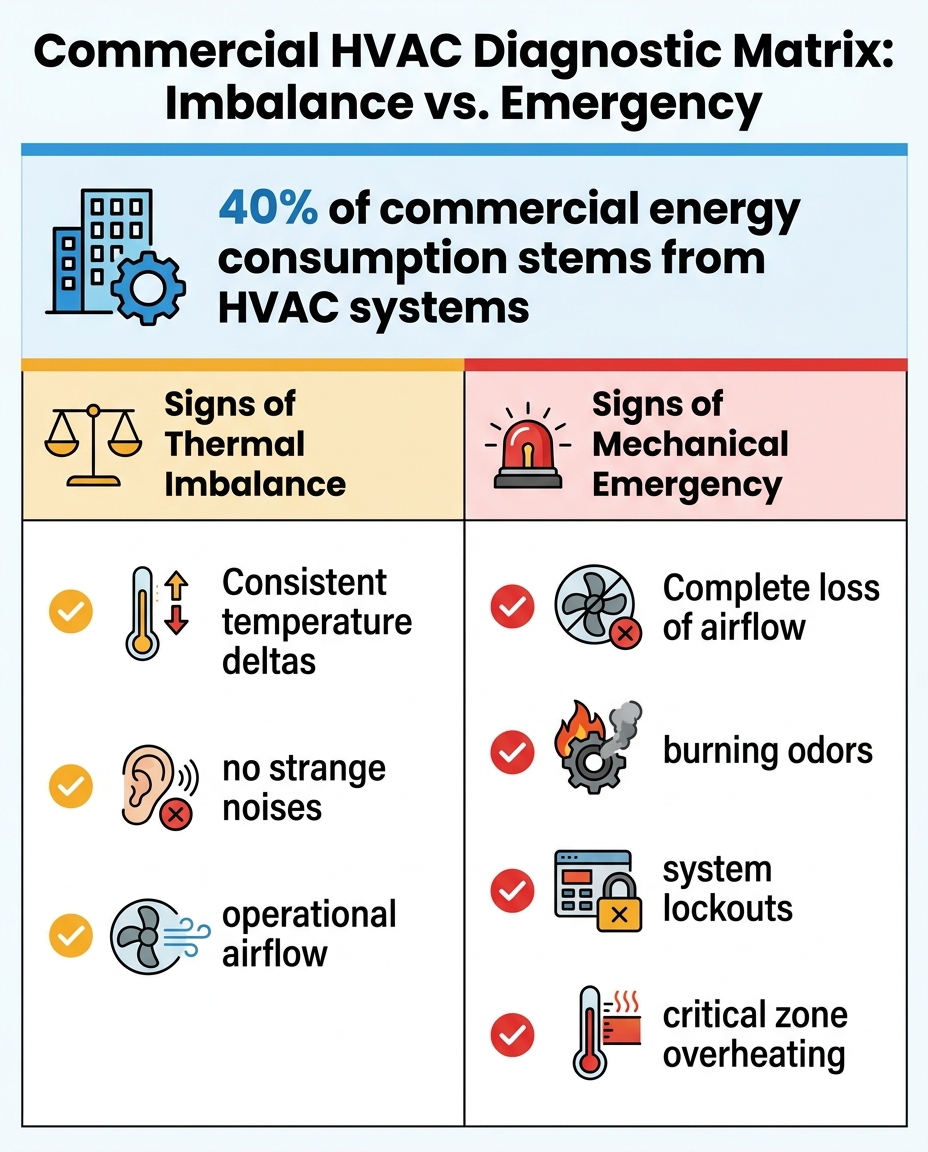
Nearly 40% of total commercial building energy consumption traces directly back to heating and cooling systems, a figure that spikes drastically during volatile transitional weather. At Cypress Cooling Company, we know firsthand that navigating 24/7 commercial HVAC repairs in Hammond during the shoulder season requires facility managers to understand exactly why these systems consume so much power and experience such high failure rates when the weather shifts. As early fall approaches, our team sees how the drastic daily temperature swings in South Louisiana force commercial systems to simultaneously heat and cool different zones within the exact same building.
This creates a concrete problem for facility managers: sun-facing zones overheat rapidly, while shaded zones require heating just to maintain a comfortable baseline. These extreme temperature imbalances push commercial equipment to its physical limits. Determining whether these imbalances require an emergency dispatch or proactive control adjustments is a critical decision point that impacts both your operating budget and tenant satisfaction. A comprehensive understanding of your commercial air conditioning systems is the first step in mitigating this seasonal strain.
During the September shoulder season, the contrast between morning lows and afternoon highs is particularly punishing. Systems that operate efficiently during the peak heat of August suddenly struggle to interpret conflicting thermostat signals. Recognizing the difference between a system that is struggling with environmental load and a system that is actively failing is essential for protecting your commercial investment and keeping your facility operational.
Understanding Thermal Load Imbalances in Local Office Buildings
The severe temperature disparities across different zones in a commercial structure rarely stem from a random equipment glitch. Instead, they are the result of complex physics and environmental factors interacting with the building's architecture. In our experience servicing Hammond commercial office districts, the orientation of a building plays a massive role in how thermal loads are distributed throughout the day. When a multi-zone system is improperly balanced, it cannot process the conflicting demands of different suites.
To effectively manage your facility and coordinate Hammond HVAC services, you must understand the underlying causes of these thermal imbalances. The issue generally breaks down into two distinct environmental challenges that occur simultaneously.
The Solar Heat Gain Effect on Commercial Facades
Modern commercial architecture relies heavily on glass facades, which are notorious for trapping heat. Even on cooler autumn days, the solar heat gain on south and west-facing exterior walls creates an extreme demand for cooling.
• The greenhouse effect: Glass panels allow short-wave solar radiation to enter the building, but prevent the resulting long-wave thermal radiation from escaping, rapidly elevating the temperature in perimeter offices.
• Delayed thermal mass: Building materials absorb heat throughout the afternoon and continue to radiate it into the workspace long after the sun has passed its peak.
• Sensor confusion: Thermostats located in these sun-drenched zones demand maximum cooling, forcing the central rooftop unit to push cold air throughout the entire ductwork system.
Why Shaded Zones Freeze Out Tenants
While the south-facing offices are battling solar heat gain, the interior suites and north-facing zones experience a completely different climate. During crisp autumn mornings, these areas lack ambient heat retention and cool down rapidly.
Our technicians often find that because the central system is overcompensating for the overheating sun-facing zones, it pushes cold air into suites that are already chilly. Variable air volume (VAV) boxes attempt to restrict this airflow, but if the system is not properly balanced, the static pressure forces cold air into the shaded zones anyway. The result is a building where half the tenants are sweating and the other half are running space heaters—a scenario that severely taxes your HVAC infrastructure.
Mechanical Strain: When Simultaneous Demands Damage Equipment
The physical toll that conflicting temperature demands take on commercial HVAC components cannot be overstated. When one zone demands heavy cooling and another demands commercial heating, the central equipment is forced into a state of mechanical confusion. This simultaneous demand leads to rapid short-cycling, a condition where the massive commercial compressors turn on and off continuously rather than running in smooth, energy-efficient cycles.
Short-cycling is incredibly destructive. The start-up phase of a commercial compressor draws the highest electrical current and inflicts the most mechanical wear. When a unit cycles on and off dozens of times an hour to satisfy conflicting thermostats, the compressor lifespan is drastically reduced. Furthermore, the blower motors and VAV boxes endure extreme wear and tear as they constantly modulate dampers in a futile attempt to balance the conflicting airflow requirements.
ASHRAE guidelines explicitly warn against the energy waste and mechanical strain that occur when building controls are not carefully calibrated for shoulder seasons. Our repair crews consistently see that ignoring these systemic strains during the September shoulder season inevitably leads to catastrophic, after-hours equipment failures. The constant vibration, electrical surges, and pressure fluctuations weaken internal components until a critical part—like a contactor, capacitor, or the compressor itself—fails entirely, usually at the most inconvenient time.
Diagnostic Matrix: Control Adjustments vs. True Mechanical Failures
Before initiating an emergency service call, we advise facility managers to use a clear, actionable framework for evaluating HVAC issues. Many temperature complaints can be resolved with proactive control adjustments, while others signal a catastrophic breakdown. Utilizing a comprehensive HVAC maintenance plan ensures that minor imbalances are caught early, but knowing how to read the symptoms on site empowers you to make data-driven decisions about your building's thermal performance.
Use the following diagnostic matrix to determine if the situation in your Hammond commercial office districts requires immediate intervention or routine optimization.
• Consistent temperature delta (e.g., south side always 5 degrees warmer) — Likely Cause: Thermal load imbalance / Solar heat gain — Recommended Action: Schedule a routine load balancing audit and control adjustment.
• Adequate airflow from vents, but air is not cool — Likely Cause: Refrigerant cycle issue or sensor miscalibration — Recommended Action: Request priority service during standard business hours.
• Complete loss of airflow across multiple zones — Likely Cause: Blower motor failure or severe system lockout — Recommended Action: Emergency: Dispatch a 24/7 commercial repair technician immediately.
• Acrid, electrical burning odors near vents or equipment — Likely Cause: Failing wiring, seized motor, or burnt contactor — Recommended Action: Emergency: Shut down the system and request an immediate dispatch.
• Frequent short-cycling (unit turning on/off every few minutes) — Likely Cause: Conflicting thermostat demands or pressure faults — Recommended Action: Schedule a diagnostic evaluation to prevent impending compressor failure.

Identifying When You Need 24/7 Commercial HVAC Repairs in Hammond
Not every temperature complaint constitutes a true emergency, but when critical infrastructure is threatened, a rapid response is mandatory. Understanding exactly what qualifies as a commercial HVAC emergency helps you protect sensitive inventory and minimize tenant disruption. When a system suffers a hard failure during the September shoulder season, you need to know exactly how to initiate 247 commercial hvac repairs hammond.
A true commercial emergency typically involves a complete building shutdown, severe electrical faults, or the loss of climate control in highly sensitive areas. In these scenarios, relying on prompt 247 commercial hvac services hammond is the only way to mitigate secondary damage to your property.
Critical Infrastructure Protection
Certain zones within a commercial facility simply cannot tolerate temperature swings. Identifying these areas ahead of time allows you to prioritize emergency calls appropriately.
1. IT and Server Rooms: High-density electronics generate massive internal heat. A loss of cooling here can lead to server crashes and catastrophic data loss within hours.
2. Medical and Chemical Storage: Pharmaceuticals and specific industrial materials require strict temperature parameters to remain viable and safe.
3. Manufacturing Floors: Humidity and temperature shifts can warp materials, disrupt sensitive machinery, and halt production lines entirely.
After-Hours Dispatch Protocols
When you encounter a catastrophic failure, understanding the timeline of a professional emergency response sets clear expectations. One local property manager experienced this firsthand when an upper-floor rooftop unit failed entirely on a Saturday night. Our Cypress Cooling Company dispatch team received the request early Sunday morning, and one of our technicians arrived within the hour to diagnose the catastrophic failure, securing the zone with temporary cooling measures until our crew installed a complete commercial replacement by Tuesday.
Professional protocols ensure that even if a specialized commercial-grade part must be sourced from a supply house on Monday, temporary solutions are deployed immediately to keep your facility safe. For a deeper look at this process, review how we handle 24/7 commercial HVAC emergencies for Hammond warehouses.
Solving the Root Cause: Advanced Commercial Zoning and Load Balancing
While rapid emergency response is critical when equipment fails, true expertise involves diagnosing and correcting the underlying thermal load imbalances that caused the failure in the first place. Swapping out a burnt contactor or a failed blower motor without addressing why the system was short-cycling simply guarantees another breakdown in the future.
Solving the root cause requires a comprehensive audit of a commercial building's airflow, ductwork, and VAV terminal units. By analyzing how air is distributed throughout Hammond commercial office districts, technicians can identify where static pressure is too high and where dampers are failing to modulate correctly. Proper load balancing eliminates the simultaneous heating and cooling conflict. It ensures that the central rooftop unit receives accurate, unified data from the building's sensors, allowing it to operate in long, efficient cycles rather than frantic, damaging bursts.
This is where our team's proven local expertise in complex commercial HVAC load balancing alongside 24/7 emergency dispatch capabilities becomes invaluable. Because Cypress Cooling Company understands the specific architectural and climate challenges of South Louisiana, we will not just fix the broken part; we will re-calibrate your building's controls, adjust airflow parameters, and optimize the system to handle the extreme temperature swings of early fall without tearing itself apart.
Frequently Asked Questions About Commercial HVAC Load Balancing
What is considered a commercial HVAC emergency?
A commercial HVAC emergency is any failure that threatens building safety, critical infrastructure, or completely halts business operations. This includes a total loss of airflow, electrical burning smells, system lockouts, or the failure of dedicated cooling units in server rooms and medical storage areas. Minor temperature imbalances in individual offices are generally not emergencies and can be handled during standard hours.
Why are some office rooms hot and others cold?
Temperature disparities are usually caused by thermal load imbalances, where sun-facing rooms absorb massive solar heat while shaded, interior rooms do not. If the commercial HVAC system is not properly balanced, the central unit struggles to satisfy conflicting thermostats, often pushing excess cold air into already chilly zones while trying to cool the sun-exposed offices.
How do you balance a commercial HVAC system?
Balancing a commercial system involves auditing the entire ductwork network and adjusting dampers, VAV boxes, and blower speeds to ensure proper airflow to every zone. Technicians use specialized hoods to measure the exact cubic feet per minute (CFM) of air exiting each register, comparing it to the building's engineered design to correct over-conditioned and under-conditioned areas.
How do you fix simultaneous heating and cooling issues?
Fixing simultaneous heating and cooling requires re-calibrating the building's control systems and adjusting the deadband—the temperature range where neither heating nor cooling is activated. By widening the deadband and ensuring VAV boxes are communicating correctly with the rooftop unit, technicians can prevent the system from fighting itself during transitional weather.
What causes a commercial rooftop unit to short-cycle during the fall?
Short-cycling during the fall is typically caused by conflicting thermostat demands during the September shoulder season. When morning temperatures require heating but afternoon solar heat gain demands cooling, the rooftop unit turns on and off rapidly trying to satisfy both extremes. This places immense mechanical strain on the compressor and electrical components.
Protect Your Facility Before the Next Temperature Swing
Addressing thermal imbalances before they cause a catastrophic failure is the most effective way to protect your operating budget. The extreme daily temperature swings of the season place immense strain on commercial equipment, and ignoring consistent hot and cold spots inevitably leads to premature mechanical breakdowns. Facility managers in Hammond commercial office districts must remain proactive to keep tenants comfortable and infrastructure secure.
If your building is struggling with simultaneous heating and cooling demands, do not wait for a complete system lockout to take action. Schedule a comprehensive system evaluation and load balancing audit with our team today. By optimizing your controls now, you can prevent costly disruptions and ensure you are fully prepared for navigating 24/7 commercial HVAC repairs in Hammond during the shoulder season should an unexpected emergency arise.
OUR CLIENTS HAVE TO SAY ABOUT US



Service areas
Our service areas are designed to meet the diverse needs of our clients. We focus on providing exceptional service and ensuring customer satisfaction in every location we operate.

