
How We Handle 24/7 Commercial HVAC Emergencies for Hammond Warehouses
.webp)
When Logistics Halt: The Threat of a Commercial Cooling Failure
If you are wondering exactly how we handle 24/7 commercial HVAC emergencies for Hammond warehouses, the answer begins with recognizing that a rooftop unit shutting down on a 95-degree late-summer afternoon is more than just an operational inconvenience. For a commercial logistics center losing critical cooling capacity, it is an immediate threat to temperature-sensitive inventory that brings supply chains to a grinding halt. You are suddenly on the clock, watching internal temperatures climb while scrambling to protect your goods. At Cypress Cooling Company, our team knows firsthand that every single minute counts when the August heat threatens your bottom line.
When the worst happens, you need a proven partner for commercial air conditioning services to deliver a rapid Hammond HVAC emergency response.
Facility managers are forced into a critical decision point the moment an alarm triggers or a warehouse zone begins to overheat. The window to trigger an emergency response before temperatures breach safe thresholds is incredibly narrow. Our systematic, rapid-response commercial emergency protocol is specifically engineered to take that burden off your shoulders, triaging the failure and stabilizing large-scale warehouse cooling before inventory loss becomes a reality.
The Critical Window: Protecting Inventory from Extreme Heat and Humidity
In the peak of August 95-degree late summer heat, an enclosed logistics center without active cooling quickly becomes a thermal trap. Temperatures inside a metal-roofed facility can easily exceed outside ambient temperatures by 15 to 20 degrees within a matter of hours. This rapid escalation creates a dangerous environment not just for the products stored on the racks, but for the personnel operating forklifts and managing the floor.
The unseen threat of moisture: South Louisiana's notoriously high relative humidity accelerates inventory damage faster than heat alone. In our years of serving the Metairie and Hammond areas, our technicians routinely see how quickly a facility loses its primary dehumidification mechanism when a commercial cooling system fails. This leads to rapid condensation on cooler surfaces inside the warehouse. Cardboard packaging softens and loses structural integrity, adhesive labels peel away, and sensitive logistics inventory can be permanently ruined by moisture before the ambient temperature even reaches its peak.
To understand the severity of this window, consider the operational guidelines set by regulatory bodies. ASHRAE (The American Society of Heating, Refrigerating and Air-Conditioning Engineers) recommends strict temperature and humidity thresholds to prevent the degradation of stored goods. Simultaneously, OSHA enforces strict guidelines regarding worker safety in high-heat environments. Failing to maintain these standards is not just a logistical nightmare; it is a massive liability.
• 1 to 2 Hours — Temperature Escalation: +5°F to +8°F above ambient — Humidity & Condensation Impact: Air feels heavy; dehumidification stops — Inventory Risk Level: Low to Moderate (Monitoring required)
• 3 to 5 Hours — Temperature Escalation: +10°F to +15°F above ambient — Humidity & Condensation Impact: Visible condensation on metal racks and concrete — Inventory Risk Level: High (Cardboard degradation begins)
• 6+ Hours — Temperature Escalation: +15°F to +20°F above ambient — Humidity & Condensation Impact: Severe sweating on packaging and sensitive goods — Inventory Risk Level: Critical (Spoilage and structural packaging failure)
This rapid timeline is exactly why a standard "we will get there tomorrow" service call is unacceptable for commercial facilities. Protecting your bottom line requires an emergency protocol that moves as fast as the escalating heat.
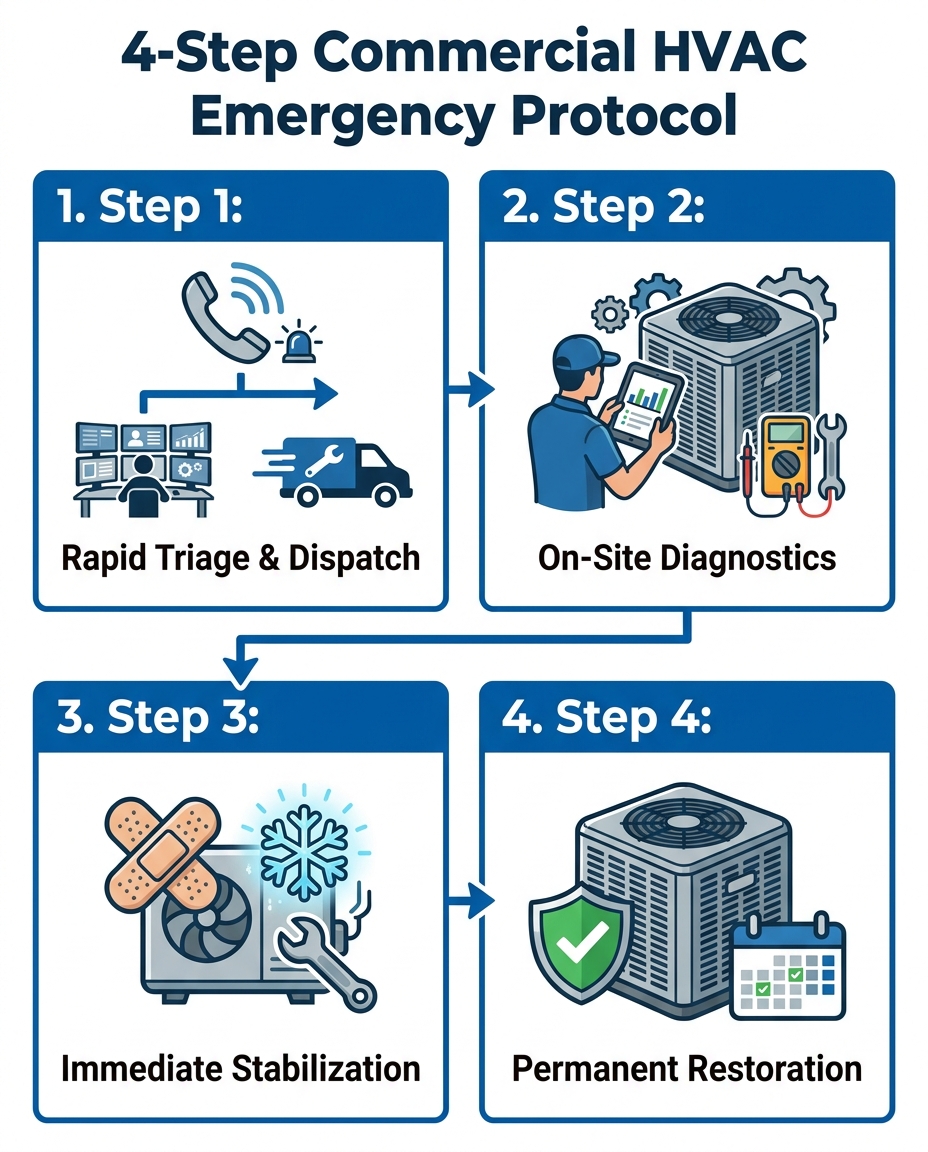
Step 1: Rapid Triage and 24/7 Dispatch Protocol
When a facility manager makes an emergency call, the clock is already ticking. Our proven 24/7 emergency response protocols and rapid dispatch are tailored specifically for commercial logistics operations, ensuring that high-stakes infrastructure failures are pushed to the front of the line.
Early one Sunday morning during peak summer heat, our team responded when a local facility experienced a total AC system failure. Because the call was prioritized through our commercial dispatch protocol, a Cypress Cooling Company technician was routed immediately, arrived on-site within an hour, and had the system fully repaired and functioning within that same hour. That level of speed does not happen by accident; it is the result of a highly structured triage system.
Prioritizing High-Stakes Commercial Calls
The first 15 minutes after a facility manager initiates an emergency call dictate the success of the entire operation. Our dispatchers are trained to gather critical facility data immediately, assessing the scale of the cooling loss and the specific inventory risk. We do not just ask for an address; we assess the operational threat.
• System identification: Determining whether the failure involves a single rooftop unit (RTU), a large-scale chiller, or a centralized air handler.
• Zone vulnerability: Identifying which specific areas of the warehouse are affected and what type of inventory is housed in those zones.
• Access and safety protocols: Confirming roof access points, loading dock clearances, and any site-specific safety requirements our technicians need to follow upon arrival.
• Immediate mitigation advice: Guiding the facility manager on immediate steps to take, such as shutting down non-essential heat-generating equipment on the floor.
By gathering this intelligence before the truck even leaves the yard, our technicians arrive fully prepared to execute a targeted diagnostic process, saving precious time when it matters most.
Step 2: On-Site Diagnostics for Commercial Rooftop Units
Arriving at Hammond logistics and warehouse facilities, our technicians immediately bypass the guesswork. A pattern we see often in our commercial service calls is that these HVAC systems are complex networks of electrical relays, massive compressors, and intricate refrigerant lines. We perform a systematic inspection of rooftop units, chillers, and commercial airflow systems to isolate the exact point of failure.
Isolating the issue safely: One of the most critical aspects of commercial diagnostics is performing the work without disrupting ongoing warehouse floor operations. While forklifts continue to move pallets below, our technicians are on the roof or in the mechanical room running advanced diagnostic tests. We check electrical continuity across contactors, measure blower motor amp draws, and test refrigerant pressures to pinpoint the breakdown. Whether the issue is a blown fuse, a seized compressor, or a catastrophic refrigerant leak, we identify the root cause swiftly.
Beyond finding the immediate broken part, we evaluate the overall health of the system. A blown capacitor might just be a symptom of a much larger issue, such as an overheating motor struggling against restricted airflow. Determining whether a system requires an immediate minor repair or a larger intervention is a crucial part of the process, which ties directly into evaluating rooftop commercial HVAC lifespans. We provide facility managers with the hard data they need to make informed decisions about their equipment.
Step 3: Immediate Stabilization and Temporary Solutions
The critical window when a facility manager must trigger an emergency vendor response to restore cooling before warehouse temperatures breach safe inventory thresholds is heavily dependent on immediate stabilization. Sometimes, diagnosing the problem reveals that a highly specific OEM commercial part is required—and that part might be sitting in a supply house two states away. When a permanent fix cannot be executed on the spot, our focus shifts entirely to stabilization.
On a recent Saturday night, a facility's rooftop unit suffered a capacitor failure. Our Cypress Cooling Company technician arrived the same day and utilized a temporary, compatible part to safely restore system function. This immediate intervention allowed the building to escape the heat and maintain safe inventory temperatures until the permanent OEM component arrived.
Strategies for immediate facility stabilization:
1. Deploying temporary components: Utilizing universal commercial-grade parts (like contactors or capacitors) to get the compressor running safely while the exact factory match is ordered.
2. Bypassing non-critical faults: If a secondary sensor has failed but the primary cooling loop is intact, we can often safely bypass the sensor temporarily to restore airflow.
3. Localized cooling strategies: Adjusting commercial dampers to funnel all available cold air from functioning units directly into the most critical, temperature-sensitive inventory zones.
4. Restoring partial capacity: Getting a multi-stage compressor to run on its first stage at least provides active dehumidification and air circulation, preventing the rapid condensation that ruins packaging.
Restoring even 50% capacity during a catastrophic failure can save massive amounts of temperature-sensitive goods. Our protocol ensures that your facility is never left completely defenseless against the heat while waiting on parts.
Step 4: Permanent Restoration and Future-Proofing
Once the immediate emergency is stabilized and the facility is no longer in danger of inventory loss, our systematic protocol shifts to permanent restoration. This phase is about transitioning from a reactive emergency state back to long-term operational stability.
Installing the correct commercial OEM components is just the beginning. We ensure that the new parts integrate flawlessly with the existing infrastructure. Interestingly, managing South Louisiana humidity in a massive warehouse is not just about the air conditioning side of the equation. It requires assessing the entire climate control network, including commercial heating systems, to ensure that proper reheat and dehumidification sequences are functioning correctly year-round.
Post-repair verification testing:
• Airflow balancing: Verifying that the static pressure across the commercial ductwork has returned to factory specifications so that cold air reaches the furthest corners of the warehouse.
• Refrigerant charge verification: Utilizing digital manifolds to ensure the system has the exact amount of refrigerant required for maximum energy efficiency.
• Thermostat and control recalibration: Ensuring that the building management system (BMS) is accurately reading the internal environment and staging the cooling equipment properly.
• ASHRAE compliance checks: Confirming that the restored system is pulling enough fresh outside air to meet indoor air quality standards for warehouse personnel.

Why Hammond Logistics Centers Trust Our Emergency Protocol
Managing Hammond logistics and warehouse facilities means mitigating risk at every turn. When high-value inventory is sitting on the racks, hope is not a strategy. Waiting until a catastrophic failure occurs to start Googling for a commercial HVAC vendor is a massive operational risk.
The value of proactive partnerships: Establishing a vendor relationship before an emergency strikes ensures that your facility is already in our system. We know your roof access codes, we know your equipment tonnage, and we know your critical inventory zones. This pre-established intelligence shaves vital minutes off our response time during a crisis.
Ultimately, the best emergency response is the one you never have to make. Transitioning from a reactive stance to a proactive preventative HVAC maintenance plan is the most effective way to protect your facility. Routine commercial maintenance catches degrading capacitors, fraying belts, and slow refrigerant leaks long before they cause a total system shutdown on a 95-degree afternoon.
Frequently Asked Questions About Commercial HVAC Emergencies
What qualifies as a commercial HVAC emergency?
An emergency is any failure that threatens inventory, worker safety, or critical operations. If a rooftop unit goes down and internal warehouse temperatures begin climbing toward thresholds that could spoil goods or violate OSHA heat standards, it requires immediate intervention. Minor issues like a strange noise or a slightly dirty filter can wait for scheduled service, but total loss of cooling or severe water leaks from a commercial system demand an emergency response.
How fast is emergency commercial HVAC service dispatched?
Triage happens immediately, with rapid deployment based on the severity of the operational threat. When a commercial facility calls in a failure, our dispatchers prioritize the call based on inventory risk and facility type. For high-stakes logistics centers facing extreme heat, technicians are often routed within minutes to ensure they arrive on-site as quickly as traffic and distance allow.
How do you cool a warehouse during an AC failure?
We utilize temporary stabilization, strategic ventilation, and prioritize localized zones. If the main system cannot be fully repaired immediately, technicians may adjust dampers to funnel air from functioning units to critical areas. We also advise facility managers to keep bay doors closed, shut down heat-generating machinery, and utilize large-scale industrial fans to keep air moving and prevent hot spots.
Can high humidity damage inventory as fast as high temperatures?
Yes, rapid condensation can ruin packaging and sensitive goods within hours. When a commercial AC fails, it stops removing moisture from the air. In humid climates like South Louisiana, this causes the warehouse to "sweat." Cardboard boxes absorb this moisture, losing their structural integrity, which can lead to pallet collapses and ruined product long before the heat itself causes damage.
What should a facility manager do while waiting for HVAC repair?
Limit bay door openings, shut down non-essential heat-generating equipment, and monitor internal temperatures. The goal is to trap whatever cool, dry air is left inside the building for as long as possible. Facility managers should also clear any pallets or equipment away from roof access ladders and mechanical rooms so the technician can begin diagnostics the moment they arrive.
Secure Your Facility's Cooling Strategy Today
A clear, professional breakdown of our emergency response steps proves that Cypress Cooling Company has the commercial capacity, urgency, and expertise to protect high-stakes inventory. When a rooftop unit fails during the peak of summer, you do not have time to wonder if your HVAC contractor understands the urgency of logistics operations. You need a team that arrives with a structured plan, the right diagnostic tools, and the capability to stabilize your facility immediately. Don't wait for the next major heatwave to test your current contingency plan. Reach out to discuss your facility's specific emergency response needs and secure a cooling strategy that keeps your operations moving 24/7.
OUR CLIENTS HAVE TO SAY ABOUT US



Service areas
Our service areas are designed to meet the diverse needs of our clients. We focus on providing exceptional service and ensuring customer satisfaction in every location we operate.

