
The Truth About Topping Off Freon Before the School Year Starts
.webp)

Is a Quick Freon Top-Off Really the Answer for Late Summer Cooling Woes?
Is your air conditioner running constantly but failing to keep the house cool as the late summer heat peaks? If you are sweating through August and searching for the truth about topping off Freon before the school year starts, you are facing a very common homeowner dilemma. The transition back to school brings enough chaos without a struggling AC unit adding to the stress. A typical pattern we see is a homeowner requesting a quick "refrigerant top-off" just to get through the rest of the season. For a lasting solution, exploring professional HVAC services is the smartest move.
The critical decision point: Do you pay for a temporary recharge that will inevitably leak out, or do you authorize a proper diagnostic and repair? Many homeowners assume that air conditioners naturally use up their refrigerant over time, much like a car uses gas. Because of this misconception, they view a top-off as a standard seasonal maintenance task. However, the mechanical reality of your cooling system tells a very different story. Understanding how your system actually works is the first step toward making a decision that protects both your comfort and your wallet.
As the August back-to-school transition accelerates, time is of the essence. You need a reliable home environment for homework, rest, and family routines. Relying on a temporary fix often guarantees another breakdown right when you need your system the most. By taking a closer look at the science behind your air conditioner, you can avoid the frustrating cycle of repeated service calls and secure consistent cooling for the months ahead.
The Closed-Loop Reality: Where Does the Refrigerant Go?
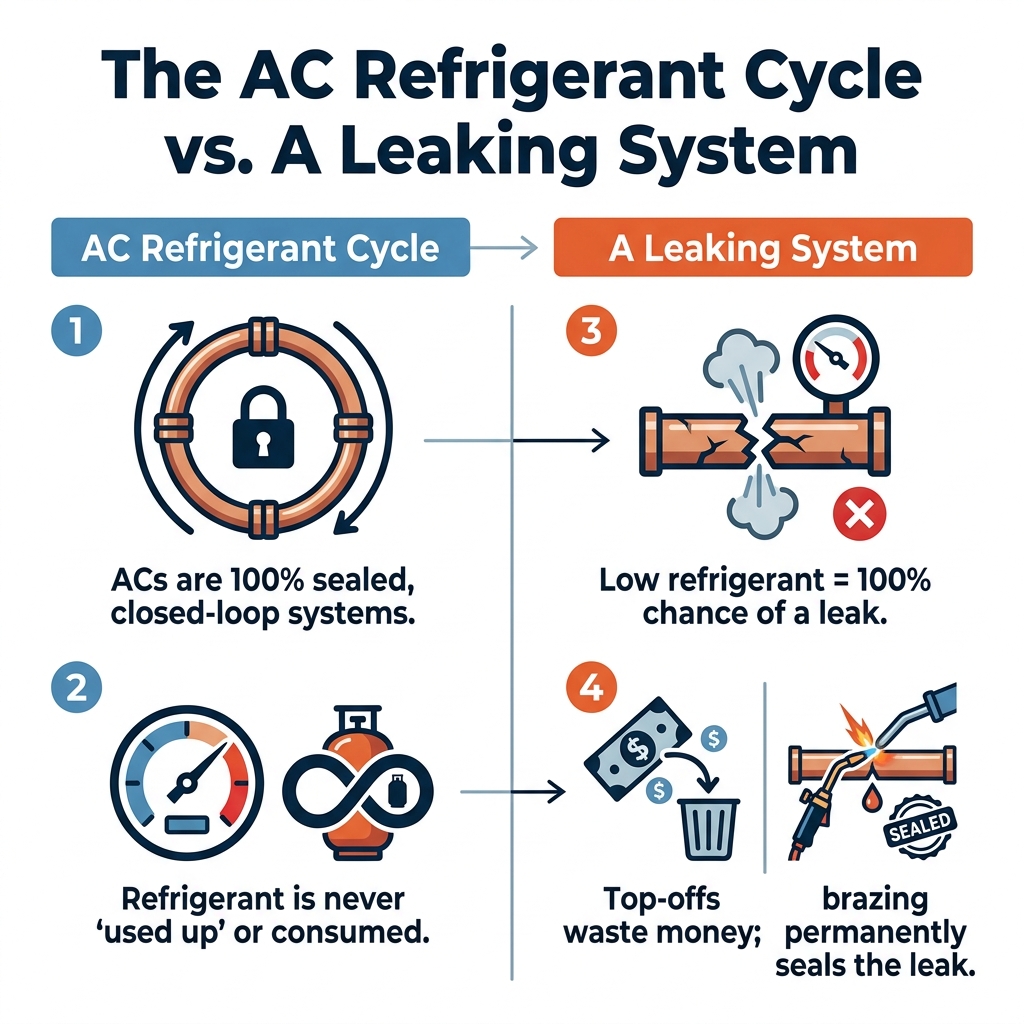
To understand why a simple recharge is rarely the right answer, you have to look at how an air conditioner is built. Your AC is a completely sealed, closed-loop system. The refrigerant inside travels endlessly between the indoor evaporator coil and the outdoor condenser coil, changing from a liquid to a gas and back again. During this continuous cycle, the refrigerant absorbs heat from inside your home and releases it outside.
The Automotive Analogy
A common misunderstanding compares AC refrigerant to car gas or engine oil. When you drive, your car actively consumes gasoline and burns off small amounts of oil, requiring regular refills. Air conditioning refrigerant does not work this way. It is never consumed, burned off, or used up during the cooling process. The exact amount of refrigerant that was weighed into the system at the factory is the exact amount that should remain inside it ten years later.
If you want to know how to check if your AC refrigerant is low, the symptoms usually point to one undeniable physical reality: a leak exists somewhere in the coils or the copper lines. Whether your system uses older R-22 (often referred to by the brand name Freon) or modern R-410A, the mechanical principles remain identical. The chemical compound cannot simply vanish. If the pressure is low, the closed loop has been compromised.
During the busy August back-to-school transition, discovering a leak can feel overwhelming. However, acknowledging that the system is broken—rather than just "empty"—is the only way to move forward with a permanent repair. Ignoring the underlying breach in the copper lines will only lead to more severe mechanical failures down the road.

Why the Annual 'Top-Off' is a Costly HVAC Myth
The Problem: Your home feels warm, the air coming from the vents is weak, and you just want the system working again quickly. The easiest request to make is for a technician to simply "add some Freon" and get the cold air flowing.
The Cause: This mindset stems from decades of poor industry practices where "gas-and-go" technicians would recharge systems without ever addressing the root cause. Topping off a leaking system is exactly like putting air in a tire with a nail in it. It provides temporary relief, but it absolutely guarantees another failure in the near future. The pressure will drop again, the cooling will stop, and you will be right back where you started.
The Solution: The only honest approach is locating and repairing the leak. Repeated top-offs waste money, as the homeowner pays for expensive refrigerant that simply leaks back into the atmosphere. Furthermore, environmental regulations—specifically EPA Section 608—strictly govern the handling of refrigerants to prevent this exact type of atmospheric venting. Intentionally adding refrigerant to a system known to have a significant leak is not just bad practice; it violates federal environmental guidelines.
The Honest Approach to Diagnostics
Cypress Cooling Company focuses on honest diagnostics and permanent solutions, refusing to sell temporary "top-off" band-aids that waste the homeowner's money. When a technician insists on finding the leak rather than just adding chemical charge, they are protecting your long-term investment. A proper diagnostic reveals the true condition of your equipment, giving you the facts needed to decide between a repair or a system replacement.
How Refrigerant Leaks Impact Your Home's Comfort and Equipment
Running an air conditioner with a low refrigerant charge does much more than just make your house feel warm. It actively damages the internal components of your HVAC system. When refrigerant levels drop, the pressure inside the indoor evaporator coil changes drastically. This pressure drop causes the temperature of the coil to plummet below freezing.
As warm, humid indoor air blows across this super-cooled coil, the condensation instantly freezes. Before long, the entire indoor unit can turn into a solid block of ice. This severely restricts airflow and forces the outdoor compressor to work overtime. The compressor is the heart of your air conditioner, and forcing it to circulate adequate cooling with inadequate refrigerant risks a catastrophic, highly expensive failure. If you are noticing these signs, scheduling prompt air conditioning repair is highly recommended.
The Metairie Humidity Factor
With summer temperatures and extreme humidity lingering in Metairie, a fully charged AC is required for proper dehumidification. An air conditioner does not just lower the temperature; it actively pulls moisture out of the air. A leaking system will freeze up rather than dehumidify in this climate. This loss of dehumidification makes the home feel sticky, heavy, and deeply uncomfortable, even if the air blowing out of the vents feels somewhat cool.
• Ice buildup on indoor coil or copper lines — Mechanical Impact: Restricts airflow and prevents heat absorption
• Hissing or bubbling noises near the unit — Mechanical Impact: Indicates the physical location of a moderate-to-large leak
• High indoor humidity (sticky feeling) — Mechanical Impact: Evaporator coil cannot condense and remove airborne moisture
• System runs constantly without satisfying the thermostat — Mechanical Impact: Severe strain on the compressor, leading to overheating
The Right Way to Diagnose Low Refrigerant Levels
Finding a microscopic pinhole in hundreds of feet of tightly wound copper tubing requires specialized tools and patience. A true professional distinguishes themselves from a "gas-and-go" technician through their diagnostic thoroughness. When you hire experienced Metairie AC technicians, they follow a strict protocol to pinpoint the exact source of the failure.
One Metairie homeowner reached out when water unexpectedly started dripping from their ceiling. A technician responded quickly, diagnosed the underlying issue, ordered a new drip pan, and installed it the same day so the customer was not without air conditioning for a second day. While that specific scenario involved a drainage failure, the exact same level of urgency and thoroughness applies to diagnosing a refrigerant leak. Guesswork is never part of the process.
Tools for Pinpointing Leaks
• Electronic Leak Detectors: These highly sensitive wands sniff the air around the coils and copper lines, beeping rapidly when they detect the chemical presence of refrigerant escaping.
• Ultraviolet (UV) Dye Tests: A specialized UV-reactive dye is injected into the system. As the system runs, the dye escapes alongside the refrigerant. The technician later uses a UV light to spot the glowing dye, revealing the exact location of microscopic cracks.
• Nitrogen Isolation Testing: For hard-to-find leaks, the technician will isolate the indoor evaporator coil from the outdoor condenser. They then pressurize the system with nitrogen. Because nitrogen is highly sensitive to pressure changes, watching the gauges allows the technician to confirm which half of the system holds the leak.
Emphasizing a thorough diagnostic provides you with clear, transparent options for repair. You know exactly what is broken, where it is broken, and what it will take to fix it permanently.
The Permanent Fix: Why Brazing Beats Band-Aids
Once the leak is successfully located, the focus shifts to a permanent mechanical repair. This is not a simple patch job. It requires specialized welding techniques and a strict adherence to environmental protocols. A permanent fix restores peak efficiency just in time for the busy fall routine, ensuring your home remains a comfortable refuge during the August back-to-school transition.
Here is how a professional technician executes a permanent leak repair:
1. Safe Refrigerant Recovery: Before any welding can happen, the remaining refrigerant must be safely recovered into a specialized tank according to EPA guidelines. Venting it into the atmosphere is illegal and environmentally harmful.
2. Precision Brazing: The technician uses an oxy-acetylene torch to braze (weld) the copper lines or repair the damaged section of the coil. This process uses a filler metal to create a seal that is just as strong as the original copper tubing.
3. Pulling a Deep Vacuum: Once the system is sealed, the technician attaches a vacuum pump. Pulling a deep vacuum removes all atmospheric air, moisture, and contaminants from the lines. Moisture left inside an AC system will mix with refrigerant oil to create a highly corrosive acid, which destroys compressors from the inside out.
4. Weighing in the Charge: Finally, the technician uses a digital scale to weigh in the exact factory-specified amount of fresh refrigerant. This ensures the system operates at its absolute peak efficiency.
Maintaining this newly sealed system is critical. Enrolling in a comprehensive AC maintenance plan ensures that your coils remain clean and your pressures are monitored year after year, preventing future issues before they disrupt your schedule.
Frequently Asked Questions About AC Refrigerant and Leaks
Is it normal for an AC to lose refrigerant?
No, it is never normal for an air conditioner to lose refrigerant. Because it is a sealed loop, any loss indicates a physical leak that requires professional repair. Refrigerant does not evaporate or get burned off during normal operation. If a technician tells you that your system is just "a little low" due to age, they are ignoring a mechanical failure.
What happens if my AC is low on Freon?
Running an AC with low refrigerant forces the compressor to overwork and often causes the indoor coil to freeze. This leads to poor cooling, high energy bills, and potential compressor failure. The system will run longer cycles trying to reach the temperature set on the thermostat, placing immense wear and tear on electrical components.
Can you just add Freon to a leaking AC?
While physically possible to add more refrigerant, it is a temporary and wasteful band-aid. The newly added refrigerant will continue to escape until the underlying leak is located and brazed. Paying for a recharge without a repair simply guarantees you will have to pay for another service call when the system inevitably fails again.
How often should Freon be added to a home AC?
Ideally, never. A properly installed and sealed air conditioner should operate for its entire lifespan on its original refrigerant charge. If it needs adding, it needs repairing. Routine seasonal maintenance focuses on cleaning coils and checking electrical connections, not topping off chemicals.
Why does my AC freeze up when the refrigerant is low?
Low refrigerant drops the pressure inside the evaporator coil, causing its temperature to fall below freezing. Condensation from the air freezes to the coil instead of dripping into the drain pan. This ice acts as an insulator, blocking airflow and completely stopping the cooling process inside your home.
Does low refrigerant affect my home's humidity levels?
Yes. An air conditioner dehumidifies the air as it cools. When refrigerant is low, the system struggles to remove moisture, leaving the indoor air feeling sticky and uncomfortable. In high-humidity areas like Metairie, this loss of dehumidification is often the first sign that something is wrong with the system.
Secure Your Comfort Before the School Bell Rings
The truth about topping off Freon before the school year starts is simple: a top-off is a temporary illusion that masks a real mechanical issue. Air conditioners are closed loops, and a low charge always means there is a leak somewhere in the system. Paying for a quick recharge might get you through the weekend, but it leaves you vulnerable to a major breakdown right when your family's schedule gets the most hectic.
A permanent brazing repair is the only way to ensure reliable cooling and proper dehumidification during the intense August heat. Do not settle for temporary band-aids that drain your wallet. Schedule a professional diagnostic today to find the real issue, permanently seal the leak, and secure your family's comfort before the busy season begins.
OUR CLIENTS HAVE TO SAY ABOUT US



Service areas
Our service areas are designed to meet the diverse needs of our clients. We focus on providing exceptional service and ensuring customer satisfaction in every location we operate.