
How Cypress Cooling Handles Late-Season AC Replacements in Gretna
.webp)

The High Stakes of a Late-Season AC Failure in Gretna
Your air conditioner is blowing warm air right as the humidity peaks, leaving you wondering exactly how Cypress Cooling handles late-season AC replacements in Gretna without turning your home into an oven during the swap. In our years of keeping Greater New Orleans homes comfortable, we've seen firsthand how a failing AC unit in late summer or early fall creates a highly stressful dilemma for homeowners. You know the system needs to be replaced, but you naturally fear the downtime of a major installation when the weather outside is still brutally unforgiving.
If you are exploring comprehensive air conditioning services or actively looking for a dependable Gretna AC replacement team, understanding the logistics of a late-season installation is critical to protecting your home.
Executing a full AC replacement in Gretna without leaving the home dangerously hot requires precise, strategic sequencing. The core decision point comes down to how the installation crew sequences the teardown of the old equipment and the installation of the new system to minimize cooling downtime. Unlike homes in cooler northern climates, our local properties cannot passively cool down by simply opening a window in early fall. The intense regional humidity traps heat indoors, meaning that every minute your air conditioner is offline counts.
Choosing a local team equipped with rapid-response logistics ensures that the transition is handled swiftly. By treating these late-season replacements as high-stakes operations rather than relaxed off-season jobs, the right professionals ensure your home remains safe, comfortable, and protected from the elements.
Navigating September Transition Weather with Sudden Heat Spikes
When evaluating an AC replacement in the early fall, you have to account for the specific environmental challenges of the Greater New Orleans area. Navigating September transition weather with sudden heat spikes requires a completely different operational approach than a standard winter furnace swap. Our technicians at Cypress Cooling Company know that the volatile early fall months present a unique set of logistical hurdles for HVAC contractors.
According to National Weather Service climate data, average September temperatures in the region still feature daily highs in the upper 80s. More importantly, this transition period is notorious for frequent, unpredictable heat spikes that push temperatures well into the 90s. When you combine these temperatures with the area's persistently high relative humidity, the heat index skyrockets. This makes "off-season" replacements just as urgent and physically demanding as mid-summer emergency calls.
Comparing Summer vs. Early Fall Replacements
• Average High Temperatures — Peak Summer (July/August): Consistently mid-to-upper 90s — Early Fall (September): Upper 80s with sudden spikes into the 90s — Impact on Installation Logistics: Heat index remains at dangerous levels for the home interior.
• Relative Humidity — Peak Summer (July/August): Extremely High — Early Fall (September): Persistently High — Impact on Installation Logistics: Prevents passive cooling; open windows only introduce moisture.
• Weather Volatility — Peak Summer (July/August): Predictably hot day-to-day — Early Fall (September): Highly unpredictable temperature swings — Impact on Installation Logistics: Requires crews to be flexible and prepared for sudden shifts.
Because of this weather volatility, we ensure our installation crews arrive fully prepared for sudden temperature shifts on the day of the job. There is no room for missing parts or delayed equipment deliveries. Treating early-fall replacements as high-stakes logistical operations ensures that your home is never left vulnerable to a surprise heat wave while the system is dismantled.
Pre-Installation Staging: Preparing for a Seamless Swap
The secret to minimizing the hours your home is exposed to the heat lies in the preparation phase that occurs before the old unit is even turned off. After countless installations across Metairie and Gretna, our team has dialed in this pre-installation staging to focus entirely on workflow efficiency and site preparation.
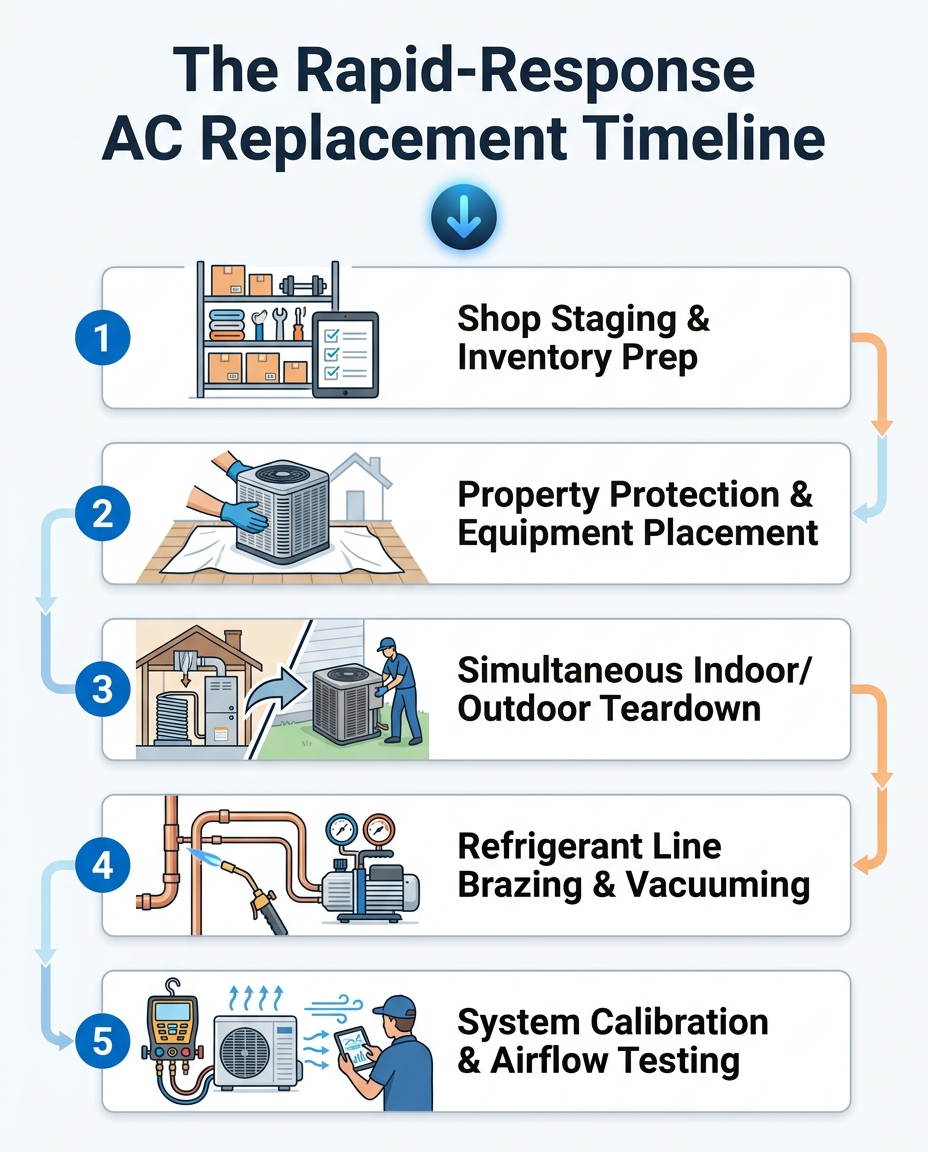
1. Shop-Level Inventory Checks: Long before the crew arrives at your property, all equipment, electrical components, and custom sheet metal fittings are verified and staged at our shop. This eliminates the need for mid-day supply runs.
2. Property Protection and Routing: Once on-site, the team immediately preps the property. Drop cloths, floor runners, and protective gear are laid out to ensure a clean workspace, allowing technicians to move quickly without damaging your home.
3. Strategic Equipment Positioning: Tools, brazing materials, recovery tanks, and the new condenser unit are positioned strategically around the home and yard. This setup eliminates unnecessary trips back and forth to the service truck.
4. Homeowner Timeline Briefing: Before a single wrench is turned, our lead installer walks you through the day's timeline so you know exactly what to expect, when the power will be cut, and when cooling will be restored.
This level of preparation highlights our reliable, rapid-response logistics and local readiness that prevent homeowners from being stranded without air conditioning. A pattern we see often during these September transitions is a sudden spike in urgency. For example, one homeowner recently needed a new AC unit installed during a hot stretch. By professionally and efficiently installing the new unit, explaining the process step-by-step, and answering all their questions, our crew ensured a seamless installation and flawless operation of the new system without unnecessary delays.
Strategic Teardown to Minimize Heat Exposure
Once staging is complete, the strategic teardown begins. Over our years in the field, we've refined the precise operational steps taken to remove the old system around one primary goal: keeping the downtime window as narrow as legally and mechanically possible.
If your existing system is still partially functional, we keep it running until the absolute last moment before the teardown begins. This banks as much cool air in the house as possible. Once the system is shut down, the old refrigerant is safely and legally recovered using high-capacity recovery machines. This specialized equipment expedites the extraction process while ensuring full compliance with environmental regulations.
While the recovery machine is running, our technicians begin pre-staging the electrical disconnects, cutting away old ductwork transitions, and preparing the drain lines for immediate removal.
Coordinating Indoor and Outdoor Crews
To maximize speed, our installation team is split to tackle the indoor air handler and the outdoor condenser at the exact same time. We recommend this parallel approach because simultaneous teardown is critical for rapid execution and prevents the bottlenecks we often see with less experienced crews.
• Parallel Dismantling: The outdoor technician unbolts the old condenser and removes the electrical whip, while the indoor technician disconnects the evaporator coil and furnace or air handler.
• Constant Communication: The crews maintain constant communication to ensure the copper refrigerant lines are flushed, cleaned, and ready for the new equipment simultaneously, preventing either team from waiting on the other.

Rapid-Response Installation and System Calibration
With the old equipment removed, the rapid-response installation phase begins. This phase focuses heavily on speed, but never at the expense of quality, safety, or manufacturer compliance. The new outdoor condenser is set on a leveled, vibration-absorbing composite pad, while the indoor air handler or evaporator coil is secured with precision to the existing ductwork.
One of the most critical steps in the installation is brazing the copper refrigerant lines. Technicians flow nitrogen through the pipes while brazing. Why this matters: The heat from the torch causes oxidation (black soot) inside copper pipes. Flowing nitrogen displaces the oxygen, preventing this soot from forming and protecting the new compressor from future clogs. Once brazed, the team pulls a deep vacuum on the system using a micron gauge to remove all moisture and non-condensable gases, saving crucial time while electrical connections are finalized.
When unexpected failures occur, navigating the logistics of a sudden replacement can be stressful. We understand this urgency firsthand. For instance, when an upstairs AC unit died overnight on a Saturday for a local customer, our rapid-response logistics meant we were able to respond on Sunday morning, diagnose the critical failure, and have the new unit fully installed by Tuesday. To make these sudden investments more manageable, homeowners frequently explore flexible AC replacement financing options to alleviate the upfront burden.
Finally, the system is charged with the exact factory-specified refrigerant weight, ensuring the new unit delivers optimal cooling performance the moment it is turned on.
Post-Installation Testing and Long-Term Reliability
The installation is not complete just because the air is blowing cold. In our experience, skipping the final calibration is a common mistake that leads to premature wear. The final steps ensure the system is ready to handle immediate heat and long-term operations without faltering. Post-installation testing is a rigorous process that our team uses to verify every component is operating at peak efficiency.
Key Metrics We Measure Before Leaving:
• Airflow and Static Pressure: Ensuring the ductwork is properly sized for the new blower motor and that air is distributing evenly throughout the home.
• Temperature Drop (Delta T): Measuring the difference between the return air and supply air to confirm the refrigerant cycle is absorbing heat effectively.
• Electrical Draw: Checking the amperage on the compressor and blower motor to ensure they are operating within safe, manufacturer-specified ranges.
Once the technical metrics are confirmed, our lead installer walks you through the new thermostat controls, explaining how to set efficient schedules and demonstrating basic filter replacement procedures. We also take the time to discuss how modern, high-efficiency equipment immediately impacts utility bills, and how energy savings offset replacement costs over the lifespan of the unit.
To keep the new system running flawlessly through future summers, we help you set up a proactive schedule via a comprehensive preventative maintenance plan. This ensures your investment remains protected year after year.
Frequently Asked Questions About Fall AC Replacements in Gretna
How long does it take to replace an AC unit?
A standard replacement typically takes 4 to 8 hours depending on the complexity of the ductwork and electrical connections. By utilizing a coordinated team that splits indoor and outdoor tasks, the teardown and installation processes overlap, significantly reducing the total time required. Complex installations involving extensive duct modifications or difficult attic access may push closer to the 8-hour mark.
Can you replace an AC in the fall?
Yes, fall is an excellent time for replacement, provided the installation team is fully prepared for the environment. In Louisiana, early fall still brings sudden late-season heat spikes, so our crews treat the job with the same urgency as a summer replacement. Scheduling in the fall often allows for more flexible booking times compared to the peak emergency season in July.
What happens during an AC replacement?
The process involves recovering old refrigerant, safely removing the existing indoor and outdoor units, and preparing the site for new equipment. Technicians then install the new system, braze the copper refrigerant lines with nitrogen, pull a deep vacuum to remove moisture, and calibrate the electrical systems. Finally, the system is charged with refrigerant and tested for proper airflow and temperature drop.
Is September a good time to buy an air conditioner in Louisiana?
It can be ideal for scheduling, but homeowners must ensure their contractor has a rapid-response plan to avoid extended downtime. Because September frequently features unpredictable 90-degree days and high humidity, passive cooling isn't an option. Choosing a contractor with streamlined logistics ensures your home won't overheat during the transition.
Will my home get dangerously hot during a same-day AC replacement?
With strategic teardown sequencing and a coordinated crew, indoor temperatures are kept highly manageable. By leaving the old system running until the last possible moment and utilizing simultaneous indoor/outdoor dismantling, the new system is brought online before the house can severely overheat. Proper staging ensures the downtime window is kept as short as possible.
Secure Reliable Cooling Before the Next Heat Wave Hits: How Cypress Cooling Handles Late-Season AC Replacements in Gretna
Dealing with a failing air conditioner during volatile transition weather doesn't have to mean suffering through days of unbearable humidity. A clear, transparent breakdown of installation logistics proves that downtime can be safely minimized, even when the heat index suddenly spikes. You don't have to endure a failing unit out of fear of the installation process.
By prioritizing pre-installation staging, simultaneous teardowns, and rigorous system calibration, we ensure your home remains safe and comfortable throughout the entire process. If your system is struggling to keep up with the late-season heat, reach out today to discuss your specific cooling needs and schedule a comprehensive assessment with our local experts.
OUR CLIENTS HAVE TO SAY ABOUT US



Service areas
Our service areas are designed to meet the diverse needs of our clients. We focus on providing exceptional service and ensuring customer satisfaction in every location we operate.

