
Evaluating A/C Replacement vs. Compressor Repair for 15-Year-Old Units in Westwego
.webp)
Facing a Dead Compressor in the Heat of Summer?
If you find yourself evaluating A/C replacement vs. compressor repair for 15-year-old units in Westwego, you already know the intense stress of losing your cooling during the peak of summer. At Cypress Cooling Company, our team regularly helps homeowners navigate this exact crossroads when their air conditioner suddenly stops blowing cold air in the middle of July peak heat and humidity, making a fast decision feel critical. However, rushing into a major repair on an obsolete system can often lead to more frustration and higher costs down the road. The compressor is the heart of your cooling system, and when it fails on an older unit, you face a significant decision.
The dilemma we see our customers face is straightforward but challenging: do you invest heavily in a major repair for an aging system, or do you take the leap and upgrade to a brand-new, highly efficient unit? This guide is designed to provide an objective, no-pressure look at both options based on our years of field experience, so you can find the most reliable long-term solution for your home.
For immediate assistance with your cooling needs, learn more about our air conditioning services or schedule AC services in Westwego today.
The Reality of Operating an Aging R-22 System
To make an informed choice about your broken air conditioner, you first need to understand the technical and regulatory status of your current equipment. A 15-year-old R-22 system operates on technology that is now considered obsolete by modern environmental and efficiency standards. Understanding these limitations is the first step in deciding your system's future.
The 2020 EPA Phaseout
The regulatory shift: The Environmental Protection Agency (EPA) completely phased out the production and import of R-22 refrigerant in the United States as of 2020. Because this refrigerant was found to deplete the ozone layer, the industry shifted to more environmentally friendly alternatives like R-410A and, more recently, R-454B. Because new R-22 is no longer being manufactured, any supply our technicians have access to today is reclaimed or recycled.
Energy Efficiency and SEER Ratings
The efficiency gap: Older systems operate at significantly lower Seasonal Energy Efficiency Ratio (SEER) ratings compared to modern Department of Energy minimum standards. A 15-year-old R-22 system might operate at a SEER rating of 10 or 12, whereas modern base-model systems start at 14.3 SEER2 or higher. This massive gap in efficiency means your older unit requires substantially more electricity to produce the same amount of cooling, driving up your monthly utility bills.
The Refrigerant Supply Problem
The maintenance reality: Sourcing remaining R-22 for repairs is increasingly difficult and impractical for long-term maintenance. If your compressor failure is linked to a refrigerant leak—or if the repair process requires recharging the system—the scarcity of R-22 makes the repair process highly prohibitive. In our experience serving Westwego and the greater Metairie area, when considering how long an AC unit typically lasts in South Louisiana, the lack of available refrigerant is often the deciding factor that pushes a system into retirement.
Compressor Repair: A Short-Term Fix with Compounding Risks
Our technicians often compare choosing to replace a dead compressor on a 15-year-old R-22 system to putting a brand-new engine into a car with a failing transmission and a rusted frame. While the compressor itself might be new, the surrounding environment it operates in is severely degraded. This creates a cycle of compounding risks.
The Problem: Immense Strain on Aging Components
When a new, powerful compressor is installed into an older system, it immediately begins pushing refrigerant through aging, weakened lines and coils. The evaporator coil (inside your home) and the condenser coil (outside) have endured 15 years of continuous thermal expansion, contraction, and elemental wear. The sudden introduction of optimal pressure from a new compressor often exposes the weaknesses in these older parts, leading to secondary failures in the blower motor, fan blades, or electrical relays.
The Cause: Inevitable Refrigerant Leaks
Because the copper tubing and coils in a 15-year-old R-22 system have degraded over time, microscopic pinhole leaks are highly common. If you replace the compressor today, there is a substantial risk that the aging coils will spring a leak tomorrow. As discussed earlier, refilling a system with R-22 is exceptionally difficult due to the EPA phaseout. You could easily find yourself paying for a major compressor repair, only to lose the system entirely a few months later due to an unrepairable refrigerant leak.
The Solution: Looking Beyond Limited Warranties
If you opt for a compressor replacement, the contractor will typically provide a limited part warranty that covers the new compressor itself. However, the rest of your 15-year-old system remains completely unprotected. If the reversing valve sticks, the condenser fan motor burns out, or the indoor coil begins leaking, you will be entirely responsible for those repair costs. A short-term patch often creates a false sense of security that quickly fades when the next aging component inevitably fails.
How Extreme Gulf Coast Humidity Impacts Your Decision
When you live in Westwego, your air conditioner does much more than just lower the temperature. An air conditioner's secondary—and equally important—job is acting as a heavy-duty dehumidifier. The local climate demands a system that can handle immense moisture loads, and an aging system simply cannot keep up.
During the Westwego July peak heat and humidity, the thermal load on your home is extreme. A struggling, patched compressor fails to remove ambient moisture effectively. When an older system loses its dehumidification power, the results are immediate: the air feels heavy, indoor air quality plummets, and you may even notice condensation forming on surfaces. We recently helped a local homeowner who experienced the severe effects of poor cooling performance during the summer when their house grew uncomfortably hot and the floors actually began sweating. While our technicians resolved their specific issue by reattaching an attic vent and improving airflow—resulting in a house that stayed chilly during the day—the situation perfectly illustrates how quickly a home becomes unlivable when the cooling system cannot manage indoor moisture.
Furthermore, older units must run much longer cycles to combat this subtropical moisture. Because a 15-year-old R-22 system lacks the efficiency of modern units, it will run almost continuously during the hottest parts of the day just to make a dent in the humidity. This constant operation accelerates wear and tear on the newly replaced compressor and the surviving older parts, drastically shortening the lifespan of the repair.
System Replacement: The Long-Term Solution for Reliability
While the initial prospect of replacing your entire HVAC system can feel daunting, our team finds it is often the most financially and functionally sound decision you can make for your home. Upgrading to a new system provides immediate benefits that a patched 15-year-old R-22 system simply cannot match.
• Immediate improvement in cooling and humidity control: Modern, high-SEER systems are designed with advanced coil technology and optimized airflow. This allows them to extract moisture from the heavy Westwego air far more efficiently than older models. You will feel the difference in comfort almost immediately, as the indoor air will feel crisp and dry rather than damp and stagnant.
• Comprehensive manufacturer warranties: When you install a new system, you are not just getting a warranty on a single part. New installations come with comprehensive manufacturer warranties that cover all major components—including the compressor, coils, and motors—often lasting for up to a decade. This provides immense peace of mind during the harsh summer months.
• Potential incentives and rebates: Upgrading to a modern, energy-efficient system can also unlock financial incentives. Qualifying high-efficiency installations may be eligible for generic federal tax credits or local utility rebates. These incentives, combined with the substantial reduction in your monthly energy bills, help offset the initial investment over time.
When a major component fails, replacement is often the fastest route to reliable comfort. For example, when one local homeowner's upstairs AC died in the middle of a Saturday night during the summer, our on-call technician responded early Sunday morning. After diagnosing a catastrophic failure, our installation crew had a completely new unit installed by Tuesday, getting the family back into a reliably cool home without the lingering anxiety of future breakdowns. If you are considering an upgrade, exploring HVAC financing options can make the transition smooth and manageable.
Using the '5,000 Rule' to Evaluate Your Next Steps
If you are still on the fence about whether to repair or replace, our industry professionals often recommend a simple mathematical framework known as the "5,000 Rule." This formula helps homeowners determine if a repair is a financially sound investment or a sunk cost.
1. Determine the exact age of your equipment: Locate the manufacturing date on your outdoor condenser unit's data plate. For this scenario, we are looking at a 15-year-old R-22 system.
2. Obtain a professional repair estimate: Have a licensed technician diagnose the dead compressor and provide a full estimate for the replacement, including labor and any necessary refrigerant recovery.
3. Apply the formula: Multiply the age of the equipment by the estimated cost of the repair.
4. Evaluate the result: If the resulting number is greater than 5,000, conventional wisdom suggests that the repair is a poor financial decision and the money would be better spent toward a new system. If the number is less than 5,000, a repair might still make sense—though with a 15-year-old unit, the math almost always points toward replacement.
At Cypress Cooling Company, our team provides a candid, no-pressure breakdown of these risks to help local homeowners make the most financially sound long-term decision without aggressive sales tactics. We encourage our customers to weigh this calculation against the long-term energy savings of a new unit. Every month you operate an inefficient older system, you are paying a premium on your utility bills that could be invested in reliable, modern comfort.
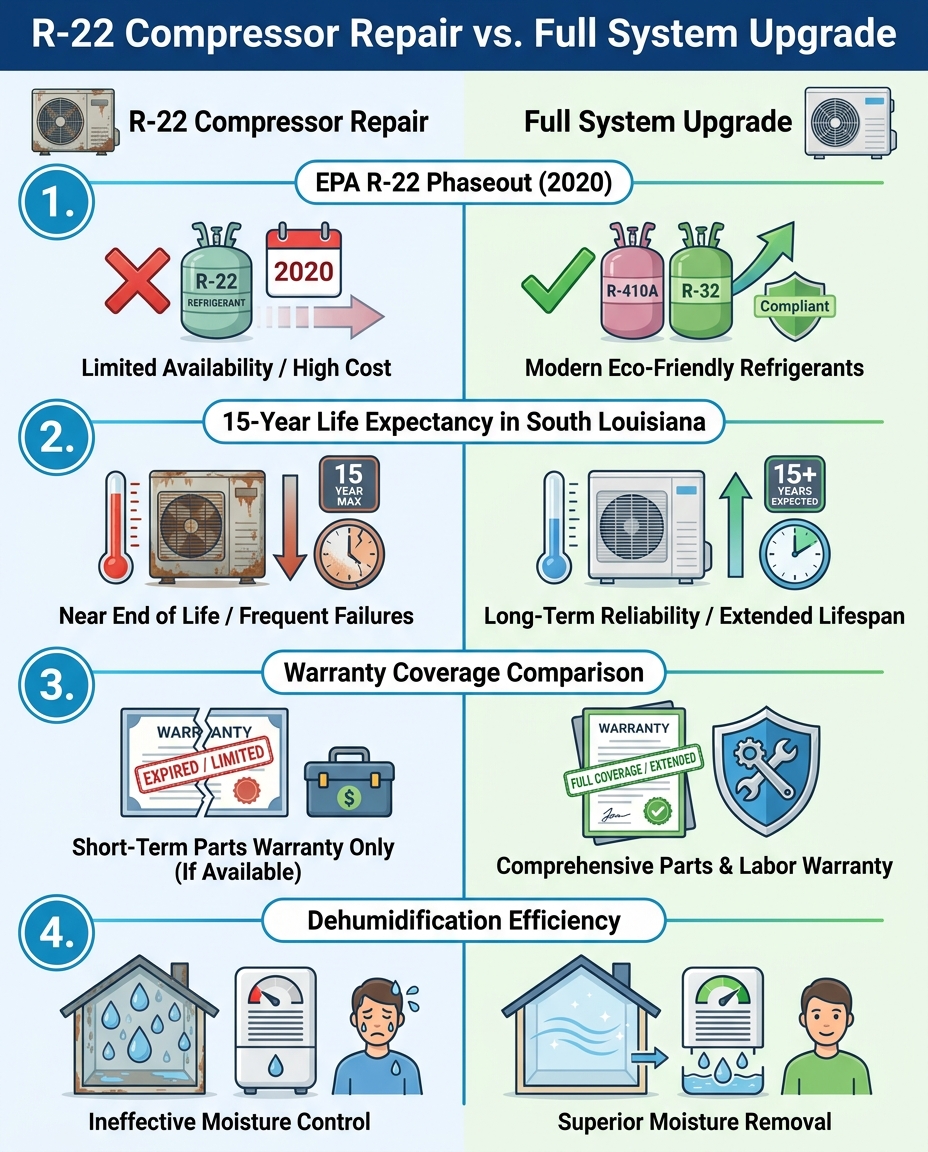
Side-by-Side: R-22 Compressor Repair vs. Full System Upgrade
To help visualize the decision-making process, it helps to look at the direct comparisons between patching your current unit and upgrading to a new one. The differences in reliability, efficiency, and environmental compliance are stark.
• Timeframe & Disruption — R-22 Compressor Repair: Requires sourcing difficult-to-find parts and refrigerant; high risk of follow-up repairs. — Full System Upgrade: Scheduled installation, usually completed in a single day with reliable, modern equipment.
• Energy Efficiency — R-22 Compressor Repair: Remains at the low SEER rating of a 15-year-old system, resulting in high utility bills. — Full System Upgrade: Meets or exceeds modern DOE minimum standards, significantly lowering monthly energy usage.
• Warranty Coverage — R-22 Compressor Repair: Limited part warranty on the compressor only; the rest of the aging system is unprotected. — Full System Upgrade: Comprehensive manufacturer warranty covering all major system components for years to come.
• Humidity Control — R-22 Compressor Repair: Struggles to manage severe summer humidity, leading to longer cycles and poor indoor air quality. — Full System Upgrade: Advanced moisture removal capabilities designed specifically for high-humidity climates.
When you look at the comparison, it becomes clear that while a repair might seem like the path of least resistance today, it leaves you highly vulnerable to future breakdowns and continued high energy costs.

Frequently Asked Questions About Aging AC Systems
Is it worth replacing a compressor on an R22 system?
Our technicians generally advise no, due to the high cost of R-22 and the likelihood of other aging parts failing soon after. Because the EPA has phased out this refrigerant, sourcing it is difficult and expensive. Additionally, putting a new compressor into a 15-year-old R-22 system puts immense strain on the older coils and motors, often leading to a domino effect of secondary breakdowns.
How long does an AC unit typically last in South Louisiana?
In our local service area, due to extreme heat and humidity, systems typically last 10-15 years before efficiency drops significantly. The constant demand for both sensible cooling and heavy-duty dehumidification forces local air conditioners to run longer and harder than they would in milder climates. By the time a unit reaches the 15-year mark, it is usually operating well below its original efficiency rating.
What are the benefits of replacing a 15-year-old air conditioner?
Improved energy efficiency, better humidity control, reliable warranties, and compliance with modern environmental standards. A new system will lower your monthly utility bills by utilizing advanced technology that requires less electricity. Furthermore, you gain the peace of mind that comes with a comprehensive warranty, ensuring you won't be left sweltering during the next major heatwave.
What are the signs my AC compressor is failing?
Warm air blowing from vents, loud grinding or screeching noises, hard starting, and frequently tripped circuit breakers. The compressor is the engine of your cooling system, and when it struggles to pump refrigerant, it pulls excessive electricity and creates mechanical noise. If you notice your system stuttering when it turns on, it is critical to have our team evaluate it immediately.
Can I still get R-22 refrigerant for my old AC?
It is no longer manufactured or imported, meaning any available supply is reclaimed and increasingly difficult to source. Because of the 2020 EPA phaseout, HVAC technicians must rely on recycled R-22 recovered from older systems. This scarcity makes any repair involving the refrigerant loop highly impractical for long-term home maintenance.
Make a Confident Choice for Your Home's Cooling Future
Evaluating A/C replacement vs. compressor repair for 15-year-old units in Westwego ultimately comes down to weighing short-term convenience against long-term reliability. While a quick patch might seem appealing in the moment, a full replacement often provides the best long-term value, superior comfort, and significantly lower energy bills.
It is vital to secure your home's cooling reliability before the worst of the July peak heat and humidity takes an even greater toll on your daily life. Whether you decide to upgrade your equipment or you want to keep a newer system running at peak performance, scheduling a professional assessment with our team is your best next step. Explore our preventative maintenance plan to ensure your home remains a comfortable, reliable sanctuary all summer long.
OUR CLIENTS HAVE TO SAY ABOUT US



Service areas
Our service areas are designed to meet the diverse needs of our clients. We focus on providing exceptional service and ensuring customer satisfaction in every location we operate.