Comparing SEER2 Ratings for Late-Summer A/C Replacements in Marrero
.webp)
Is an 18-SEER2 Upgrade Worth It When Your A/C Fails in August?
Are you suddenly facing an unexpected air conditioning breakdown just as the most oppressive heat of the year sets in? Comparing SEER2 ratings for late-summer A/C replacements in Marrero can feel overwhelming when your primary goal is simply getting your house comfortable again. At Cypress Cooling Company, we see this panic every August. When the late-summer humidity pushes the heat index into dangerous territory, the temptation to install the first available unit is incredibly strong. However, rushing this choice often leads to decades of higher energy bills and subpar indoor comfort.
If your system has suffered a catastrophic failure at the end of the cooling season, you are standing at a critical decision point. You must choose between standard baseline SEER2 equipment and high-efficiency 18-SEER2 systems. Taking a moment to evaluate the new efficiency standards, rather than just settling for a quick fix, directly impacts your long-term comfort and daily energy consumption. For those exploring an air conditioning replacement, understanding the technical differences between these ratings is the key to making an objective, informed investment.
Understanding the SEER2 Standard in South Louisiana
To make sense of your replacement options, you first need to understand the recent shifts in energy regulations. In 2023, the Department of Energy (DOE) implemented a massive update to testing standards, shifting from the traditional SEER metric to the new SEER2 (Seasonal Energy Efficiency Ratio 2) standard. This was not merely a name change; it represented a fundamental shift in how air conditioners are tested for operational efficiency.
The previous SEER testing conditions did not accurately reflect the real-world conditions found in most homes. They tested equipment against an external static pressure of just 0.1 inches of water column. The new M1 testing procedures for SEER2 increase this static pressure requirement to 0.5 inches of water column. This higher pressure better mimics the resistance created by real-world ductwork, dirty filters, and standard home layouts, providing homeowners with a much more accurate representation of how a system will actually perform once installed.
Because climate directly dictates cooling requirements, the DOE divides the country into specific regions with distinct minimum standards. Louisiana falls firmly into the Southeast region. Under the current regulations, the baseline minimum requirement for air conditioners below 45,000 BTUs in this region is 14.3 SEER2. Our installation crews always remind homeowners that while installing a system that meets this 14.3 SEER2 baseline keeps you compliant with federal regulations, simply meeting the legal minimum might not be enough to deliver the optimal comfort you expect, especially when fighting extreme southern weather.
The Real Enemy: Tackling August Late-Summer Humidity
The actual temperature reading on your thermostat only tells half the story of your home's comfort. In South Louisiana, the real challenge is latent heat. Latent heat load refers to the massive amount of humidity present in the air during late summer that must be physically removed for a home to feel cool. If an air conditioner lowers the temperature without extracting the moisture, the resulting environment feels cold, clammy, and deeply uncomfortable.
When a system struggles with this moisture load, the symptoms are obvious. You might notice sweating floors, hot daytime indoor temperatures, condensation on windows, and a thermostat that never seems to match your actual physical comfort level. Removing this heavy moisture requires longer, slower air conditioning run times rather than rapid, aggressive blasts of cold air. The air must pass over the cold evaporator coil slowly enough for the water vapor to condense and drain away.
One local homeowner reached out to our team recently as the back-to-school transition began, complaining their house was uncomfortably hot during the day, despite the system running constantly. One of our technicians discovered the system was struggling with airflow and pulling unconditioned attic air—reattaching a vent in the attic and updating the filter restored the chilly indoor environment they expected. When an aging unit fails entirely, we see similar symptoms appear because the equipment can no longer process the heavy moisture load. This intense August late-summer humidity is the primary reason many homeowners look beyond the baseline 14.3 SEER2 rating and explore systems engineered specifically for superior moisture removal.
Head-to-Head: Standard 14.3 SEER2 vs. 18-SEER2 Systems
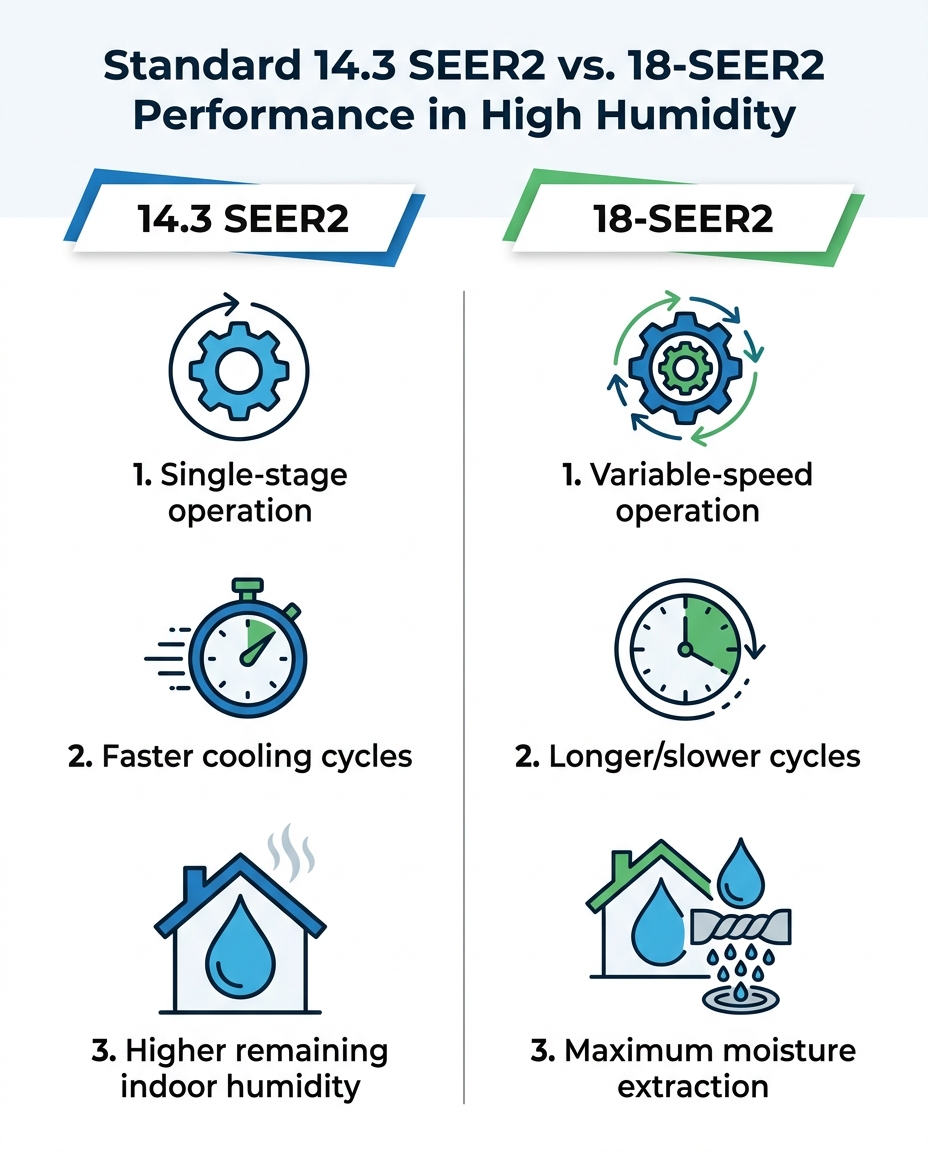
In our years serving Metairie and Marrero, we've found the choice between a baseline unit and an upgraded model usually comes down to the underlying compressor technology. Standard 14.3 SEER2 units typically utilize single-stage operation. This means the compressor only has one speed: 100% capacity. It turns on, blasts cold air until the thermostat registers the target temperature, and immediately shuts off. While this cools the room quickly, these short on/off cycles do not give the system enough time to extract meaningful amounts of humidity from the air.
In contrast, an 18-SEER2 system almost always features variable-speed or multi-stage technology. Instead of running at full blast, a variable-speed compressor can modulate its output, running at lower capacities (often as low as 25% or 30%) for extended periods. This continuous, low-speed operation excels at latent heat removal. By constantly circulating air over the indoor coil, an 18-SEER2 unit continuously pulls moisture from the home without overcooling the space.
• Compressor Type — Standard 14.3 SEER2: Single-stage (On/Off) — High-Efficiency 18-SEER2: Variable-speed or Two-stage
• Cooling Cycles — Standard 14.3 SEER2: Short, rapid cycles — High-Efficiency 18-SEER2: Long, continuous cycles
• Humidity Control — Standard 14.3 SEER2: Basic (leaves moisture behind) — High-Efficiency 18-SEER2: Superior (prioritizes dehumidification)
• Energy Consumption — Standard 14.3 SEER2: Higher operational draw — High-Efficiency 18-SEER2: Lower, modulated power draw
• Temperature Swings — Standard 14.3 SEER2: Noticeable hot/cold spots — High-Efficiency 18-SEER2: Even, consistent temperatures
Understanding how energy savings from a new AC offset replacement costs requires looking at these operational differences. The premium for an 18-SEER2 unit makes the most sense if you plan to stay in your home for several years and prioritize ultimate indoor comfort over the lowest possible upfront price tag.
Performance in High Humidity
The defining difference between these two tiers of equipment is how they behave during a muggy afternoon. Standard units cool the air quickly but leave the heavy moisture behind, resulting in that dreaded "cold and clammy" feeling. High-efficiency 18-SEER2 units adjust their speed to prioritize dehumidification, ensuring the air inside your home is both cool and crisp.

Why Installation Expertise Outweighs the Efficiency Rating
A common, yet incredibly costly, misconception in the HVAC industry is that bigger is always better when it comes to air conditioning tonnage. Some homeowners assume that buying the largest available unit with the highest SEER2 rating will automatically solve all their cooling problems. In reality, over-sizing a high-SEER2 unit destroys its ability to function properly.
An oversized air conditioner cools the house down so rapidly that it satisfies the thermostat in a matter of minutes. This leads to short-cycling—a destructive process where the unit turns on and off too quickly. Because the system never runs long enough to extract moisture, an oversized unit fails entirely at dehumidifying the home, regardless of how high its efficiency rating might be. It also causes massive wear and tear on the compressor, leading to premature breakdowns.
This is why our team insists on a professional load calculation, known as a Manual J, before any installation. This calculation measures your home's specific thermal envelope, factoring in square footage, ceiling height, window orientation, insulation quality, and local climate data. At Cypress Cooling Company, we leverage our deep understanding of South Louisiana climate challenges to prioritize precise load calculations over simply upselling the highest rating. A high-efficiency system only delivers its promised operational efficiency if it is sized flawlessly for your specific floor plan.
Navigating Upfront Investments and Generic Incentives
Upgrading to an 18-SEER2 system requires a larger initial investment compared to baseline models. The advanced variable-speed technology and sophisticated control boards inherently cost more to manufacture and install. However, homeowners rarely have to shoulder the entire burden of this upgrade alone, thanks to a variety of energy transition programs designed to encourage the adoption of high-efficiency equipment.
Federal tax credits and local utility rebates may apply to qualifying high-efficiency A/C installations, helping offset those initial costs. Because these programs are constantly evolving based on legislative funding and local utility budgets, it is vital to consult with your utility providers or tax professionals to verify current, generally applicable incentive programs. These incentives often bridge the gap between a standard system and a premium upgrade.
When an unexpected breakdown happens in the heat of late summer, having the cash on hand for a premium system isn't always a reality. Exploring financing options for new A/C systems can make high-efficiency upgrades much more accessible. Breaking the upfront cost into predictable monthly payments allows you to enjoy the superior dehumidification of an 18-SEER2 system immediately without draining your emergency savings.
Exploring Current Offers
Before finalizing your installation choice, take the time to review the broader market for support. Check for seasonal manufacturer incentives, which often peak during the transition between summer and fall. Review available HVAC installation promotions to maximize your value, ensuring you get the best possible technology for your home.
Managing Emergency Replacements Before the Season Ends
The specific rush of late-summer replacements creates a chaotic environment in the HVAC industry. As older systems finally succumb to the relentless August heat, contractors get overwhelmed with calls. Unfortunately, this rush often leads to rushed installations or skipped load calculations by less experienced contractors who are just trying to move on to the next job. When a unit fails overnight or on a weekend, leaving the home exposed to severe heat, rapid response times are critical—but quality must never be sacrificed for speed.
We recently helped a Marrero family who experienced this firsthand when their upstairs AC died completely in the middle of the night on a Saturday. One of our on-call technicians diagnosed the catastrophic failure immediately, and we dispatched an installation crew to replace the unit, ensuring the family wasn't left suffering through the intense weekend heat. This highlights the importance of choosing a responsive, local contractor who can handle emergencies without cutting corners.
The ideal emergency replacement process follows a strict, professional protocol to protect your home and your investment:
1. Rapid Diagnosis: A qualified technician inspects the failed equipment to confirm that replacement, rather than a repair, is the only viable option.
2. Temporary Relief: If the replacement cannot happen the same day, temporary cooling solutions or spot coolers may be deployed to keep the family safe.
3. Precise Measurement: A proper load calculation is performed, even under tight deadlines, to ensure the new system is sized correctly.
4. Professional Installation: The new equipment is installed to exact manufacturer specifications, with careful attention paid to duct connections and refrigerant charges.
Even in a high-stress emergency, taking the time to properly evaluate your SEER2 options yields the best long-term results. Be sure to ask your contractor about current HVAC installation promotions that might be available to help ease the burden of an unexpected replacement.
Marrero SEER2 Replacement FAQs
When evaluating your options for Marrero air conditioning services, our customers typically want clear, factual answers to help guide their decision. Here are the most common questions homeowners ask when navigating the new efficiency standards.
What is the difference between standard SEER2 and 18-SEER2?
The primary difference lies in the compressor technology and operational cycles. Standard SEER2 (14.3) typically operates on a single-stage system, meaning it turns on at full blast and shuts off completely. In contrast, 18-SEER2 systems often use variable-speed technology, allowing them to run at lower capacities for longer periods, which provides better efficiency and overall comfort.
How does an 18-SEER2 system handle high humidity?
An 18-SEER2 system handles humidity exceptionally well because it runs at lower speeds for longer durations. This continuous operation allows the indoor coil to extract significantly more moisture from the air without overcooling the space. The result is a crisp, comfortable indoor environment rather than a cold and clammy one.
What SEER2 rating is required in Louisiana?
Because climate dictates cooling needs, Louisiana is classified in the Southeast region by the Department of Energy. The minimum requirement for this region is 14.3 SEER2 for systems under 45,000 BTUs. Any new air conditioner installed in the state must meet or exceed this baseline standard.
Is an 18 SEER2 air conditioner worth it?
Whether the upgrade is worth it depends entirely on your long-term plans for the home and your personal comfort goals. If you plan to live in the house for many years, the superior operational efficiency and unmatched dehumidification capabilities often justify the upgrade, especially in highly humid southern climates.
Does a higher SEER2 rating dehumidify better?
Yes, provided the higher SEER2 unit features two-stage or variable-speed technology. A high rating alone doesn't guarantee moisture removal, but the advanced compressors found in these premium units do. Proper sizing by a professional is absolutely required to realize these dehumidification benefits in your home.
Why is proper sizing critical for high-efficiency A/C units?
An oversized unit will cool the house down too quickly and shut off before it has time to remove humidity from the air. This leads to a cold but clammy indoor environment and causes increased wear and tear on the system from constant starting and stopping. Accurate sizing ensures the equipment runs long enough to perform as designed.
Make an Informed Decision for Your Marrero Home
Navigating an unexpected breakdown during the hottest part of the year is stressful, but understanding the difference between baseline equipment and an 18-SEER2 system empowers you to make the right choice. By focusing on how variable-speed technology handles latent heat and recognizing the absolute necessity of proper sizing, you can transform a frustrating failure into a long-term upgrade for your home. A clear, objective framework for evaluating generic rebates, financing options, and efficiency benefits ensures your long-term satisfaction. Don't let the August heat force you into a rushed decision—schedule a professional load calculation and replacement consultation with our local experts today to secure the comfort you deserve.
OUR CLIENTS HAVE TO SAY ABOUT US



Service areas
Our service areas are designed to meet the diverse needs of our clients. We focus on providing exceptional service and ensuring customer satisfaction in every location we operate.