
Upgrading Your Kenner AC: Deciding Between Single-Stage and Variable-Speed Cooling
.webp)
The Late-Summer Cooling Dilemma: Why Your Home Feels Clammy
Dealing with a sticky, uncomfortable house in late summer usually means one thing: you are facing the reality of upgrading your Kenner AC: deciding between single-stage and variable-speed cooling is the critical next step. Your air conditioner might be running nonstop, but the indoor air still feels thick, heavy, and damp. You lower the thermostat, hoping for relief, but all you get is a freezing cold room that still feels surprisingly clammy. At Cypress Cooling Company, our technicians see this frustrating pattern constantly as August late-summer humidity settles over the region, pushing aging systems past their breaking point just as families are settling into their back-to-school routines.
When your system reaches the end of its lifespan, you are presented with a major decision. Do you replace it with a standard, traditional unit, or do you invest in advanced technology designed specifically to handle heavy moisture? Choosing the right path requires understanding exactly how different compressor types manage the air inside your living space. If you are planning an air conditioning replacement, the choice you make now will dictate your daily comfort, your indoor air quality, and your monthly energy usage for the next decade or more.
The signs of a struggling system our team commonly encounters include:
• Musty odors: A lingering damp smell that never quite goes away, even after cleaning.
• Sticking doors and warped wood: Excess moisture causing the materials in your home to swell.
• Sweaty windows: Condensation building up on the inside of your glass panes during the afternoon heat.
• Restless sleep: Tossing and turning because the bedroom air feels stagnant and warm, regardless of the thermostat setting.
Most homeowners do not realize that temperature is only half the equation. To truly solve the late-summer cooling dilemma, we have to look closely at how your equipment handles the invisible moisture trapped inside your walls.
Understanding Sensible vs. Latent Heat in Southern Louisiana
To understand why your house feels so uncomfortable, you have to understand the two different types of heat your air conditioner is fighting. The first is sensible heat. This is the heat you can easily measure with a thermometer. When your thermostat says it is 78 degrees inside, it is measuring sensible heat. The second, and far more stubborn enemy, is latent heat. Latent heat is the thermal energy hidden inside the moisture in the air—what we commonly call humidity.
In our regional climate, relative humidity frequently pushes above 70% for days or weeks at a time. Because of this extreme moisture load, removing latent heat is absolutely mandatory for indoor comfort. If your system only lowers the sensible heat (the temperature) without extracting the latent heat (the moisture), your home will feel like a cold swamp. High indoor humidity makes the air feel significantly warmer against your skin, because your body cannot evaporate sweat effectively. This is why you might find yourself dropping the thermostat down to 68 degrees just to feel comfortable, wasting massive amounts of electricity in the process.
Why the Thermostat Lies to You
In our years of servicing homes across Metairie and Kenner, we have found that your thermostat only reads temperature, not comfort. If you live in Kenner, you know firsthand that 75 degrees on a dry day feels completely different than 75 degrees on a highly humid afternoon. When you are looking for AC installation services in Kenner, the goal should not just be to buy a machine that blows cold air. Our team always recommends installing a system capable of wringing the water out of your indoor environment like a sponge. Achieving that requires a compressor that runs long enough to pull that moisture across the cold evaporator coil, allowing it to condense and drain away outside.
How Single-Stage Cooling Handles Heat Waves
The Problem: Traditional single-stage air conditioners operate with a very simple mechanical design. They only have one speed: 100% capacity. When the thermostat calls for cooling, the system turns on at full blast. When the target temperature is reached, the system shuts off completely. There is no middle ground, no lower gear, and no nuance to how it operates.
The Cause: During the brutal heat of August late-summer humidity, this all-or-nothing operation leads to a phenomenon known as short-cycling. Because the system is blowing at maximum capacity, it quickly drops the sensible heat (the temperature reading) in the house. The thermostat registers that the room is cool and abruptly shuts the system down. However, the system simply did not run long enough to pull the latent heat (the humidity) out of the air. The heavy moisture remains suspended in your living room, leaving you feeling cold but clammy.
The Solution: Unfortunately, for a single-stage system, there is no easy solution to this mechanical limitation. The constant on-and-off cycling puts immense strain on aging compressors as the season wears on. Every time the heavy motor starts up, it draws a massive surge of electricity and grinds the internal components. Just last August, our Cypress Cooling Company dispatch team responded to a local homeowner who experienced this firsthand when their upstairs AC unit died completely overnight. After they reached out on a Sunday morning, our technician arrived within an hour, and we had a completely new unit installed by Tuesday. Their old single-stage system had simply worn itself out from years of harsh, rapid-fire cycling trying to keep up with the summer heat.
Key drawbacks of single-stage cooling include:
• Temperature swings: The house gets freezing cold, then slowly warms up until the system kicks on again, creating a rollercoaster effect.
• Poor dehumidification: Short run times prevent the evaporator coil from extracting enough water vapor.
• Higher wear and tear: The constant starting and stopping dramatically shortens the lifespan of the compressor and electrical components.
• Loud operation: Every time the system turns on, it does so at maximum volume and power.
Continuous Comfort: The Variable-Speed Advantage for Humidity Control
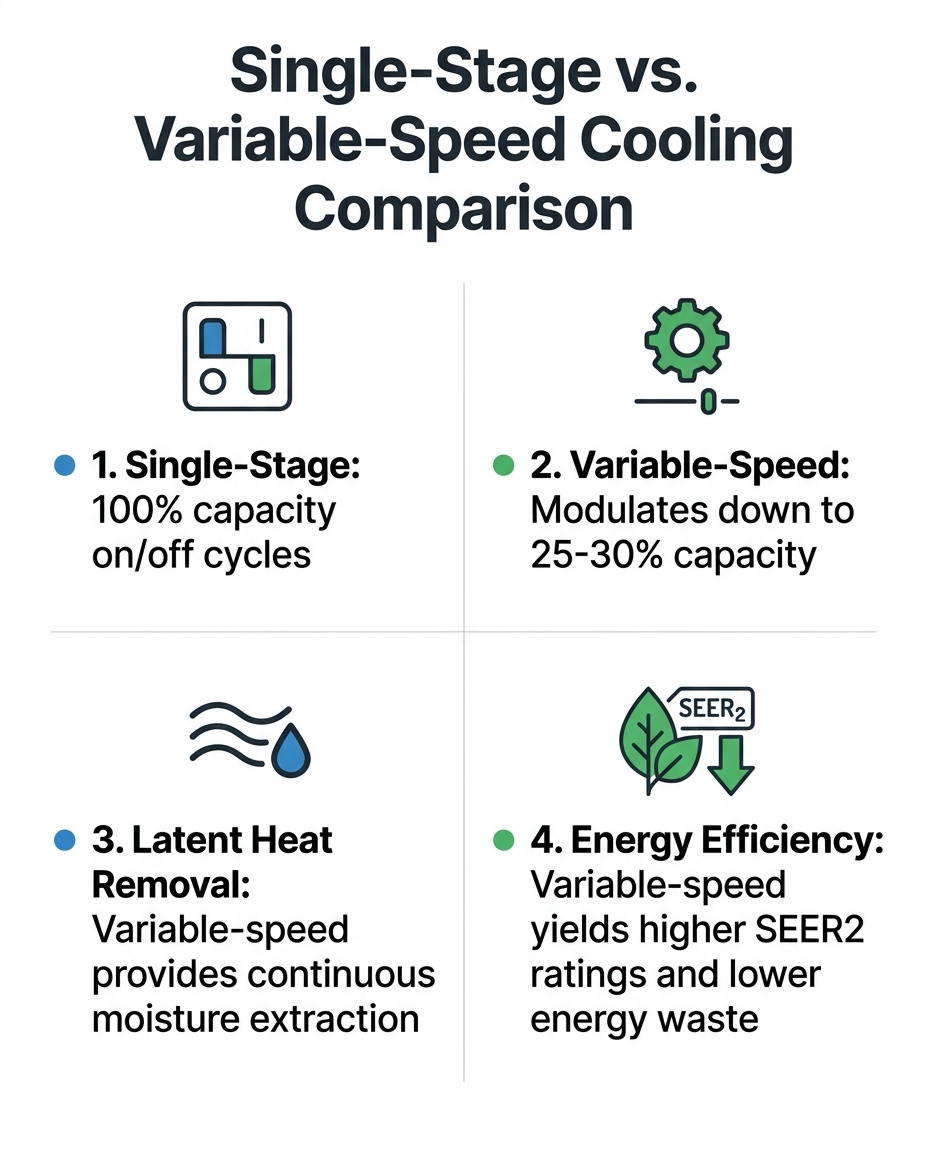
If a single-stage system is like a car that can only drive at 100 miles per hour or sit at zero, a variable-speed system is like a car with cruise control. Variable-speed technology completely changes the mechanics of how your home is cooled. Instead of turning on at maximum capacity, these advanced compressors can modulate their output in tiny increments, often running at capacities as low as 25% to 30%.
The "Cruise Control" Effect on Your Home's Air
When we install a variable-speed system, our customers quickly notice how the unit assesses the cooling load and selects the exact speed needed to maintain the temperature. On a mild Kenner morning, it might run at just 30% capacity. As the afternoon sun beats down, it might ramp up to 70%. This ability to modulate means the system rarely shuts off completely. Instead, it runs in long, slow, continuous cycles.
This continuous operation is the ultimate weapon against humidity. Because the system is running almost constantly at a low speed, air is continuously circulating over the cold evaporator coil. This gives the system hours of uninterrupted time to extract moisture from the air, funneling it safely out through the condensate drain. The result is a home that feels incredibly dry, crisp, and comfortable, even if the thermostat is set to 75 or 76 degrees.
Furthermore, because the air is constantly mixing, you eliminate the hot and cold spots that plague so many multi-level homes. The temperature remains perfectly even in every room, and you never experience that sudden blast of freezing air followed by a stuffy silence. The system simply hums quietly in the background, maintaining perfect equilibrium.
Weighing Your AC Replacement Options Side-by-Side
Making the right choice for your home requires looking at the facts clearly. While variable-speed technology offers superior comfort, single-stage systems remain a reliable and straightforward option for many households. Here is how our team compares the two technologies when dealing with August late-summer humidity.
• Capacity Control — Single-Stage Cooling: 100% on or 100% off. No modulation. — Variable-Speed Cooling: Modulates from roughly 25% to 100% based on exact need.
• Dehumidification — Single-Stage Cooling: Poor to Fair. Short cycles leave moisture behind. — Variable-Speed Cooling: Excellent. Long cycles extract maximum water vapor.
• Temperature Consistency — Single-Stage Cooling: Noticeable swings between cycles (2-4 degrees). — Variable-Speed Cooling: Precise consistency (within 0.5 degrees of setting).
• Noise Levels — Single-Stage Cooling: Loud start-ups; noticeable airflow noise. — Variable-Speed Cooling: Whisper-quiet operation; gentle, continuous airflow.
• Upfront Investment — Single-Stage Cooling: Lower initial cost. — Variable-Speed Cooling: Higher initial cost.
Pros and Cons of Single-Stage Systems:
• Pro: More budget-friendly upfront investment.
• Pro: Simpler technology means standard parts are widely available.
• Con: Struggles to control heavy indoor humidity.
• Con: Uses more electricity due to harsh start-up surges.
Pros and Cons of Variable-Speed Systems:
• Pro: Unmatched moisture removal and indoor air quality.
• Pro: Exceptionally quiet operation inside and outside.
• Pro: Lower monthly energy usage due to low-speed operation.
• Con: Requires a larger upfront financial commitment.
Another customer recently needed a new AC unit installed to combat the heavy summer heat. Because our technicians explained these differences upfront, they were able to choose the exact right system for their layout. The installation process was seamless, with every step explained and all their questions answered, leaving their new unit running flawlessly. If you are trying to weigh these options for your own property, utilizing an AC replacement pricing tool can help you visualize the different tiers of equipment available.

Why Proper Sizing Matters for Local Home Styles
Here is the thing: buying the most expensive, advanced variable-speed air conditioner on the market will not solve your humidity problems if the system is the wrong size for your house. In fact, an oversized variable-speed unit will behave almost exactly like a single-stage unit. It will cool the house too quickly, shut off prematurely, and leave you sitting in a cold, damp living room.
Proper sizing is about much more than just looking at the square footage of your property. A precise load calculation (often called a Manual J calculation) takes into account dozens of specific variables. This is where local expertise becomes absolutely vital. At Cypress Cooling Company, our expertise in performing precise load calculations tailored specifically to local home styles ensures that your new system delivers peak performance. A raised home in Kenner with original single-pane windows has a vastly different thermal load than a modern brick ranch home sitting on a concrete slab, even if both houses are exactly 2,000 square feet.
When our team performs a proper load calculation, we evaluate:
1. Insulation levels: The R-value of the insulation in your attic, walls, and crawlspace.
2. Window efficiency: The number, size, and directional facing of every window in the home.
3. Ductwork condition: The layout, sealing, and location of your existing air ducts.
4. Ceiling height: The total volume of air that needs to be conditioned, not just the floor space.
5. Occupancy and lifestyle: How many people live in the home and heat-generating appliances used daily.
By tailoring the size of the equipment perfectly to your home's unique thermal profile, we ensure that the system runs exactly as the manufacturer intended, wringing out moisture and keeping your indoor climate perfectly balanced.
Maximizing Energy Efficiency and Exploring Upgrade Incentives
When you upgrade to advanced cooling technology, the benefits extend far beyond just feeling more comfortable during August late-summer humidity. There is a significant financial and energy-saving component to consider. Because superior humidity control allows you to feel perfectly comfortable at higher thermostat settings, you naturally use less electricity. A dry house at 76 degrees feels infinitely better than a humid house at 70 degrees.
Furthermore, variable-speed systems achieve much higher SEER2 (Seasonal Energy Efficiency Ratio) ratings. By running at 30% capacity for long stretches, they consume a fraction of the wattage required to constantly start and stop a massive single-stage motor. Over the 15-year lifespan of a new system, this reduction in energy waste adds up significantly. If you are curious about the long-term math, you can read more about how energy savings from a new AC offset replacement costs over time.
In addition to monthly energy savings, high-efficiency systems often qualify for various incentives. Qualifying high-efficiency installations, particularly advanced heat pumps and variable-speed systems, may be eligible for general federal tax credits or local utility rebates. While these programs change frequently, they are designed to reward homeowners who invest in green, energy-saving technology. We always recommend checking with your utility provider or a tax professional to see what generic programs currently apply to your upgrade.
Flexible Options for Your Investment
We understand that upgrading to a premium variable-speed system is a significant decision. The upfront investment is higher, but the long-term payoff in comfort, air quality, and efficiency is undeniable. To make these high-efficiency systems more accessible, many homeowners choose to explore HVAC financing options. By breaking the initial investment into manageable monthly payments, you can enjoy the immediate benefits of continuous comfort and lower energy bills without compromising on the technology your home truly needs.
Frequently Asked Questions
Why does my house feel humid even with the AC running?
Your house feels humid because your AC system is likely short-cycling and not running long enough to remove latent heat. When a system blasts cold air quickly and shuts off, the temperature drops but the moisture stays trapped inside. Our technicians see this highly common issue with oversized or aging single-stage units.
Is a variable speed AC better for humidity control in Louisiana?
Yes, a variable-speed AC is vastly superior for humidity control in our climate. By running continuously at lower capacities, it constantly pulls air across the cold evaporator coil. This ongoing process wrings out moisture all day long, keeping the indoor air crisp and dry.
Does a variable speed AC run all the time?
It runs almost continuously, but at a very low, energy-efficient speed. Instead of turning on and off loudly at 100% power, it might hum quietly in the background at 30% capacity. This continuous operation uses less electricity than the massive power surges required to constantly start a standard motor.
What is the disadvantage of a variable speed AC?
The primary disadvantage is the higher upfront investment required for the equipment and installation. Additionally, because the technology is more complex, replacement parts (if needed outside of warranty) can sometimes be more specialized than standard single-stage components.
Should I upgrade from a single-stage to a variable speed AC?
If you struggle with hot and cold spots, high indoor humidity, or excessive noise from your current unit, we highly recommend upgrading. The improvement in daily comfort and indoor air quality is immediate and substantial.
How do precise load calculations impact AC dehumidification?
Precise load calculations ensure your AC is perfectly sized for your home's exact thermal profile. If a system is too large, it will cool the house too fast and fail to dehumidify, entirely defeating the purpose of buying a high-end unit. Proper sizing guarantees the system runs in the long cycles required to extract moisture.
Making the leap to a new cooling system is a major milestone for your home. By understanding exactly how single-stage and variable-speed units handle Louisiana's intense humidity, you can make an informed, objective decision. Ultimately, choosing the right technology ensures you will enjoy a dry, comfortable, and highly efficient home for many summers to come.
OUR CLIENTS HAVE TO SAY ABOUT US



Service areas
Our service areas are designed to meet the diverse needs of our clients. We focus on providing exceptional service and ensuring customer satisfaction in every location we operate.

