Deciding Between a Gas Furnace and an Electric Heat Pump for Your Marrero Home
.webp)
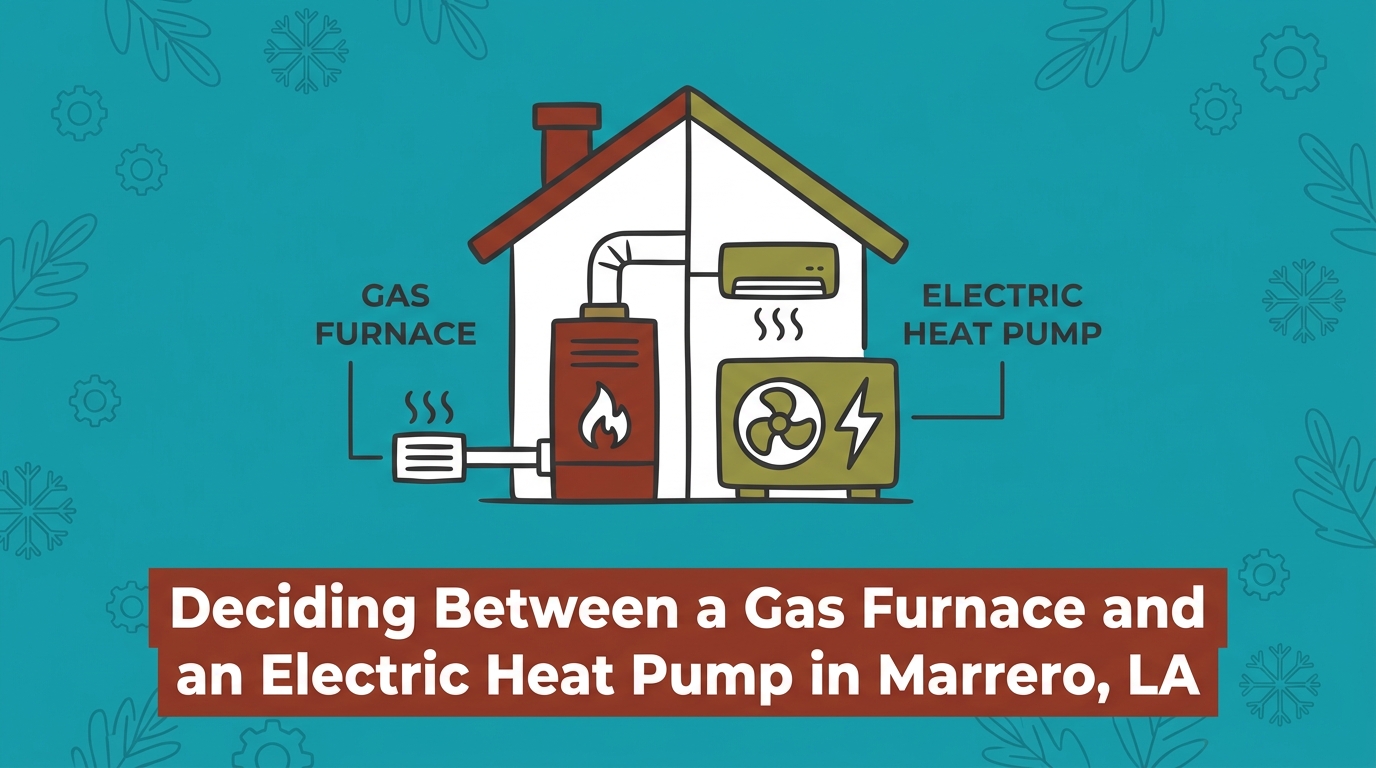
Is a Heat Pump or Gas Furnace Better for Your Home?
How do you know if your aging heating system will survive another unpredictable winter on the Gulf Coast? Deciding between a gas furnace and an electric heat pump for your Marrero home is one of the most important choices you can make right now. As we enter the September pre-heating season transition, the window to replace a struggling system is narrowing. Waiting until the first major cold snap arrives often leads to rushed decisions, limited equipment availability, and uncomfortable nights spent shivering indoors.
The core dilemma comes down to choosing between traditional gas heating technology and modern electric alternatives. Both systems offer distinct advantages depending on your home's layout, your existing ductwork, and your family's personal comfort preferences. Whether you are looking into comprehensive heating services to overhaul your entire setup or you are specifically interested in an electric heat pump installation, understanding how these systems operate is the first step. Let's break down exactly how each option performs when the temperature drops, so you can make an informed, confident upgrade before winter officially begins.
How South Louisiana's Unique Climate Impacts Heating Choices
When you research heating systems online, you often find generic advice built for homes in the Midwest or Northeast. That national advice simply does not apply to Marrero and the Greater New Orleans metro. Our local winters are entirely different. We experience mostly mild temperatures, but those mild stretches are frequently punctuated by brief, intense deep freezes that put immense strain on your HVAC equipment.
Furthermore, high humidity plays a massive role during our long shoulder seasons. A 45-degree day in South Louisiana feels significantly colder than a 45-degree day in a dry climate because the moisture in the air pulls heat away from your body. You need a system that effectively manages indoor humidity while providing consistent warmth. If your heating system is oversized or built solely for extreme cold, it will short-cycle during these mild, humid weeks, leaving your home feeling clammy and uncomfortable.
This is where working with local experts makes a difference. At Cypress Cooling Company, our deep understanding of the true South Louisiana climate means we provide tailored, honest advice rather than pushing one-size-fits-all recommendations. We know the challenges of balancing mild-weather efficiency with extreme-weather reliability. When you are looking for reliable Marrero HVAC services, you need a team that factors in our hot, humid summers, our extended fall transitions, and the sudden temperature plummets brought on by winter cold fronts.
The Case for Gas Furnaces: Rapid Heat When It Counts
For decades, natural gas has been the standard for powerful, reliable home heating. When you look at a traditional furnace vs heat pump comparison, the most defining characteristic of a gas furnace is how it creates warmth. Furnaces generate heat through combustion, burning natural gas in a sealed heat exchanger. The blower motor then forces air over this extremely hot metal, delivering high-temperature air directly through your vents.
If you prioritize intense, fast heating that warms up a cold room in minutes, a gas furnace is incredibly effective. However, installing one requires specific infrastructure and careful maintenance.
Performance During Deep Freezes
When a severe Gulf Coast cold front drops temperatures below freezing, a gas furnace truly shines. Here is what you can expect:
• Consistent high-temperature output: A furnace maintains its high heat output regardless of how cold it gets outside. The air coming out of your registers is often between 120°F and 140°F.
• Rapid recovery times: If you turn your thermostat down while you are away at work, a gas furnace can warm a completely cold house back to a comfortable 70°F very quickly.
• Unaffected by frost: Because all the heating components are safely indoors, a furnace never has to run a defrost cycle during freezing rain or sleet.
Installation Requirements
While powerful, gas furnaces are not a simple plug-and-play solution. They require specific home infrastructure to operate safely and legally.
• Natural gas infrastructure: Your home must already have access to a municipal natural gas line, or you must be willing to pay for the extensive work required to run new lines to your property.
• Strict ventilation standards: Combustion produces exhaust gases, including carbon monoxide. A furnace requires proper flue pipes running safely out of your home. Due to the severe safety risks of gas leaks and improper venting, furnace installation and repair must always be handled by licensed professionals—never attempt DIY modifications on gas appliances.
• Seasonal maintenance: Because a furnace sits idle for many months during our long summers, the burners, flame sensors, and heat exchangers must be professionally inspected and cleaned every fall before you turn the system on.
The Case for Electric Heat Pumps: Year-Round Efficiency
If you are exploring a furnace vs heat pump comparison, the most important thing to understand about a heat pump is that it does not burn fuel to generate heat. Instead, it uses electricity and refrigerant to transfer heat from one place to another. Even when it feels chilly outside, there is still ambient thermal energy in the outdoor air. A heat pump captures that energy, compresses it to make it warmer, and pumps it into your home.
This transfer process is remarkably energy-efficient. Because they consume electricity only to move heat rather than create it, modern heat pumps offer exceptional energy savings. Additionally, generic federal tax credits may apply to qualifying high-efficiency installations, making the initial investment even more attractive (always consult a tax professional to verify current programs).
Handling Humidity and Mild Winters
Heat pumps are uniquely suited to the typical weather patterns of South Louisiana. They excel in conditions where a traditional furnace might be overkill.
• Peak mild-weather efficiency: Heat pumps operate at their absolute highest efficiency during our typical 40-degree to 50-degree winter days. They provide a steady, gentle warmth that maintains your home's temperature without the constant on-and-off cycling of a massive gas burner.
• Superior dehumidification: During the long, damp shoulder seasons, running a heat pump helps pull excess moisture out of your indoor air, making your living spaces feel crisp and comfortable rather than sticky.
Dual Heating and Cooling Capabilities
The greatest advantage of a heat pump for Gulf Coast homeowners is its dual functionality. By simply reversing the flow of refrigerant, a heat pump becomes a high-performance air conditioner.
• Consolidated equipment: You no longer need a separate furnace and AC unit. A heat pump handles both jobs, streamlining your HVAC system.
• Seamless transitions: As our fall weather fluctuates wildly—requiring heating on a Tuesday morning and cooling by Wednesday afternoon—a heat pump transitions smoothly between modes.
• Cooling season strength: When integrated with modern air conditioning systems, a heat pump provides powerful, efficient cooling during our long, brutal summers.
Side-by-Side Comparison: Efficiency, Comfort, and Installation
To make the best choice for your home, it helps to look at how these two technologies stack up against each other across the categories that matter most to homeowners. Every furnace vs heat pump comparison ultimately comes down to balancing your desire for intense heat against your desire for year-round efficiency.
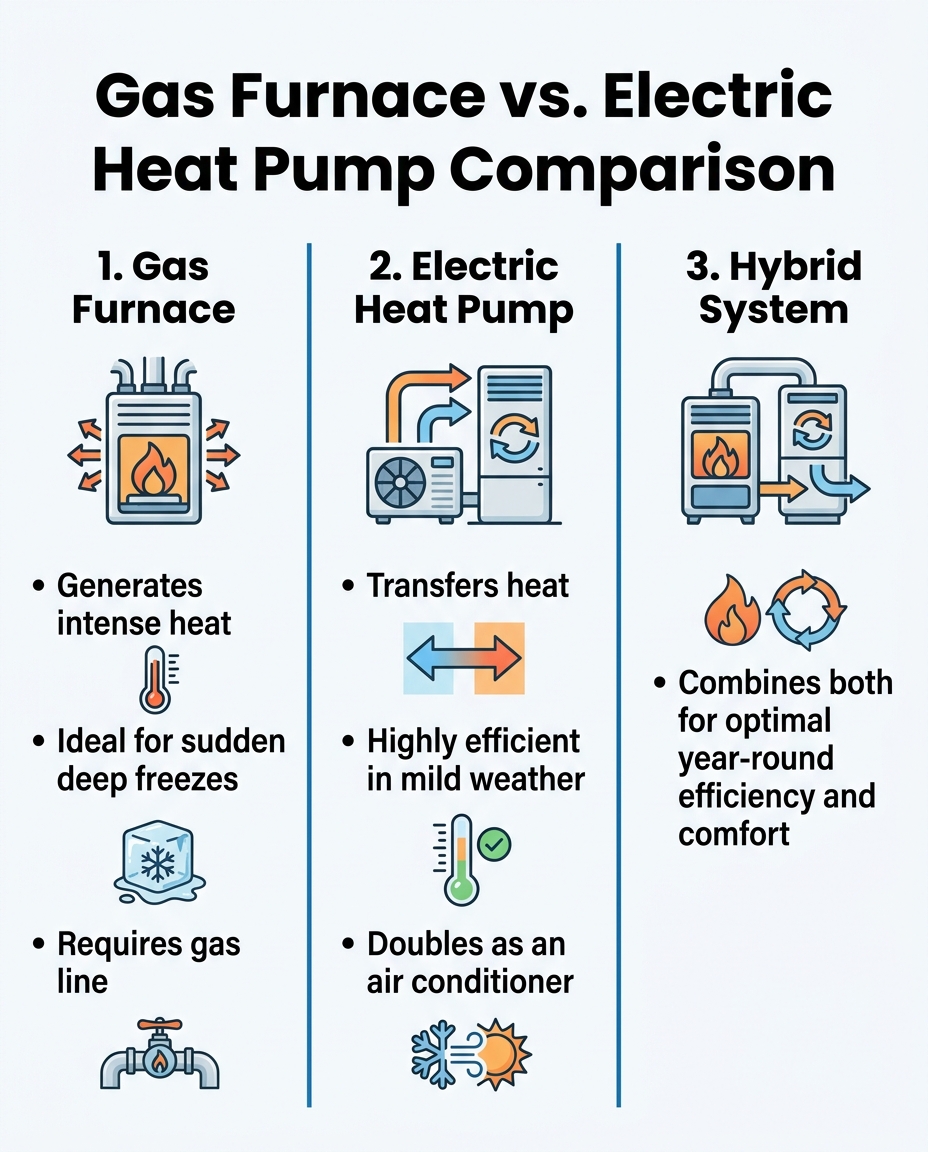
• Air Temperature at the Vent — Gas Furnace: Very hot (typically 120°F - 140°F). Provides a blast of rapid, intense heat. — Electric Heat Pump: Warm and steady (typically 90°F - 100°F). Provides gradual, consistent comfort.
• Operational Efficiency — Gas Furnace: Highly efficient at converting gas to heat, but uses more energy overall than heat transfer. — Electric Heat Pump: Exceptionally efficient in mild weather, using a fraction of the energy to move ambient heat.
• Lifespan and Usage — Gas Furnace: Runs only a few months a year. Typically lasts 15-20 years with proper maintenance. — Electric Heat Pump: Runs year-round (heating and cooling). Typically lasts 12-15 years due to continuous use.
• Maintenance Needs — Gas Furnace: Requires annual fall tune-ups to check gas lines, burners, and exhaust flues. — Electric Heat Pump: Requires bi-annual checks (spring and fall) since the system operates every day of the year.
Analyzing the differences: The air temperature at the vent is often the biggest adjustment for homeowners switching from gas to electric. A furnace blasts very hot air, which feels great when you come inside from a freeze. A heat pump blows air that is warmer than the room, but cooler than your body temperature. It doesn't feel like a blast furnace, but it efficiently maintains a perfect 70°F ambient room temperature.
Regarding lifespan, remember that a heat pump is doing double duty. Because it serves as both your heater and your air conditioner, it accumulates wear and tear faster than a furnace that sits dormant for eight months a year. This makes sticking to a strict preventative maintenance schedule absolutely critical for heat pump owners.

Can't Decide? The Advantage of Hybrid Heating
If you are torn between the everyday efficiency of a heat pump and the extreme-weather power of a gas furnace, there is a third option that offers the best of both worlds. A hybrid heating system—also known as a dual-fuel system—combines an electric heat pump with a traditional gas furnace.
Here is how it works: For 80% of our South Louisiana winter, the weather is mild. During these days, the system relies entirely on the highly efficient electric heat pump to keep your home comfortable and manage humidity. However, when a harsh cold front rolls in and temperatures drop near freezing, a smart thermostat automatically detects that the heat pump is losing efficiency. The system seamlessly shuts off the heat pump and ignites the gas furnace, delivering the intense, rapid heat you need to combat the freeze.
Once the cold snap passes and temperatures rise again, the system automatically switches back to the electric heat pump. This setup provides the ultimate comfort and efficiency solution for our unpredictable climate, ensuring you never waste energy on mild days and never freeze on the coldest nights. If you want to explore how this specific setup operates, you can learn more about hybrid HVAC systems for South Louisiana homes and see if your property is a good candidate.
Frequently Asked Questions About Heating Systems in South Louisiana
Is a heat pump better than a gas furnace in Louisiana?
For most homes in South Louisiana, a heat pump is highly advantageous because our winters are predominantly mild. Heat pumps are incredibly energy-efficient in temperatures above 40 degrees, and they double as powerful air conditioners during our brutal summers. However, if your home already has gas lines installed and you prefer very hot air coming from your vents during winter cold snaps, a gas furnace remains a strong, reliable choice.
At what temperature does a heat pump become inefficient?
Older heat pumps typically began losing efficiency when outdoor temperatures dropped below 40°F, as there was less ambient heat to extract from the air. Modern, high-efficiency heat pumps can continue extracting heat well below freezing, though they do work harder to achieve this. During the rare, deep freezes we experience on the Gulf Coast, a heat pump will run almost continuously, which is why some homeowners prefer the supplemental power of a gas furnace.
Can you have both a heat pump and a gas furnace?
Yes, you absolutely can. This setup is called a hybrid or dual-fuel system. It uses an electric heat pump for efficient heating on mild days and automatically switches to a gas furnace when the temperature drops to freezing. It is widely considered the most effective way to handle the unpredictable temperature swings of the Gulf Coast.
Do heat pumps work well in humid climates?
Heat pumps work exceptionally well in humid climates like ours. Because a heat pump operates using the same refrigeration cycle as an air conditioner, it naturally acts as a dehumidifier while it runs. This helps pull excess moisture out of your indoor air during our damp shoulder seasons, making your home feel much more comfortable.
Are there tax credits available for upgrading my heating system?
Yes, there are often federal tax credits and generic energy rebates available for homeowners who upgrade to qualifying high-efficiency heating systems, particularly electric heat pumps. Because these programs, eligibility requirements, and incentive structures change frequently, we strongly advise consulting with a tax professional or checking current federal energy guidelines to see what applies to your specific installation.
Make the Right Choice for Your Home's Winter Comfort
Ultimately, deciding between a gas furnace and an electric heat pump for your Marrero home comes down to evaluating your existing ductwork, your access to natural gas, and how you prefer your home to feel during the winter. A gas furnace provides that robust, intense heat that pushes back against a bitter freeze, while a heat pump delivers quiet, consistent efficiency for the vast majority of our mild winter days.
With the September pre-heating season transition underway, now is the time to make this critical decision. Waiting until a cold front pushes your failing system over the edge will only limit your options. Schedule a consultation with a local expert to thoroughly evaluate your home's infrastructure. By securing a clear, regionally-specific breakdown of your options today, you can choose the perfect system to keep your family comfortable all winter long.
OUR CLIENTS HAVE TO SAY ABOUT US



Service areas
Our service areas are designed to meet the diverse needs of our clients. We focus on providing exceptional service and ensuring customer satisfaction in every location we operate.