
How High Dew Points Affect Your AC's Ability to Cool Your Hammond Home in August
.webp)
Why Your AC Runs Constantly but the House Still Feels Sticky
Your air conditioner is running nonstop, but when you sit down on the living room sofa, your skin still feels clammy. If you are experiencing this frustrating cycle, you are likely wondering exactly how high dew points affect your AC's ability to cool your Hammond home in August. The air blowing from your ceiling vents feels ice-cold to the touch, yet the overall atmosphere inside the house remains heavy, damp, and uncomfortable. This is a common pattern our team at Cypress Cooling Company sees when the weather shifts from standard summer heat to the extreme, moisture-laden air of late summer.
As families prepare for the back-to-school transition, August in South Louisiana brings extreme heat paired with suffocating high dew points, making this sticky indoor feeling a universal local experience. When the outdoor air feels like a swamp, your cooling equipment is forced to work twice as hard. The reality is that cooling a home requires your system to perform two entirely distinct jobs simultaneously: it must remove the heat from the air, and it must remove the moisture. If your system is struggling with the latter, it will never be able to achieve the former.
Before you assume your equipment is completely broken and needs to be replaced, it helps to understand the heavy lifting your system is doing behind the scenes. Often, the system is simply overwhelmed by the specific moisture load pushing into your home. By exploring professional air conditioning services, you can pinpoint exactly where the cooling cycle is falling short. Late-August high dew points place an immense burden on residential cooling systems, and diagnosing the issue starts with understanding the hidden physics of humidity.
Latent Heat vs. Sensible Heat: What Your AC is Actually Doing
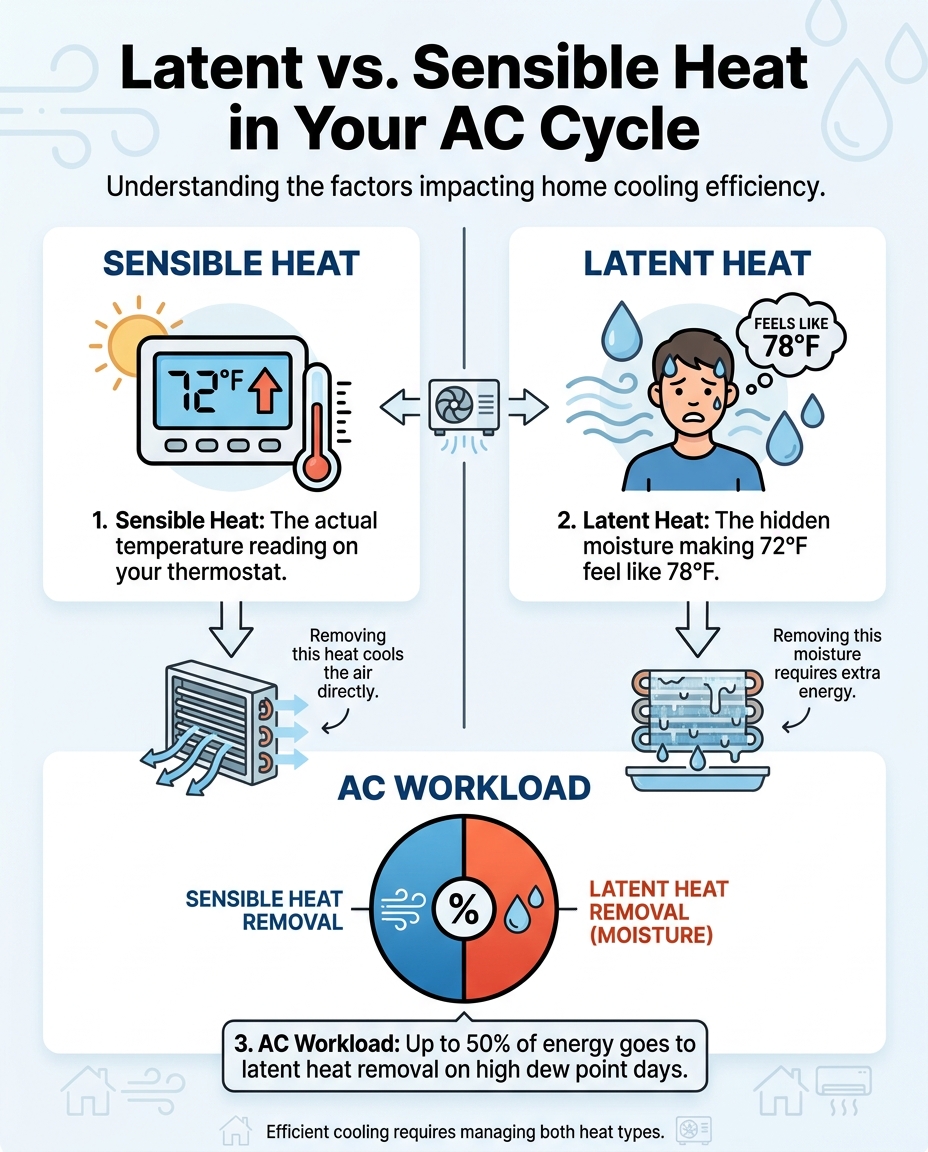
To understand why your house feels so uncomfortable despite the AC running, we need to talk about the difference between sensible heat and latent heat. Sensible heat is the actual temperature you read on a thermometer or your wall thermostat. If your thermostat says it is 72°F inside, that is the sensible heat measurement. Latent heat, on the other hand, is the hidden thermal energy stored within the moisture in the air. This moisture is what makes a thermostat reading 72°F but feeling like 78°F due to indoor humidity such a common frustration for Gulf Coast homeowners.
The problem begins when outdoor dew points climb into the mid-to-upper 70s, which maximizes the latent heat load on residential systems in our region. Your air conditioner actually acts as a dehumidifier first and a temperature-cooler second. It must expend a massive amount of energy removing the latent heat—literally wringing the water out of your indoor air—before it can effectively lower the sensible heat. If the moisture load is too high, the system spends its entire operating cycle just fighting the humidity, leaving very little capacity to actually drop the room temperature.
The Dehumidification Phase of the Cooling Cycle
Inside your indoor air handler unit sits an A-shaped component called the evaporator coil. This coil is filled with freezing-cold liquid refrigerant. As warm, humid air from your home blows across this freezing coil, a physical reaction occurs. Think of a glass of ice water sitting on your patio on a hot afternoon; water droplets immediately form on the outside of the glass. Your evaporator coil does the exact same thing on a massive scale.
• Moisture extraction: The cold coil forces the invisible water vapor in your indoor air to condense into liquid water.
• Drainage: This liquid water drips down into a drain pan and is carried out of your house through a PVC pipe.
• Energy consumption: The process of turning vapor into liquid requires a tremendous amount of your system's cooling capacity.
During days with extreme dew points, your system is forced to spend most of its cycle time just wringing out water. The air returning to your rooms might be slightly cooler, but until the latent heat is fully managed, the house will continue to feel sticky and warm.

Why Cranking the Thermostat to 68 Degrees Risks Freezing Your Coil
When the living room feels sticky, the most common reaction is to walk over to the thermostat and drop the temperature down to 68 degrees or lower. It makes logical sense—if you are hot, you ask the machine for more cold air. However, in a high-humidity environment, this behavioral risk can actually trigger a complete system failure.
Forcing your air conditioner to run continuously at a very low setpoint when the indoor air is saturated with moisture creates a dangerous physics problem. As the system runs endlessly trying to reach that impossible 68-degree mark, the evaporator coil gets colder and colder. The excessive moisture condensing on the coil doesn't have time to drip away into the drain pan. Instead, as the coil temperature drops below freezing, that condensation turns into a solid block of ice.
A frozen evaporator coil is a serious issue. Once ice forms over the metal fins, air can no longer pass through the system. This completely stops the cooling process, meaning your vents will either blow warm air or stop blowing air entirely. Worse, a frozen coil forces liquid refrigerant to travel backward down the copper lines into the outdoor compressor. Compressors are designed to pump vapor, not liquid, and this backward flow can permanently destroy the compressor motor.
If you find yourself constantly lowering the temperature just to feel dry, you need to understand why your AC is running but the house still feels humid. Chasing a lower number on the thermostat does not speed up the dehumidification process; it only increases the likelihood of a costly breakdown.
How Hidden Airflow Restrictions Make High Dew Points Worse
Removing moisture from your home requires a very precise volume of warm air moving over the cold indoor coil. If that airflow is restricted or disrupted in any way, your system's ability to dehumidify plummets. When the air moves too slowly, the coil gets too cold and freezes. When the air moves too quickly, the moisture doesn't have enough time to condense on the metal fins, meaning the humidity just blows right back into your living room.
Just last late summer, our technicians responded to a local homeowner who reached out because their living room was uncomfortably hot during the day, and their hardwood floors were actually sweating from the moisture. While it seemed like their older AC unit was completely failing, a Cypress Cooling technician discovered a disconnected supply vent in the attic that was dumping cold air into the rafters instead of the house. After reattaching the ductwork and swapping out a highly restrictive, clogged air filter, the system began cooling effectively again, making the house feel chilly even at a higher thermostat setting.
This situation highlights that simple airflow fixes can drastically change how the home feels without requiring a full unit replacement. Dirty air filters, crushed ductwork, or blocked return grilles severely cripple the AC's ability to manage latent heat.
Safe Steps Homeowners Can Take Today
Before calling our team for a repair, there are several safe, straightforward steps you can take to improve your system's airflow and help it manage the heavy moisture load.
1. Check and replace restrictive air filters: A clogged filter acts like a brick wall for your airflow. Swap out dirty filters with standard pleated options. Avoid ultra-thick "allergen" filters if your system isn't designed to push air through them, as they can inadvertently restrict airflow too much.
2. Ensure all supply and return vents are open: Walk through every room and verify that the vents are fully open. Make sure large pieces of furniture, rugs, or heavy curtains are not blocking the return grilles on the walls or floors.
3. Utilize your ceiling fans: Ceiling fans do not lower the sensible heat of a room, but they do create a wind-chill effect on your skin. This helps evaporate sweat, making higher indoor temperatures feel significantly more comfortable while the AC works on the humidity.
4. Keep interior doors open: Closing doors to unused bedrooms traps air and disrupts the carefully balanced pressure of your home's duct system, making it harder for the central unit to pull humid air back to the coil.
Staying on top of these basic tasks is a core part of routine AC maintenance, ensuring your equipment always has the breathing room it needs to wring out the Louisiana humidity.
Advanced Moisture Control: Beyond Basic Air Conditioning
We have to acknowledge a difficult truth: even a perfectly functioning, brand-new air conditioning system might struggle to keep your home completely dry during the absolute worst late-August weather. Central air conditioners are designed to cool the air first. Dehumidification is just a helpful byproduct of that cooling process. When the outdoor humidity is extreme, relying solely on your AC to manage the moisture is like using a butter knife to chop firewood—it might eventually work, but it is not the right tool for the job.
This is where advanced moisture control comes into play. Whole-home dehumidifiers serve as a dedicated solution for latent heat removal. Unlike portable units that you have to empty manually every day, a whole-home dehumidifier is integrated directly into your existing ductwork. It works alongside your central AC, pulling moisture out of the air before it ever reaches your living spaces. If you decide this is the right upgrade for your Hammond home, keep in mind that generally applicable energy rebates or federal tax credits may apply to qualifying high-efficiency installations. We always advise our customers to verify current programs with their utility provider or a tax professional.
The benefits of dedicated dehumidification include:
• Reduced wear and tear: By separating dehumidification from cooling, your primary AC unit does not have to run constantly. It can quickly cool the sensible heat and then shut off, extending the lifespan of the compressor.
• Higher setpoint comfort: When the indoor air is exceptionally dry, 74 degrees feels incredibly crisp and cool. You can raise your thermostat setpoint, which lowers your energy consumption without sacrificing comfort.
• Protection for your home: Managing moisture prevents hardwood floors from cupping, stops condensation from pooling on windowsills, and protects organic materials in your home from dampness.
If you find that your cooling equipment is technically working but you still feel sticky, exploring dedicated indoor air quality solutions is often the most effective next logical step.
Diagnosing Oversized Units and Failing Equipment
Sometimes, the inability to manage humidity points to a fundamental flaw in how the system was designed or a mechanical failure that requires professional intervention. The Hammond and Metairie LA climate is unforgiving. In our years of providing AC services across the region, our team understands exactly how this specific microclimate stresses equipment differently than standard humid zones. Our weather requires specialized airflow configurations and precise load matching to maintain comfort.
A frequent pattern we see is the negative impact of an oversized air conditioner. There is a common misconception that a larger, more powerful AC will cool the house better. In reality, an oversized AC unit cools the sensible heat far too quickly. It blasts the rooms with cold air, satisfies the thermostat in ten minutes, and shuts off. Because it only ran for ten minutes, it never had the time to remove the latent heat. This phenomenon is known as short-cycling, and it leaves the home feeling like a cold, damp cave.
The Short-Cycling Dilemma
Proper HVAC load calculations account for both sensible and latent heat. If a unit is too large, it will constantly turn on and off, which not only fails to dehumidify the home but also spikes energy bills and burns out electrical components prematurely.
• Properly Sized AC — Run Cycle Length: 15 to 20 minutes — Humidity Removal: Excellent (plenty of time to extract moisture) — Overall Comfort Impact: Crisp, dry, and consistently cool
• Oversized AC — Run Cycle Length: 5 to 10 minutes — Humidity Removal: Poor (shuts off before moisture is removed) — Overall Comfort Impact: Cold but clammy, damp feeling
• Failing Components — Run Cycle Length: Runs continuously — Humidity Removal: Minimal (lacks the capacity to condense water) — Overall Comfort Impact: Warm, sticky, and frustrating
Beyond sizing issues, failing components can also diminish your system's dehumidification capacity. A weak run capacitor might prevent the outdoor fan from spinning at full speed, or a slow refrigerant leak might rob the indoor coil of its ability to get cold enough to condense water. Recently, our dispatch received a call from a Hammond customer who experienced a sudden system malfunction early on a humid Sunday morning. One of our expert technicians responded within an hour, identified the failing component, and resolved the problem on the spot, restoring the system's ability to pull moisture from the air.
This highlights the value of a professional diagnosis. Rather than guessing why the house feels damp, a thorough evaluation from our team can clearly explain the root cause—whether it is a sizing issue, a failing part, or simply the extreme weather—and provide clear options for moving forward.
Frequently Asked Questions About AC and Humidity
Why is my AC running but the house feels humid?
Your AC is likely struggling to remove the latent heat (moisture) from the air quickly enough to match the moisture entering your home. This often happens when the system has poor airflow due to a dirty filter, when the outdoor dew point is extremely high, or if the unit is low on refrigerant. The system can lower the sensible temperature slightly, but without enough time or capacity to wring out the water, the air remains sticky.
How does dew point affect air conditioning?
The dew point determines how much moisture is physically suspended in the air. A higher dew point forces your air conditioner to spend a massive portion of its energy condensing that moisture into liquid water. When dew points rise above 70 degrees, your system prioritizes dehumidification over temperature reduction, which is why it takes much longer to cool the house on muggy days.
What is a comfortable indoor dew point?
For optimal indoor comfort, you want to maintain an indoor dew point below 60 degrees. When the indoor dew point drops into the 50s, the air feels crisp and dry, allowing your sweat to evaporate naturally. If the indoor dew point creeps above 62 degrees, most people will start to feel clammy, regardless of what the actual temperature reading is on the wall.
Does lowering the thermostat remove more humidity?
No, lowering the thermostat does not force the system to remove humidity faster; it only forces the system to run longer in an attempt to reach a colder temperature. In highly humid conditions, dropping the setpoint too low (like 68 degrees) can actually cause the excessive condensation on the indoor coil to freeze into a block of ice, which will completely stop the cooling process.
Can an oversized AC cause high indoor humidity?
Yes, an oversized air conditioner is one of the leading causes of high indoor humidity. A unit that is too large for the square footage of the home will cool the air very quickly and shut off in short bursts. Because it doesn't run for a long, sustained cycle, it never gets the chance to extract the moisture, leaving you with a home that feels cold but damp.
Managing How High Dew Points Affect Your AC's Ability to Cool Your Hammond Home in August
Surviving the late-summer heat requires managing moisture just as much as managing the actual temperature. When the outdoor air feels heavy enough to cut with a knife, your cooling equipment is fighting a relentless battle against latent heat. By ensuring your filters are clean, your vents are open, and your airflow is unrestricted, you give your system the best possible chance to wring that uncomfortable moisture out of your living spaces.
If your system is running constantly without improving your comfort, or if you are tired of feeling clammy in your own living room, it might be time to have the equipment evaluated by our professionals. Whether the solution is a simple airflow adjustment, repairing a failing component, or installing a dedicated whole-home dehumidifier, you do not have to settle for a sticky house. Reach out to your Hammond AC experts to properly diagnose the issue and restore crisp, dry comfort to your home before the next heat wave hits.
OUR CLIENTS HAVE TO SAY ABOUT US



Service areas
Our service areas are designed to meet the diverse needs of our clients. We focus on providing exceptional service and ensuring customer satisfaction in every location we operate.

