
Deciding on a Dual-Fuel System for Your Hammond Heating Installation
.webp)

Are You Prepared for South Louisiana's Unpredictable Winter Weather?
Deciding on a dual-fuel system for your Hammond heating installation often comes down to one critical question: Is your current equipment truly designed to handle the region's rapid temperature swings? In our years of providing local HVAC solutions, our team at Cypress Cooling Company finds that many local homeowners get stuck between choosing an electric heat pump or a traditional gas furnace. The reality of living in this part of the state is that you experience a mild early fall transitioning to deep winter freezes, sometimes within the span of a single week. A standard setup often forces you to compromise—either you suffer through inefficient, short-cycling heat on mild days, or you lack the raw heating power needed when an unexpected hard freeze rolls through.
Finding a system that operates efficiently during a breezy 60-degree afternoon but provides robust, unwavering heat during a sudden drop below freezing is the ultimate goal. The dual-fuel hybrid system was engineered specifically as the solution for this exact climate challenge. By combining two distinct heating methods into one intelligent package, you never have to sacrifice comfort for efficiency. If you are exploring your heating services options ahead of the upcoming winter season, understanding how this technology adapts to our local weather patterns is the first step toward making a sound, long-term investment for your home.
The Challenge of Weather Whiplash in Tangipahoa Parish
The local climate creates unique demands on residential HVAC equipment. In our experience servicing the Hammond and greater Metairie area, our technicians regularly see the strain caused by what meteorologists call "weather whiplash." This phenomenon occurs when Gulf Coast humidity and mild air collide with sudden, fast-moving Arctic cold fronts. You might enjoy a sunny, mild 65-degree day on a Tuesday, only to wake up to a sudden drop below freezing by Wednesday morning. This rapid fluctuation puts immense strain on heating equipment that only operates at a single speed or uses a single fuel source.
The heat pump limitation: Relying solely on a standard heat pump can lead to significant system strain during rare but intense winter freezes. Heat pumps extract ambient heat from the outside air and move it indoors. While they are incredibly efficient in mild weather, their capacity drops as the outdoor temperature plummets. When a deep freeze hits Tangipahoa Parish, a standard heat pump often resorts to using auxiliary electric resistance heating strips. These emergency heat strips consume massive amounts of electricity, driving up your utility bills and sometimes struggling to keep the house comfortable.
The gas furnace overkill: Conversely, relying entirely on a gas furnace presents the opposite problem. A gas furnace is built for raw heating power. When you run a powerful furnace on a mild, 55-degree autumn morning, the system produces heat so rapidly that it overshoots your thermostat setting and shuts off almost immediately. This frequent turning on and off—known as short cycling—wastes fuel, causes uneven temperatures throughout the house, dries out your indoor air, and accelerates wear and tear on the internal components.
To maintain consistent indoor comfort without wasting energy, we always advise that South Louisiana homes require an adaptable system that responds to real-time outdoor temperatures, utilizing the right tool for the exact weather condition at hand.
How a Dual-Fuel Hybrid System Solves the Climate Puzzle
A dual-fuel hybrid system solves the weather whiplash problem by pairing an electric heat pump with a high-efficiency gas furnace. Instead of forcing one piece of equipment to handle every extreme, the system utilizes an intelligent control board to switch between the two heat sources based on outdoor conditions. If you are already looking into heat pump systems, upgrading to a dual-fuel configuration maximizes the technology's benefits while eliminating its cold-weather drawbacks.
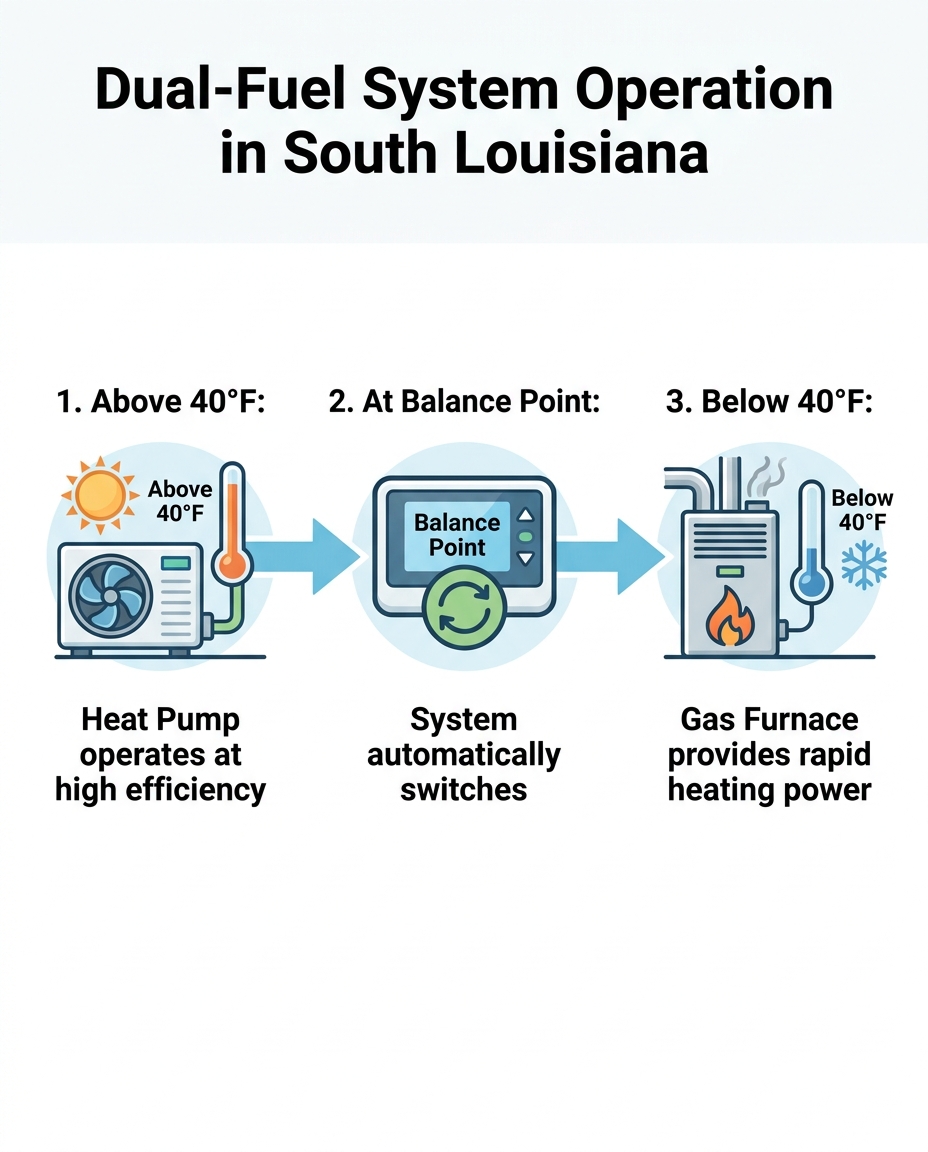
Here is how the automated switchover process works to protect your home through a mild early fall transitioning to deep winter freezes:
1. The Mild Weather Phase: During the majority of the fall and winter, outdoor temperatures hover between 45°F and 65°F. In this phase, the system operates exclusively as an electric heat pump. Because it is simply transferring existing heat rather than burning fuel to create it, the heat pump operates at peak energy efficiency, easily keeping your home warm.
2. The Monitoring Phase: As a cold front moves in, the system's outdoor sensors constantly monitor the dropping temperature. The intelligent thermostat calculates the exact moment when the heat pump will begin to lose its efficiency advantage.
3. The Automated Switchover: When temperatures plummet past a specific threshold, the system automatically shuts down the heat pump compressor. Simultaneously, it ignites the gas furnace. There is no disruption in airflow; the transition is entirely automated and requires no manual intervention from the homeowner.
4. The Deep Freeze Phase: With the gas furnace now running, your home receives rapid, powerful heating. The furnace easily combats the freezing outdoor temperatures, delivering hot air through your vents until the cold snap breaks and temperatures rise enough for the heat pump to take over again.

Head-to-Head: Standard Gas Furnace vs. Dual-Fuel System
Providing a direct, side-by-side comparison of the two main options helps clarify which investment aligns with your long-term goals. When our team sits down with homeowners, we explain that while both setups will keep you warm, they achieve that goal through very different mechanical processes. Understanding these differences is key to evaluating South Louisiana hybrid HVAC systems versus traditional configurations.
• Mild Weather Efficiency — Standard Gas Furnace: Burns fuel regardless of outdoor temperature; prone to short-cycling on mild days. — Dual-Fuel Hybrid System: Heat pump transfers heat, producing more energy than it consumes for maximum efficiency.
• Extreme Cold Performance — Standard Gas Furnace: Delivers exceptionally fast, hot air recovery during hard freezes. — Dual-Fuel Hybrid System: Switches to the gas furnace to deliver the exact same fast, hot air recovery.
• Upfront Complexity — Standard Gas Furnace: Lower installation complexity; requires standard gas and electrical hookups. — Dual-Fuel Hybrid System: Higher complexity; requires compatible electrical infrastructure for the heat pump plus gas lines.
• Fuel Flexibility — Standard Gas Furnace: Locked into natural gas or liquid propane prices for 100% of heating needs. — Dual-Fuel Hybrid System: Alternates between electricity and gas, optimizing for the cheapest utility at any given time.
The Case for a Standard Gas Furnace
A standard gas furnace remains a viable option for specific situations in the Hammond and greater Metairie area. The primary advantage is the lower upfront installation complexity. If you live in an older home that lacks the 240-volt electrical infrastructure required to support a high-capacity heat pump, upgrading your electrical panel can add time and coordination to the project. In these cases, a straight gas furnace replacement is often much faster. Additionally, a gas furnace delivers consistently hot air right out of the vents regardless of outdoor conditions, which some homeowners simply prefer the feel of.
The Case for a Dual-Fuel Hybrid System
For homeowners planning to stay in their property for years to come, we highly recommend the dual-fuel system for its superior long-term benefits. It maximizes utility savings by inherently using the cheapest energy source for the current temperature. Furthermore, it significantly reduces wear and tear on the gas furnace by limiting its operation to only the coldest days of the year. Because the heat pump component also acts as a high-efficiency air conditioner during the summer, you gain a year-round comfort upgrade rather than just a winter heating solution.
The Secret to Maximum Efficiency: Configuring the Balance Point
The hardware of a hybrid system is only as good as its configuration. The "balance point"—also known as the switchover temperature—is the exact outdoor temperature where the heat pump loses its efficiency advantage and the gas furnace takes over. Setting this point correctly requires a deep understanding of local climate data, home insulation values, and specific equipment performance curves.
The problem with factory defaults: We often encounter hybrid systems that arrive from the manufacturer with factory default settings designed for Northern climates. A thermostat might be pre-programmed to switch to gas at 40°F or even 45°F. Because Hammond's deep freezes are infrequent, setting the balance point too high wastes money by triggering the furnace prematurely. You end up burning gas on days when the heat pump could have easily and cheaply handled the load.
Calculating the ideal switchover: There are two types of balance points to consider. The thermal balance point is the temperature at which your home loses heat faster than the heat pump can replace it. The economic balance point is the temperature at which local electricity rates become more expensive per BTU than local natural gas rates. The ideal configuration finds the perfect intersection of these two metrics.
Working with local experts is the key to unlocking the system's full potential. As a trusted local provider, our technicians at Cypress Cooling Company bring specialized knowledge in calculating and configuring the exact balance point specifically for South Louisiana's unique climate and utility landscape. Properly dialing in this transition temperature ensures you squeeze every ounce of efficiency out of the heat pump before the furnace ever ignites.
Long-Term Utility Savings and Available Incentives
Choosing a dual-fuel system is an investment in long-term utility management. By utilizing electricity during mild weather and reserving gas solely for deep freezes, you optimize your monthly utility bills across the entire heating season. When you schedule a Hammond heating installation, you are upgrading to modern equipment that uses far less energy to produce the same amount of comfort as your outdated unit.
Beyond the month-to-month utility reductions, upgrading to high-efficiency equipment often opens the door to various financial incentives:
• Federal Tax Credits: Under current energy initiatives, upgrading to qualifying high-efficiency heat pumps and hybrid systems often qualifies homeowners for federal tax credits. These credits are designed to offset a portion of the installation costs for energy-saving home improvements.
• Local Utility Rebates: Many regional utility providers offer incentive programs and rebates for replacing older, inefficient HVAC systems with modern dual-fuel technology. These programs aim to reduce overall demand on the power grid during peak weather events.
• Reduced Maintenance Costs: Because the workload is split between two different mechanical systems, neither the heat pump nor the furnace works as hard as a standalone unit would. This shared duty cycle reduces cumulative wear and tear, often leading to fewer emergency repair calls over the lifespan of the equipment.
We always advise readers to consult directly with their installation professional and a qualified tax advisor to verify current incentive programs, equipment eligibility, and exact program requirements before making a final decision.
Why Early Fall is the Ideal Time to Upgrade Your Heating System
As we move through September 2026, our team always reminds customers that the mild early fall transitioning to deep winter freezes is just around the corner. Early fall is the perfect transition period to evaluate your existing heating equipment before the first unexpected cold snap arrives. Waiting until your current system fails in the middle of a January freeze leaves you with limited options and subjects you to the peak-season winter rush.
Scheduling your evaluation and installation in early fall ensures your home is fully prepared for unpredictable temperature drops. To get your home ready, follow this simple preparation checklist:
• Assess your current equipment age: If your furnace or heat pump is over 10-12 years old, it is likely losing efficiency and prone to unexpected breakdowns.
• Schedule a professional assessment: Have a technician evaluate your home's ductwork, insulation, and electrical panel to determine if a dual-fuel system is physically compatible with your property.
• Compare equipment options: Review the load calculation provided by your technician to see exactly how a hybrid system compares to a standard gas furnace for your specific square footage.
• Plan the installation timeline: Booking an installation with our crew in September or October secures your spot on the schedule before emergency "no-heat" calls flood our service boards in late November.
Frequently Asked Questions About Hybrid Heating in Louisiana
At what temperature does a dual fuel heat pump switch to gas?
The system typically switches over between 35°F and 40°F, but it depends heavily on the specific balance point configured by your installer. In the Hammond area, a properly calibrated system will keep the heat pump running as long as it remains the most efficient option. Once the outdoor temperature drops below that exact economic and thermal threshold, the gas furnace automatically takes over.
Is a hybrid heat pump better than a gas furnace?
For regions with mild winters and occasional freezes, a hybrid system offers superior energy efficiency compared to relying solely on a gas furnace. A standard furnace burns fuel every time it turns on, which is often overkill for a mild 60-degree day in South Louisiana. The hybrid system provides the efficiency of an electric heat pump for mild days while keeping the furnace in reserve for true winter weather.
Is a dual fuel system worth the investment?
Yes, the long-term savings on utility bills and the reduction in wear on the furnace often offset the initial installation costs over the lifespan of the equipment. Because the system constantly optimizes for the cheapest available heating method, homeowners typically see a noticeable stabilization in their winter utility costs. Additionally, the system provides high-efficiency air conditioning during the summer months.
What are the disadvantages of a dual fuel heat pump?
The primary disadvantage is the higher initial installation complexity and the requirement for both gas lines and compatible electrical infrastructure. If your home currently only has a gas furnace and standard electrical service, adding a high-capacity 240-volt circuit for the heat pump may require an electrical panel upgrade. The physical footprint of the equipment can also be slightly larger than a standalone unit.
How long does a dual-fuel heating installation take in Hammond?
Our installation crews typically complete these projects in one to two days, depending on your existing ductwork and electrical setups. If the project is a straightforward swap of existing hybrid equipment, it can often be finished in a single day. If new electrical circuits, gas line modifications, or ductwork transitions are required, the process will extend into a second day to ensure everything is safely configured.
Secure Your Home's Comfort Before the Winter Freeze
Navigating a mild early fall transitioning to deep winter freezes doesn't have to be a stressful experience for your family or your HVAC equipment. A dual-fuel hybrid system offers the ultimate peace of mind, providing a customized, adaptable solution designed specifically for weather whiplash. By utilizing the efficiency of a heat pump and the raw power of a gas furnace, you guarantee consistent indoor comfort no matter what the forecast holds.
Don't wait for the first hard freeze to test the limits of your aging equipment. Getting a professional assessment now allows you to carefully weigh your options and choose the perfect setup for your long-term needs. If you are deciding on a dual-fuel system for your Hammond heating installation, reach out to schedule an installation consultation today and secure your home's comfort for the seasons ahead.
OUR CLIENTS HAVE TO SAY ABOUT US



Service areas
Our service areas are designed to meet the diverse needs of our clients. We focus on providing exceptional service and ensuring customer satisfaction in every location we operate.

