How We Perform 24/7 Heating Repairs in Hammond When the Weather Flips
.webp)
Waking Up to a Cold House: The Early Fall Heating Crisis
Your furnace is running nonstop, but the vents are blowing cold air, leaving you wondering exactly how we perform 24/7 heating repairs in Hammond when the weather flips. Having served local Louisiana families through countless seasonal shifts, our team at Cypress Cooling knows firsthand how the jarring transition from a long, humid summer to the sudden chill of an early fall night often catches homeowners completely off guard. You step over to the thermostat during that unpredictable September transition or first fall cold snap, switch the system from cooling to heating, and are met with either lukewarm air or total equipment failure. This is the critical decision point: realizing that waiting for regular business hours is no longer an option and that your home requires immediate, professional emergency intervention.
If you are dealing with a sudden breakdown, our comprehensive HVAC services and emergency heating repair are available around the clock to safely restore your home's comfort.
At Cypress Cooling, our approach to diagnosing and resolving these sudden early-season breakdowns begins with understanding exactly what happens to a furnace while it sits idle. A heating system does not simply pause in a vacuum during the summer months. Instead, it is subjected to a harsh environment that degrades mechanical and electrical components. When the first genuine cold front pushes through Louisiana, dropping overnight temperatures rapidly, these compromised parts are suddenly called into action. The resulting failure is rarely a complete mystery; in our daily field experience, it is usually the predictable outcome of environmental exposure. Addressing these failures requires our methodical, expert approach to ensure that the system is not only forced back on, but restored to a safe, reliable operating condition for the remainder of the winter.
How South Louisiana Humidity Sabotages Dormant Heating Systems
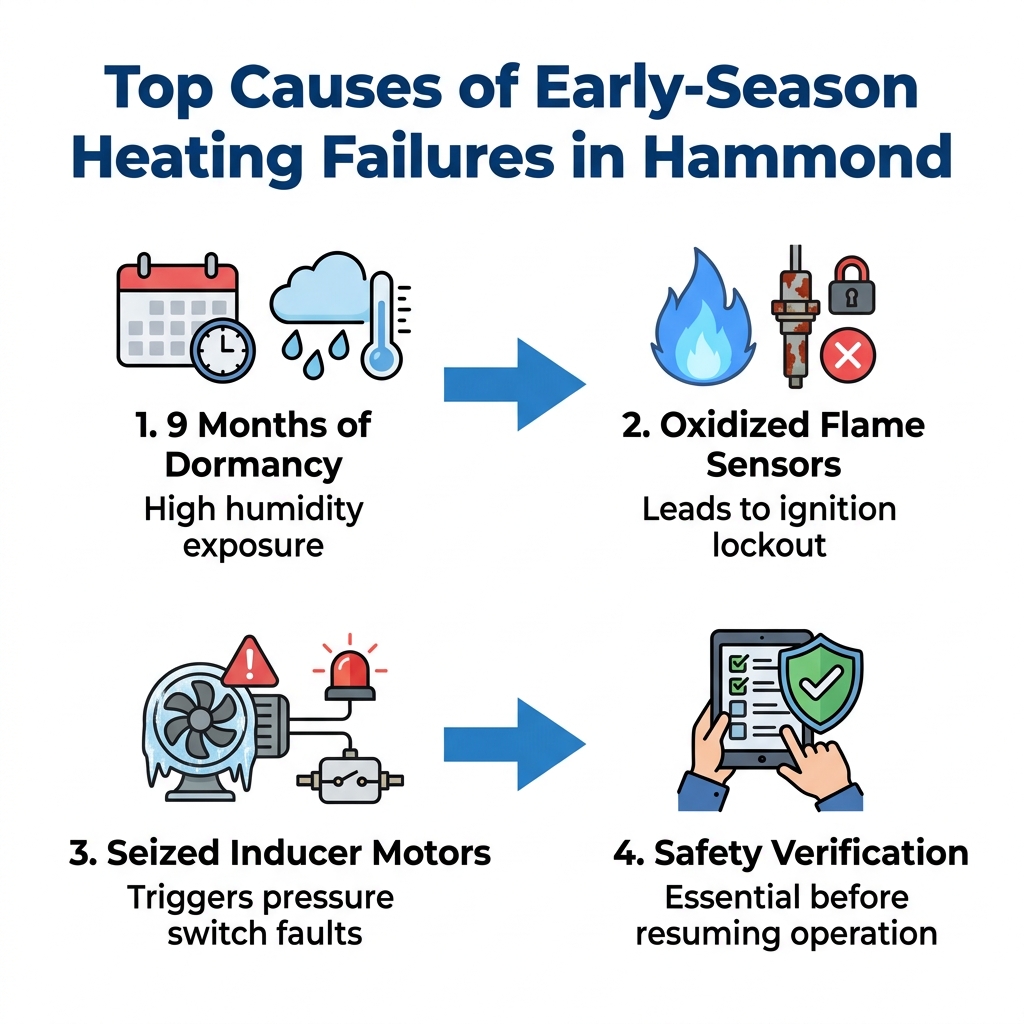
South Louisiana is famous for its relentless humidity, and that moisture actively sabotages idle heating equipment. Based on National Weather Service data and what our technicians observe on nearly every fall maintenance call, our region experiences a grueling nine-month cooling season where ambient humidity levels frequently hover above 70 percent. During this extended period, your furnace sits completely dormant, acting as a magnet for settling moisture inside the HVAC cabinet. In our years of field experience, we've found that homeowners across the Hammond, LA service area often assume that because their furnace performed perfectly on the last cold day of February, it will fire up flawlessly in October. Unfortunately, this ignores the hidden damage caused by off-season environmental exposure.
While your air conditioner is running constantly to keep your home cool, the heating side of your system is turned off. High humidity accelerates oxidation on internal metallic furnace components. Microscopic layers of rust and corrosion form on sensitive electrical contacts, sensors, and moving parts. Because this is a localized, regional phenomenon driven by our specific climate, diagnosing these failures requires the kind of local expertise our Cypress Cooling team brings to every job.
• Active Winter Operation — Environmental Exposure: Low humidity, frequent heat cycling — Mechanical Impact: Components remain dry; moving parts stay lubricated.
• Summer Dormancy — Environmental Exposure: High ambient moisture (70%+ humidity) — Mechanical Impact: Oxidation builds on sensors; bearings begin to seize.
• First Fall Startup — Environmental Exposure: Sudden temperature drop, high demand — Mechanical Impact: Compromised parts fail under initial electrical load.
This prolonged exposure means that the simple act of turning on your heater forces degraded components to perform under stress. Moisture that has settled on circuit boards or seeped into motor housings over three seasons creates immediate resistance. Understanding this climate reality is the first step in recognizing why early-season heating failures are so common, and why our team insists on precise, professional troubleshooting rather than guesswork.
Flame Sensors and Ignition Lockouts: The Most Common Culprit
When our technicians are dispatched during that initial September transition, we consistently find that one of the most frequent victims of summer humidity is the flame sensor. This small metallic rod plays a massive role in your system's safety mechanism. Its sole job is to detect whether gas is successfully igniting when the furnace turns on. Over the long cooling season, ambient moisture causes microscopic oxidation and carbon buildup on the sensor's metallic surface. When you turn on your heater during that September transition or first fall cold snap, the oxidized sensor cannot read the flame accurately.
The typical symptom our team observes: You will hear the furnace click, the burners will briefly ignite for a few seconds, and then the system will abruptly shut down. This is known as an ignition lockout. The furnace's control board shuts off the gas valve because the dirty sensor failed to confirm a steady flame, preventing raw gas from flooding your home. Cleaning or replacing a flame sensor requires a licensed professional to ensure strict gas safety protocols are met. Attempting to bypass or clean this component without professional training can permanently damage the sensor or compromise the safety of your gas heating system.
Understanding the Ignition Lockout Sequence
To understand why your furnace refuses to stay on, it helps to know the safety sequence that governs its operation. Modern heating systems are designed to fail safely. If any step in the ignition process cannot be verified, the control board halts the operation immediately.
1. The Call for Heat: Your thermostat detects a temperature drop and sends a signal to the furnace control board.
2. Draft Inducer Activation: The system turns on the draft motor to clear any residual gases out of the heat exchanger.
3. Igniter Glows: The hot surface igniter heats up, or the spark igniter begins firing.
4. Gas Valve Opens: Fuel is released into the burner assembly.
5. Flame Verification: The flame sensor must detect the fire within roughly three to four seconds. If oxidation blocks this reading, the control board closes the gas valve.
Repeated homeowner attempts to restart the system by turning the thermostat on and off will eventually trigger a "hard lockout." Once a hard lockout occurs, the furnace will refuse to attempt ignition at all until a licensed Cypress Cooling technician clears the fault codes and resets the control board. This safety feature emphasizes why professional diagnostics are mandatory.
Seized Inducer Draft Motors and Pressure Switch Faults
While flame sensors account for many ignition failures, our field teams report that seized inducer draft motors represent the second major cause of early-season breakdowns in Hammond. The inducer draft motor is a small fan that activates before the main burners ever ignite. Its function is to safely vent toxic exhaust gases out of the heat exchanger and through the flue pipe. If this motor does not spin at the correct speed, the furnace will not allow gas into the combustion chamber.
During the nine-month cooling season, moisture from the humid air can settle into the motor's bearings. After sitting completely idle, the lack of lubrication and the presence of surface rust can cause the bearings to stick or seize entirely. When you turn the thermostat to "heat," the motor struggles to turn, draws too much electrical current, and fails to create the necessary draft.
The resulting symptom: The system triggers a pressure switch fault. The pressure switch is designed to sense the negative pressure created by a working inducer motor. If the motor is stuck, the switch remains open, and the furnace halts the startup sequence before the igniter even gets hot. This mechanical failure differs significantly from issues found in heat pump systems, which operate year-round for both heating and cooling, thereby keeping their internal components moving and less susceptible to dormancy-related seizing.

Why Emergency Repair Requires Comprehensive Safety Verification
At Cypress Cooling, we differentiate our service through our decades of combined experience diagnosing dormant-system failures and our unwavering commitment to safety over quick, careless fixes. We position early-season emergency calls not just as a rapid parts swap, but as a mandatory safety verification for a system waking up from dormancy. When a furnace has been exposed to high humidity and temperature fluctuations for months, forcing it to run without a thorough inspection is a severe liability.
Our emergency repair process involves a comprehensive safety protocol. Rushing a repair without verifying the entire system's integrity can lead to dangerous conditions, such as carbon monoxide leaks, or subsequent breakdowns just days later. We connect the thoroughness of these safety checks directly to how long an HVAC system lasts in South Louisiana, as proper maintenance and safe operation extend the lifespan of your equipment.
• Heat Exchanger Inspection: We meticulously check for hairline cracks or rust spots that could allow carbon monoxide to escape into the living space.
• Gas Valve Operation: We verify that the gas valve opens and closes cleanly without sticking, ensuring no raw gas leaks into the cabinet.
• Flue and Venting Checks: We ensure that the exhaust pathways are clear of debris, bird nests, or moisture blockages that accumulated over the summer.
• Electrical Load Testing: We measure the amperage draw on all motors to confirm they are not overworking and at risk of an electrical short.
Contingency Planning for Catastrophic Failures
Sometimes, our safety verification reveals a problem that cannot be safely repaired, such as a severely cracked heat exchanger or a completely flooded control board. In these instances, operating the furnace is an immediate hazard to your home. We address these catastrophic failures by providing rapid contingency plans. If a system is condemned during that September transition or first fall cold snap, our team coordinates priority heating installation options to ensure your family is not left without heat during a severe cold front. (Note that federal tax credits or local utility incentives may apply to qualifying high-efficiency replacements, though we advise verifying current programs with a tax professional.) Safety always dictates the path forward, and we ensure you have clear, safe options.
24/7 Emergency Response When Local Temperatures Drop
The unpredictability of the first major temperature drop in Hammond creates a unique logistical challenge. Unlike the gradual warming of spring, fall cold fronts often arrive rapidly overnight. This sudden shift triggers mass early-season heating failures across the city simultaneously, as thousands of homeowners turn on their dormant systems at the exact same time. Local demand spikes dramatically, overwhelming companies that lack the infrastructure to handle the surge.
This is why having a dedicated 24/7 emergency response team is non-negotiable. Our emergency availability is specifically tailored to handle this sudden, unpredictable first fall cold snap. When local demand spikes, we have the dispatch protocols, fully stocked service vehicles, and trained technicians ready to mobilize. We understand that a heating failure at 2:00 AM is stressful, and we want to reassure you that no matter the time of night, our local experts arrive equipped with the right diagnostic tools and replacement parts to get the job done.
There is profound peace of mind that comes from relying on a locally established team that understands these exact seasonal patterns. We know precisely how Louisiana humidity affects different furnace models, and we carry the specific flame sensors, igniters, and pressure switches most likely to fail in our climate. You are never left waiting days for a basic part to ship while your house stays freezing.
Frequently Asked Questions About Early-Season Heating Failures
Why won't my heater turn on after summer?
The short answer is that extended dormancy combined with high humidity causes mechanical and electrical components to degrade. Over the nine-month cooling season, moisture settles on critical parts like flame sensors and inducer motor bearings. When you attempt to start the system in Hammond, oxidation prevents the sensors from reading correctly, or rust causes the motors to seize. The furnace's internal safety mechanisms detect these faults and prevent the heater from turning on to protect your home.
Is it normal for a heater to smell when first turned on?
Yes, a brief burning smell is very common during the first startup of the season. This odor is simply the burning off of accumulated summer dust that has settled on the heat exchanger and burners while the system was idle. The smell should dissipate within 15 to 30 minutes of operation. However, if you smell raw gas, burning plastic, or an electrical metallic odor, shut the system down immediately, as these indicate dangerous electrical or gas issues requiring professional repair.
What causes a furnace inducer motor to stick?
Moisture and a prolonged lack of use are the primary culprits behind a stuck inducer motor. Because the motor sits idle over the long cooling season, the factory lubrication inside the bearings can dry out or become compromised by ambient humidity. When the thermostat finally calls for heat, the unlubricated bearings seize, preventing the fan from spinning. This triggers a pressure switch fault, halting the entire ignition process.
Why is my furnace not igniting after summer?
If your furnace refuses to ignite, it is most likely trapped in an ignition lockout sequence. This is frequently triggered by a dirty or oxidized flame sensor failing to detect the pilot or burner flame within the required few seconds. To prevent raw gas from building up in the combustion chamber, the control board immediately shuts the gas valve and locks the system down. A licensed technician must clean the sensor and reset the safety controls.
Who to call for emergency heating repair in Hammond?
You should call a licensed, local HVAC contractor like Cypress Cooling who offers dedicated 24/7 emergency services and prioritizes comprehensive safety verifications. Because dormant system failures involve complex gas and electrical safety mechanisms, you need professionals equipped to diagnose the root cause rather than just applying a temporary fix. Relying on local experts ensures a rapid response during sudden temperature drops when demand for service spikes.
Restoring Your Comfort Safely and Quickly
Early-season heating failures are incredibly frustrating, but as we constantly remind our customers, they are a common, climate-driven mechanical issue rather than a guaranteed sign of a ruined system. The combination of prolonged dormancy and high ambient moisture creates the perfect storm for sensor lockouts and seized motors during that September transition or first fall cold snap. Fortunately, expert insight and proper diagnostic procedures can safely and efficiently restore your equipment.
You do not have to endure a freezing night waiting for normal business hours. If your furnace is blowing cold air, making strange noises, or refusing to turn on at all, we are ready to help. Schedule an emergency repair or a comprehensive safety verification with our local 24/7 team, and let us ensure your heating system operates safely and reliably all winter long.
OUR CLIENTS HAVE TO SAY ABOUT US



Service areas
Our service areas are designed to meet the diverse needs of our clients. We focus on providing exceptional service and ensuring customer satisfaction in every location we operate.