The Importance of Checking Carbon Monoxide Detectors Before Firing Up Your Gretna Furnace
.webp)
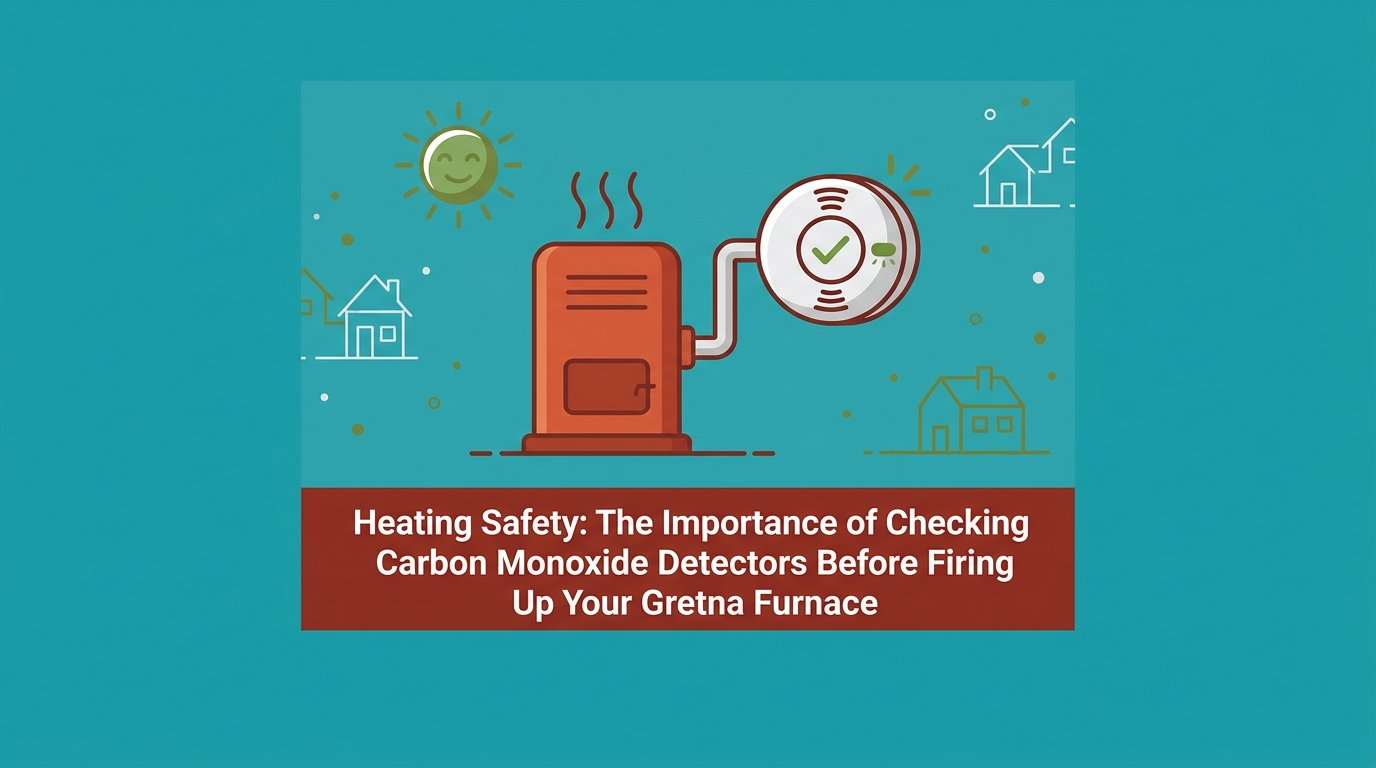
The Silent Threat Hiding in Dormant Heating Systems
You flip the thermostat to the heating setting for the first time in months, expecting a comforting wave of warm air, but that simple action might also trigger a hidden hazard. When temperatures finally dip in early fall and you prepare your home for the colder months, understanding the importance of checking carbon monoxide detectors before firing up your Gretna furnace becomes a matter of vital safety. Carbon monoxide (CO) is a highly toxic, colorless, odorless, and tasteless gas. Because it cannot be detected by human senses, it is frequently referred to as the "silent killer" in residential HVAC systems.
The specific danger arises when older gas furnaces are turned on after sitting completely inactive through the long, humid summer. Over those dormant months, internal components can degrade, shift, or rust. When you introduce highly combustible natural gas back into an unverified system in September or early fall, the risk of incomplete combustion and exhaust leaks spikes dramatically. A typical pattern we see is homeowners assuming their heating system is perfectly safe simply because it worked fine last winter.
This creates a critical decision point for your household: will you rely solely on pressing the test button on aging, wall-mounted carbon monoxide detectors, or will you invest in a comprehensive professional safety check that prevents the gas from leaking in the first place? While alarms are necessary, true safety requires understanding the mechanical health of your heating equipment. If you need professional heating services or a comprehensive fall tune-up, establishing a baseline of safety is the first step.
The Mechanics of Incomplete Combustion in Gas Furnaces
To understand why carbon monoxide enters a home, you must first understand how a gas furnace generates heat. Your furnace relies on a highly specific chemical reaction. When natural gas mixes with the exact right amount of oxygen and is ignited by the burners, complete combustion occurs. Complete combustion is safe and highly efficient. It produces heat, water vapor, and carbon dioxide—byproducts that are easily and safely vented out of your home through the exhaust flue.
The problem: Incomplete combustion happens when that delicate fuel-to-air ratio is disrupted. If the burners are starved of oxygen, or if the gas pressure is incorrect, the chemical reaction changes. Instead of producing harmless carbon dioxide, the struggling flames begin to produce high levels of carbon monoxide.
The cause: A lack of oxygen is usually the primary culprit. This can be caused by restricted airflow, a blocked exhaust vent, or simply an accumulation of dirt and debris on the burner assembly. According to data from the CDC and the National Fire Protection Association (NFPA), residential heating equipment is a leading source of carbon monoxide incidents, precisely because these mechanical disruptions go unnoticed by homeowners.
The solution: Monitoring the physical characteristics of the burner flames and ensuring the combustion chamber is entirely free of obstruction. A healthy natural gas flame should burn a crisp, steady blue. If the flames are lazy, flickering, yellow, or orange, the furnace is not burning fuel completely and is likely generating excess carbon monoxide.
• Complete Combustion — Flame Appearance: Crisp, steady blue flame — Primary Byproducts: Heat, water vapor, carbon dioxide — Danger Level: Low (Safe operation)
• Incomplete Combustion — Flame Appearance: Lazy, flickering yellow/orange flame — Primary Byproducts: Soot, excess moisture, carbon monoxide — Danger Level: High (Immediate safety risk)
How Burner Alignment Affects Gas Combustion
Precision is everything when it comes to burner operation. Gas flows through tiny orifices into the burner tubes, pulling in ambient air as it goes. Over time, soot buildup, dust, and even minor rust can partially block these orifices or misalign the burners. This disruption alters the fuel-to-air ratio drastically.
When the burners are misaligned, the gas does not burn efficiently. The resulting incomplete combustion not only produces carbon monoxide but also generates additional soot. This creates a dangerous cycle: the soot coats the heat exchanger and burners, which further starves the system of oxygen, leading to even more incomplete combustion and higher levels of toxic gas.
How South Louisiana Summers Impact Your Furnace Components
One of the most overlooked factors in heating safety is regional climate. In the Gulf South region, furnaces typically sit completely dormant for eight to nine months out of the year. While the air conditioner runs continuously to battle the heat, the heating components remain cold, dark, and unused in your attic or utility closet.
During these long summer months, high ambient humidity introduces significant moisture into the air. When warm, humid air comes into contact with the cold, heavy metal components of a dormant furnace—particularly the heat exchanger—condensation forms. This persistent moisture initiates a slow but relentless oxidation process. Surface rust begins to develop on critical heating parts that were designed to remain dry.
When you rely on professional HVAC services in Gretna, technicians look specifically for this climate-induced wear and tear. The rust weakens the structural integrity of the metal. Then, when the first sudden cold snap hits in late autumn and the furnace fires up, the sudden blast of intense heat causes that weakened metal to expand rapidly. This extreme thermal stress on rusted components dramatically increases the risk of mechanical failures, burner malfunctions, and structural breaches exactly when the system is under the most strain.
Signs of climate-induced wear include:
• Visible rust flakes: Orange or brown flakes accumulating near the bottom of the burner compartment.
• Corroded electrical contacts: Moisture damage to the safety switches that monitor the exhaust draft.
• Stiff gas valves: Valves that struggle to open smoothly after months of inactivity, leading to delayed ignition.
Cracked Heat Exchangers: The Breach in the System
Even if your furnace is experiencing incomplete combustion and producing carbon monoxide, that toxic gas should technically remain inside the exhaust system and vent safely out of your roof. The critical component responsible for keeping this toxic exhaust separated from your breathing air is the heat exchanger.
The heat exchanger is a series of metal tubes or clamshells located directly above the burners. The toxic combustion gases flow inside the heat exchanger, while the blower motor pushes your home's indoor air over the outside of the hot metal. The heat transfers through the metal walls, warming your home without ever allowing the exhaust gases to mix with the conditioned air. It is an absolute barrier.
However, as we discussed regarding rust and thermal stress, the constant expansion from heating and contraction from cooling takes a toll on the metal. Over years of operation, weakened areas of the heat exchanger can develop microscopic cracks or hairline fractures. When the blower motor turns on to distribute warm air, it creates pressure changes that can force the toxic carbon monoxide out of the cracked heat exchanger and directly into your ductwork.
Once a breach occurs, carbon monoxide mixes directly with the conditioned air circulating through your vents. This is a severe mechanical failure that requires immediate replacement of the heat exchanger or the entire furnace. You may wonder why your first heater cycle smells like burning dust—which is normal—but a cracked heat exchanger produces no smell at all. Inspecting a heat exchanger requires specialized diagnostic cameras and chemical tests. It cannot be done through a basic visual check by a homeowner, making professional oversight essential.
Carbon Monoxide Detectors: Your Critical Last Line of Defense
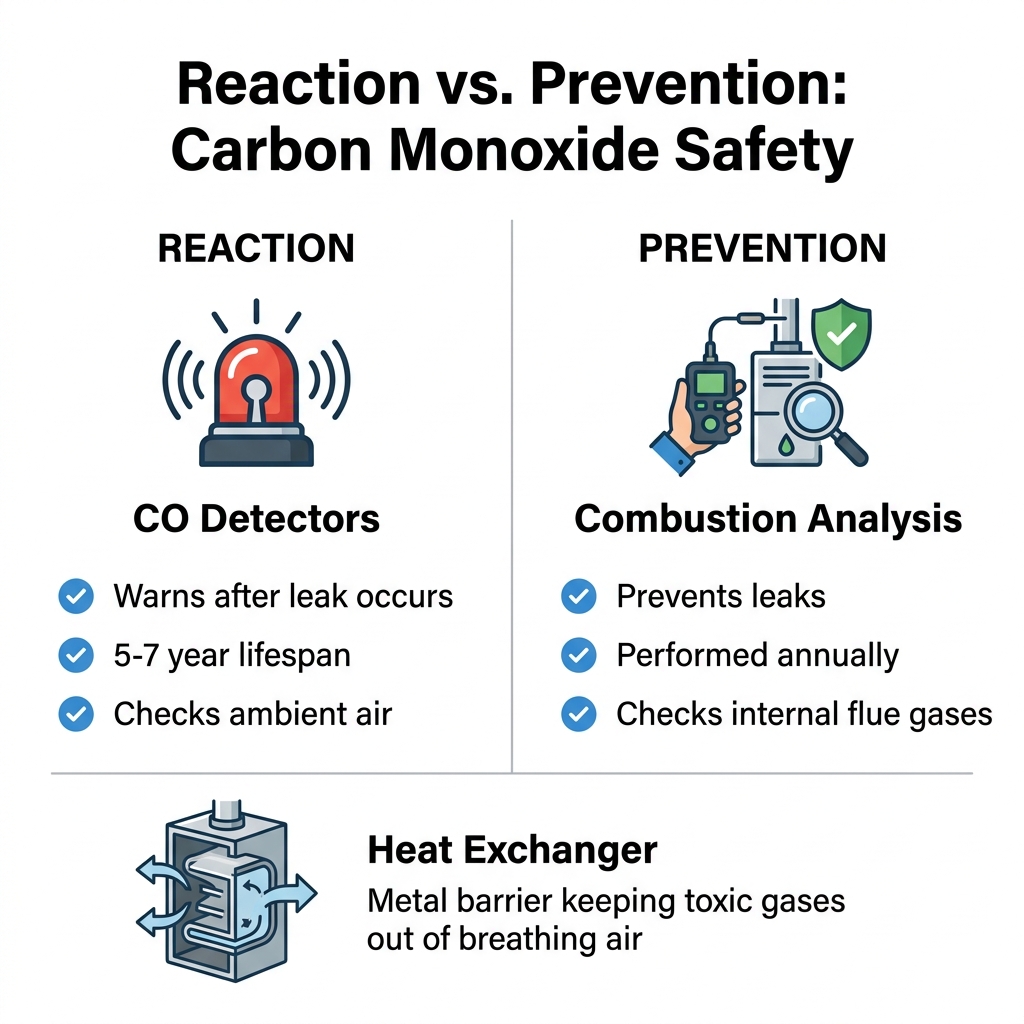
Because carbon monoxide is invisible and odorless, specialized alarms are required by building codes and the NFPA to alert occupants of a leak. However, it is crucial to understand that a carbon monoxide detector is a reactive measure, not a proactive one. If your alarm sounds, it means a mechanical failure has already occurred and toxic gas has already entered your living space.
To ensure your home's indoor air quality remains safe, proper placement and maintenance of these devices is non-negotiable. The NFPA recommends installing carbon monoxide detectors in a central location outside each sleeping area, on every level of the home, and away from direct airflow like air vents or open windows, which could dilute the gas readings.
Crucial steps for verifying your CO detectors:
1. Check the manufacturer date: Remove the unit from the wall and look at the back. Most CO alarms have a strict lifespan of 5 to 7 years.
2. Replace expired units immediately: If the current year is more than 7 years past the manufacture date, throw the unit away and install a new one. The sensor is no longer accurate.
3. Perform a functional test: Press and hold the "Test" button until the horn sounds to verify the battery and speaker are working.
4. Clear away dust: Gently vacuum the exterior vents of the detector to ensure airborne particles aren't blocking the internal sensor.
Proper Testing vs. Sensor Expiration
One of the most dangerous misconceptions among homeowners is that pressing the "Test" button confirms the detector can actually sense carbon monoxide. This is false. The test button only confirms that the battery has power and the electronic circuit can trigger the audible horn.
Inside the detector is an electro-chemical sensor that reacts to carbon monoxide molecules. These chemical sensors degrade naturally over time, losing their sensitivity. By year seven, the sensor is largely depleted. You could have a detector with brand-new batteries that successfully beeps when you press "Test," but will completely fail to detect a lethal buildup of carbon monoxide gas. This is why checking the actual expiration date on the back of the unit is the only way to guarantee functionality.

Professional Combustion Analysis: Proactive Leak Prevention
While checking your wall-mounted detectors is a critical task for early fall, transitioning your mindset from reaction to prevention requires professional intervention. A homeowner checking a detector is waiting for an emergency; an HVAC technician performing a professional combustion analysis is actively preventing one.
During a comprehensive fall tune-up, professional technicians do not just look at the flames and guess if the system is safe. They utilize digital combustion analyzers—highly specialized diagnostic tools with sensor probes that are inserted directly into the exhaust flue. These tools measure the exact parts-per-million (PPM) of carbon monoxide, the percentage of oxygen in the exhaust, the stack temperature, and the draft pressure.
This level of diagnostic testing detects the earliest stages of incomplete combustion long before enough gas escapes to trigger a wall-mounted home alarm. Cypress Cooling Company utilizes rigorous safety protocols and specific combustion analysis tools during every fall tune-up to catch incomplete combustion and ensure your heat exchanger remains uncompromised. By analyzing the chemistry of the exhaust, technicians can tune the burners, adjust the gas pressure, and verify that the heat exchanger is securely sealing the toxic gases away from your living space.
Because this testing involves working directly with combustible gas lines and toxic exhaust pathways, it must be performed by licensed professionals. Proactive leak prevention ensures that when the first cold night of the year arrives, your family stays warm without hidden risks.
Frequently Asked Questions
Can a gas furnace cause carbon monoxide poisoning?
Yes, a gas furnace can cause carbon monoxide poisoning if it malfunctions. When a furnace experiences incomplete combustion and has a cracked heat exchanger or a blocked exhaust flue, the toxic gas can leak directly into the home's ductwork. Regular maintenance and professional safety checks are the best ways to prevent this.
How do HVAC professionals test for carbon monoxide?
HVAC professionals use a digital combustion analyzer to test for carbon monoxide directly at the source. They insert a probe into the furnace's exhaust flue to measure the exact parts-per-million of CO, oxygen levels, and draft pressure. This specialized tool detects incomplete combustion long before the gas ever reaches the living spaces of your home.
Where should a carbon monoxide detector be placed near a furnace?
A carbon monoxide detector should not be placed directly next to or inside the same utility closet as the furnace. The NFPA recommends installing detectors outside every sleeping area and on every level of the home, keeping them at least 15 to 20 feet away from the furnace to avoid false alarms from the brief puff of gas that occurs during normal ignition.
How do I know if my furnace is leaking carbon monoxide?
Because carbon monoxide is invisible and odorless, the only definitive way to know if your furnace is leaking is through a triggered CO alarm or a professional combustion analysis. However, warning signs of a failing system include excessive soot around the burners, a yellow or orange burner flame instead of blue, or excessive moisture accumulating on your windows.
What is the difference between a carbon monoxide detector test and a combustion analysis?
A carbon monoxide detector test simply verifies that the battery and horn on your wall-mounted alarm are functioning. A combustion analysis is a proactive diagnostic test performed by a licensed technician to measure the chemical makeup of the furnace's exhaust, ensuring the system is burning fuel cleanly and safely before a leak ever occurs.
How does summer humidity affect my gas furnace's heat exchanger?
High summer humidity introduces moisture to the dormant, cold metal of the heat exchanger, causing condensation to form. Over several months, this moisture leads to oxidation and surface rust, which weakens the metal. When the furnace is turned on in the fall, the rapid heating causes the weakened metal to expand, increasing the risk of structural cracks.
Ready to secure your home for the heating season?
Understanding the mechanics of your heating system proves that carbon monoxide detectors are only your last line of defense. True peace of mind comes from knowing your equipment is burning cleanly and safely. Schedule your professional combustion analysis and fall tune-up today to ensure your family stays safe and comfortable all winter long.
OUR CLIENTS HAVE TO SAY ABOUT US



Service areas
Our service areas are designed to meet the diverse needs of our clients. We focus on providing exceptional service and ensuring customer satisfaction in every location we operate.