Upgrading to a Smart Thermostat in Westwego During the Fall Transition
.webp)
Is Your Current Thermostat Ready for Louisiana's Fluctuating Fall Weather?
Are you constantly walking past your hallway wall to manually switch your system from cooling to heating and back again? At Cypress Cooling Company, this is one of the most common complaints our team hears every September. When upgrading to a smart thermostat in Westwego during the fall transition, the primary goal is not just getting Wi-Fi access from your phone—it is managing indoor comfort during highly erratic weather shifts. Early autumn in the South means your air conditioner might run at full capacity during lunch, while your furnace needs to kick on before midnight. Traditional manual thermostats force you to act as the middleman, toggling modes and adjusting dials multiple times a day just to keep your living space comfortable.
Here is the thing: a premium smart thermostat handles this seasonal chaos automatically, but not all brands approach the problem the same way. The decision between industry leaders like Ecobee and Nest smart thermostats comes down to how their specific auto-switch capabilities, remote sensors, and smart scheduling handle rapid daily temperature swings. This guide skips the basic smart home features you already know about—like voice control or app design—and focuses strictly on climate-specific performance for our region.
Whether you need comprehensive air conditioning services to handle the lingering midday heat or are preparing your system for the cooler months ahead, choosing the right control center is the critical first step.
The South Louisiana Fall Challenge: AC at Noon, Heat at Night
The reality of September weather: The Louisiana early fall transition (September) with extreme daily temperature swings creates a unique challenge for any HVAC system. The weather frequently refuses to pick a lane. It is completely normal to experience 85-degree midday highs that leave a sun-facing living room sweltering, followed by rapid drops to 50-degree nighttime lows that make the bedrooms feel uncomfortably cold. This rapid daily temperature shift puts an immense burden on your comfort levels and your equipment.
Manual changeover strain: When you rely on a basic thermostat, you have to manually switch the system from "Cool" to "Heat." Homeowners often wait until the house is already too cold before turning on the furnace, forcing the heating system to work overtime to recover the lost temperature. Conversely, leaving the heat on overnight often means waking up to a stuffy, overheated house once the morning sun hits the roof.
We recently helped a local homeowner who experienced a severe version of this midday heat struggle, noticing their house becoming uncomfortably hot during the day while the AC failed to match the thermostat settings. After our team providing Westwego HVAC services inspected the system, reattached a disconnected attic vent, and recommended a better air filter, the system's performance significantly improved, leaving the house chilly during peak sun hours. However, even with perfectly sealed ductwork and a highly efficient air conditioner, a traditional thermostat still struggles when the sun goes down and temperatures plummet.
The auto-changeover solution: This is where auto-changeover becomes essential. Instead of a single setpoint, auto-changeover allows you to set a temperature range—for example, keeping the house between 68 and 74 degrees. The thermostat automatically calls for cooling if the house hits 75, and automatically calls for heat if it drops to 67. Understanding how Ecobee and Nest handle this specific function is vital for a smooth transition into autumn.
Auto-Switching Capabilities: Ecobee vs. Nest Side-by-Side
Both Ecobee and Nest smart thermostats offer automatic transitioning between heating and cooling modes, but their underlying mechanics cater to different types of users. If you are planning heating system upgrades this season, our technicians highly recommend pairing your new equipment with the right auto-switching logic to protect your investment.
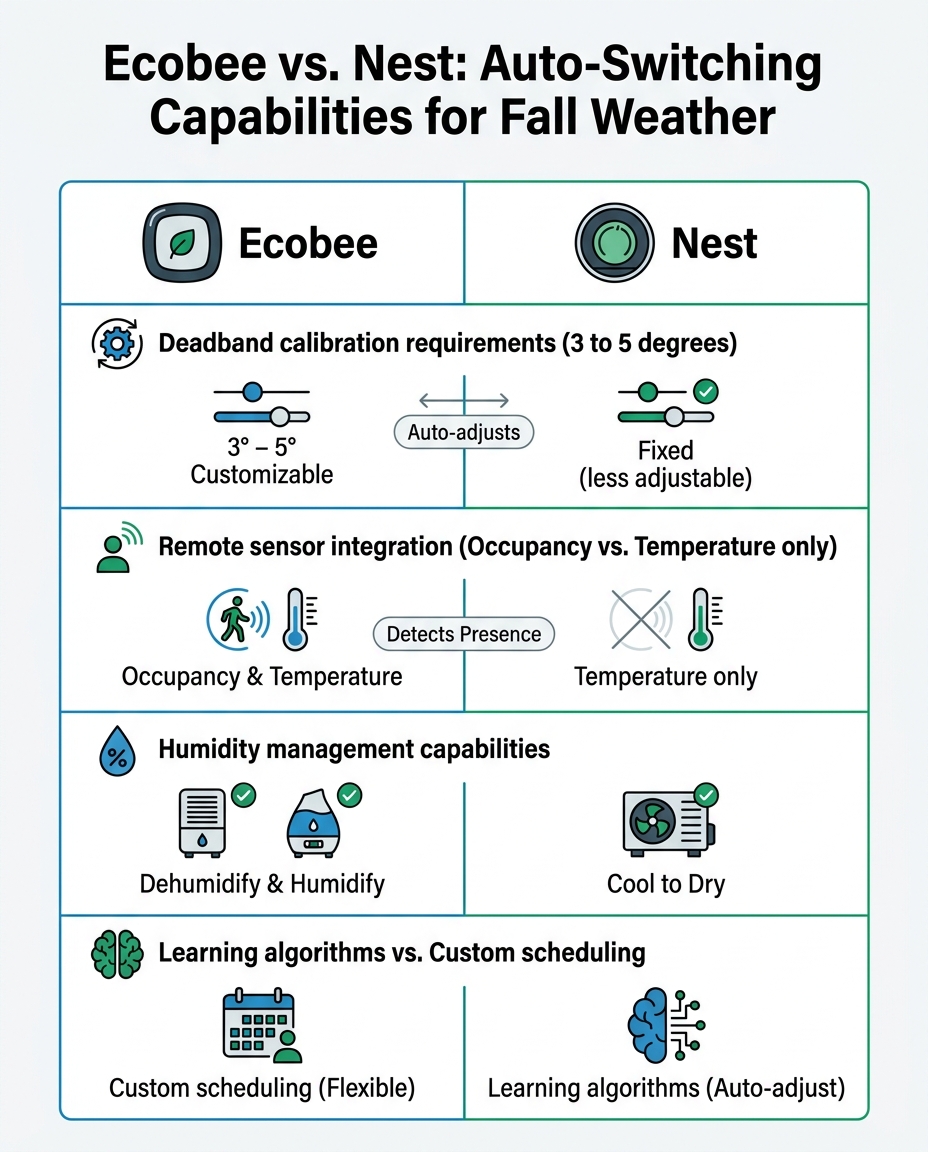
• Auto-Changeover Logic — Ecobee Smart Thermostats: Strictly follows user-defined temperature ranges and schedules. — Nest Learning Thermostats: Uses learning algorithms to predict when you want the mode changed.
• Deadband Customization — Ecobee Smart Thermostats: Highly customizable buffer zones to prevent short-cycling. — Nest Learning Thermostats: Automated buffer zones with limited manual override for transitions.
• Weather Responsiveness — Ecobee Smart Thermostats: Reacts immediately to indoor temperature sensor data. — Nest Learning Thermostats: Uses "Time-to-Temperature" to pre-heat or pre-cool based on weather forecasts.
• Best For — Ecobee Smart Thermostats: Homeowners who want precise, manual control over their ranges. — Nest Learning Thermostats: Homeowners who prefer a hands-off, algorithm-driven experience.
Ecobee's Approach to Auto-Changeover
Ecobee takes a highly structured, data-driven approach to auto-changeover. The device requires you to set a specific heating setpoint and a specific cooling setpoint. The system then strictly obeys these thresholds. If a sudden cold front blows through Westwego on a Tuesday afternoon, the Ecobee waits until the indoor temperature crosses your defined heating threshold before activating the furnace.
The standout feature here is how Ecobee prevents short-cycling—a damaging process where the AC and furnace rapidly turn on and off in sequence. By allowing users and installers to set a firm minimum distance between the heating and cooling setpoints, the thermostat ensures the system never gets confused by a sudden draft or a burst of sunlight.
Nest's Approach to Auto-Changeover
Nest approaches the "Heat/Cool" mode through the lens of its famous learning algorithm. While you can set a temperature range manually, the Nest Learning Thermostat actively monitors your habits, the local weather forecast, and how long it takes your specific home to heat up or cool down.
During transition seasons, Nest utilizes a feature called "Time-to-Temperature." If the algorithm knows a major temperature drop is coming overnight, and it knows your furnace takes 45 minutes to raise the house by three degrees, it can proactively switch modes and start heating before you ever feel the chill. This creates a highly automated experience, though it can occasionally guess wrong during unusually erratic weather patterns.

Remote Temperature Sensors for Uneven Westwego Homes
Most traditional thermostats are installed in a central hallway. The problem is that you do not live in your hallway. During the fall, the hallway might read a perfectly comfortable 72 degrees, while the master bedroom over the garage drops to 64 degrees, and the kitchen bakes in the afternoon sun. Remote sensors solve this by telling the main thermostat what the temperature is in the rooms that actually matter.
Balancing an uneven home requires proper equipment and proper setup. During a recent service visit, our Cypress Cooling Company technicians installed a new thermostat for a local customer and took the time to explain exactly how to utilize the system's features to balance comfort across the home. That level of detailed explanation is crucial when dealing with remote sensors, because placing them in the wrong spot can throw off your entire HVAC system. Both Ecobee and Nest smart thermostats offer remote sensors, but they function very differently.
• Ecobee SmartSensors (Occupancy and Temperature):
— Pros: These sensors detect both temperature and human presence. If you are working in the home office, the Ecobee knows you are there and averages the home's temperature based on that occupied room. If a room is empty, it ignores that room's temperature data.
— Cons: If you have pets walking around, they can occasionally trigger the occupancy sensors, slightly skewing the temperature averages.
• Nest Temperature Sensors (Temperature Only):
— Pros: Nest allows you to schedule which sensor the system should prioritize at different times of the day. You can tell the thermostat to strictly follow the bedroom sensor from 10 PM to 6 AM, ensuring perfect sleeping conditions.
— Cons: They do not detect occupancy. If your schedule changes and you spend the afternoon in the bedroom instead of the living room, the Nest will not automatically adjust unless you manually change the active sensor in the app.
For homes with highly variable room temperatures during the fall, Ecobee's active occupancy tracking often provides a more seamless, hands-off comfort experience, while Nest appeals to homeowners with rigid, predictable daily routines.
Managing Humidity Alongside Temperature Drops
Temperature control alone is insufficient for South Louisiana falls. When a cold front moves in, the temperature might drop to 65 degrees, but the humidity can remain hovering at 80 percent. This creates a cold, clammy feeling indoors that a standard thermostat cannot fix. Because the air is cool, the air conditioner never turns on, meaning the system never naturally dehumidifies the house.
Managing this moisture requires precise humidity control alongside temperature management, a gap often missed in generic thermostat reviews. Both Ecobee and Nest offer advanced solutions for this regional climate quirk, often integrating directly with indoor air quality equipment like whole-home dehumidifiers.
The Ecobee approach to humidity: Ecobee features a setting called "AC Overcool Max." If the indoor humidity exceeds your preferred threshold, the thermostat will force the air conditioner to keep running—even if the house is already at the target temperature—dropping the room by an extra degree or two specifically to wring moisture out of the air. It also features dedicated terminals to wire in and precisely control a standalone whole-home dehumidifier directly from the app.
The Nest approach to humidity: Nest offers a similar feature called "Cool to Dry." When the system detects high humidity without a call for cooling, it will periodically run the AC to manage the moisture levels. The Nest app provides a clear, color-coded history of your indoor humidity levels, making it easy to see how the weather outside is impacting your comfort inside.
If you live in a tightly sealed home that traps moisture during the Louisiana early fall transition (September) with extreme daily temperature swings, our team has found that having a thermostat that actively monitors humidity is just as important as one that monitors temperature.
Smart Scheduling and the Importance of Deadband Calibration
The Problem: When you set a thermostat to automatically switch between heating and cooling, there is a risk of the system fighting itself. If you set the heat to 70 and the AC to 71, the furnace will heat the house to 70, the residual heat might push the room to 71, and the AC will immediately turn on to cool it back down. This constant back-and-forth is called short-cycling, and it causes massive wear and tear on your compressor and heat exchanger.
The Cause: Short-cycling usually occurs when a homeowner attempts a DIY smart thermostat installation without understanding the necessity of a "deadband." A deadband is the temperature range where neither heating nor cooling is active. For example, setting the heat to 68 and the cool to 73 creates a 5-degree deadband. In this zone, the HVAC system rests completely. Improper DIY calibration during erratic weather often leads to deadbands that are too narrow, causing the system to run nonstop.
The Solution: A 3 to 5-degree deadband is essential to prevent the system from short-cycling between heat and AC. Ecobee allows users to manually adjust this minimum delta in the installation settings, enforcing a strict buffer zone. Nest handles much of this automatically, preventing users from setting conflicting temperatures.
However, getting these settings perfectly dialed in requires understanding your home's thermal envelope. Our technicians at Cypress Cooling Company bring deep local expertise in professionally calibrating these auto-switch deadbands specifically for South Louisiana's demanding climate. A professional installer ensures the system transitions smoothly without burning out your equipment. Combining professional calibration with the best thermostat settings to save money ensures your home stays comfortable without driving up your utility bills during the erratic fall months.
Frequently Asked Questions About Smart Thermostats in Westwego
Does Ecobee automatically switch from heat to cool?
Yes, Ecobee thermostats feature a robust auto-changeover mode that automatically switches between heating and cooling. You set a specific heating threshold and a cooling threshold, and the system activates the appropriate equipment when the indoor temperature crosses those lines. This feature requires a minimum temperature gap, or deadband, to ensure the system does not short-cycle.
How does auto-switching work on Nest thermostats?
Nest utilizes a "Heat/Cool" mode that automatically transitions your system based on a temperature range you define. Additionally, Nest uses its learning algorithms to track how fast your home loses or gains heat. It uses this data to proactively switch modes, ensuring the house reaches your desired temperature right on schedule during shifting weather.
Which smart thermostat is best for changing weather?
Both Ecobee and Nest excel in changing weather, but they serve different preferences. Ecobee is generally preferred for homes that want strict, customizable control and utilize occupancy sensors to balance uneven rooms. Nest is ideal for homeowners who prefer a hands-off approach, relying on the algorithm to predict and adjust to weather changes automatically.
How do I set my thermostat to automatically switch between heat and cool?
To enable this feature, you must select the "Auto" or "Heat/Cool" mode in your thermostat's main menu or mobile app. Once activated, you will be prompted to set two temperatures: a minimum heat setpoint and a maximum cool setpoint. Ensure there is at least a 3 to 5-degree difference between the two numbers to prevent the HVAC system from running continuously.
Which is better for humidity control, Nest or Ecobee?
Both models offer excellent humidity management through features that overcool the home slightly to remove moisture (Nest's "Cool to Dry" and Ecobee's "AC Overcool Max"). However, our HVAC professionals often favor Ecobee for complex setups because it offers slightly more granular control over dedicated whole-home dehumidifiers directly from the main interface.
Do I need a professional to calibrate the deadband on a smart thermostat?
While basic scheduling can be done by the homeowner, professional calibration is highly recommended for auto-changeover deadbands. A professional understands the specific airflow and thermal retention of your home, ensuring the deadband is wide enough to protect your compressor from short-cycling while remaining narrow enough to keep you comfortable during rapid temperature drops.
Upgrade Your Westwego Home's Comfort This Fall
Navigating the Louisiana early fall transition (September) with extreme daily temperature swings does not have to be a daily battle with your hallway thermostat. Both Ecobee and Nest smart thermostats offer excellent, robust tools for managing erratic weather, from intelligent auto-switching capabilities to remote sensors that balance out hot and cold spots in your home. The right choice ultimately depends on whether you prefer the strict, occupancy-based control of an Ecobee or the predictive, automated learning of a Nest.
However, even the smartest thermostat on the market cannot perform properly if it is installed incorrectly. Professional installation is vital for configuring the correct deadband, setting up humidity controls, and protecting your wider HVAC system from the dangers of short-cycling. Do not wait for the deep temperature swings to begin. Schedule a professional thermostat upgrade with Cypress Cooling Company today, and be sure to ask our team if generic utility incentives or energy rebates may apply to your installation. Secure a clear, unbiased framework for keeping your home perfectly comfortable all season long.
OUR CLIENTS HAVE TO SAY ABOUT US



Service areas
Our service areas are designed to meet the diverse needs of our clients. We focus on providing exceptional service and ensuring customer satisfaction in every location we operate.