
The Transition from Cooling to Heating: Preparing Your Metairie Heat Pump
.webp)
The Hidden Risk of the First Fall Cold Snap
Your heat pump has been running flawlessly all summer, but when that first cold front hits and the house stays freezing, The Transition from Cooling to Heating: Preparing Your Metairie Heat Pump becomes your most urgent priority. After months of relentless heat, we often expect our home comfort systems to instantly shift gears the moment the temperature drops outside. You adjust the thermostat, wait for the familiar rush of warm air, and instead, you are met with a chilly breeze that makes the house feel even colder.
At Cypress Cooling Company, this is a common pattern our technicians see every year across Metairie. Heat pumps are incredible pieces of technology, but they rely on a specific mechanical component to physically switch modes from cooling to heating. Like any moving part, this component can become stuck or sluggish after prolonged, continuous use in a single setting. When your system has been blasting cold air for five straight months, asking it to suddenly reverse its entire operation is a significant mechanical demand.
The smartest decision you can make is to proactively test your system before the weather truly turns. Running a controlled test during the September transition or early fall prevents an unexpected emergency breakdown later in November or December when you truly need the warmth. Because our local weather is notoriously unpredictable, relying on Metairie HVAC professionals ensures you have the local expertise necessary to navigate our unique climate shifts. Understanding exactly what happens inside your unit when you flip that switch is the first step toward a comfortable, stress-free winter.
How Your Heat Pump Shifts Gears: The Reversing Valve Explained
To understand why your system might struggle during the transition, you first need to understand how a heat pump actually works. Unlike a standard air conditioner that only cools, or a traditional furnace that only burns fuel to create heat, a heat pump does both by moving heat from one place to another. The secret to this dual functionality is a crucial component called the reversing valve.
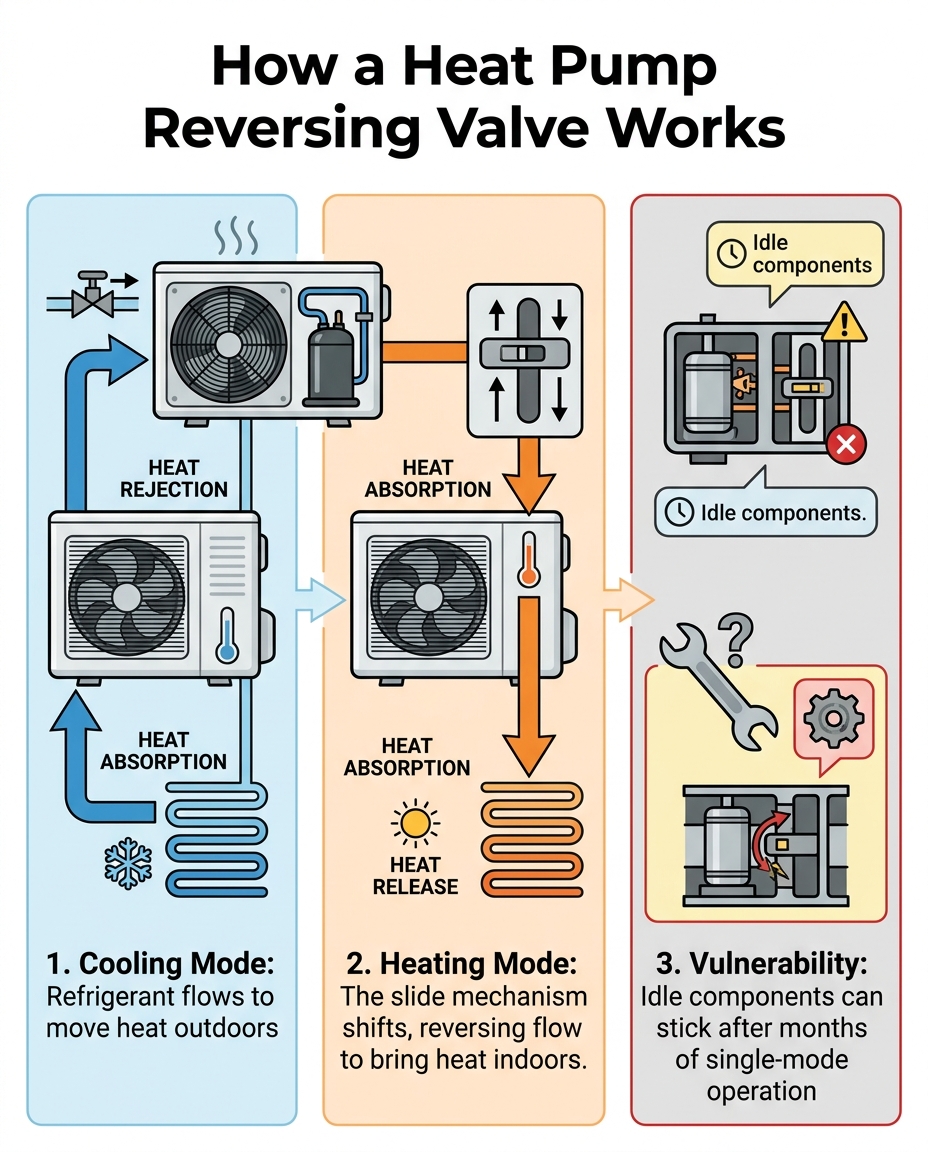
The reversing valve is a specialized brass valve located in the outdoor unit of your heat pump. Its entire job is to reverse the flow of refrigerant through your system. During the Metairie summer, the valve directs the refrigerant to absorb heat from inside your home and release it outdoors. When you switch to heating mode, the valve physically shifts position. This reverses the flow, allowing the refrigerant to absorb ambient heat from the outside air (even when it feels cold outside) and carry it indoors to warm your home.
It is helpful to contrast this with traditional split systems to highlight why heat pumps face unique mechanical challenges:
• Heat Pump — Cooling Mechanism: Absorbs indoor heat, releases outdoors — Heating Mechanism: Absorbs outdoor heat, releases indoors — Transition Method: Mechanical shift via reversing valve
• Traditional Split System — Cooling Mechanism: Air conditioner unit cools the home — Heating Mechanism: Separate furnace generates heat — Transition Method: Electronic switch between two separate units
Because the reversing valve is a physical, moving part, it is subject to mechanical wear, tear, and sticking. It is not just an electronic signal; it is a mechanical action happening inside a pressurized copper and brass system.
The Mechanics of Reversing Refrigerant Flow
The internal operation of the reversing valve is a fascinating piece of engineering. It consists of a large brass body containing a sliding mechanism, a smaller pilot valve, and an electromagnetic component called a solenoid coil.
• The Solenoid Coil: When you change your thermostat to "Heat," it sends a low-voltage electrical signal to the solenoid coil on the outdoor unit. This coil magnetizes and pulls a tiny plunger inside the pilot valve.
• The Pressure Shift: The movement of the pilot valve changes the internal pressure dynamics of the refrigerant gas.
• The Main Slide: This pressure difference forces the main internal slide to physically move from one side of the brass tube to the other, redirecting the flow of hot, high-pressure gas from the compressor.
This is a complex mechanical action. If the solenoid fails electrically, or if the internal slide gets mechanically stuck, the system will remain trapped in cooling mode, no matter what your thermostat says.

Why Southern Summers Are Tough on Idle Heating Components
In our extensive experience repairing local HVAC systems, the team at Cypress Cooling Company has found that the mechanical reality of the reversing valve is heavily influenced by the environment it operates in. South Louisiana's extreme summer heat and relentless humidity create a uniquely challenging environment for HVAC systems. When a heat pump runs continuously in cooling mode for four to five months straight, the reversing valve sits completely dormant in one position.
The Problem: During a long Metairie summer, your heat pump is working overtime. The compressor is generating intense heat, and the outdoor unit is exposed to high ambient temperatures. Meanwhile, the reversing valve remains locked in the cooling position. Because it isn't actuating or moving, the internal lubrication can settle, and the extreme temperature fluctuations can cause the brass components to expand and contract.
The Cause: Furthermore, our regional humidity—often exceeding 75% for weeks on end—exacerbates the risk. High moisture levels in the air can lead to minor oxidation or corrosion on the external electrical connections of the solenoid coil. When the first cold snap finally arrives and you demand a sudden shift to heating mode, the dormant valve is suddenly asked to move against high refrigerant pressures after months of sitting still. If the slide is slightly seized, or if the solenoid is weakened by summer wear, it simply won't shift.
The Solution: This is why specialized systems, including hybrid HVAC systems for South Louisiana, face unique regional wear and tear. The solution is not to wait for the system to fail on the coldest night of the year, but to proactively address the vulnerability of these idle heating components before the severe weather arrives.
The September Thermostat Test: A Safe Preventative Step
Because the reversing valve is prone to sticking after a long summer, the September transition or early fall is the absolute ideal window to perform a preventative test. The weather is usually mild enough that if the heat pump fails to switch over, you won't be trapped in a freezing house overnight. You can safely perform a basic test at your thermostat to ensure the mechanical shift is functioning correctly.
Just recently, our Cypress Cooling Company team helped a Metairie homeowner who needed an early-fall tune-up and a new thermostat installation. After our technician performed the tune-up and installed the new thermostat, they took the time to explain all the steps for safely operating the new controls, including how to test the modes. The customer was completely satisfied with the service and the clear explanations. Having a professional walk you through your system is invaluable, but you can also run this basic test yourself.
Strict Warning: This test is performed entirely at the thermostat. Never open your outdoor unit, attempt to bypass electrical components, or try to manually tap or unstick the reversing valve. These systems contain high-voltage electricity and highly pressurized refrigerant. Any physical repairs or diagnostics inside the cabinet require a licensed professional.
Step-by-Step Thermostat Switch-Over
Follow these numbered steps to safely test your heat pump's heating mode:
1. Turn the system to "Off": Before switching modes, turn your thermostat to the "Off" position and wait 3 to 5 minutes. This allows the highly pressurized refrigerant in the system to equalize, reducing the mechanical strain on the reversing valve when it shifts.
2. Select the "Heat" setting: Change the system mode from "Off" to "Heat."
3. Raise the temperature: Adjust the thermostat so it is 2 to 3 degrees above the current indoor room temperature. This will trigger the system to call for heat.
4. Listen for the shift: If you are near the outdoor unit, you may hear a distinct "whoosh" sound or a solid metallic click. This is the reversing valve sliding into the heating position.
5. Monitor the airflow: Go to the nearest indoor air vent and wait. It typically takes 10 to 15 minutes for the system to fully engage and for the air coming out of the registers to feel noticeably warm.
If the air is warm and the system runs smoothly, your transition test is successful. You can turn the system back to cooling or off, knowing you are ready for winter. If it fails, you know it is time to look into professional heating system services before the real cold arrives.
Recognizing the Signs of a Stuck Reversing Valve
If your September thermostat test does not go as planned, it is important to recognize the symptoms so you can accurately describe the issue to a technician. A stuck reversing valve presents a few very specific warning signs that differentiate it from other common HVAC failures in Metairie.
• Symptom 1: Blowing cold air in heating mode. This is the most obvious sign. If your thermostat is set to heat, the indoor fan is running, but the air coming out of the vents feels just as cold as it did during the summer, the reversing valve has likely failed to shift. The system is still physically operating in cooling mode.
• Symptom 2: Unusual noises from the outdoor unit. When the thermostat calls for heat, the outdoor unit should turn on smoothly. If you hear a loud, repetitive clicking, a buzzing noise, or a sustained hum without the compressor fully engaging, the solenoid coil may be struggling to move the stuck valve slide.
• Symptom 3: Tripping the circuit breaker. If the reversing valve is severely stuck, the compressor may struggle against incorrect refrigerant pressures, causing it to draw too much electrical current. This sudden spike in amp draw will frequently trip the dedicated circuit breaker for the heat pump.
It is also worth noting that a valve failing to shift isn't always a physically stuck slide. Sometimes, it is a symptom of a failing solenoid coil that can no longer generate a magnetic field, or even low refrigerant levels that prevent the internal pressure from building enough to move the valve. In any of these scenarios, professional diagnosis is required.
Beyond the Thermostat: The Role of Professional Fall Maintenance
While the homeowner's thermostat test is a fantastic first step, it is only a surface-level check. To truly protect your system, transitioning from cooling to heating requires comprehensive, professional preventative care. A pre-season tune-up goes far beyond just listening for a click; it involves a deep dive into the mechanical and electrical health of your entire system.
During a professional fall tune-up, a licensed technician will rigorously test the solenoid coil to ensure it is drawing the correct voltage. They will check the refrigerant charge in both heating and cooling modes, as incorrect pressures can prevent the reversing valve from operating. They will also wash the outdoor unit, clearing away the dirt, pollen, and debris that accumulated over the long summer, ensuring the system can properly absorb heat from the outside air.
This level of detailed attention is a core part of a proactive, preventative maintenance approach tailored specifically to the unique weather transitions of the Greater New Orleans area. For example, during a recent early-fall visit, one of our Cypress Cooling Company technicians worked with a local customer whose older unit needed reconfiguring for the transition. Our technician performed a comprehensive tune-up, explained the system's operation in detail, and provided clear suggestions for the next steps. The homeowner received helpful tips and a clear understanding of their HVAC system's specific needs. Professional explanations of system operations help homeowners make informed decisions about their comfort.
Catching a sticking valve or a weak solenoid during the September transition or early fall prevents emergency, after-hours weekend calls in November or December when technicians are booked solid. Furthermore, keeping your system highly optimized through a routine maintenance plan ensures it runs at peak efficiency, which may help you qualify for generic energy rebates or utility incentives available for high-efficiency heat pump operation. Always verify current rebate programs with your local utility provider.
Frequently Asked Questions About Heat Pump Transitions
How do I test my heat pump before winter?
You can test your heat pump by switching your thermostat from "Off" to "Heat" and raising the temperature a few degrees above the current room temperature. Wait about 10 to 15 minutes to see if the air coming from your vents feels noticeably warm. If you hear a click outside but only cold air blows inside, the system is likely failing to transition modes. Performing this test in early fall gives you plenty of time to schedule repairs if needed.
What does a heat pump reversing valve do?
The reversing valve is a mechanical component that physically changes the direction of refrigerant flow inside your heat pump. In the summer, it directs refrigerant to absorb heat from inside your home and release it outdoors. In the winter, it shifts position to absorb heat from the outdoor air and release it inside your home. It is the single component that allows a heat pump to act as both an air conditioner and a heater.
Why is my heat pump stuck in cooling mode?
A heat pump usually gets stuck in cooling mode because the reversing valve is mechanically seized or the solenoid coil that controls it has failed electrically. After running in cooling mode for months during a Metairie summer, the internal slide can stick due to lack of use. Low refrigerant levels or a faulty thermostat wire can also prevent the valve from receiving the pressure or signal it needs to shift.
At what temperature should I switch my heat pump to heat?
You should generally switch your heat pump to heating mode when indoor temperatures drop below your personal comfort level, typically around 68°F to 70°F. Because heat pumps pull ambient heat from the outdoor air, they are highly efficient in mild fall weather. There is no strict outdoor temperature requirement for the switch, but testing the system before the first major cold front arrives is always recommended.
How often does a reversing valve need to be replaced?
A reversing valve does not have a set replacement schedule and is designed to last the lifetime of the heat pump, which is typically 10 to 15 years. However, if the valve becomes permanently stuck, develops a refrigerant leak, or suffers internal mechanical failure, it must be replaced by a professional. Regular preventative maintenance helps extend its lifespan by ensuring proper refrigerant pressures and electrical function.
Ensure Your Home is Ready for Unpredictable Fall Weather
The peace of mind that comes from a successful September thermostat test is invaluable. When you know your system can smoothly transition from fighting off the summer heat to providing cozy winter warmth, you can face the unpredictable weather with confidence. Understanding how your reversing valve works is the first critical step in avoiding unexpected winter breakdowns.
If your system struggled during the test, or if you simply want the assurance that every mechanical and electrical component is in peak condition, do not wait for the first freeze. Schedule a professional inspection during the September transition or early fall to handle any mechanical sticking safely and efficiently. By trusting comprehensive heat pump services, you ensure your Metairie home remains comfortable, efficient, and ready for whatever the changing seasons bring.
OUR CLIENTS HAVE TO SAY ABOUT US



Service areas
Our service areas are designed to meet the diverse needs of our clients. We focus on providing exceptional service and ensuring customer satisfaction in every location we operate.