
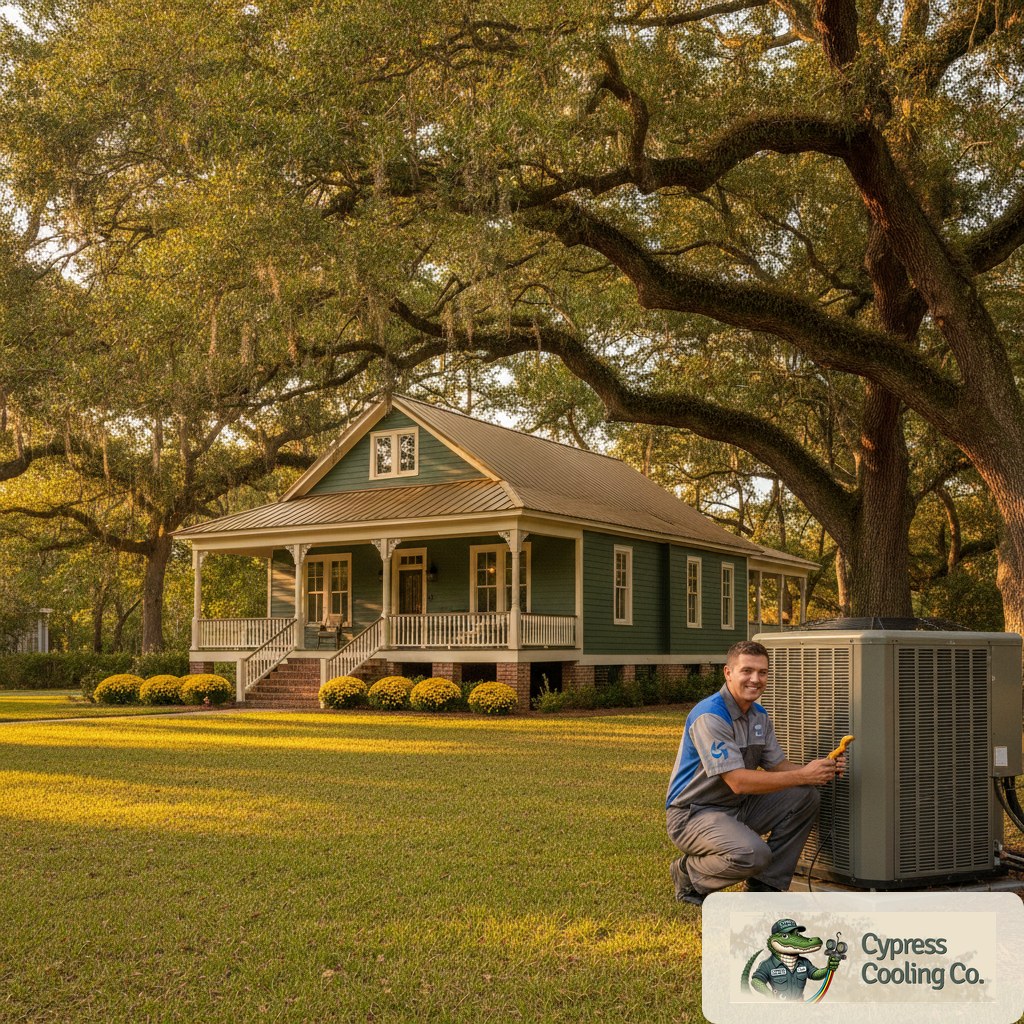
What Happens in the First 30 Minutes of a Cypress Cooling Service Call
Here's exactly what the first 30 minutes of a Cypress Cooling service call look like — in order, with the measurements we take, the questions we ask, and the tools we pull out of the van.
This is the same opening sequence on every visit type. Whether you called for an AC that quit on a 95°F July afternoon, a furnace that's lockout-coding through a January cold snap, a humidity complaint that nothing seems to fix, or a second-opinion review on someone else's quote — the first half hour runs the same way. The body of the visit changes based on what we measure. The opening doesn't.
You should know what to expect, what to watch for, and what to ask before you sign anything.
What is the first 30 minutes of a service call, and why does it matter?
The first 30 minutes of an HVAC service call is the diagnostic block — the structured opening sequence that every honest visit runs before any parts get swapped or any quote gets written. It produces measurements. Everything that happens later in the visit (a repair, a recommendation, a plan, a quote) flows from those measurements.
Done right, the first 30 minutes does four things:
- Captures the homeowner's symptom in their words — date the problem started, when it appears, what triggers it.
- Establishes a baseline — return-air temperature, supply-air temperature, indoor humidity, outdoor ambient.
- Locates the failure — refrigerant side, airflow side, electrical side, or controls side.
- Sets the path forward — what we'll do for the rest of the visit, what it'll cost, and what your options are.
Done wrong, it's 30 minutes of small talk and a $400 capacitor that didn't need swapping. The difference is whether the tech is measuring or guessing.
When does this 30-minute sequence apply?
Every paid service call we run starts with the same 30-minute opening — only the deeper diagnostic that follows changes. That includes:
- No-cool calls — the AC quit, the house is climbing.
- No-heat calls — the furnace or heat pump is lockout-coded.
- Weak-cool / weak-heat calls — the system runs but never catches up.
- Humidity complaints — the temperature reads fine but the house feels swampy.
- Sudden bill spikes — kWh use jumped without an obvious cause.
- Second-opinion visits — see our honest second-opinion diagnosis guide.
- Pre-purchase HVAC inspections — before you buy a house in Lakeview or Old Metairie.
- Annual diagnostic visits — distinct from a quick filter-change tune-up; see tune-up vs inspection vs diagnostic.
The only visit type where the 30-minute opening compresses is a confirmed warranty part replacement where the diagnosis has already been documented in a prior visit — even then we re-verify the refrigerant charge and static pressure before closing the work order.
How do bad shops blow the first 30 minutes?
The bad-shop version of an HVAC service call looks like this:
- The tech walks straight to the condenser, swaps the capacitor without measuring it, hands you a $389 invoice, and leaves before the system has run a full cycle.
- The tech spends 25 of the 30 minutes on a sales tablet selling a replacement system. No panels come off. No gauges go on.
- The tech announces "you're low on refrigerant" without taking subcooling or superheat readings — then sells you a $400 "leak search" that's really just adding refrigerant.
- The tech blames the ductwork without ever putting a manometer on the system to read total external static pressure.
- The tech never asks what symptom you actually called about. They guess from the equipment age and start writing.
Our version is built around removing each of those failure modes. Specifically:
- We listen first. Five minutes of homeowner brief before any tool comes out.
- We measure before we name a part. Amp draw on the compressor and microfarads on the capacitor decide whether either is actually weak.
- We never quote a tune-up that skips refrigerant superheat. We never quote a replacement before measurement is complete.
- We don't sell on the same visit we diagnose unless you specifically ask. If the answer is replacement, we'll come back with the quote and the load calc.
Pressure to decide in the first 15 minutes is the single clearest sign you're being sold to, not diagnosed.
What does the 30 minutes actually look like, minute by minute?
Here's the timestamped breakdown of a real Cypress Cooling service call. Times are approximate — humid days and complex symptoms add 5–10 minutes to phases two and three.
- 0:00 — Arrival. We park where you asked us to park. We knock, introduce ourselves by name, show our company ID, and put boot covers on before stepping inside.
- 0:00–0:05 — Listening. We ask three questions: when did this start, what does it sound like or feel like, and what makes it worse. We write your answers down. We don't talk over you.
- 0:05–0:10 — Exterior visual. Outdoor unit photo, fan motor and contactor inspection, refrigerant line set check, condensate drain locate, electrical disconnect open. Pull amp clamp on the compressor lead while the unit is in a cooling call.
- 0:10–0:20 — Indoor diagnostic block. This is where the heavy tools come out:
- Digital manifold gauges on the service ports — read suction and liquid pressures.
- Calculate measured superheat at the suction line and measured subcooling at the liquid line.
- Manometer on the supply trunk for total external static pressure.
- Digital hygrometer reading of indoor relative humidity at the return-air grille.
- IR thermography sweep of the air handler, electrical panel, and supply registers.
- Capacitor microfarad value vs the nameplate spec.
- Temperature split: return-air temp minus supply-air temp at the closest register, target 18–22°F.
- 0:20–0:30 — Walkthrough with you. We come back to wherever you're working, show you the numbers we just wrote down, point to the photos on our tablet, and explain in plain English what's working, what's borderline, and what's failing. Then we lay out the options and the price for each one — repair, repair plus maintenance, or planned replacement — and we wait for your decision. No pressure, no clock.
At minute 30 you have a written diagnostic, real numbers in degrees and inches of water column, and a price for every reasonable path. That's the entire deliverable of the opening. The rest of the visit is the work you authorize.
How to get the most out of those 30 minutes
The first 30 minutes is on us — but you can make the diagnostic faster, sharper, and cheaper by doing seven things:
- Write the symptom down before we arrive. One sentence. "AC ran fine until Tuesday morning; now the outdoor unit hums but the fan doesn't spin." Specific beats vague every time.
- Have the model and serial numbers ready. Snap a phone photo of the indoor unit nameplate and the outdoor unit nameplate. Saves us 10 minutes of crawling.
- Prep the home. Replace the filter the day before, clear two feet around both units, and confirm the attic ladder works. Our companion checklist how to prep your home before an HVAC technician arrives walks the full list.
- Stay accessible for the first 10 minutes. You don't have to hover — but the listening phase is real, and we need you near a phone if we have a question.
- Ask to see the three numbers. When we come back at the 20-minute mark, ask: "What did the manifold gauges read? What was the static pressure? What was the temperature split?" An honest tech will read them straight off the tablet. A bad tech will dodge.
- Get the diagnostic in writing before you authorize a repair. Even on small visits. The written record protects you if anything regresses.
- Skim the option ladder before you pick. Repair vs full repair vs planned replacement — each is priced separately. Our repair vs replace framework covers how to think about that math.
When you're ready, request service with Cypress Cooling and we'll bring the gauges. The clock starts when we knock on the door.
What tools are actually in our diagnostic kit?
You'll see most of these in the first 30 minutes of any AC service call. We bring them every time, not just on hard problems:
- Digital manifold gauge set with R-410A, R-454B, and (for older systems) R-22 compatibility.
- Calibrated manometer for total external static pressure.
- Clamp meter for compressor amp draw and capacitor microfarad readings.
- Digital hygrometer for indoor relative humidity.
- IR thermography camera for coil sweat, electrical hot spots, and supply-register temperature mapping.
- Combustion analyzer for any heating diagnostic — gas furnace flue gas, CO ppm, draft pressure.
- Megohmmeter for compressor windings on suspected mechanical failures.
If a tech shows up without these and starts diagnosing, that's worth a polite question.
How do I know we're diagnosing, not selling?
Five tells that the visit is going right:
- We name three numbers (subcooling, superheat, static pressure) before we name a price.
- We can point to the failure on a photo, not just say "I think it's the…"
- The replacement option, if mentioned, comes after the repair option, with the repair quote in writing.
- We leave the written diagnostic with you, free, even if you decline all the work.
- You don't feel rushed.
Frequently asked questions
Reviewed by Cypress Cooling Technical Team · Last reviewed: 2026-06-26
Ready when you are.
We diagnose, educate, and guide — we don't sell. Whenever you're ready for a real measurement-based conversation, here are the next steps.
Continue learning
Next reads from the Cypress Cooling Learning Center
How Air Conditioning Actually Works — A Homeowner's Field Guide
An air conditioner doesn't make cold air — it moves heat. Here's how the refrigerant cycle actually works, where Louisiana climate breaks the textbook, and what to ask a contractor before you sign anything.
Read the learn article → CompareTune-Up vs Inspection vs Diagnostic — What You're Actually Paying For
Tune-up, inspection, and diagnostic mean three different things. Here's what each HVAC visit actually delivers, what it should cost, and how to tell when you're being upsold.
Read the compare article → ActHow to Get an Honest Second-Opinion HVAC Diagnosis
Got a $12k+ HVAC replacement quote and want a real second opinion? The operational checklist: what to ask, what we measure, what the report contains.
Read the act article →Let’s get your home comfortable again.
Honest diagnosis, fair pricing, and a team that actually cares. Call Cypress Cooling or request service online — we'll take it from here.