
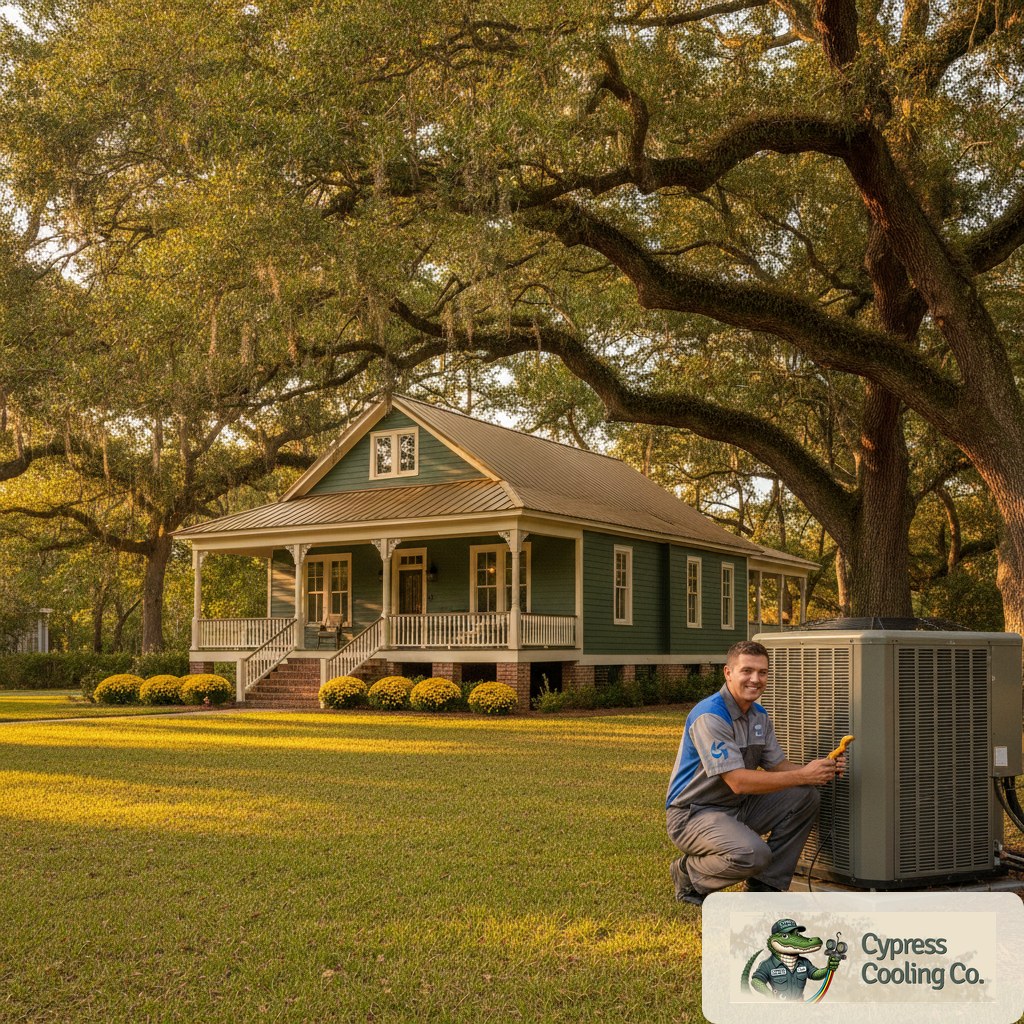
Why Louisiana Homes Hide Humidity Problems (And What to Do About Them)
If your house in New Orleans feels cold and clammy at the same time, your AC isn't broken. It's losing a quiet fight with the air outside. South Louisiana sits in one of the highest-dewpoint zones in the country, and most homes here weren't built — or retrofitted — to handle that load gracefully.
The frustrating part is that humidity problems don't usually announce themselves. They show up as musty closets, sticky 74°F bedrooms, warped baseboards, allergies that never settle down, and an AC that runs constantly without satisfying anyone. By the time a homeowner names "humidity" as the issue, they've usually already spent money chasing other diagnoses.
This is the article we wish every Greater New Orleans homeowner read before the first hot afternoon. Plain physics, real local numbers, and an honest sort of fixes that work versus fixes that don't.
What's an indoor humidity problem, really?
An indoor humidity problem is what happens when the moisture coming into your home from outside, from cooking, showers, breathing, and slab/crawlspace vapor outpaces your HVAC system's ability to remove it. The technical name is latent load failure, and it has nothing to do with the thermostat. You can be 72°F and miserable.
Air conditioning systems remove moisture by condensing water out of warm humid air as it passes across the cold evaporator coil. The colder the coil and the longer air spends crossing it, the more water condenses and drains away. A system's dehumidification ratio — sometimes labeled sensible heat ratio, or SHR, on the rating plate — tells you how much of its capacity goes to removing moisture versus dropping temperature. A 0.75 SHR system uses 25% of its work to dehumidify. A 0.85 SHR system uses only 15%.
The goal in our climate is indoor relative humidity between 45-55% during cooling season. Below 40% is dry enough to crack hardwood; above 60% is the band where mold, mildew, and dust mites thrive. Most Louisiana homes drift to 60-72% indoors during summer without anyone noticing — until the closets smell.
When does humidity become the real problem you're solving?
Almost always, in this part of the country. But there are four signals that the moisture side has officially taken the wheel.
Sticky air at a cool thermostat setting. If you've dropped the thermostat to 70°F and the house still feels muggy, you don't have a cooling problem. You have a latent-load problem. The system is satisfying its sensible target before it has time to wring out moisture.
Short cycles in late summer. An oversized AC will run for 8-12 minutes and shut off. It cools quickly because it has too much capacity for the sensible load, but the coil never gets cold enough long enough to condense meaningful water. Long runtime at lower capacity is the friend you want here.
Cool but persistent mustiness. Wet drywall, soft baseboards near exterior walls, a musty smell in closets that share a wall with the outside, or visible black/green spots on grout. These are downstream symptoms of indoor humidity living above 60% for weeks at a time.
Allergies that don't track pollen counts. Dust mites thrive between 65-85% relative humidity. If symptoms peak indoors in July and August rather than during oak-pollen season, look at moisture first, not MERV filtration.
If two or more of these are true in your New Orleans, Mandeville, or Slidell home, the diagnosis path needs to start with measurement, not equipment.
Why do Louisiana homes hide humidity problems so well?
Four reasons, in roughly this order of frequency.
Oversized equipment. The most common failure mode in our market. A contractor sizes by square footage rules of thumb instead of running a real Manual J load calculation. The result is a system that's 30-50% too big. It satisfies the sensible thermostat in 6 minutes and shuts off, leaving the moisture untouched. Then the homeowner blames "humidity" and gets sold a whole-home dehumidifier they shouldn't have needed.
Single-stage cooling. A single-stage compressor only runs at 100% or 0%. A two-stage or variable-speed compressor can run at 30-100% for hours at a time, keeping the coil cold and pulling water out continuously. In South Louisiana, the capacity-modulation difference often matters more than the SEER2 number.
Leaky returns and unsealed ductwork. Pre-2010 retrofit ductwork in Greater New Orleans is often unsealed at boots, plenums, and elbows. Return-side leaks pull humid attic air into the system, adding latent load the AC then has to remove. We've measured attics hitting 95°F at 75% RH in late August. Every cubic foot of that air the return inhales is a cubic foot the coil has to dehumidify, and the math goes negative fast.
Building envelope. Older slab homes, raised piers with vented crawlspaces, and houses with chronic flashing issues let bulk moisture in around the perimeter. No HVAC system can outrun a vapor source the size of a slab edge. This is the failure mode PE-consolidator quoting tools don't even ask about.
Lazy shops sell a dehumidifier. Honest shops measure first.
How can you measure what's actually happening?
Humidity diagnosis runs on numbers, not impressions. Here's what we measure on a call and what you can read at home.
A digital hygrometer with a calibration date — not a smart-thermostat readout, which is often 10-15% optimistic — gives you indoor relative humidity and temperature. Read it in three rooms: living area, primary bedroom, and the worst-feeling space. If any of them sit above 60% in cooling season, the system is failing on the latent side.
A dewpoint reading on the supply air at a register tells us whether the coil is doing its job. Healthy AC supply-air dewpoint in summer is in the low 50s°F. If supply dewpoint is in the 60s, the coil isn't cold enough or isn't getting enough runtime to condense water.
A duct-blaster or smoke-pencil test on the return side surfaces attic-air infiltration. If you can see smoke get sucked into a return joint or boot, that's measurable latent load you're paying to remove. The fix is mastic sealing — not tape, which fails in attic heat — and rebalancing.
A manifold-gauge superheat and subcooling check confirms the coil is at the right temperature. An undercharged or overcharged system can't reach proper coil temperatures, and dehumidification suffers even when sensible cooling looks fine. We dig into that diagnostic chain in how air conditioning actually works.
An infrared scan of slab edges, exterior wall plates, and bath/laundry walls flags bulk-water intrusion that would otherwise look like an HVAC failure. Often the fix is caulk and flashing, not equipment.
What do you do once you know it's humidity?
Match the fix to the measurement, in this order.
First, seal the envelope and the return ducts. Free or nearly free latent-load wins.
Second, get a real Manual J done before any equipment decision. An oversized system is the single most expensive mistake a Louisiana homeowner can make twice.
Third, if equipment is on the table, weigh staging and runtime — not headline efficiency. The comparison we walk through in whole-home dehumidifier vs. standalone handles the next decision: when supplemental dehumidification is actually warranted and when it's a band-aid for oversizing.
When you're ready for eyes on it, the second-opinion diagnostic walkthrough shows exactly what we measure first, what we measure last, and why we won't quote equipment before we have the humidity numbers in front of us.
What about a standalone dehumidifier in the closet?
A portable dehumidifier in the living room is a $300 way to admit your HVAC system isn't doing its job. It works, in the sense that it pulls water out of the room it's sitting in. It also adds heat to that room (every kilowatt-hour of compressor work becomes a kilowatt-hour of waste heat), runs noisy, and only treats one zone at a time. If you can hear it from across the house, it's the wrong tool.
A ducted whole-home dehumidifier installed on the return side is a different animal. It treats every conditioned cubic foot of the house, runs independently of the thermostat call, and can hold a specific RH setpoint year-round. In an oversized-AC home, it's a real fix. In a properly sized two-stage or variable-speed AC home, it's usually unnecessary except during shoulder seasons.
The question is never "should I get a dehumidifier" — it's "is my AC's latent capacity correct for this house?" If the answer is yes and you still need help in May and October when the system barely runs, a whole-home unit earns its keep. If the answer is no, fix the AC first.
Frequently asked questions
Reviewed by Cypress Cooling Technical Team · Last reviewed: 2026-06-26
Ready when you are.
We diagnose, educate, and guide — we don't sell. Whenever you're ready for a real measurement-based conversation, here are the next steps.
Continue learning
Next reads from the Cypress Cooling Learning Center
How Air Conditioning Actually Works — A Homeowner's Field Guide
An air conditioner doesn't make cold air — it moves heat. Here's how the refrigerant cycle actually works, where Louisiana climate breaks the textbook, and what to ask a contractor before you sign anything.
Read the learn article → CompareWhole-Home Dehumidifier vs Standalone — A Buyer's Guide
Whole-home or standalone dehumidifier for South Louisiana? A buyer's framework covering AHAM ratings, install cost, AC latent capacity, and when each actually solves the problem.
Read the compare article → ActHow to Get an Honest Second-Opinion HVAC Diagnosis
Got a $12k+ HVAC replacement quote and want a real second opinion? The operational checklist: what to ask, what we measure, what the report contains.
Read the act article →Let’s get your home comfortable again.
Honest diagnosis, fair pricing, and a team that actually cares. Call Cypress Cooling or request service online — we'll take it from here.