
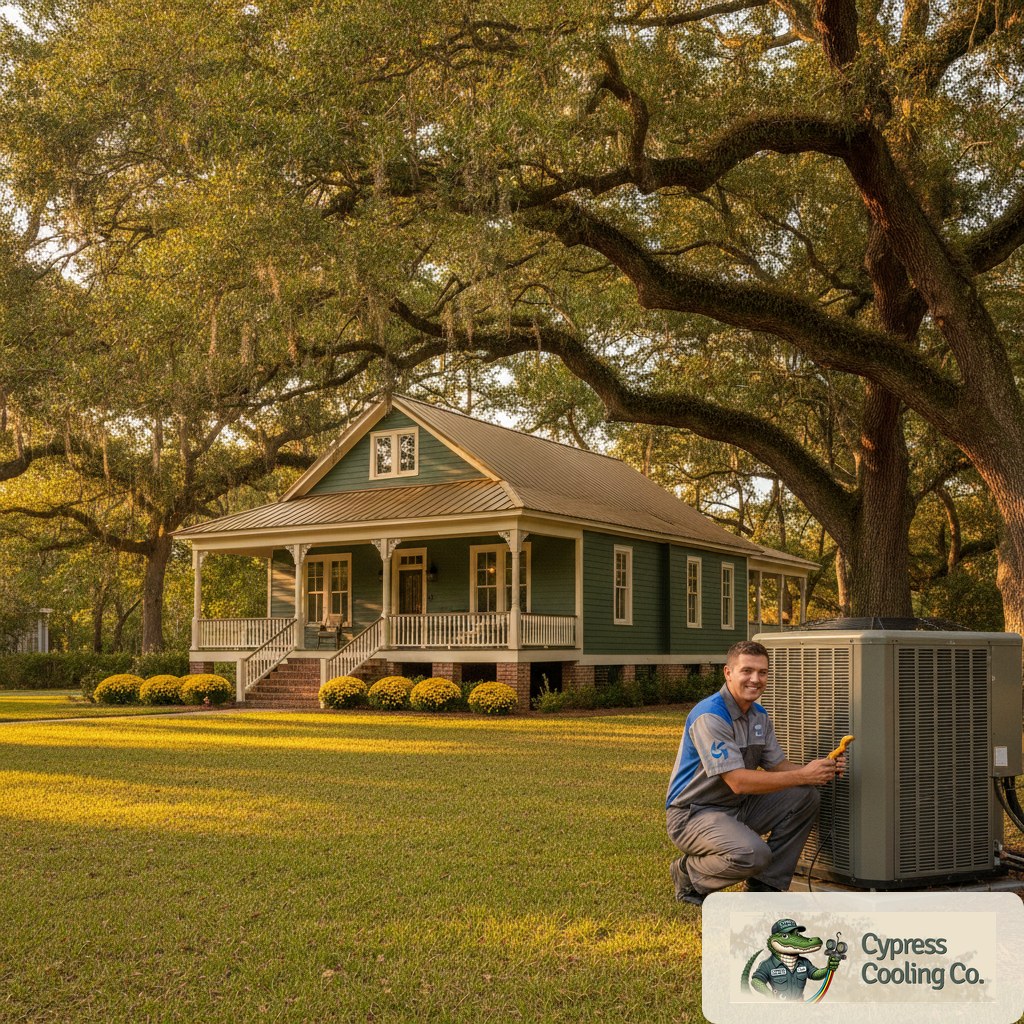
Heat Pumps vs Gas Furnaces in South Louisiana — Which One Wins?
In coastal South Louisiana, the heat-pump-versus-furnace question is mostly settled science: heat pumps win the math on most homes here because we don't actually need a furnace's brute-force heat output for very many days a year. But "mostly" is doing real work in that sentence.
Three scenarios still tilt toward gas — homes north of Lake Pontchartrain that see sub-30°F runs lasting more than 48 hours, homes with an existing gas line and a healthy chimney plus a furnace under 10 years old, and homes where the electric service can't take a heat-pump-plus-strip-heat load without a panel upgrade. Everything outside those three is a heat pump or a dual-fuel install.
What are we actually choosing between?
Before the trade-offs, the vocabulary.
A heat pump is an air conditioner that runs in reverse during heating season — it moves heat from outside air into your home using the same refrigerant cycle, just flipped by a reversing valve. Modern variable-speed (inverter) heat pumps deliver useful heat down to roughly 5°F outdoors, well below anything South Louisiana has ever recorded.
A gas furnace burns natural gas (or propane) in a sealed heat exchanger and uses a blower to push the resulting hot air through ducts. It produces 80–98% of the fuel's energy as heat — the AFUE rating — and is rated in BTU/hr of output, not in tons.
A dual-fuel (hybrid) system pairs a heat pump with a small gas furnace and uses the furnace only when outdoor temperature drops below the heat pump's balance point — the temperature at which the heat pump's output equals the home's heat loss.
When does each option win in our market?
A heat pump wins when the home has no existing gas service, the electric panel can handle the upgrade without a service change, the home sits south of Lake Pontchartrain (so design temperature is in the high 20s°F), and the homeowner cares about the cooling-side efficiency upgrade as much as the heat. With current HSPF2 equipment ratings, a heat pump's per-BTU operating cost in our market beats a 95% AFUE gas furnace burning natural gas for roughly nine months of the year.
A gas furnace wins when the existing gas line and flue are healthy and recent, the home sits on the Northshore where overnight lows below 25°F happen multiple times most winters, the homeowner values short heating recovery time after a hard cold snap (gas wins on raw output), and the existing duct system was originally designed around a furnace's higher supply-air temperature.
Dual-fuel wins in two specific situations: the home already has a working furnace under 10 years old (use it as the cold-snap backup, install the heat pump as the workhorse), and homes in Covington, Mandeville, Slidell, and Hammond where the math says a single-stage heat pump alone gets uncomfortable below 35°F. Setting the balance point around 35°F means the heat pump carries roughly 95% of annual heating hours and the furnace covers the worst two weeks.
Defaulting to "whatever was there before" is the choice that's almost never right unless one of these three conditions is met on its own merits.
How does this decision typically go wrong here?
The "you don't need a furnace in Louisiana" oversimplification. The cliché is half-true: most homes here don't need 80,000 BTU of furnace, but they do need something with reliable output at 22°F. A bare single-stage heat pump with no strip heat — sold as a "Louisiana solution" — will leave a Northshore home at 62°F during a February cold snap and burn through its defrost cycles trying to recover.
The "we'll just put back what was there" install. A 15-year-old gas furnace failing in a 1990s home isn't evidence the home needs a new gas furnace today. The duct system, building envelope, window package, and insulation have probably changed. A fresh Manual J load calculation on the current home routinely shows the original equipment was 30–50% oversized — installing the same size again locks in another 15 years of short-cycling.
The "heat pump can't handle cold" sales tactic. Often paired with a high-margin variable-speed gas furnace quote. Modern inverter heat pumps — with measured coefficient of performance above 2.0 at 5°F outdoor temperature — handle any temperature South Louisiana has ever recorded. The objection is real for central Wisconsin. It is not real here.
The "ignore the duct system" mistake. Heat pumps deliver supply air at roughly 95–105°F — cooler than a furnace's 130–140°F. If the existing ducts are leaky, undersized, or routed through an uninsulated attic, that cooler supply air feels "weak" at the registers. The fix isn't a furnace. The fix is the ducts.
How do we prove the answer on your home?
Five measurements settle this for any specific South Louisiana home.
- Manual J heat loss. A Manual J load calculation tells us the home's peak heating demand at design temperature (roughly 28°F for New Orleans, 25°F for Covington). That number, in BTU/hr, sizes the equipment. Without it, every other decision is downstream of a guess.
- Balance point. Plot the home's heat loss curve against the proposed heat pump's output curve. The crossover is your balance point. A balance point above 35°F means strip heat or a furnace backup will run more than you'd like. A balance point below 30°F is comfortable for almost any year in our market.
- HSPF2 vs AFUE economics. Pull 12 months of Entergy or Cleco kWh data and matching Atmos or Entergy gas usage. At current rates, a 9.5 HSPF2 heat pump beats a 95% AFUE furnace on cost-per-delivered-BTU for outdoor temperatures above roughly 32°F. Below that, the math flips. Count the hours per year your home spends in each band.
- Gas line and flue condition. If the recommendation is "furnace," the gas-line pressure test, sediment trap, and chimney/flue inspection have to pass first. A failing flue turns an apparent $0 advantage into a $1,500–3,000 hidden cost.
- Cleco PowerWise rebate eligibility. Cleco's residential efficiency rebate program ties rebates to specific tonnage, HSPF2, and SEER2 thresholds. We'd verify current program status, rebate amounts, and territory eligibility on your home — changing rebate windows materially shift payback math.
What do we recommend you do next?
The framework, condensed: get a Manual J first, then let the balance point and current utility rates pick the equipment. Don't let the salesperson's commission structure pick. Don't let what was there before pick. Don't let your neighbor's anecdote pick.
For background on what your air conditioner is already doing for half of the year (because a heat pump is the same machine in reverse), our how air conditioning actually works primer covers the refrigerant cycle, compressor staging, and why coil temperature matters.
If you've already been quoted a system and the recommendation arrived without a load calc or a balance-point chart, a second-opinion HVAC diagnosis will tell you whether the math behind the recommendation holds up. We'd rather walk away from a sale than install the wrong-shaped system in a home that will live with it for 15 years.
How do heat pumps and gas furnaces actually compare on the criteria that matter?
Real engineering criteria, not marketing line items.
| Criterion | Modern Inverter Heat Pump | 95% AFUE Gas Furnace + AC |
|---|---|---|
| Useful output at 25°F (Covington design temp) | ~80% of nameplate | 100% of nameplate |
| Annual operating cost (South LA climate) | Lower 9 months/year | Lower during ≤32°F hours only |
| Supply air temperature | 95–105°F | 130–140°F |
| Cooling efficiency (same cabinet) | Up to 18 SEER2 | AC paired separately |
| Installed equipment cost | Higher upfront | Lower upfront (if gas line exists) |
| Combustion-safety / CO risk | None (no combustion) | Requires annual flue + heat-exchanger inspection |
| Expected lifespan (LA salt air) | 12–15 years | 15–20 yrs (furnace), 12–15 (AC) |
| Cleco PowerWise rebate eligible | Yes (at qualifying HSPF2/SEER2) | AC portion only |
| Performs during hurricane outage | No (electric) | No (blower still needs power) |
Heat pumps don't always win this table — but in our market, a single-stage gas furnace alone with no AC upgrade plan only wins when "we already have a six-year-old furnace and an electric panel that can't take an upgrade." Outside that lane, the math tilts heat-pump or dual-fuel.
Frequently asked questions
Reviewed by Cypress Cooling Technical Team · Last reviewed: 2026-06-26
Ready when you are.
We diagnose, educate, and guide — we don't sell. Whenever you're ready for a real measurement-based conversation, here are the next steps.
Continue learning
Next reads from the Cypress Cooling Learning Center
How Air Conditioning Actually Works — A Homeowner's Field Guide
An air conditioner doesn't make cold air — it moves heat. Here's how the refrigerant cycle actually works, where Louisiana climate breaks the textbook, and what to ask a contractor before you sign anything.
Read the learn article → CompareRepair vs Replace — A 7-Question Framework for HVAC Decisions
A seven-question diagnostic framework for deciding whether to repair or replace HVAC equipment in South Louisiana — what to measure, what to ignore, and how to spot a sales-driven recommendation.
Read the compare article → ActHow to Get an Honest Second-Opinion HVAC Diagnosis
Got a $12k+ HVAC replacement quote and want a real second opinion? The operational checklist: what to ask, what we measure, what the report contains.
Read the act article →Let’s get your home comfortable again.
Honest diagnosis, fair pricing, and a team that actually cares. Call Cypress Cooling or request service online — we'll take it from here.